Nuclear War and Exterminism


I

Russia’s brutal war against Ukraine has unexpectedly resurrected the threat of global nuclear war many believed had disappeared with the end of the Cold War. Yet the world stands closer to destruction than any comparable crisis during the Cold War with the exception of the Cuban missile crisis. Despite steep falls in nuclear warheads since 1991 both the US and the Russian Federation retain planet killing arsenals.

With the revival of enmities between Washington and Moscow a new era of security competition between major power blocs led respectively by the US and China – a Cold War redux, has arrived indicating a development that if it doesn’t spell a definitive end to globalisation, is certainly a major inflection point in this era.

A New Cold War would look different minus the stark ideological divide of capitalism versus ‘communism’ of the first Cold War. A significant change has been China’s embrace of the market and the spectacular economic growth that lifted it to superpower status. Equally, the Russian Federation chaotically transitioned away from a Soviet era centralised economy. Commentators have linked these two Great Powers to the emerging geo-political axis of new authoritarianism that is now in a stand off against democracy. Perhaps this will be the fault line of the new age of climate breakdown but democracy is already showing signs of senescence with the American Republic listing badly despite Biden’s 2020 Presidential victory. The Republican Party, captured by Trumpism, is determinedly pursuing voter suppression and the erasure of democracy. The GOP may yet ditch Trump but the libertarian, Populist recalibration of Republican ideology will survive. Presently it looks as though De Santis is the coming man but a 2024 Trump Presidential win (this would be a steal) would revive the America First agenda and surely end the rehabilitation of US global leadership while definitively recasting US-China security competition as nothing but a naked power struggle.

Such chaotic vistas are distant from the cool strategic analysis of Washington’s 2022 National Defense Strategy (NDS) document which tells us the US defence establishment now sees the world as a tripolar environment with the US, China and Russia as nuclear peers and China elevated to the US’s main challenger for global dominance.

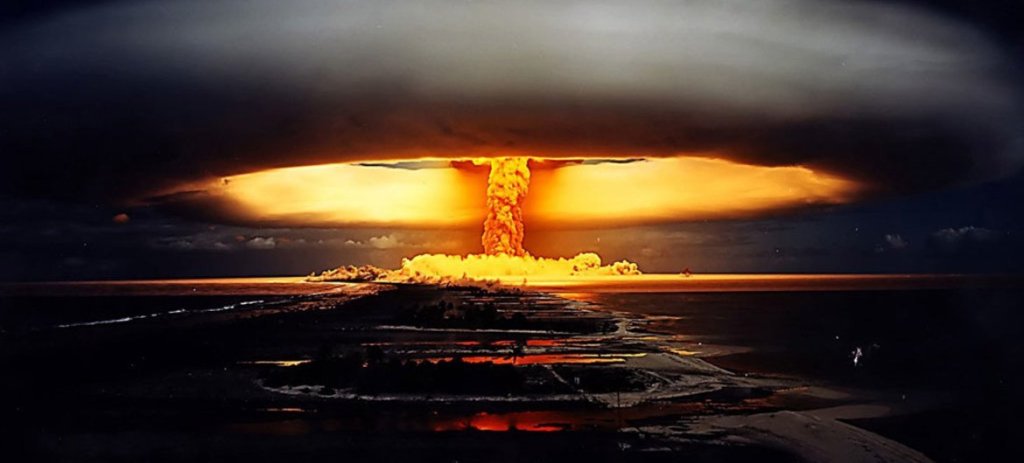
It is estimated there are over 13,000 nuclear warheads in the world. Though this figure is lower than the Cold War peak in 1986 when the Soviet Union hit 40,000 nuclear weapons and the US 23,000 (down from its highpoint 31,000 in 1967) just a fraction of this destructive power would deliver omnicide (John Somerville) and kill all planetary life. A one megaton thermonuclear bomb would produce intense radiation (gamma rays and neutrons) from an explosion hotter than the Sun’s core. Superheated air would grow rapidly creating a fireball a mile in diameter only 10 seconds after it exploded. Its thermal flash (a third of the weapons energy) would start a firestorm and burn exposed flesh even from 20 miles away while a blast wave (air pressure) like a moving wall would cause most physical destruction sending concrete, bricks and glass flying. This would last a minute or so before the firestorm turned into an inferno. Radioactive isotopes in the fallout would linger for years but most radioactive lethality would occur within weeks of the blast.

Inevitably a global thermonuclear war would kill billions of people outright and to the fallout, EMP impact (electro-magnetic pulses which would fry any electronic circuitry – the basis of present day civilisation) enough debris would have been hurled into the upper reaches of the atmosphere from the blasts and firestorms to create a nuclear winter ie blocking out the Sun, preventing photosynthesis and leading to rapid and steep falls in surface temperature, drastic declines in rainfall resulting in famine for any remaining human populations. Here is a critical point that bears keeping in mind at all times because the following will discuss nuclear postures, low yield or tactical nuclear weapons, escalating to de-escalate, disarming first strikes and all the other concepts belonging to the lexicon of Deterrence Theory, nuclear planning and realism which imply nuclear weapons might have some ‘rational’ utility beyond being a totemic strategic deterrent so lethal no Nuclear Weapons State (NWS) would ever dare actually using it. That critical point? Computer modelling suggests only a 100 firestorms would create a nuclear winter well within the current range of US-Russian Federation arsenals (thousands of nuclear weapons) and their potential targets. This would likely end all life on the planet.

Nuclear proliferation means there are now more Nuclear Weapon States (NWS) than the height of the Cold War. Though we are entering an unstable era compared to the immediate post-war years, the New Cold War (which few are talking about as yet) has been overshadowed by climate breakdown and the latter is likely to exacerbate geo-political conflicts in the absence of effective action to tackle CO2 emissions.

Many features of the coming New Cold War are opaque while the global public are the last to be informed in the course of political steering as Leviathan tries to interpellate citizens and create what Raymond Williams in the early 1980s described as deterrent subjects. Thus Leviathan sought to leverage the ‘limited rationality’ of nuclear deterrence and exploit the public’s fearful desire for security to swing opinion behind supporting deterrence. Williams claimed the populace was the object of metastasising ideologies of deterrence, eternally hailed by the necessity for an effective deterrent and the case for perpetual weapons upgrades. Indeed the obligations of taking part in an international security alliance helped insulate the “military-security complex” from democracy and circumscribe sovereignty.

Today’s Security State is the offspring of the Warfare-Welfare State and total war. China, embodying the new authoritarianism, is a variant of the Security State, overtly authoritarian and offering an alternative (and challenge) to political democracy. Paradoxically, the Security State and ‘risk society’ thrive in symbiosis with the latter the arena of market forces (qua fate) limiting and shaping agency. For instance, the Orwellian ‘war on terror’ united many Powers in a Grand Alliance against ‘terrorism – an elastic concept that helped Leviathan’s articulation of the imaginary terrors of its sleeping citizens. The phantom threat of the Other – cultivating fear and indifference among citizens in equal measure, in turn fed the infantalisation of the social body. Leviathan promised to eliminate risk as it defined it or mitigate those ‘risks’ like the market’s impact, that couldn’t be eliminated. The threats or risks facing citizens were framed by Leviathan in communicative or symbolic hierarchy differentiating between internal and external terrors but aim to bind citizens to the state via securitarian concerns. Admittedly, critically penned responding to E.P. Thompson’s Exterminism formulations (see below), William’s notion of deterrent subjects wasn’t unpacked to any great extent.*

The existence of nuclear weapons reduces ‘citizens’ to bystanders while the purchase of any ideology of deterrence first and foremost concerns political steering and legitimacy rather than instrumental goals like recruiting for the armed forces. Phenomena like the ‘Vietnam Syndrome’ reveal that citizens are “refusing patriotic dying” (James Der Derian) in the US’s eternal wars – one of the problems for which digital/information technology iteration of the “revolution in military affairs” promises at least a partial solution by delivering overwhelming firepower and the capacity to kill at a distance without endangering service personnel (drones, cruise missiles etc).

As Chalmers Johnson observed in The Sorrows of Empire (2004) those enlisting in the US armed forces in the C21st didn’t join to die for their country but to escape unemployment, deprivation and racism and to gain decent salaries, benefits, training in transferable skills or find a route into college or civilian employment. It seems there is a ‘crisis’ of martial ideology in Russian society to judge Putin’s struggles with ‘manpower’ and we might add that militarism, essential to Leviathan, is evident in developed societies only as a milquetoast patriotism that is happiest with near casualty free conflicts (‘enemy’ casualties are invisible). Developed societies have become pacific.

In critically appraising the idea nuclear weapons were responsible for a dramatic decline in conflict between the world’s major powers John Mueller counterposed the Great Stability as the fruition of long term trends including the waning of nationalism’s ferocity. Many states had literally opted out of aggressive militarism. As examples Mueller cites Holland, Sweden, Switzerland, Spain and other European countries. As modernity matured these societies retreated from the martial. These trends predated the nuclear age according to Mueller and so declining conflicts wasn’t entirely explained by the deterrent effect of nuclear weapons. This might seem to be contradicted by WWI and WWII but both were aberrant global conflagrations whose horrors reinforced the pacific trends. The arguments are complex and controversial but we think Mueller is persuasive despite obvious objections he never really confronts such as the inter-war paroxysm of social conflict and civil violence that swept Europe. Briefly, WWI was an unexpected thunderclap, it arrived in August 1914 as each nation fell like a domino. Also it was quite unlike the conflict young men across Europe thought they were going to fight in. Freud’s mournful reaction to the shattering impact of war on European civilisation after his spasm of patriotic enthusiasm when war’s tocsin sounded, is revealing. Conversely, the outbreak of the Second World War found populations in Britain and France (and later the US) initially reluctant participants in war because of the still lingering memories of 1914-18.

For many European powers war once seemed inevitable but since 1945 the richest 48 countries have not a fought war with each other with rare or fleeting exceptions like Britain and Argentina in the south Atlantic (a war both sides blundered into misunderstanding the intentions of the other). Following years of collecting statistical data and undertaking a comparative analysis of states and collective violence, the late political scientist R.J. Rummel, concluded “power kills” and discovered democratic societies were far less likely to go to war with each other and were also averse to committing democide (ie the state killing its own citizens) in contrast to authoritarian or totalitarian social systems which Rummel calculated had killed over 200 million people in the C20th. Rummel’s point about the relative benignity of democracy is well made and important but in focusing on the C20th alone Rummel obscures the violent, bloody origins of democracy as it emerged from modernity’s cradle: capitalism, slavery and colonialism. There is little reflection on imperialism, for example, the ‘Scramble for Africa’ (1885-1914) by the European powers. Some of powers were democracies (the subject does not appear in the index of Rummel’s Power Kills: Democracy As A Method of Non-Violence for example) or such C20th catastrophes as the 1943 Bengal famine estimated to have killed between 2 to 3 million people when Britain was the colonial power.

The link between malign colonial governance or imperialism and the representative democracies of the Global North, deludedly universal but thoroughly “provincial”, has recently been forcefully made by Achille Mbembe who also reminds us the barrier between democracy and totalitarianism was never impermeable. Democracy had a double character, a “nocturnal face” in part meaning it was underpinned by exclusion: racial, sexual and class hierarchies, repression and furious violence – so parliaments of the ‘motherland’ could cohabit with slavery and genocide in a vast geographical space rendered a liminal “third place” and the object of malign Projection, violence and terror.

Clearly war is a massive reality of the C20th and C21st but increasingly its most deadly manifestations have been among underdeveloped or developing societies though developed societies are hardly blameless whether that is selling the arms used in these wars, sponsoring these conflicts (though not invariably) or even taking part as a combatant such as the US in Korea, Vietnam, Iraq and Afghanistan or Saudi Arabia in Yemen.

Evidently there are two issues here that Mueller doesn’t really disentangle: the growing ‘pacifism’ of developed civil societies and the increasingly “obsolete” (Mueller) nature of security competition among developed societies and nation-states though the two topics overlap. Opinions on the strength of opposition to nuclear weapons in civil society are likely to differ but nuclear weapons seem to exist apart from, even above society (or somewhere else), and in the normal course of events a nuclear armed Leviathan doesn’t worry unduly what its citizens think about nuclear weapons. The interesting question is: could this ever change?

II

Since the US dropped atom bombs on Hiroshima and Nagasaki in 1945 membership of the Hell Fire Club of NWS’s has grown to nine – more than at the height of the first Cold War. The nine NWSs are:

Russian Federation – the US might no longer consider Moscow a full peer competitor (a view not without critics among IR analysts) but the country has the largest arsenal of any NWS with an estimated 6,250 nuclear warheads (roughly a quarter are deployed). About 2,000 of these are low yield ‘tactical’ nuclear weapons intended for the ‘battlefield’ that supposedly produce much less fallout than more powerful strategic warheads. Even so the moniker ‘tactical’ can be deceptive as many of these are far more powerful than the bombs dropped on Hiroshima and Nagasaki.

The Russian Federation’s possession of ‘tactical’ nukes reflects an explicit shift in Moscow’s military doctrine since the end of the Cold War when the country lost many military allies and its conventional strength diminished vis-à-vis NATO. In 1993 the Russian Federation officially adopted a first strike policy though many analysts and scholars think the Soviet Union always had plans to use disarming first strikes against NATO targets in the event of a hot war between East and West.

US – estimated to have 5,500 nuclear warheads with roughly 1,390 of these said to deployed (ie not in a storage facility or bunker).

In October 2022 the US released a new NDS (mentioned above) and a Nuclear Posture Review (NPR) outlining the direction of US defence and security policy in the immediate, medium and long term. The NDS saw the US’s wider security environment as increasingly challenging as the world has become a tripolar environment with the US unprecedentedly facing two nuclear peers. Yet in the final analysis only China is considered a full peer competitor capable of strategically challenging Washington in all ‘domains’ in contrast to Putin’s Russian Federation which poses a severe conjunctural threat but only on a regional level. Unsurprisingly, some US analysts worry Washington is underestimating its old rival.

As the invasion of Ukraine shows the Russian Federation has an immense capacity to destabilise the global order despite its poorly performing military forces. Until recently Washington thought a ‘reduced’ Russian Federation might join the US led balancing coalition to contain China in the Asia-Pacific region but such misplaced hopes were dispatched with the Russian seizure of Crimea in 2014. Putin has delivered continuous shocks to the system, first by invading a sovereign neighbour but also ramping up his misinformation war, issuing chilling nuclear threats, conducting economic warfare by threatening European and global grain supplies, launching forays into hybrid war including cyber-attacks, sabotage and political assassinations across Europe.

For Western IR specialists with Moscow and Beijing expanding and modernising their nuclear arsenals both powers seem bent on returning to an older Great Power version of international politics though Moscow is doing so with a degree of recklessness that is unsettling everyone including China while demonstrating the advantages a major NWS has in being able to throw its weight around. Moscow can destroy Ukrainian infrastructure and plunge millions of people into cold and darkness without any real fear of reprisals.

The NDS emphasises the importance of having partners, allies and ‘regional security architectures’ in opposition to the China-Russia axis. Concerning US’s nuclear posture both Obama and Biden toyed with a No First Use and a Single Purpose policies (ie trying to gain greater clarity about the circumstances the US would use nuclear weapons) but the risks of a changing ‘security environment’ gave Washington pause, and certain options have been retained for now. With Ukraine concentrating minds many in the US administration and many analysts are concluding ‘escalation dynamics’ can’t be predicted or controlled as readily as the recent past.

China – is rapidly expanding its nuclear arsenal and is estimated to have about 400 warheads. So China has increased its military spending and adopted a more assertive posture to match its growing ambitions as a new superpower and a potential regional hegemon. According to John Mearsheimer the US is presently the only regional hegemon and its uncontested dominance of the western hemisphere is the basis of its ability to project its power globally. In contrast China has many regional competitors in the Asia-Pacific region including Japan, South Korea, India, Vietnam not to speak of the US itself. Also India is a NWS while Japan is a civil nuclear power and part of the US led regional military alliance. A feature of China’s strategic alliance with Putin is Beijing’s desire to access Russian nuclear weapons know how, one of the few domains where Moscow can boast of its superiority.

France – estimated to have 290 nuclear weapons.

Britain – estimated to have between 225 to 260 nuclear weapons. In fact Britain’s nuclear weapons experienced a modest increase for the first time since the Cold War’s end. A recent Ministry of Defence document Global Britain in a Competitive World (March 2021) registered the increasing international security challenges and committed Britain to maintaining and upgrading its sea-based Trident nuclear deterrent. Britain became the third NWS in 1952 and in subsequent decades was heavily reliant on the US for its nuclear weapons though scientific collaboration between the two nations stretches back to the Manhattan Project (Britain’s purchases of nuclear warheads from the US stem from their cost effectiveness due to the economies of scale involved). Britain’s deterrent is entirely sea-based (there are four ballistic missile submarines and one submarine is at sea at any time). Besides Britain’s own nuclear deterrent, the US has deployed its own nuclear weapons on British soil since 1954. Britain first acquired a nuclear deterrent for various reasons – mainly trying to maintain the prestige of a great, independent power but also in the unlikely event of the US withdrawing its nuclear umbrella from Europe. Yet the dominant feature of Britain’s security was to tie its defence policy to the US global security priorities.

Many have questioned whether its possible to speak of an ‘independent’ nuclear deterrent given how close Britain is to the US. Yet the US doesn’t have a veto on Britain’s use of the Bomb though Washington did receive certain assurances from the British state about the parameters of nuclear weapons use. Even so it’s difficult to imagine a politically independent use of nuclear weapons such as a ‘limited’ or tactical use in contrast to the ‘big three’: the US, China and the Russian Federation who all might conceivably use a ‘tactical’ nuclear on the ‘battlefield’ against a non-NWS. In the case of the Russian Federation this is an ongoing and live possibility. There are other plausible nuclear use scenarios like a regional war in the Middle East or the Indian sub-continent.

British government plans to renovate its ageing Trident nuclear deterrent is likely to cost more than two hundred billion pounds (the cost of building the new Dreadnought class of nuclear submarines and refurbishing the existing American Trident D-5 SLBMs). Britain’s nuclear deterrent costs about 15% of its annual defence spending though there are various hidden additional costs (like decommissioning).

Pakistan – estimated to have 165 nuclear weapons while Islamabad doesn’t disguise its adherence to what in Deterrence Theory (DT) is sometimes termed ‘escalating to de-escalate’ ie adopting a low threshold for using nuclear weapons (usually said to be so-called ‘tactical’ or low yield nuclear warheads) such as ending a conventional war when the threat of defeat raises the spectre of “existential jeopardy” ie the destruction of the state. As we will see Pakistan is not alone in admitting such a posture. Given nuclear proliferation is a fact and with many regional conflicts becoming sharper with climate breakdown, a drift to lower thresholds for nuclear use is an alarming sign.

India – estimated to have 156 nuclear weapons. The regional rivalry with Pakistan could plausibly escalate to a nuclear conflict. There are also tensions between India and China over long running border disputes that included a brief war in 1962. Though Delhi and Beijing have strong economic ties and India recognises China’s claims on Taiwan, their own border dispute flared up again recently. Rising nationalism in both countries threatens to disrupt a more temperate diplomacy. Also China has strong bilateral ties with Pakistan adding another fly in the ointment of their relations.

Israel – estimated to have between 90 or 400 nuclear weapons stockpiled though the Israeli state doesn’t publicly admit it belongs to the NWS Club having adopted a stance of “strategic ambiguity.” This stance partly evolved in the course of a decade long diplomatic tussle behind closed doors between US administrations who wished to inspect Israeli facilities at Dimona in the Negev desert and rejected Israeli evasions about building a bomb. Eventually Nixon’s Presidency arrived at a mutually agreed modus operandi that the US would continue to pretend it was unaware of the Israeli bomb and Israel would continue to keep its bomb a ‘secret’ – a position that suited Tel Aviv perfectly. Washington was anxious that acknowledgement of Israel’s modest nuclear weapons arsenal would encourage nuclear proliferation across the MENA especially if the Soviet Union chose to supply know how or weapons to regional clients. Henry Kissinger felt the Israeli state – ‘surrounded’ by enemies had the greatest potential to actually use nuclear weapons. Indeed by the mid 1970s Israel’s Samson Option dictated that Israel’s conventional military defeat at the hands of its enemies would have to be answered by nuclear weapons strikes as a last resort.

Israel’s bomb was built in the Negev desert, initially with France’s aid. The first usable bomb was probably developed in 1966-67 making Israel the sixth NWS to emerge. Unsurprisingly Israel displays no ambiguity where the possibility of its neighbours acquiring nuclear weapons is concerned. The Begin Doctrine decrees preventative strikes to stop regional proliferation and thwart nuclear weapons development in neighbours like Syria, Iraq and Iran and that has included airstrikes against research and production facilities and the assassination of scientists.

North Korea – estimated to have 30 to 40 nuclear weapons, the country is pressing ahead with developing the missiles to deliver its warheads including test firing rockets that have passed over Japan at altitude. In 2003 North Korea withdrew from the Nuclear Non-Proliferation Treaty (NPT), that many countries in the Global South regard as an extension of the US State Department. Other countries like Pakistan, India and Israel never signed the NPT in the first place.

***

Only three sovereign states have relinquished nuclear weapons. Two of those: Kazakhstan and Ukraine were part of the former Soviet Union and repatriated their warheads to the Russian Federation. As we know Ukraine did so in exchange for Moscow’s security guarantees in 1997. The other country to decommission its nuclear arsenal was South Africa with apartheid’s end and black majority rule’s arrival. Before this historic watershed, the apartheid regime was developing its own nuclear weapons program in collaboration with Israel from the 1970s onwards. Although there are nine NWS only five are recognised as such (US, Russian Federation, China, France and Britain) while 90% of all nuclear weapons are held by the Russian Federation and the US. The existing NWS are likely to be joined by other states wishing to join the nuclear weapons club.

The world faces many dangers with nuclear proliferation with more countries than ever having nuclear weapons. These dangers should be obvious with a greater risk of regional and even global conflict, disputes escalating out of control or ‘accidents’ (there have been many of these already as Eric Schlosser’s work indicates). In the early 1960s there were ‘only’ four nuclear powers: the superpowers, the US and Soviet Union and then Britain whose bomb was built secretly by Atlee’s 1945-51 Labour government and France. This quartet were soon joined in 1966 by China (Israel developed its own bomb at some point in the 1960s).

As the memoir of former American nuclear planner and whistleblower Daniel Ellsberg makes clear four nuclear powers was already a ‘crowded field.’ US nuclear strategy had always been shrouded in a great deal of secrecy with aspects of its posture hidden from most Americans but the US didn’t rule out a first strike against the Soviet Union. In the early 1960s former Ford executive and wartime planner and later Kennedy’s Defense Secretary Robert McNamara indicated the US favoured using nuclear weapons against Soviet military targets rather than Soviet cities. The latter would be “hostage” to a second retaliatory US strike if necessary but such ‘assurances’ were questionable not least because France’s ‘independent’ deterrent targeted Moscow and other Russian cities.

In reality the long range bombers of the USAF’s Strategic Air Command (SAC) had targeted Soviet cities since the 1950s (Moscow was targeted with ten US bombs alone) and nuclear strategic planning in the Asia-Pacific region meant the USAF targeted all the major Chinese population centres despite China not having nuclear weapons until a decade later. One of the festering causes of the Sino-Soviet split was Moscow’s reluctance to provide China with nuclear weapons knowhow after the 1958 Taiwan straits crisis. A geo-political rift with Moscow and the lack of a nuclear arsenal was no impediment to the USAF SAC targeting China. There would be no bystanders in a global nuclear war while global stability is greatly complicated as new entrants join the nuclear weapons club.

III

If NWSs – democratic, authoritarian (or a mixture), share features in common there are also clearly differences. The citizens of a democracy should not envy anyone living in an authoritarian misinformation universe with opinion strategically managed by the state. Yet the similarities are undeniable given democracies also face the problem of an infosphere shaped by elites. This shouldn’t be surprising given the limits of representative democracy or liberal oligarchies as Cornelius Castoriadis described societies where autonomy was circumscribed albeit less drastically than authoritarian societies.

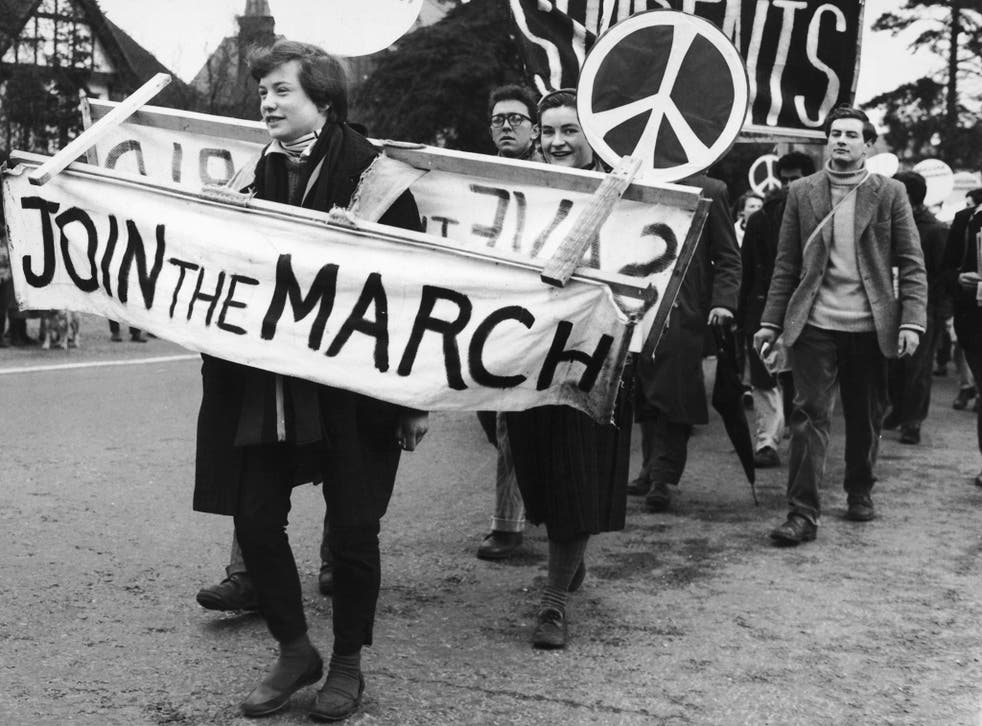
In the early 1980s the socialist historian E.P. Thompson coined the term exterminism. Thompson originally employed his neologism as Ronald Reagan and Margaret Thatcher were denouncing the Soviet Union and its satellites as the “evil empire.” Plans were announced to station Pershing Cruise missiles at USAF airbases in eastern England incidentally reviving the anti-nuclear peace movement including a women’s camp at Greenham Common. Some observers talked of a Second Cold War with the Soviet invasion of Afghanistan paralleling the US’s refusal to ratify SALT II, sharply increasing arms spending and announcing plans to develop a space based defence system: the Strategic Defense Initiative (SDI), also known as ‘Star Wars.’ In 1987 Andrei Sakharov told Mikhail Gorbachev that the Americans would never get ‘Star Wars’ to work but the Soviet leadership were already spending a greater proportion of a smaller GDP on defence to stay in touch with the US and considered Washington’s hikes in arms spending as effectively a declaration of economic war.

Thompson addressed the renewed Cold War tensions and the threat posed by the “machinery of annihilation” east and west. Eschewing the reductionism of his socialist confrères, Thompson cautioned against a view of the Cold War as a clash between two rival modes of production: capitalism in the West and socialism in the East (whether degenerated or deformed). The basis of Exterminism as a global reality was the nuclear dyad formed by the US-Soviet Union though the cascading “reciprocal logic” of a nuclear arms race extended to other major powers like China. Thompson defined the Cold War as a force field that enforced the convergence of the major powers despite their different social-historical origins. Thompson was unimpressed by claims the nuclear arms race was driven by ruling class interests. The isomorphism of competing social systems was the telos of nuclear led security competition. The internal dynamics of the two superpowers and their military competition was mutually reinforcing, driving the capacity to unleash planetary overkill by means of logics that were both endogenous and exogenous.

The Cold War wasn’t the class struggle writ large or a sublimated form of deadly inter-systemic competition as the late Mike Davis claimed in retailing the most reductive Marxist orthodoxy imaginable. As Davis expressed the idea: “At a first approximation let me propose the strategic arms race must be conceived as a complex regulative instance of the global class struggle (p.53).” In comparison Davis dismissed Thompson’s gauche (even “Kafkaesque” – simply unvarnished abuse on Davis’s part) understanding as Eurocentric and proposed the breakdown of detente and the New Cold War from the late 1970s onwards was intimately linked to the crisis of the Third World following the world economic crisis of 1973-75 fed a rising tide of anti-colonial struggle especially across Africa.

For Thompson’s part the idea the nuclear arms race was a distorted manifestation of the global class struggle was deeply misguided. For the majority of Marxist critics, the world was divided into two camps: active offensive imperialism led by the US and a reactive defensive socialist bloc led by the Soviet Union. The US imperialist camp sought to ‘contain’ the Soviet bloc and prevent the spread of socialism and thwart national liberation struggles, with the goal of undermining the latter in its strongholds. One implication of this view was the drive to war was located in the expansionary logic of capital accumulation. In contrast, the Soviet Union and its allies (varieties of deformed socialism) were drawn into unwanted competition and forced to constitute a defensive alliance and divert precious resources from the construction of socialism and instead build a nuclear deterrent.

On the left Thompson had many critics but perhaps the most arresting criticism was proffered by Raymond Williams while reflecting on the political impasse of CND in the early 1980s including the interesting suggestion that the hold of an ideology of deterrence was powerful and had created deterrent subjects (see above). Whatever the drawbacks Exterminism held as a concept it did at least avoid seeing nuclear security competition through prism of campism which suggested one camp, led by the US, was the protagonist of the Cold War and the main driver of the accumulation of the means of destruction.

Rather than a distorted expression of the global contest between capitalism and socialism, the Cold War had properly transcended this ‘world-historical’ struggle for Thompson. Such disputes might appear arcane now the Soviet Union has gone but much of this thinking is alive and well in an ideological imaginary we call neo-campism. Crucially this frame retains the view of the US as the malign global actor operating today bent on NATO aggrandisement, pushing eastward in Europe and containing China while the tenor of some of its commentary on Putin’s seizure of Crimea in 2014 and the invasion of Ukraine, is often apologetic or full of mitigating caveats. Putin’s aggression in Ukraine then becomes a regrettable but understandable response by Moscow to years of pro-Western provocation of the Kiev government and NATO’s eastward expansion. It is hard not to detect a certain cynicism in a view that is an analogue of establishment fables of realism (for more see below).

The basic thrust of Exterminism Thompson sketched was a system whose logics had escaped the control of any one actor. The nuclear arms race was fundamentally irrational while the production and constant upgrading of nuclear weapons systems, technology creep and the rest, was self perpetuating and driven by exigencies impervious to democracy.

Even in representative democracies (or liberal oligarchies as Castoriadis termed them) the nuclear weapons machinery was insulated from any genuine democratic oversight or popular control. Britain’s alignment with the US Imperium reflected the reality that it was hardly more than an outpost of the US’s global nuclear defence system designed to protect “Sanctuary USA.” A British government veto on American nuclear weapons should be considered strictly notional. In a global nuclear war Europe would be the main theatre of the apocalypse – an unpalatable reality hidden from European citizens behind veils of secrecy.

In representative democracies the development of specific nuclear weapons systems obeys a longer time span than the electoral cycle or the life of any elected government. This reality indicates a major hurdle to renouncing nuclear weapons added to the anaesthetising effect of a political consensus that unites all political parties realistically aspiring to government. Existing nuclear defences are sacrosanct and a key pillar of the NWS. It is significant the American bomb was built in conditions of wartime secrecy. Equally no referenda sanctioned a British bomb built in peacetime secrecy by Attlee’s Labour government.

To date no social movement trying to achieve nuclear disarmament has even come close to forcing any state to adopt disarmament. Only in exceptional circumstances has a state divested itself of nuclear weapons. We mentioned the newly independent Ukraine’s cordial negotiations with Moscow in the 1990s. Another example was the arrival of black majority rule in South Africa. The context in both cases was significant: nuclear disarmament was state led, a by-product of a profound political transformation and the benign geo-political situation ushered in by the end of the Cold War. Also Ukraine and South Africa were relatively peripheral states in the Great Power hierarchy. South Africa’s strong economy meant it remained a regional powerhouse but no longer faced hostile neighbours as it did in the apartheid era. Equally, Ukraine was able to slip the nuclear leash in the most propitious historical circumstances it could have done before Putin and his allies began rebuilding Russian power.

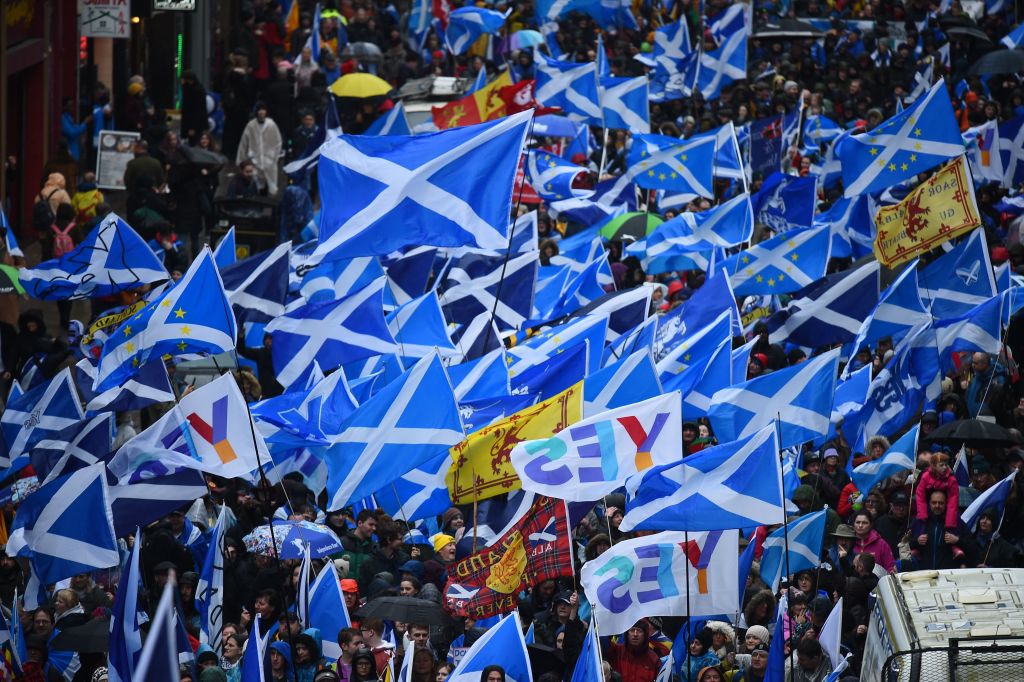
Perhaps future opportunities for disarmament will be created as the secondary effects of social or political earthquakes rather than any frontal challenge by a domestic peace movement. For example, Scottish independence would pose a real threat to the continued existence of a British nuclear deterrent if the SNP implemented its policy of removing Trident from the Clyde. Yet an independent Scotland could also plausibly water down its disarmament commitment or even cave completely. In the present global securitarian environment it’s difficult to envisage any national government – even notionally radical administrations – bucking the security consensus and ditching allies and alliances. A newly independent Scotland would likely apply to rejoin the EU as soon as it possibly could (62% of Scots voted Remain in 2016) and commit to NATO membership. This was always likely and made even likelier by Russia’s invasion of Ukraine.

In an early article from 1960 E.P. Thompson astutely observed politics across Western Europe was strongly influenced by a ‘Natopolitan’ mindset. Even with the end of the Cold War (returning with a vengeance) this mindset continued to linger and is bursting back into life with Sweden and Finland executing a volte face and petitioning to join NATO. Scotland is part of a unitary British state and is the main home of its nuclear deterrent. Britain is only one of three NATO countries with an independent nuclear deterrent though a number of NATO countries host US nuclear weapons including Germany and Turkey. The US and France are the other NATO NWSs. It isn’t difficult to imagine the intense diplomatic pressure Washington (let alone London) would bring to bear on Edinburgh to remain part of NATO’s nuclear umbrella.

IV

When the Russian Federation invaded Ukraine in February, Putin reminded the world his country was in charge of the world’s largest nuclear arsenal and the message to the West was stark: do not stop Russia achieving its war aims. The West was put on notice there were limits to its support for Ukraine and though it has tested Moscow’s limits it has also feared escalation and a wider conflict. As the year’s end approaches and Moscow’s brutal war continues Putin and other senior Kremlin figures reheated the nuclear threats made at the invasion’s start with language notable for its bitter paranoia towards the West.

Putin’s latest threats couldn’t disguise Russia’s ailing war effort. Despite fake plebiscites in eastern Ukraine to justify Moscow’s land grab Ukrainian forces are currently winning back villages towns and have just recaptured Kherson. But such reverses also underline a dangerous moment in the war not only for Ukraine but the rest of the world. Back door contacts between the Americans (Lloyd Austin, the US Defense Secretary) and the Russians (Sergei Shoigu, Russia’s most senior General), saw the latter cynically inform Austin, that Ukraine was preparing to use a ‘dirty bomb’ (combining conventional explosives and radioactive material) on their own territory.

Russian Federation military forces have resorted to terror attacks against Ukrainian towns and cities, targeting energy and water infrastructure to degrade civil life secure in the knowledge Ukraine is unlikely to retaliate in kind. Fear of such an escalation has so far stopped the West supplying Kiev with missiles able to strike deep inside Russia. Zelensky responded to Russia accusations of ‘dirty bomb’ plans by insisting Moscow was guilty of Projection ie planning a ‘false flag’ attack that would gravely escalate the war further. The Guardian (24.10.2022) recently reported Nigel Gould-Davies, senior fellow at the International Institute for Strategic Affairs, conclusion the Russian Federation had escalated attacks on Ukraine’s energy sector alongside ‘covert’ attacks on European energy infrastructure, as well as Shoigu doubling down on Putin’s nuclear threats might indicate Moscow is seriously preparing for nuclear use. Gould-Davies believes military setbacks have backed Russia into a corner with diminishing room to manoeuvre and pressures for nuclear far greater than is appreciated in the West.

One takeaway from Moscow’s nuclear threats is the apparent adoption of a low threshold for nuclear use – or what in Deterrence Theory is sometimes termed coercive nuclear escalation. Debate about whether Moscow would resort to tactical nuclear weapons to staunch conventional military defeats predated the invasion of Ukraine and is now suggested they could be used to break the back of Ukrainian resistance. Putin’s brutal war has turned sour and though his military routed Georgian forces in 2008 they have since lost much of their intimidating lustre. It was already understood Moscow didn’t have the conventional strength of yesteryear but its poor performance still surprised most observers. The initial armoured thrust towards Kiev was meant to quickly topple Zelensky’s government but became bogged down thanks to planning and logistical failures that left Russian soldiers and armour a sitting target for mobile Ukrainian forces fighting on home soil.

Moscow revised its nuclear doctrine, opting for a lower threshold on nuclear use mainly to counter NATO’s superior conventional forces. In the last two decades the Russian Federation has led the way in the number of tactical nuclear weapons with about 2,000 low yield dispersed throughout its territory, mostly stockpiled in military storage facilities and needing a more or less lengthy preparation period before they could deployed for use. This reversed the Cold War balance when NATO openly touted its flexible nuclear posture to counter the Warsaw Pact’s perceived conventional superiority and the widely held conviction that central and western Europe would inevitably be overrun by the Red Army.

Whether Putin would actually sanction tactical nuclear weapon use to forestall defeat or staunch an exhausting attritional conflict, no one can confidently say. It seems unlikely even for a leader who fought a ‘dirty war’ in Chechnya and whose military conducted an utterly ruthless air war against urban population centres in Syria to prop Assad’s thanatocratic Baathist regime and allowed GRU operatives to recklessly use nerve agent in a British city – actions that either reveal an extremely cynical ‘realist’ actor or a sociopath.

Could Putin’s kleptocracy survive a defeat against Ukraine? In International Relations (IR) it’s generally thought NWSs are stable regimes. For example, the US could lose the war in Vietnam without its continued existence being seriously questioned. The fallout from the US defeat was severe (‘Vietnam Syndrome’ etc) but wars of intervention are still a part of US foreign policy. Post-Vietnam saw the professionalisation of US armed forces and the so-called ‘revolution in military affairs’ (RMA) entailing high tech and digital based innovations to increase ingenuity of killing at a distance like the US’s perpetual drone war against its enemies around the globe.

Similarly, if we may indulge some counterfactual historical speculation: imagine a British defeat in the south Atlantic against the Argentinian military junta in the Falklands War (a closer run eventuality than was generally appreciated in 1982). Thatcher’s government would almost certainly have fallen instead of enjoying her 1983 election apotheosis but the broader polity would have survived. Perhaps an incoming Labour government would have reformed Britain’s antique parliamentary system and abolished the Lords (Britain’s unelected second chamber) and introduced some form of Proportional Representation (PR). Perhaps not given Labour’s congenital timidity before Britain’s venerable institutions but much of Thatcher’s ‘small state, free market’ agenda like breaking trade union power, selling off council housing stock, rate capping local government, privatisation, financial de-regulation of the City, wouldn’t have happened. Instead Tory rule continued for another fifteen years and reshaped British society though victory in the south Atlantic certainly didn’t halt long term imperial decline even if it did feed the illusory sense of British exceptionalism.

If Afghanistan was the Soviet Union’s ‘Vietnam’ the same analogy doesn’t really fit the Russian Federation’s war with its close neighbour. Moscow simply can’t shrug off defeat so readily (leaving aside how much of a grave, strategic defeat Afghanistan was for the Soviet Union) which is why the attritional war and more devastating military firepower aimed at Ukrainian civil society and infrastructure seems the most likely in the medium term. Currently negotiations seem a distant prospect though there are whispers Washington is urging Kiev to seriously consider talking with Moscow. Though Ukraine has the upper hand on the battlefield and is clawing back territory there seem to be limits to how far ‘rollback’ can go especially as its Western allies are unwilling to supply the weapons that could strike inside Russia but dangerously escalate the conflict further. Equally negotiations wouldn’t work for Putin unless Kiev was willing to accept annexation of a part of eastern Ukraine and unpalatable concessions like accepting some form of ‘neutrality’ or distance from the EU and NATO. Kiev knows such a settlement would invite continued interference in its internal affairs by Moscow which would prefer a corrupt, authoritarian Ukraine to a more, open, less corrupt, democratic neighbour.

Using tactical nuclear weapons to quickly end the war must be a temptation but actually using them would be fraught with risk for Moscow. The US has repeatedly warned Moscow against embarking on such a dangerous course. If Putin was tempted to use the paralysing psychology of terror, to ‘escalate to de-escalate’ to end the war on his terms, it could easily lead to further escalation and the spread of the conflict. The global shockwave would be incalculable with hugely symbolic red line crossed for the first time since 1945 against a neighbour and a non-NWS only fifteen years after that sovereign state relinquished nuclear weapons in exchange for Moscow’s security guarantees. The Russian state would be an even greater pariah than it is already.

Seemingly, the US’s global intelligence network is able to penetrate even the most secretive recesses of Russian leadership circles, having already accurately warned of Moscow’s invasion plan from the end of 2021 onwards. Similarly, Washington’s strong warning to Moscow against nuclear weapon use and the potentially catastrophic consequences, suggest the US is cognizant of Russian leadership and military ‘chatter’ and internal debate. We can only speculate but the tentative indications are there no signs – despite Moscow’s dark warnings – that Russian forces are preparing tactical nukes, a process that it is said the West’s ‘intelligence eyes’ could follow in real time.

V

On the face of it the return of the prospect of global nuclear immolation was unexpected. Yet it’s moot whether the danger of nuclear war ever really vanished as many hoped during the brief rapprochement between Washington and Moscow after the Soviet Union’s collapse. Leaving aside the question of whether the major NWS’s ever really stopped targeting their old Cold War enemies, it is surely a truism as Elaine Scarry observed in Thermonuclear Monarchy (2014) that nuclear weapons are ultimately ungovernable and could never be fired only misfired.

On the inherently ungovernable nature of a nuclear deterrent we agree with Scarry though her polemic is less about the actual machinery of nuclear armageddon, of the US’s nuclear arsenal and its rules of operation but instead sounds a tocsin against the euthanasia of American democracy. For Scarry the erasure of the revolutionary Social Contract of 1776 was unavoidable once the Republic began cohabiting with the military-industrial complex and a ramified nuclear apparatus crowning an unfathomably outsized Leviathan with an unmatched global reach. Similarly, the most perspicacious critic of the malignity of American global power and its staggering breadth and depth, Chalmers Johnson (formerly a Cold War hawk), diagnosed the capsizal of the American Republic as militarism in bloom marked ‘New Rome’s’ arrival.

Scarry reminds us that American citizens are largely ignorant of the most basic facts of the US’s nuclear deterrent including the Pentagon’s commitment to a first strike policy. Polls show the average American woefully underestimates how many nuclear warheads belong to the nation’s stockpile (the public routinely suggests the low hundreds but there are thousands). Yet Scarry’s critical position with its nigh on Tocquevillian evocation of American democracy’s promise carries an air of implausibility given the withering of democracy which not only parallels the nuclear age but predates the Nuclear Leviathan’s arrival in 1945.

The popular consciousness assumes nuclear war is unthinkable because any use would lead to mutually assured destruction (MAD) and the destruction of everything. Yet the state planners and nuclear planners of the NWS have a different calculus. They don’t just see nuclear weapons as the ultimate deterrent ensuring universal stability, a guarantee against “existential jeopardy” and Leviathan’s eternity but also having a broader purpose beyond mutual destruction – behaviour driven by the geo-political realities of inter-state competition.

Perversely perhaps nuclear weapons can be regarded as a practical ‘battlefield’ option as well as a strategic weapon of mass destruction. For a group of IR specialists whom John Mearsheimer dubbed Offensive Realists (among whom he counted himself) the existence of tactical nuclear weapons exposed the error of the Nuclear Revolution originally formulated by Robert Jervis (a Defensive Realist according to Mearsheimer) which claimed the proliferation and dispersal of nuclear arsenals had resulted in peace among the major powers after 1945.

Jervis argued nuclear weapons had provided NWS’s and their allies with a degree of peace and stability unknown in an earlier, more anarchic age of security conflict thanks to the logic of deterrence. Kenneth Waltz stipulated three basic requirements of a potent nuclear deterrent: (i) a survivable nuclear deterrent able to deliver a retaliatory second strike, (ii) a capacity for the state to to identify false alarms, (iii) the capacity to maintain command control in a crisis. A survivable arsenal should deter any NWS aggressor. The Nuclear Revolution had supposedly suppressed geo-political competition while some of its proponents didn’t think it mattered if a potential adversary had a larger nuclear arsenal so long as a robust retaliatory capacity was in situ. For critics like Mearsheimer Defensive Realists also tended to downplay the importance of conventional forces in the age of the Nuclear Revolution. Non-NWSs would generally be deterred from undertaking conventional attacks on a NWS though there were instances when a non-NWS had attacked a NWS with conventional forces.

Evidently Defensive Realist arguments for a Nuclear Revolution are flawed. Generally, we might say it is poor social science based on unexamined assumptions whose plausibility is derived from a commitment to a rarefied branch of IR and realism. James Der Derian pithily illumines some weaknesses of realism:

“Realism has built a life out of the transformation of fictions, like the immutability of human nature and the apodictic threat of anarchy, into facticity. With a little digging, realism comes to resemble nothing so much as the undead, a perverse mimesis of the living other, haunting international politics through the objectification of power, the fetishization of weaponry, the idealization of the state, the virtualization of violence, and the globalization of the new media. Now the fact of its own death lives on as a powerful fiction, as the morbid customs, characteristics, and habits of the living dead. Realism has become virtual” (Der Derian pp.36-37).

For critics like Mearsheimer the Nuclear Revolution hypothesis simply isn’t realist enough though his criticisms hit their target. Though there has – so far – been no direct major wars between the major NWSs such a calamity can’t be ruled out indefinitely. Where global nuclear war is concerned we only need to be unlucky once. There have been many wars since 1945. The US itself fought a number of significant conventional wars including Korea, Vietnam, Iraq and Afghanistan to name only a few.

Despite the absence of direct conflict between the superpowers the Global South was a theatre of social conflict and wars including national liberation and anti-colonial struggles – historically inevitable – that were bloodier and costlier thanks to the US or the Soviet Union throwing their weight behind their respective clients or allies. This subject is far more complex than we can fully explore here but we should also acknowledge the superpowers had ‘spheres of influence’ where they enjoyed a ‘free hand’ and their superpower rival stood back. So the US could suborn and overthrow governments in latin and southern America while the Soviet Union crushed rebellions in eastern Europe. Exceptions to this mutual superpower understanding like the 1962 Cuban missile crisis demonstrate the overall veracity of this observation.

The reasons for this mutual ‘non-interference’ (it was relative, security competition including propaganda and subversion continued) were many but the key reasons related to limitations of great power projection – a limitation both superpowers tried to overcome with the US (more economically powerful with more powerful allies and an unchallenged regional hegemon) enjoying the greatest success. Equally in the post-colonial period some of those earlier conflicts segued into uncivil, fratricidal and sometimes genocidal conflicts often as a result of the legacy of colonialism as anti-colonial alliances broke down and ethno-identity or class divisions came to the fore – divisions previously cultivated by the colonial power for the purposes of divide and rule. Such bitter internal dissension was exacerbated by the Great Power’s in many ways including arms exports that nourished repression in post-colonial society and regional inter-state conflict. It is noteworthy the bloodiest war since the Second World War was also one of the most obscure, barely registering in the infotainment sphere: the war in the Democratic Republic of Congo, fought as the last century gave way to the C21st.

Yet it would be anachronistic and reductive to define the ‘Global South’ (a flawed, misleading nomenclature as various critics have argued) as one homogenous social-historical or cultural reality, or to think of it all as peripheral and benighted vis-a-vis the old ‘heartlands’ of modernity given the centre of gravity of the global order has inexorably shifted south and east since 1945. Ontologically few are the groups or societies that don’t feel they are the centre of the universe. Nonetheless China’s rise to superpower status is a prime example while Beijing has been joined by other Great Powers in the making like India (set to overtake China as the world’s most populous country in the near future) and other major regional powers like Iran, Israel, Brazil, South Africa, Vietnam to mention just a few. These dynamic trends continue to unfold resulting in security competition among peer competitors in many regions of the world and one index of this process of differentiation is nuclear weapons proliferation whose extent, and incongruity, is shown by the example of Pakistan – a regional power on the Indian sub-continent and sharing a rivalry with its neighbour India – a member of the NWS Club. Incongruous because Pakistan is currently at the sharp end of climate breakdown with a third of the country flooded by record monsoon rainfall that has left 30 million people homeless despite the fact Pakistan (2.8% of the world’s population) accounts for 0.8% of global carbon emissions.

VI

We might say the fables of realism are woven into IR’s fabric and the related field of Deterrence Theory. Exploring this field has the uncanny quality of disappearing with Alice down a rabbit hole and entering a strangely disjointed reality, so the reader should consider themselves forewarned as we closely follow and comment on a recent criticism of the Nuclear Revolution by two nuclear analysts Keir Lieber and Daryl Press. A critical summary verging on apparent mimesis doesn’t constitute agreement with realist perspectives in IR. As mentioned we think realism is theoretically pinched and rests on faulty assumptions that accept the eternity of ‘what is’ because it’s committed to a particular narrative about the inevitability of power competition and war. As such realism assumes a universe whose horizon can’t be transcended and insofar as this universe is our reality, realism yields a certain provisional knowledge or ‘local truth’ as it reflects on inter-state competition and distills the ‘strategic’ thinking of state managers, military planners and other executives of Leviathan.

Briefly, realism emphasises the primacy of the geo-political and inter-state competition and conflict with states conceptualised as the main strategic agents. Realists assume states generally conduct themselves rationally in pursuit of their interests and though the global order is a perpetuum mobile it is usually a stable, relatively constant configuration of actors and forces. Global order and anarchy are not absolute opposites while states qua actors as they pursue their interests are likely to find it necessary to co-operate with other states, join coalition building and alliances and participate in international institutions.

Lieber and Press stress nuclear proliferation didn’t end competition among states. The vaunted nuclear ‘stalemate’ at the heart of the Nuclear Revolution didn’t allay the restless jockeying for strategic advantage. Instead nuclear weapons themselves became a focus of intense rivalry between the superpowers in the Cold War while other aspects of their political, economic and military rivalry was displaced and superimposed on existing conflicts in the Global South where the logic of realism no doubt also applied. So security competition did not become passé as both superpowers continued to behave as if they inhabited the pre-nuclear universe of geo-political struggle (to a degree). The world avoided nuclear armageddon by a hair’s breadth (on a number of occasions) as Eric Schlosser documented in his unnerving chronicle Command and Control (2014). There is an unquantifiable element of jeopardy with nuclear weapons where a miscalculation or accident could potentially lead to global disaster that authority can’t acknowledge.

The core assumptions of the Nuclear Revolution might well be optimistic but whether Defensive or Offensive Realists, it’s agreed nuclear weapons can’t uninvented – a truism that is less persuasive when closely examined – while any disarmament perspective is considered utopian and thus beyond the bounds of critical reflection. Both realist camps accept nuclear weapons are ‘rational’ insofar as they allowed a strategic stalemate between the Great Powers. Lieber and Press inevitably accept the relative utility of deterrence but demur about the cessation of security competition but of course if they didn’t accept this starting point then radical arguments for disarmament would intrude.

In terms of nuclear parity, this wasn’t established stricto sensu when the Soviet Union detonated its first atom bomb in 1949 (or even its first thermonuclear device in 1955) but arrived in the early 1960s after lengthy efforts to build a survivable retaliatory arsenal. The road to nuclear stalemate was fraught and even after arriving, the similarly matched rivals continued to search for chinks in their adversaries nuclear armour to gain a tangible advantage.

However, the assumptions of the Nuclear Revolution, of nuclear parity, MAD and the rest, were not only falsified by the destabilising impact of ongoing security competition but, disturbingly, suggested a nuclear stalemate was potentially reversible. John Mearsheimer observes the US and Soviet Union reached parity in the 1960s and continued chasing nuclear superiority for the remaining 25 years of the Cold War. The ongoing arms race and accumulation of the means of destruction wasn’t – in a final analysis – due to a dysfunctional domestic politics, encroaching bureaucracy, the military-industrial complex, competing modes of production or a belligerent stratocracy but the realist logic of inter-state competition. More specifically, no NWS could afford to simply rest on its laurels as military and nuclear technology, like technology in general, was constantly evolving.

Accordingly Lieber and Press claim that despite having a nuclear arsenal at their disposal, state managers and political leaders can’t afford to be sanguine about their rivals “relative gains.” After the Soviet Union collapsed, the US pushed its “relative gains” to the maximum possible with NATO’s expansion east. Today, the US fears a newly assertive China – a “peer competitor” with the potential to overtake the US as the most powerful global hegemon, an eventuality Washington never remotely feared in the case of the Soviet Union or the Russian Federation (outsized military apparatus yes, but with an economy comparable to Spain). Long before the unexpected crisis in Ukraine arose, the US (Obama administration) had begun to “pivot” towards Asia-Pacific to forge a balancing coalition of countries wishing to contain China like India, Japan, South Korea, Indonesia, Vietnam, Australia and others. NWS spend vast treasures developing nuclear weapons, delivery systems and counter-measures against their rivals arsenals and the nuclear dyad US-China is set to become the great power rivalry despite Beijing’s relatively modest nuclear arsenal.

It’s noteworthy NWS’s still get entangled in conventional conflicts. In 1973 Egypt and Syria launched a surprise attack on Israel, calculating that Tel Aviv would never retaliate with nuclear weapons. Cairo and Damascus aimed to seize back territory Israel took in the 1967 Six Day War. In the mid 1960s Israel adopted the Samson Option entailing massive retaliation including the use of nuclear weapons in the event of an invasion of the country – literally a determination to bring the whole house down. Israeli defences were severely tested in the Yom Kippur War before its defenders were able to turn the military tide. Egypt and Syria regarded winning back lost territory a limited strategic goal but it might have looked like “existential jeopardy” in Tel Aviv. Could Israel afford to second guess Arab intentions and get the answer wrong? This differed from the Argentinian military junta that invaded the Malvinas/Falklands knowing their invasion didn’t pose any issue of “existential jeopardy” for Britain who would never contemplate nuclear use though in 2002 news leaked from London that nuclear torpedos were present in the south Atlantic. In the event the major strategic blunder Buenos Aires made was assuming Britain wouldn’t send a military force thousands of miles to retake the islands – a comprehensible blunder given mixed diplomatic signals from London before the invasion.

Military defeats are never good for Leviathan but it’s a greater threat for some than others. The US and China can survive military defeats without imperilling the state but more vulnerable NWS’s with relatively weak economies, brittles polities or both like North Korea or Pakistan, who face strong regional rivals, are subject to greater “existential jeopardy.” This might incentivise political leaders to opt for a lower threshold for nuclear use. Does this picture fit the dilemmas facing Putin? Though Moscow might have adopted a lower threshold for nuclear use (or be more prepared to launch a devastating EMP attack on Ukraine), the Kremlin must have initially been confident its military forces would easily prevail in Ukraine before such confidence evaporated.

We know the US has never been above nuclear ‘blackmail’ ie threatening nuclear use against non-nuclear countries. New Left critics of the US Imperium have pointed to many instances of such nuclear power projection and threats while some of those same – neo-campist – voices see the US as distinctly aggressive and expansionary as it is the imperial hegemon of the age. This is a view we discuss at length from a Civilizational perspective in Leviathan and Empire (a forthcoming Paths and Bridges post and companion to this article). The interesting point here is that it isn’t only NWS’s with weak conventional forces who have declared low nuclear use thresholds. Even a Great Power NWS has incentives to exploit the fact they have a nuclear arsenal to get their own way. Presumably there is a strategic ‘cost benefit’ calculus to such threats with, say, US state managers treating such ‘nuclear diplomacy’ as part of the toolkit to be used in suitable situations to achieve its security or geo-political goals. In other words, such ‘postures’ needn’t be a reaction to “existential jeopardy” but could be part of the Great Power NWS playbook.

So consistent realism dictates security competition can never be frozen even if every NWS had a survivable retaliatory deterrent. But can security ever be truly assured in the real world of imperfect information? No NWS could simply hope their rivals would never develop a first strike capability or effective counter-measures. Evolving technology could neutralise a nuclear arsenal – at least in theory – but it’s difficult to avoid the unsettling conclusion that such technological competition might also nourish the illusion a disarming first strike could be attainable. In fact the US believed it was on the verge of being able to do so shortly before the Cold War ended and that it had also acquired the technology to shadow the entire Soviet submarine fleet and therefore destroy it if necessary. No defence could give one hundred per cent coverage but this goal spurred US efforts like Reagan’s ‘Star Wars’ escalatory initiative which leaving aside its dubious viability, also blurred the line between defence and offence.

VII

Lieber and Press propose four stages in the historical evolution of nuclear weapons arsenals and the stages a NWS might pass through to reach assured destruction, the basis of MAD and a global nuclear stalemate:

(i) existential deterrent – a rudimentary nuclear arsenal designed to deter potential aggressors. Every NWS acquired nuclear weapons fearing they might share Japan’s fate in 1945 except of course the US which secure in the Western hemisphere, thought it was in a race with Nazi Germany. Recently North Korea strained every sinew to acquire nuclear weapons no doubt fearing it would share the fate of Iraq and Afghanistan especially given the “bellicose” language of the Bush administration towards Pyongyang while disregarding Seoul’s efforts at rapprochement with its northern neighbour (Johnson 2004 pp.88-95). An existential deterrent might be an effort to join the NWS Club and deter potential aggressors but some historians suggest it made the Soviet Union more of a US target in the 1950s, encouraged Washington to develop its nuclear ‘defence’ further and even contemplate a disarming first strike while the Soviet Union still lacked a reliable capacity to retaliate.

(ii) minimum deterrence – is only feasible when retaliation against a first strike is plausible and the ‘enemy’ themselves think so.

(iii) assured retaliation – is achieved when a NWS’s nuclear arsenal is “robust” enough to survive a first strike allowing retaliation. Lieber and Press claim the strategic thinking here is more pessimistic about mitigating security competition as it recognises rivals won’t rest looking for weaknesses. No single element of a nuclear defence guarantees assured retaliation. Effective delivery systems are needed, strong command and control systems and survivable basing platforms. Thus strategic calculation never rests given military peer competition is part of the nuclear age.

(iv) assured destruction – there is significant security competition among various protagonists and wide dispersal and basing of an extensive arsenal to secure retaliatory robustness. Assured destruction implies mutually assured destruction (MAD) – that is its ultimate deterrent power. So no ambiguity is possible: a first strike against a peer competitor would also be suicide.

After 1945 the US, alone in having nuclear weapons, was hugely strengthened as a Great Power. But this strength was belied by the Soviet Union’s conventional military superiority in Europe. By 1949 the US had 300 nuclear weapons but lacked a reliable delivery system. The US initially relied on the long range bombers modelled on the RAF/USAF bombing campaign of Germany except the distances to the Soviet Union were greater while the USAF lacked adequate aircrew (according to Daniel Ellsberg’s account atom bombs had to be ‘primed’ en route to their target). Though the US nuclear monopoly had disappeared by the 1950s the Soviet Union only had an existential deterrent and a poor delivery system with glaring vulnerabilities well understood by its American adversary despite recurrent hysteria about (non-existent) bomber and missile gaps.

Some historians of the Cold War have posed the counterfactual question: why didn’t the US strike the Soviet Union in the late 1940s or 1950s when they claim the US could have emerged from the conflict virtually unscathed. Equally the US might have used nuclear weapons against China during the Korean War 1950-53. After all nuclear weapons immediately broke the back of Japanese resistance and forced its unconditional surrender. Except these were never really plausible scenarios for any of number of reasons. Other historians have proposed normative or ethical constraints stopped Washington pre-emptively attacking the Soviet Union (by the 1950s this was would also have included China despite the fact Beijing didn’t have the bomb until the 1960s). But such constraints didn’t prevent Hiroshima and Nagasaki though that doesn’t mean they were not an impediment to some degree. Ethical constraints were likely to have been reinforced after Hiroshima and Nagasaki as the practical demonstration of the destructive power (and horror) of nuclear weapons became fully clear. Detonation of the hydrogen bomb (many, many times more powerful than the atom bomb) can only have underlined the apocalyptic power.

Even such constraints would likely have been trumped if a strategic calculus had deemed nuclear use likely to achieve certain imperative goals as they did in 1945 when the US was able to bring the war in the Pacific theatre to an abrupt end, sparing hundreds of thousands of American casualties invading the Japanese homeland and shutting the door on Soviet entry into the region not to mention Washington’s undeniable desire to demonstrate the power of the weapon they alone possessed. It’s noteworthy that ethical or normative constraints didn’t prevent the US deliberately laying waste to North Korea with conventional munitions delivered by airpower that destroyed towns, villages, roads, dams and food production – in part intended as a message to Moscow and Beijing about how pitiless Washington could be.

Therefore the reasons the US didn’t use its nuclear monopoly against the Soviet Union or China lie elsewhere – in part in realist strategic calculations. In 1950 the US nuclear arsenal was still relatively small and not easy to deliver though Washington did threaten China with them during the Korean War but the Chinese called the American’s bluff. Gabriel Kolko has strongly emphasised the limits on American power in this period – or rather acknowledged Washington disposed of great resources and military power but had expectations for the efficacy of such power than went far beyond what they could be expected to deliver. This was encapsulated by the failure of US strategic goals on the Korean peninsula: defeat Kim Il Sung and his army and unify the country behind its client in Seoul. Instead the US became entangled in a conflict that was hard to win and harder to exit.

So there were real limits to the use of US military power whether conventional or nuclear despite American superiority in economic resources and technology. For Kolko, the US’s pursuit of its global and geo-political goals was marked by a tendency to overreach when using its conventional forces with the accent on airpower, overwhelming firepower and superior technology. Conflicts from North Korea, Vietnam, Afghanistan and, of course Iraq (‘winning’ the war but spectacularly losing the peace) to name only the most prominent engagements, have many lessons in relation to American power: its strategic aims and actual conduct but one ‘lesson’ we cannot unpack here for space but deserves to be mentioned is how complex real conflicts are and how their course is quite unexpected. Similar considerations apply to the rarefied nostrums of Deterrence Theory. Examples of American nuclear diplomacy – the coercion and threats made to various non-NWS in a variety of conflict scenarios derive from a desire to exploit its nuclear assets beyond its existence as a strategic deterrent.

In the 1950s the US enjoyed nuclear superiority meaning a first strike against the Soviet Union would likely have been disarming and annihilating. President Eisenhower’s main concern was less US casualties from Soviet retaliation than fallout from US strikes. However Soviet efforts to ‘catch up’ inevitably paid off and President Kennedy was informed nuclear parity had finally arrived in September 1963 with Soviet retaliation likely to result in 70-80% American casualties.

As good realists Lieber and Press think nuclear weapons were (and are) the best possible deterrent because the least worst option in a world where nuclear weapons are a fact. Yet technological innovation poses a challenge to the survivability of any arsenal with the implication that a nuclear stalemate is transitory, a constantly reconstituted balancing act until it isn’t – hardly reassuring in terms of civilisation’s survival. Lieber and Press review the US’s technological advances in the accuracy of their missile systems and a parallel “revolution” as they describe it, in surveillance and remote sensing which threatens nuclear arsenal survivability as concealment through dispersal is no longer guaranteed. Again Lieber and Press take these advances at face value with some question begging whether such systems would be as reliable in a ‘real’ conflict though that hardly matters (on so many levels) as one takeaway here is military experts and nuclear planners advising political leaderships presumably share this confidence in technology and weapons systems.

Lieber and Press also discuss the “stability-instability paradox”: the temptation to consider using nuclear weapons when attacked by overwhelming force and the dangers of a slide to all out nuclear war. Opinion among nuclear analysts differs whether nuclear weapons deter conventional aggressors. Above we introduced a distinction between ‘weak’ NWSs or those facing a greater degree of “existential jeopardy” (North Korea at present or Israel in the past for example) and Great Power NWSs (like the US and China). But what about the Russian Federation’s aggression against Ukraine – a non-NWS – that alongside the West has been the target of Putin’s nuclear threats? As we have said Ukraine has clearly conducted its military defence with a degree of circumspection. Kiev surely knows it would be cruel and counter-productive to respond to the targeting of its cities and infrastructure with similar terror tactics – hitting its global reputation and support. But Kiev also presumably understands Moscow could retaliate by using tactical nuclear weapons (or an unprecedented, devastating EMP strike). This fear also stops Washington from supplying Ukraine with the offensive weapons that could strike inside Russian territory. Putin’s military hasn’t hesitated to plunge Ukraine’s populace into cold and dark – a deliberate Russian strategy previously essayed in Chechnya and Syria, but are there circumstances that would push Moscow to escalate to tactical nuclear weapon use?

Since the US used nuclear weapons in 1945 – a NWS against a non-NWS – many have have invoked a ‘nuclear taboo’, an informal but powerful prohibition that nuclear weapons should never be used again. This ‘nuclear taboo’ isn’t an absolute prohibition for it derives from popular horror and a global public recognition of the destructive power of nuclear weapons, it was given life by mass protest, by peace and anti-nuclear movements rooted in civil society though it was sometimes echoed by governments and international bodies. In September when Putin was repeating his nuclear threats, he suggested the US’s nuclear weapon use in 1945 set a precedent for any Russian nuclear use. Such threats strongly imply a lowering of the threshold of nuclear use in terms of the spectrum of coercive nuclear escalation. Of course grave as they are threats are probably just threats but this doesn’t exclude the possibility the Kremlin is considering a ‘defensive’ strike to stave off military defeat in Ukraine.

Is Putin articulating what we might term a rogue nuclear doctrine or is this – naked threats, openly flaunting power, the lack of ‘proportionality’ and so on – actually the real core of coercive nuclear escalation? As the US’s nuclear threats to North Vietnam illustrate it’s surely the latter which isn’t to downplay or evade the reprehensible nature of Putin’s nuclear threats. Interestingly Lieber and Press think NWS nuclear weapon threats to non-NWS violate ‘proportionality’ and the ethics of war but this is a lapse in their realism that also exposes the limits of realism with its essential faith in the reasonableness of the nuclear sword of Damocles hovering above the head of humanity.

Jules Etjim

References (as they appear in the text)

Raymond Williams The Politics of Nuclear Disarmament (pp.65-85) in Exterminism and Cold War (1982) edited by E.P. Thompson et al.

* In relation to deterrent subjects Michel Foucault’s concepts of the bio-political and governmentality might be helpful in thinking about the ‘creation’ of deterrent subjects. On the renewed interest in Michel Foucault on the bio-political and governmentality Foucault’s 1978-79 lectures at the Collège De France in The Birth of Bio-Politics translated by Graham Burchell (2008) and for an early account of Foucault’s thinking on power, governmentality and bio-politics see Thomas Lemke A Critique of Political Reason: Foucault’s Analysis of Modern Governmentality translated by Erik Butler (2019).

R.J. Rummel Power Kills: Democracy as Method of Non-Violence (1997).

Achille Mbembe Necropolitics (2019).

Daniel Ellsberg The Doomsday Machine: Confessions of a Nuclear Planner (2017).

On US military recruitment problems see Chalmers Johnson and on information technology and the ‘revolution in military affairs’ see James Der Derian Virtuous War (2009) Second Edition which includes an interview with the architect of the RMA Andrew Marsahall.

E.P. Thompson Notes on Exterminism, The Last Stage of Civilization (pp.1-33) in Exterminism and the Cold War (1982) edited by E.P. Thompson et al.

John Mueller The Irrelevance of Nuclear Weapons (1973) pp.207-20 in Robert J. Art and Robert Jervis edited International Politics: Enduring Concepts and Contemporary Issues (2003 sixth edition).

Robert Jervis The Utility of Nuclear Deterrence pp.221-229 op.cit.

Robert Jervis The Meaning of the Nuclear Revolution (1989).

John Mearsheimer The Tragedy of Great Power Politics (2014 updated edition).

Anthony Barnett Iron Britannia: Why Parliament Waged War in the Falklands (1982).

Elaine Scarry Thermonuclear Monarchy (2014).

Keir Lieber and Daryl Press The Myth of the Nuclear Revolution: Power Politics in the Atomic Age (2019).

Eric Schlosser Command and Control (2014).

Gabriel Kolko A Century of War (1994).
Things Fall Apart /// ‘Peripheral’ Nationalism and the End of Britain

Notice of intent – Belfast wall

/// A Political Crisis in the Making ///

After the May elections in Britain last year we claimed that Britain as a unitary state (England, Scotland, Wales and Northern Ireland) was displaying morbid symptoms of decay (see P&B post United Kingdom: Living Too Late May 2021). We also claimed powerful centrifugal forces were inexorably unstitching the seams of an increasingly disunited kingdom, fraying a once teak tough, if informal, constitutional framework in situ since Britain’s industrial and imperial takeoff three centuries ago. What is today often described as the Celtic fringe hosts restive want away democratic and national political forces.

This profound disordering has long been unfolding but was given a huge fillip by Brexit. While a plurality in England voted in 2016 to leave the EU (53.4%), Scotland voted remain (62%) as did Northern Ireland (55.8%), ignoring the Democratic Unionist Party’s backing for leave in doing so. On the other hand, Wales voted to leave (52.5%) but three years later in the 2019 General Election the strong Brexit sentiment of 2016 didn’t benefit the Welsh Tories as it did in England where Boris Johnson skittled many Labour ‘Red Wall’ seats in winning 80 seat landslide majority.

The essential diagnosis of Britain’s faltering post-imperial trajectory was originally sketched by Tom Nairn (soon joined by his New Left confrère Perry Anderson). Nairn found his analytical métier exploring the startling re-emergence of nationalism in Britain in the late 1960s and 1970 exemplified by SNP’s landmark victory in the 1967 Hamilton by-election and the tumult of Catholic civil rights in ‘the North’ (Northern Ireland) which provoked a brutal counter-reaction from the ‘Orange state’ that saw the onset of ‘the Troubles.’

The ‘Nairn-Anderson’ thesis in nuce proposed the British state had become antique in comparison to rivals, as a once trailblazing economy steadily fell behind and squandered successive opportunities to properly retool and modernise. Having enjoyed the advantages of pioneer status in the Industrial Revolution: an earlier episode of globalisation, the first comer was now reaping the disadvantages of the same.

On the face of it nationalism’s re-entry might seem surprising in the post-war years of the ‘Great Boom’ and the arrival of consumer society. But ‘full employment’ and civic inclusion didn’t extend to all corners of the British polity. In any case much left analysis was wedded to a providential narrative of economic integration, promoting class corporatism and ineluctably erasing archaic communal identities, and so contrived to miss the import of nationalism’s renaissance. Widely seen as recrudescent and redundant, nationalism emerged to amplify existing strains on Britain’s unitary state whose earlier global hegemony had rested on a syncretic social compact of the industrious social classes and the home nations as an indispensable fulcrum of imperial pre-eminence.

Writing in the mid 1970s Nairn suggested ‘recidivist’ nationalism’s return wasn’t simply a “relic” or residual archaism but a “portent” of trends functioning as a reaction against, and challenge to the economic and social forces seeking multi-national integration or what would decades later be dubbed globalisation. Nairn linked the rise of civic nationalism to wider developments and believed Europe had relinquished its earlier status as a demiurgic force. Invoking uneven development, Nairn argued faltering economic growth weakened social bonds (though in the 1950s and 1960s those like NI’s Catholic working class who were shut out from the benefits of post-war economic growth chafed against their continued marginal status) and allowed ‘ancient’ festering grievances to air again.

Nairn’s idiosyncratic analysis was distant from the militant leftist elan of the period. Against the backdrop of a struggle for civil rights, the main social agency in the leftist imaginary was considered to be the oppressed Catholic (working class) minority whose struggle against sectarianism had not only rocked the NI statelet but constituted a renewal and coda of the earlier, deflected Irish national liberation struggle. Leftist ‘orthodoxy’ had anticipated the intersection of the ‘national question’ and socialism and with it the promise of a radical consummation – in fierce opposition to ‘British imperialism’ which was cast as the main barrier to reunification. The political establishment in London, especially its hegemonic Tory Party wing, had been chief instigator of the ‘Orange state’ in 1921 with its junior partner, a compact of Unionist-Protestant urban and rural classes though there were quibbles about agency and where it primarily lay. Even so this analysis implied there was only one relevant national question in NI.

However Nairn demurred. To begin with, invoking ‘imperialism’ and Britain’s objective interest in retaining NI, more than plausible in 1890 or 1921 when Ireland’s industrialised north east was vital to the enterprise of Empire, increasingly made less and less sense by the early 1970s. Provocatively (then though not now) Nairn dismissed any supposed homology of the Catholic struggle with the Viet Cong against US imperialism. The progressive prospectus and its expectation of a fusion of republicanism and socialism, was deemed utopian because it lacked a serious analysis of the Protestant working class or its powerful attachment to the ‘Orange state.’ Apart from the national question exercising the left there was, so to speak, a shadow national question: Protestant workers allegiance to Britain exemplified by the Loyalist social imaginary (the Protestant Ascendancy, King Billy, the Orange Lodge, pipe and drum marching bands and all that), which patently over-determined any material interest this group was inferred to have. Identity was made from whole cloth and not readily amenable to being trumped by the Social Question.

The left was not only guilty of a wishful thinking downplaying NI’s sectarian reality but also assuming the Catholic minority was the exclusive, dynamic vector in the overall mix of social forces. The Protestant-Loyalist working class disposed of significant social power which was unleashed in the Ulster general strike that sank Heath’s Sunningdale Agreement in May 1974. The Agreement was meant to replace a suspended Stormont government with power sharing while introducing greater cross-border co-operation with Dublin (London and Dublin over other possible heads) by reviving the long defunct Council of Ireland.

Clearly much has changed since the 1970s – the ‘war’ ended and power sharing with Dublin’s involvement partnering London and Washington as ‘honest broker’ and guarantor, did finally arrive in 1998. Since then power sharing between the two main political traditions in NI – Unionism and Nationalism – has seen a few political ‘bumps in the road’ with major crises resulting in various Assembly suspensions. There were two major periods of abeyance: 2002-2007 when police raided Sinn Féin’s Stormont offices amid allegations of IRA intelligence gathering and 2017-2020 when Martin McGuinness, the Deputy First Minister resigned his post because of the Renewable Heat Incentive scandal that engulfed Arlene Foster’s executive. A third extended period of suspension is possible if the DUP persist in refusing to go back into power sharing unless the Protocol is scrapped.

There was also broader social change in NI as demographic change saw Catholics became more numerous. Meanwhile the Irish Republic economically modernised under the EU umbrella, earning the sobriquet of the ‘Celtic Tiger’ thanks to rapid growth and a generous corporate tax regime attracting inward foreign investment and foreign corporations (particularly US firms) wanting to access the European market. Also as Ireland became a more socially liberal society the Catholic Church’s power and influence receded. These – and a few other developments – have transformed the situation of Unionism-Loyalism but its Nationalist interlocutor, Sinn Féin, was also changed, not only in the obvious headline sense of having ditched the armed struggle but also because it accepted the principle of consent would determine NI’s future though happily for Republicanism this turns out to be processual ie. a question that can be revisited again and again. The principle of consent was a cornerstone of the Good Friday Agreement and rested on a double recognition: acceptance of the legitimacy of the aspiration for a united Ireland and the wish of the majority of NI’s people to remain part of Britain. Underpinning this double recognition, London and Dublin agreed that only NI’s people would decide the fate of NI.

Acknowledging the Protestant-Loyalist community would have to be persuaded to support a united Ireland Sinn Féin opted to play a patient political game to achieve its ultimate objective but no doubt also persuaded itself the ‘interested parties’ ie. Washington, Dublin and even London, would use their own leverage in NI in manner attentive to the post-imperial secular trends ‘rationalising’ NI’s polity and softening some of Loyalism’s fierce attachments. Whether this was a realistic political calculation still remains to be seen.

****

In 2021 the full implications of the local election results across Britain, were ignored by a media that carolled the Tories Hartlepool triumph, held on the same day. Labour’s electoral chastening in Hartlepool was real enough and certainly exacerbated the humiliating defections of 2019 when once sure bet northern Labour seats fell for Johnson’s confected Populist ‘insurgency’ flying under the unlikely colours of taking back control. But Hartlepool’s turnout was low by by-election standards (42.7%) while an ostensibly stellar 16% swing to a candidate (significantly representing the governing party), couldn’t hide the fact the triumphant candidate won just 23% of the eligible votes.

Brexit clearly energised many former Labour voters but a prominent feature of the contest was voter lethargy. No other British political party grasps this logic better than the vaunted ‘natural party of government.’ The Tories are well versed in using the executive levers of power to strategically energise their voters. The Tories preternatural instinct for retaining power have certainly been sharpened by the possibilities disclosed stateside by the Republican Party’s energetic voter suppression tactics and culture war strategy. Hence Johnson’s 2022 Election Bill designed to discourage those groups least inclined to vote Tory from voting at all.

This all matters a great deal more in England where discreetly ‘gaming’ the electoral playing field further to favour the Tories is possible thanks to FPTP’s as the established electoral yardstick in contrast Scotland or Northern Ireland. But then the spectre of ‘eternal’ Tory dominance south of the border clearly repels Scots and anti-Tory voters elsewhere in the Celtic fringe. Even so the 5 May local elections shows that a pincer movement combining Labour’s continuing, if fitful, revival, and a Liberal Democrat challenge where they are second to the Tories, could deprive the governing party of its majority at the next election. The Tories gamely tried to downplay the 5 May results despite eye catching losses (including Wandsworth and Westminster councils and 485 council seats shed nationwide) with Johnson temporarily reprieved thanks to the confected ‘Beergate’ scandal and Labour’s hesitant progress in the lost ‘Red Wall’ seats.

Yet the most stunning result wasn’t the Tories in most parts of Britain but Sinn Féin’s emergence as Northern Ireland’s largest party. In Scotland the SNP also celebrated their best local election results despite having been the incumbent party for fifteen years. Fittingly Scotland’s First Minister Nicola Sturgeon conveyed the magnitude of Sinn Féin’s success, stating: “If [Sinn Féin] emerge as the largest party today…that will be an extraordinary result and something that seemed impossible not that long ago.” Sturgeon added: “…there are fundamental questions being asked of the UK as a political entity right now. They are being asked here in Scotland, they’re being asked in Northern Ireland, they’re being asked in Wales and I think we’re going to see some fundamental changes to UK governance in the years to come and I am certain one of those changes is going to be Scottish independence.”

Currently opinion on Scottish independence is evenly split though Sturgeon justifiably claims the SNP’s 2019 election triumph was a mandate to prepare another referendum. Sturgeon is understandably cautious about setting a new poll date – strongly resisted by London. Given how evenly divided Scottish opinion is, a wary attitude to a premature poll is unsurprising. The stakes are high and another independence defeat would be a grave setback. What is remarkable is how readily Scottish independence bounced back thanks to the SNP’s continued hegemony and Tory misrule of the union.

In 2019 many commentators concluded Johnson’s election landslide was game changing and likely to usher in another decade of Conservative ascendancy. Today we see Johnson’s triumph was far more brittle than the hyperbole allowed. To begin with Brexit, combining a flawed project finessed by political opportunism, was only ever going to lead to economic self harm but as the hard Brexit the Tories favoured, it has been catastrophic as British trade with Europe fell off a cliff with no comparable market to replace it.

Yet to judge public opinion Brexit’s dire effects have been obscured by the pandemic. Neither a timid opposition or suppliant media wish to revisit a question that could provoke a ‘populist’ backlash at their expense. But truly abysmal bad governance from London can’t be ignored indefinitely. Brexit has been compounded by the cost of living crisis and plummeting living standards as many more people are forced to rely on food banks to survive while stagflation, supposedly banished, looms. In such circumstances talk of “levelling up” recedes into the distance but then it was always a dubious proposition coming from the party of the City and a decade of punishing austerity; a party that today baulks at introducing a “windfall tax” on the energy companies.

Perhaps time is the greatest friend of the independence movement as Brexit reverberates, the economy tanks and households struggle. Unsurprisingly Scottish voters were always more clear eyed about Brexit than their dozy southern counterparts on whom political steering is more effective. Until recently the Tories could rely on that enviable political bounty: an English electorates benefit of doubt (generous where Tory governance is concerned). In 2014 Project Fear, orchestrated from London, hammered home the message of the grave economic dangers imperilling Scots if they left the UK – arguments could be marshalled with greater accuracy against the Brexit incendiaries two years later, many of whom were among the Union’s most diehard defenders.

With the inexorable drift of political tides Ireland’s peaceful reunification which would also return the province to the EU – still some distance admittedly – seems far more tangible. For the first time since 1998 Good Friday Agreement finessed power sharing between Unionism and Nationalism and ended the attritional war between armed republicanism and the British state, Sinn Féin has become the biggest party in NI’s Assembly with right to select the First Minister.

Indeed this is the first time Sinn Féin has ever been the largest political party in the ‘province’ since the NI statelet was founded in 1921 to thwart Irish independence. In the December 1918 General Election in Britain and Ireland, Sinn Féin campaigned for an Irish parliament (promising to boycott Westminster) in an independent Ireland to end to the country’s status as Britain’s first colonial dominion. SF won 73 of the 105 seats contested in 1918 across Ireland. There could hardly have been a more clear cut endorsement for Irish independence.

Unionist mural and scriptural cues.

Originally Unionist/Protestant strength was greatest in Ulster because of the ‘plantation’ of settlers from the mainland two centuries before (mainly Scots but also Welsh and English). Colonial ‘plantation’ entailing seizing land from the Irish clan chieftains was overlaid by the English Reformation which stoked bitter sectarianism between Catholics and Protestants. Unionism later emerged from these deeply entrenched class, confessional and sectarian conflicts, in its explicit political form in 1885-86 in order to check the Irish Home Rule movement. But in 1918 Unionism was defeated everywhere except in six of the north east Ulster counties (Armagh, Down, Fermanagh, Antrim, Derry and Tyrone). Here voting favoured Unionism two to one and the Unionist architects of what would become the NI statelet decisively jettisoned the other three Ulster counties as their inclusion would have greatly reduced the Unionist-Protestant majority. As Michael Farrell stated, the Unionist camp “quailed” at the idea of holding down three counties where Catholics were the overwhelming majority. Better to save two thirds of a ship’s passengers than let everyone drown because of a reluctance to leave some behind as Unionist MP Thomas Moles sagely reasoned.

****

Fintan O’Toole recently suggested Britain had “devoured” its Unionist children. O’Toole was in part alluding to the inevitable decline of political Unionism which as an in-group allegiance was surely always something more than the symbolic balm of identity that an assorted coterie of commentators and political scientists promise can be cashed in for relinquishing the benefits of Protestant dominance. The Unionist-Protestant-Loyalist social imaginary (Cornelius Castoriadis) was, and still is powerful. Religious sectarianism, a peculiarly skewed militant anti-Papism, a supercharged patriotism that has no parallel elsewhere in Britain (and its corollary, an acute sensitivity to the ever lurking threat of Establishment betrayal), the psychological compensations of belonging to a strong affinity group with an out-group to hate and all the other components of an entrenched Protestant-Loyalist identity, could never simply be reduced to favouring Protestant workers on bread and butter issues. In the past this political position had forlornly bet on a revival of social struggles to awaken ‘proletarian’ class consciousness and break down sectarianism.

Yet Protestant identity was virtually inseparable from Unionism while the NI statelet was designed with an in-built Protestant majority to contain a restive Catholic minority. This necessitated a sectarian, repressive apparatus enforcing discrimination in housing and employment and preventing Catholics gaining political redress by their curbing civil and democratic rights (including gerrymandering). Protestant workers got preferential treatment in jobs while major engineering and shipbuilding employers like Harland and Wolff in Belfast were bastions of working class Loyalism. In 1970 500 Catholic workers were sacked shortly after the ‘Troubles’ started. But these workplaces couldn’t escape post-war Britain’s relative economic decline and global recession in the 1970s that meant de-industrialisation and the weakening the foundation of loyalist Protestant dominance.

The NI statelet faced fresh challenges from Catholics in the course of the 1960s in an era when expectations of improved living standards, civic freedom and personal liberty prevailed. In 1968 the Catholic dominated the Civil Rights Association (CRA) emerged calling for reforms and an end to Catholics second class status especially in employment and housing. CRA’s peaceful marches were met with brutal violence by NI’s Protestant dominated police force. Police riots and sectarian pogroms in Catholic areas followed and barricades were erected. In 1969 London sent the army at Stormont’s request to restore ‘law and order.’ Many Catholic communities welcomed the respite from Protestant violence but it soon became apparent the army’s presence was about policing a politically reawakened minority whose struggles challenged the ‘Orange state’ and its raison d’etre as peacekeeping morphed into occupation and urban counter insurgency.

Clearly there will be no referendum on Ireland’s reunification in the immediate future but it is closer after the 5 May MLA election. Ultimately a significant majority within NI would have to consent to reunification and majority consent would also have to be obtained in the Republic. No one – not even the supporters of a ‘united Ireland’ – now thinks a majority in the Republic would suffice. To reiterate there must first of all be an independence majority in the north. The principle of consent for Irish reunification rules out coercion and this simply shows that violence whether republican or loyalist, bankrupt and peripheral, is unlikely to find support in any community. A quarter of a century after the Good Friday Agreement turned the page on the bitter ‘Troubles’ much has changed in the ‘province.’ This isn’t to wholly discount the possibility of an uptick in, say, recidivistic Loyalist paramilitary violence to prevent the apparent ‘inevitable’ drift to betrayal and a united Ireland but it is difficult to envisage such a violence acquiring the tacit, broader support of communities that was possible in the past.

A useful analysis of the Assembly results can be found at the LSE British Politics and Policy blog and here we draw on some of their election metrics for comment.

As we know Sinn Féin was the biggest party in the NI Assembly – the first time SF or any nationalist party achieved such a position since 1921 when Stormont, in essence a Unionist parliament, voted to secede from the new Irish Free State. SF’s triumph in NI is deeply significant but the party’s political star has also been rising in the Republic where it challenges the traditional duopoly of Irish politics: Fianna Fáil and Fine Gael who have been in a coalition government with the Green party since 2020 (a historical first for such an unlikely coalition) making SF, as the third largest party in the Republic, the main political opposition.

In the NI Assembly election itself SF won 29% of the available first preference votes and this translated into 27 of the possible 90 Members of the Legislative Assembly (MLA). As we know this gives SF the right to nominate the First Minister – symbolically significant but also practically less important than it appears as the Good Friday Agreement was designed to ensure the two traditions – Unionism and Nationalism – shared power, meaning the Deputy First Minister is equally as important as the First Minister.

SF won the same number of seats as 2017 and triumphed partly because the Democratic Unionist Party (DUP), the main party of Protestant loyalism went backwards. In 1998 the GFA won overwhelming public support in NI but the DUP fiercely opposed it because they believed it would legitimise SF (the party of the gunmen as the DUP hypocritically argued given its close links to Loyalist paramilitarism). In the first new devolved Assembly government, the Ulster Unionist Party (UUP) led by David Trimble and the Social Democratic and Labour Party (SDLP) led by John Hume were the two largest parties. But in the 2003 Assembly election the DUP supplanted its ‘establishment’ Unionist rival and became the biggest party. Similarly, SF overhauled its Nationalist-Catholic rival, the SDLP, in 2003.

So the DUP came second in first preference votes with a 21.3% vote share. This was well down on the 28.1% the party won in 2017 and it lost 3 seats giving it 25 MLAs out of 90 available. In the main the DUP lost votes to Traditional Unionist Vote (TUV), a hardline Unionist group that captured Loyalist votes mainly protesting the DUP’s woeful handling of the NI Protocol (on ballot papers next to the TUV was the pithy slogan: No Sea Border). The TUV won 7.6% first preference votes but gained only 1 seat (1/90 or 1.1%) mainly because the party didn’t get many transfer votes (second preferences).

Alongside SF’s result the centrist Alliance Party has received much attention in coming third by winning 13.5% of the first preference votes but also performed strongly in winning transfer votes. The Alliance Party, neutral on the reunification question, doubled its seat tally compared to 2017 with 17 seats (17/90 or 18.8% thanks to those second preferences). An intriguing sub-plot of the Alliance Party growing support, is the extent to which it indicates the ‘normalisation’ of NI’s politics. Does it a prefigure a breakdown of confessional identity shaping politics? This assumption could be more carefully parsed and though surely part of the party’s appeal it’s also the case SF would hardly have acquired a majority of Nationalist-Catholic support if it had simply focused on the border issue to the exclusion of every other question.

Crucially as the LSE blog underlines, the DUP wasn’t wiped out in the Assembly election while SF’s modest improvements were not translated into more seats. Yet SF and the DUP still benefit from being seen as the political tribunes of their respective communities. The two ‘blocs’ won 35-37/90 MLA seats and 42% of the first preference votes. By contrast the non-aligned ‘bloc’ won 16.4% of the first preference votes but 20% of the available seats thanks to the Alliance Party’s ‘seat bonus.’ The overall picture changed little since 2017. The main story was the DUP faced fiercer competition from within Unionism (UUP and TUV) mainly because of Brexit and the Protocol.

So the Unionist bloc has 37 MLAs –> 25 DUP MLAs + 9 UUP MLAs + 1 TUV MLA.

The Nationalist bloc has 35 MLAs –> 27 SF MLAs + 8 SDLP MLAs.

Others –> 17 Alliance MLAs + 1 People Before Profits MLA.

On these figures the Unionists remain the largest ‘bloc’ with 41% while the Nationalist ‘bloc’ has 38.9% and others including independents retain a 20% seat share. Interestingly, the LSE team have roughly weighed attitudes on the ‘national question’ by tallying first preference votes gained by candidates considered as representatives of different positions, with these results: Unionism 42.2%, Nationalism 41.4% and Others 16.4%. So Unionism remains dominant but only just though we are still some distance from a referendum on reunification.

On the immediate horizon a political storm is gathering because the DUP refuses to take part in the Assembly until the NI Protocol (and the Irish sea border) is scrapped. The Protocol was negotiated by Johnson’s government shortly after he became Prime Minister and shortly before he went to the country and won the 2019 General Election. The Protocol prevented a ‘hard border’ on the island of Ireland between the north and south to guarantee the stability of the political arrangements created by the GFA. But a freely chosen hard Brexit meant a hard border and this had to go somewhere and so it went in the Irish sea separating NI from the rest of Britain because Johnson agreed to such a move. The DUP initially ‘acquiesced’ to a measure they would hardly have accepted from Theresa May. Inevitably the Protocol’s introduction could only increase Unionist opposition to the measure.

Essentially NI remained in a form of customs union enjoying easier access to the goods and services of the Republic (and the EU) and vice versa and whose corollary was harder access to Britain’s economy. In one press conference Johnson even denied there would be checks on goods moving between NI and mainland Britain. The Protocol – designed with a 2024 expiry when some other negotiated arrangement would need to be substituted – helped temporarily alleviate Johnson’s immediate political headache and removed an obstacle to his dash to the polls in December 2019.

The ironies abound because the DUP helped depose Theresa May to install Johnson as Tory leader and Britain’s PM. The DUP had favoured a hard Brexit (as Theresa May also did), voting down a customs union option for Britain as a whole not at all fazed by the fact a majority of NI voters had opted for Remain in the 2016 referendum. A customs union for Britain would certainly have prevented the present political crisis in NI. As it is the DUP is demanding the Protocol be scrapped, unilaterally if need be, preventing power sharing and stymying the restoration of an Assembly executive whose complexion would probably include four Nationalists, four Unionists and two Alliance ministers.

It bears repeating that parties backing the Protocol’s continuation, albeit with reforms where they could be consensually negotiated with Brussels and Dublin, won 53 of the 90 seats in the Assembly elections. It remains to be seen if Johnson or Liz Truss will unilaterally seek to scrap the Protocol as a whole or modify it by invoking Article 16 but it certainly appears the British government and its Unionist claque, is on a political collision course with Brussels and Dublin in a move that flagrantly disregards the views of a majority of NI’s voters. Though predictions are foolish it’s clear a crisis is unfolding because of the political impasse in NI centred on the DUP’s intransigence and Tory brinkmanship with the EU amidst a wider crisis of Britain’s post-Brexit trade policies. Yet in the final analysis these questions pale in comparison with how Brexit’s wider impact is amplifying the longstanding strains on Britain’s unitary state in an era when its post-imperial decline continues in the absence of any major initiative for reform or modernisation of its framework at its centre.

Jules Etjim

References

Michael Farrell Northern Ireland: The Orange State (1973)

Patrick Buckland Irish Unionism (1973)

Tom Nairn The Break-Up of Britain (1977, 2021)

LSE British Politics and Policy Blog

Fintan O’Toole Opinion The Guardian 9 May 2022

Ukraine: Paths and Bridges Editorial

Vladimir Putin.

Paths and Bridges says:

  • Solidarity with the Ukrainian people.
  • Victory to the Ukrainian resistance.
  • Support the anti-war movement and the movement for democracy in Russia.
  • No to the logic of exterminism.

/////

For the first few days Putin’s war went badly for him and the Russian army he ordered into Ukraine. The impressive Ukrainian resistance revealed what Putin denied: Ukraine is an independent country with a strong national identity. Russia’s armed forces didn’t make the advances expected with such a huge force, superior airpower, the tools of cyber warfare and the advantage of the initiative. Instead captured Russian soldiers or those encountered by ordinary Ukrainians seem unsure why they are in Ukraine and display low morale according to many reports and social media posts.

Some observers even think Russia’s invasion force – 190,000 troops – is too small given the size of Ukraine and the number of fighters it can mobilise. They say Putin spoke of a “special operation” as a euphemism to conceal the reality of war but probably swallowed his own propaganda thinking his “special operation” would be like the second Chechen war when he started burnishing his strongman of Russia persona shortly before his election as President in spring 2000. Since then Putin has overseen other “special operations” (South Ossetia, saving Assad’s rule in Syria, supporting separatists in eastern Ukraine and annexing Crimea) but nothing on the scale of the war with Ukraine.

In the invasion’s early days there was evidence of stretched supply lines and poor strategic planning as columns and detachments ran out of fuel and even food. There is talk of poor morale and troops being pitched into a war about whose nature they are ignorant. Frankly at a certain point this starts to look questionable both for the front line Russian soldier and the citizen ‘back home’ – you can inhabit a misinformation universe and fundamentally support your government’s stance. In comparison Ukrainian defenders are well motivated and many have experienced a tour of duty in the Donbas. Yet reports are now suggesting Russian armed forces have made major gains in some parts of Ukraine’s vast territory especially in the south and south east. Also Putin is clearly raising the lethality of the invasion to try and break the back of the unexpected resistance Russian forces have faced. This is likely to lead to indiscriminate warfare obliterating the line between combatants and civilians as we saw in Chechnya and Syria.

Clearly after one week of Putin’s war the Russian invasion is unleashing shattering violence to ensure Pax Great Rus prevails.

Paths and Bridges has previously explored this in terms of the modern ‘battlefield’ no longer constituting a discrete geographical space especially in situations where conventional war blurs into citizens insurgency or military objectives are urban. The globalised world seems to have ushered in a new age of uncivil wars and ‘death worlds’ in expanding liminal conflict zones where the state has broken down (or a strong state pursues the breakdown of another state) or a weakened state is challenged by ‘war-machines’, sectarian, millenarian insurgencies or other novel forms of martial agency.

The great drawback for Russia of ferocious military violence is that it will only deepen Ukrainian hostility to Russia. Any possible occupation – presently hard to envisage – or stooge government imposed by Moscow would face severe challenges achieving any semblance of co-operation which suggests punishing violence would continue to be a feature of any Russian presence. Apparatus’s of coercion and repression require willing collaborators and it’s difficult to envisage Moscow successfully constructing such an apparatus. Perhaps Moscow imagines ethnic Russians (17% of the Ukrainian population) would willingly sign up to be jailers and policemen? Putin’s occupation – whatever form it takes – is set to fail because it is based on his own fantasy of ‘Slav brothers’ ready to thank him for deliverance from fascist government. In reality it seems more likely Putin plans to carve out more Ukrainian territory for Greater Russia especially in the south beyond the already annexed Crimea where ethnic Russians are more highly concentrated and Russophile political parties (from moderates desiring closer ties with Moscow, at least before the invasion, to groups strongly opposed to Ukrainian independence) enjoy a significant presence.

So far Ukraine’s President Volodymyr Zelenskyy (who resisted Trump’s corrupt blandishments to smear Biden for US aid in 2019) has provided brave, intelligent leadership while impressive Ukrainian resistance has stiffened opposition to Putin across Europe where sanctions are finally being ramped up as Russian banks were shut out of SWIFT. Some commentators have suggested China’s abstention in the recent UN vote condemning Russia’s aggression indicates some unease with Putin’s course. We are sceptical. Beijing knew Russia would veto the motion. China says it respects national sovereignty but insists Putin’s security concerns are legitimate. The US shared its intelligence about Russia’s invasion plans with the Chinese presumably hoping Beijing would use its influence to dissuade Putin from his course. Instead China shared the US intelligence with Moscow. Yet there must be some unease with Putin’s course given the unpredictability of such a major conflict in the bowels of Europe and the reality there would be no bystanders in a global nuclear war.

The most important impact of the Ukrainian fightback could be inside Russia itself where Putin appears unassailable, dissent is strongly repressed and civil society is weak. Even so Putin is hiding the reality of the war against ‘brother Slavs’ for a reason. Russian state TV dissimulates a narrative from a parallel universe pretending there is genocide against Russian speakers and tabooing talk of ‘invasion’ or ‘war’ while also cracking down on any independent news reporting. But the invasion’s real nature can’t be banished entirely as the bodies of Russian soldiers return home. Despite the repression on the domestic front there have been anti-war protests in fifty or so Russian cities and towns with currently over 6,000 arrests – perhaps the start of a revival of political opposition to authoritarianism.

Putin’s nuclear threats are genuinely alarming and should probably be read as a sign of his frustration with the course of the war so far. In placing Russia’s nuclear capability on a higher alert status, Putin wants to cow all who support Ukraine. Less than a week into the invasion the sense this isn’t going to end well for Putin is becoming immovable. The belief the nuclear threats are theatrical “sabre rattling” though understandable in such circumstances, feels complacent. Putin has twice threatened a ‘West’ he clearly loathes deeply, with his nuclear arsenal despite there being no direct threat to Russia. Putin is naked, his paranoid nature, obsessive ideological fixations and sense of grievance at Russia’s imaginary humiliation, has been fully unveiled for all to see. It is our misfortune Putin is in charge of a superpower’s nuclear arsenal.

So Russia’s long planned and unprovoked invasion of Ukraine was finally unleashed as we surely knew it would with the US doggedly sharing its intelligence to alert the world and perhaps discourage Putin. It was widely reported last November the US administration took the unusual step of sending the CIA chief Bill Burns to Moscow to air Washington’s disquiet about Russia’s troop build up on the border with its neighbour. Putin denied Ukraine’s right to exist and insultingly promises to “de-Nazify” a government whose President and Prime Minister are both Jewish (much of Zelenskyy’s family were killed in the Nazi’s genocidal invasion of Ukraine) though in a warped worldview imbibed from his KGB formation and authoritarian illiberalism combined with elements of Great Russian imperial multi-nationalism, Orthodox Christian’s were equally the victims of the Nazi’s invasion.

Obviously Zelenskyy is not a fascist but crucially neither is Putin though some observers like Charles Clover believe he has tolerated Eurasian fascist ideologues like Alexander Dugin. Perhaps Dugin was considered a ‘useful idiot’ (implying he was also a nuisance) by some in Russia’s top military circles but he has also been kept at arms length despite the appeal of his foregrounding of the geopolitical. Dugin’s fascism (no matter how Russified) as opposed to his illiberalism and authoritarianism is a real sticking point because of a strong public aversion to an ideology responsible for over 20 million Soviet war dead. Tsarism’s imperial pan-slavism was taken over wholesale by the Bolsheviks despite Putin’s cute belief Lenin ‘invented’ Ukraine (a strategic error in Putin’s eyes) and Putin is committed to refurbishing imperial multi-nationalism with the Russian state as hegemon. This goal might be compatible with xenophobia or chauvinism but it doesn’t fit racial ideology. Marlene Laruelle convincingly demonstrates unapologetic fascists like Dugin are more marginal and have had much less impact on Russian elite circles than is commonly assumed by commentators in the West. This is relevant because on the subject of fascism – who is and isn’t a fascist or proto-fascist, Laruelle provides a corrective (dispelling red-brown herrings) and fruitfully lays for the ground for thinking about how Putin’s Russia should be understood without becoming entangled in defining Russia as fascist.

Putin’s goal is to erase Ukraine’s existence as an independent country though his war will only strengthen Ukrainian national identity. No doubt the ‘West’ is guilty of missing opportunities to confront Putin though the competing, non-complementary nature of the interests involved always make such unanimity difficult to achieve. The initial reluctance to impose tough sanctions stemmed from the severe economic pain it would inflict in Europe revealing the continents profound economic entanglement with Russia. Even now Europe is still buying Russian oil and gas and helping fund Putin’s war. Shortly before becoming President in 2000 Putin helped raze Grozny, the capital of Chechnya in the brutal second Chechen war. These shocking tactics were also implemented in Syria against urban centres like Aleppo. Ominously the Russia military are now issuing ‘warnings’ civilian casualties in Ukrainian cities would be the result of enemy combatants using civilians as human shields. This is a signal the indiscriminate targeting of civilians are sure to be a feature of the Russian military campaign.

If Putin wins his victory will be pyrrhic. Proxies in Chechnya or South Ossetia or even Donetsk are one thing but a puppet government in a vast, developed country like Ukraine with a strong national identity and a real democratic political culture that has developed since independence in 1991, is quite another. It is hard to believe Putin was once popular in Ukraine when there was little appetite to join NATO. All that began to change when Ukraine’s citizens overthrew the country’s pro-Moscow President in 2014 and Putin seized the opportunity to annex Crimea and back a Russian separatist land grab in eastern Ukraine.

Putin’s authoritarian modus operandi was clear from the beginning of his eternal Presidency. It isn’t explained as a reaction to NATO expansion or aggression as Putin apologists claim. The small frontline Baltic states are the most vociferous NATO members not because they are fascists or keen to go to war with Russia but because they have a well founded fear of their giant neighbour. Russia’s unaccountable kleptocratic elite and the silovik (state managers and politicians heavily drawn from the intelligence services and the military) who rule, basically share the complementary goals of building Russian state power and influence and protecting their rule from any popular or democratic pressure of the Russian people. Paths and Bridges believes this is primarily why Ukraine as an independent, democratic country on its neighbours doorstep, has to be destroyed as its example threatens the continued rule of Russia’s elite.

In recent years many observers have commented on how liberal or representative democracy as a political and institutional model is embattled in the face of a challenge from what we might describe the new authoritarianism involving the uncoupling of a developed modern economy and consumer society from democracy, epitomised by China which has rapidly ascended to the status of near invulnerable global power.

China exemplifies the new authoritarianism but also new forms of bio-political governance of populations evident to some degree in all developed countries. Unsurprisingly China chiefly holds the US and NATO responsible for the ‘Ukraine crisis’ for aggressive, expansionist policies while firmly supporting the principle of ‘non-interference’ in the affairs of all internationally recognised sovereign states. However China is selective about sovereignty and rejects Taiwan’s status as a independent state as the island is viewed as part of the mainland which aspires to bring it under Beijing’s rule. Given this backdrop Putin’s use of brute force to bloodily redraw Europe’s map is a dark portent for any rules based international order respecting national sovereignty. Equally realpolitik in relations between countries encourages authoritarians everywhere to treat minorities arbitrarily as the fate of the Uyghur population in China’s Xinjiang province shows. A startling aspect of Putin’s denial Ukraine is a genuine nation is his belief the Ukrainians belong to the great Slav nation. Evidently Moscow and Beijing have drawn closer in recent years because they share a common enemy: NATO and they both reject liberalism and democracy. But Putin’s brazen invasion might not be wholly positive for the Chinese leadership. China expected Putin to present NATO with real problems but his course is also making the case for joining NATO as shifting opinion in Sweden and Finland reveals.

We mentioned the recent commentary on the impasse of liberal democracy seemingly embattled or becalmed. For instance the ‘waves of democracy’ (originally popularised by the US scholar and liberal hawk Samuel Huntington and further explored by John Markoff, Seva Gunitsky and others) seem to have ebbed in recent years. These civic surges or ‘revolutions of a new type’ like the ‘Arab Spring’ (especially Egypt, Bahrain and Syria), the Hong Kong democracy movement and the ‘Belarus Spring’, demonstrate the daunting odds social contestation and protest has faced in recent years because of the repressive firepower of the modern state. The near universal rhetoric about the ‘war on terror’ often conflates war and civic insurgencies with the breakdown of the distinction between the battlefield and all other spaces or zones has been blurred or erased. When the battlefield is potentially everywhere civilians quickly become the primary target of military campaigns and the use of weapons like chemical weapons as happened in Syria.

Russia’s 2014 intervention in Syria in support of Assad and his Iranian and Hezbollah allies turned the tide against the ‘Syrian Spring.’ Another tragedy of Putin’s Ukrainian war has been the successful co-optation of Alexander Lukashenko’s repressive Belarus as a junior parter in war. Lukashenko was almost overthrown by the popular ‘Belarus Spring’ (2020-21) but survived thanks to the harsh repression of the democratic opposition. Yet a weaker Lukashenko was compelled to move closer to Moscow (previously resisted by Lukashenko). It is reported Belarusian troops have joined Russia’s invasion. The memory of the mass street protests in Minsk and throughout Belarus sparked by Lukashenko’s ‘sixth Presidential’ term (he supposedly won 80% of the popular vote) now seems distant. The opposition and EU didn’t consider the election free or fair. We are still paying the cost of another strongman’s political survival. Now Belarus is Moscow’s willing tool having green lighted Russian nuclear weapons being sited on Belarusian soil after a grotesque, dubious referendum.

Perhaps the gravest threat political democracy now faces are internal. Globally becalmed if not in retreat the most alarming signs of democratic senescence are in democracy’s original heartlands in western and northern Europe but particularly the US where the continued convalescence of the American Republic’s democracy can’t be taken for granted after Trump’s expulsion from the White House in 2020 thanks to Democratic Party lassitude on the one hand, and the hyper-partisan anti-democratic turn of the Republican party still in thrall to Trump and determinedly disenfranchising all those voting demographics that would block its permanent lock on power. It would be remiss of us not to admit that either the Liar in Chief who felt such kinship with Putin or a Trump anointed Republican candidate could be sitting in the White House in two years.

In 2014 Kyiv’s pro-Moscow President Viktor Yanukovich was overthrown by the Euromaidan ‘Revolution of Dignity’ and fled to Russia. The conflict essentially sprang from Yanukovich’s attempts to apply the breaks on closer relations with the EU including possible membership and instead tilt towards Russia’s ‘customs union’ as countries like Armenia had done with some arm twisting by Moscow. Putin has never forgiven Ukraine’s political class or its people for moving away from Russia towards the EU. On departing Ukraine Yanukovich pitched up in Rostov-on-Don for an impromptu press conference and tossed one final bouquet to the Ukrainian people. He invited the neighbour Putin and his military forces to intervene in Ukraine and restore ‘order.’ Essentially this was Yanukovich’s last ditch bid to get his job back. This could have been for life as is so often the case with an authoritarian coup de main but even Putin realised the bad odour about Yanukovich was too strong and he passed on this foolish pitch.

Still Putin denounced the ‘Revolution of Dignity’ and the Ukrainian masses as fascists and NATO’s pawns. In the political upheaval of 2014 he spotted a larcenous opportunity and annexed the Crimea (“gifted” to the Ukraine by Khrushchev in 1954 without any referendum being held) whose population of over 4 million people was mainly composed of ethnic Russians. Ukrainians and Tatars are the two main minorities in Crimea. Today Tatars are the subjects of oppressive surveillance and harassment by the Crimean authorities. The Tatars are the descendants of communities brutally deported to central Asia by Stalin in May 1944 as a collective punishment for ‘collaborating’ with the Nazi’s when the Soviet Union was invaded (Tatars were not the only ethnic group targeted for collective punishment). Geography meant Ukraine was a major battlefield in the Nazi’s exterminatory war of conquest. The German invasion happened a decade after Stalin’s collectivization of agriculture policies led to a genocidal famine in Ukraine (today known as Holodomor) that killed millions and led to widespread cannibalism. Since Perestroika over 250,000 Tatars had returned to their Crimean homeland. Crimea’s ethnic Russian majority generally welcomed Moscow’s annexation and a quick referendum ratified Crimea’s absorption into the Russian Federation.

Putin also backed Russian separatists in Donetsk and Luhansk in eastern Ukraine (Donbas) in 2014. A number of shadowy figures one or two removes from Putin himself were involved in fermenting and financing separatism in the Donbas and Crimea like the oligarch Konstantin Malofeev, a ‘devout’ Orthodox Christian and Putin supporter who channeled huge sums into the Donbas and Crimea. Malofeev also mixed with a number of dubious red-brown ideologues. Many had military service in the Russian army or had been mercenaries. As Charles Clover notes the first Donetsk separatist government was almost entirely Russian – the Defence Minister Igor Girkin known as Strelkov was formerly a mercenary and Malofeev’s bodyguard while the first PM was a Russian PR man called Alexander Borodai who was an associate of Malofeev and Girkin and moved in Eurasianist/nationalist circles in Moscow. This cadre of Russian red-brown ideologues and Eurasianist fantasists, albeit admittedly living the dream, have also had links with Europe’s right including the Austrian Freedom Party (FPO) and France’s Front National (FN) that rebranded itself Rassemblement National in 2018.

Speaking on 21 February 2022 after eight years of conflict in the Donbas and scorning Ukraine’s independence Putin officially recognised Donetsk and Luhansk and sanctioned a greater land grab as the separatists only occupied a third of those territories. In Putin’s up is down world this was prevent ‘genocide’ but is likely to create more bloodshed in the future. Ukraine first became independent in 1991. Russia recognised Ukraine’s sovereignty in the 1994 Budapest Memorandum and recognition was reaffirmed in the 1997 Friendship Treaty when Ukraine voluntarily divested itself of the world’s third largest nuclear arsenal.

Though Russia’s Ukraine about turn surprised some, it was a development long unfolding. As everyone knows by now Putin thought the collapse of the Soviet empire was the greatest geo-political tragedy of the C20th and the main cause of Russia’s decline. As Timothy Snyder ironically noted it was an event where Putin’s future patron Boris Yeltsin was a major protagonist. Whatever Putin’s underlying motives are for his greatest gamble those mooted ‘security concerns’ about NATO’s expansionary threat don’t wholly ring true. Ukraine’s NATO membership was moribund thanks to the ongoing Donbas disputes. If paranoia is part of the explanation, detachment from the world might be another while it seems his inner circle are either unable or incapable of delivering home truths to their Kremlin boss.

Putin also wildly claimed Zelenskyy wanted nuclear weapons for Ukraine – another falsehood though last year Ukraine’s German ambassador unwisely suggested aloud his country might have to revisit its nuclear free status. But they were referring to the unravelling of the original security pledges Moscow made when Kyiv mothballed its nuclear arsenal (Ukraine does still have a civil nuclear programme). A paranoid Putin has even suggested an independent Ukraine retains the capacity to build nuclear weapons as a developed modern society. Ukraine could never covertly embark on a suicidal course of building such weapons under the nose of their all powerful, all seeing neighbour even if they really wished to. But there was a more chilling unspoken aspect of Putin’s paranoid argument: Ukraine was best kept as a relatively backward vassal state. Perhaps a Ukraine absorbed into Greater Russia might host Russian nuclear weapons pointed at the great enemy in the West as Belarus has just signalled?

The crucial point is simply Ukraine has faced an unenviable Catch 22 dilemma given eight years of unremitting Russian hostility and pressure, the constant cyber attacks and Russia’s renewed appetite to restore an informal Greater Russian empire. It’s hard to believe Putin would stop at, or accept Ukrainian ‘neutrality’ as Ukrainians know perfectly well. Crucially existence in the Russian orbit would be fatal for Ukrainian democracy. Timothy Snyder pointed out that since independence in 1991 successive Ukrainian governments have tacked back and forth between the West and Moscow, partly to appease different constituencies (Ukraine is home to the largest Russian diaspora). But this phenomena also indicated that some Ukrainian politicians shared an elective affinity with Russia’s kleptocracy. The latter were an object lesson in insulating acquired power and wealth from the people, undermining the rule of law and subverting democracy.

In Russia such existential dicta facing the silovik and kleptocrats helped drive authoritarian state building requiring docile citizens at home and growing interference and subversion of political life abroad mainly in Russia’s nearest neighbours especially the former Soviet republics. There was also the murder of exiled opponents abroad including the attempted murder of Sergei Skripal in Salisbury using a Russian nerve poison which killed a British woman. But the most spectacular success was boosting Donald Trump’s 2016 Presidential campaign against Hilary Clinton. The operation was personally ordered by Putin and involved a St. Petersburg troll farm known as the Internet Research Agency which was able to reach millions of American social media users. Putin’s political career has been indistinguishable from building an authoritarian state including the exile of opponents and the murder of journalists. This has included coquetting with a revanchist Eurasian ideology promulgated by such ludic fascists as Alexander Dugin, the author of The Foundation of Geopolitics (1997) published by Russia’s Academy of the General Staff that outlined a plan for dismembering Ukraine. Eurasianism is unapologetically mystical and reactionary, delighting in reactivating tropes of an older authoritarian social imaginary of imperial Russia. Whether Putin or the silovik were ever fully paid up acolytes of Eurasianism or just pragmatic cherry pickers of a authoritarian ideology celebrating Great Russian power and hostile to liberalism and democracy, is not unimportant (see our remarks on Marlene Laruelle’s cogent dismissal of the widely shared belief Putin is a fascist above) but elements of it was certainly congenial with Putin’s reactionary outlook.

Since the dissolution of the Soviet Union, the Russian state’s wars show the overall authoritarian direction of travel and help explain why a democratic political culture has not been established in the country. The wars that illustrate this trend were:

The First Chechen War (1994-96) which greatly undermined Putin’s future political patron Boris Yeltsin when Russian troops enjoying overwhelming firepower were checked by Chechen separatists. Humiliating defeat marked a major boost to Russian nationalism in politics. This development dovetailed with a global trend identified by the late Zygmunt Bauman where the strong state offered security to its citizens in exchange for diminishing freedom. This was inherently illiberal and congenial to authoritarian political steering and actively fosters fear while manufacturing enemies.

This logic revealed itself in the brief and brutal Second Chechen War (1999-2000) when the Russian political class and military demonstrated they had absorbed the lessons of the first war. There wasn’t much Russian appetite for further conflict when Shamil Basaev’s Islamist fighters made an incursion into neighbouring Dagestan snapping Moscow’s patience. Russian forces now combined with Chechen defectors from the independence camp to fight the separatists in a brutal war that ended with the shattering siege of Grozny, Chechnya’s capital. Putin was Russia’s Prime Minister when Basaev entered Dagestan. A series of bombings throughout the Russian Federation including Moscow solidified Russian opinion behind a military campaign which eventually triumphed. Putin’s approval ratings skyrocketed and shortly after in spring 2000 he won the Presidential election. The Russian public’s revulsion for a separatist bombing campaign of apartment buildings that killed so many innocent people was Putin’s good fortune but questions have lingered whether these bombings were ‘false flag’ operations designed to manipulate Russian public opinion. In Ryazan vigilant residents already on the alert foiled the bombing of a residential apartment. A police bomb disposal officer disarmed the device. Shortly after the ‘bombers’ were arrested in the town except they turned out to be FSB officers. A FSB chief claimed his officers were conducting an exercise to test citizens vigilance while the bomb was a ‘fake’ – a claim rebutted by the police bomb disposal officer. Promised investigations into the murky affair never transpired.

So the Second Chechen War helped ‘make’ Putin with victory consolidating his political dominance but also accelerating illiberalism and authoritarianism. Other conflicts followed including the Georgian-Russian War in 2008 when Russian military forces helped separatists in the South Ossetian region of Georgia breakaway after Russian military forces swept through the Roki Tunnel (separating Russia and Georgia) and quickly routed the Georgian army after an uneasy truce escalated into a more serious conflict. The South Ossetian separatist leader Eduard Kokoity was close to Dugin’s Euasian movement. On Russian radio Dugin claimed ‘genocide’ against South Ossetian civilians was taking place and when Putin returned from the Beijing Olympics he repeated the charge. Russia’s success against Georgia hardened a geo-political shift Putin signalled in his 2007 Munich speech to resist a unipolar world led by the US and recreate Russia’s sphere influence in eastern Europe by gathering in the former Soviet republics and creating a ‘Eurasian union.’

The Georgian President Mikheil Saakashvili had canvassed the idea of Georgia joining NATO. This was a ‘red line’ for Moscow which was already nettled by what it saw as US unilateralism in the Balkans (the US recognised Kosovo’s independence in opposition to Moscow and its Serbian ally). Further diplomatic conflict included sanctions the West considered imposing on Russia was effectively scotched by the global financial meltdown in 2008 while Russia which spent $200bn of its hard currency reserves firefighting the crisis, backed away from any overt anti-Western stance. By 2009 Vice-President Biden was declaring a reset in relations with Moscow.

We must briefly mention Russia’s intervention in the Syrian Spring (2011-?) discussed extensively by Paths and Bridges (for example Notes on Syria and the Coming Global Thanatocracy). In 2011 Bashir Assad’s brutal Baathist state faced peaceful demonstrations demanding major economic and political reforms across Syria. Protests began in Tunisia and spread to Egypt, Libya, Bahrain, Yemen, Syria and elsewhere across MENA. Assad responded to protesters with brutal escalating violence including firing on demonstrators, detention, torture and killing in custody (an established modus operandi of the Baathist state). Assad’s violence sparked an extraordinary civic, urban rebellion but as the violence grew, the Syrian revolution was compelled to arm itself and civil war ensued. Though Assad was aided by Iranian troops and Hezbollah militias, the Baathist state stood on the precipice of defeat by September 2015. Iran appealed to its Russian ally to join Assad’s counter-revolution. Russia obliged and helped crush the Syrian people’s resistance by participating in Assad’s ferociously brutal war with indiscriminate shelling and bombing of urban and civilian areas, the use of cluster bombs, chemical weapons, barrel bombs, white phosphorous and airpower. Sadly we must mention the fact Assad and Putin were able to appeal to Islamophobia in crushing the Syrian Spring by falsely portraying a civic insurgency whose civic aspect retreated before Assad’s counter-revolutionary blows, as dominated by Salafist militants (many Syrian based Salafist militants were cynically released from Assad’s murderous prisons and torture centres in the early days of the Syrian Spring) and utilising the thoroughly debased and discourse of a ‘War on Terror.’ Like Grozny a decade before Syrian towns and suburbs like Aleppo and Deir ez Zor were ferociously pulverised by Assad with the aid of Russian airpower including white phosphorous, cluster bombs and thermobaric bombs.

The spread of such profoundly anti-democratic, reactionary forms of authoritarianism that deliberately dissimulate post-truth are fundamentally inimical to democracy and autonomy and any possibility of extending and deepening democracy. Also Putin’s Russia is a major power that relies on militarism to defend kleptocratic rule not Russian sovereignty. If Putinism isn’t really an ideology, Putin does nevertheless appeal to fascist and racist social imaginaries that draw on older imperial ideologies of Great Rus to justify Russian state power including militarism and their extension for the purpose of shaping the fate of its neighbours and their peoples.

This is why Putin’s Russia must be vigorously resisted. This is why the Ukrainian people must finally win and democracy in Russia reborn.

Paths and Bridges Editorial ////// 3.3.2022

United Kingdom: Living Too Late

Broken

/// Notes on 6 May 2021 Elections ///

Reactions to the 6 May elections across Britain have been perverse especially on the part of a London-centric media and press. As you might expect with a Tory dominated press the dominant note loudly carolled Boris Johnson’s latest apotheosis and Labour’s humbling by the precarious if patriotic proletarians of Hartlepool grateful to have found their voice in a country – Brexitannia? – unchained by Brexit. There were few grace notes and so only secondarily does the media dwell resentfully (there are so many tells) on the SNP’s successful campaign in Scotland. But the British media being the British media it also conjured High Noon climaxing with Nicola Sturgeon slapped down by London because her party fell short of a Holyrood absolute majority by one seat. Apparently the success of Sturgeon’s SNP and Welsh Labour led by unflashy Mark Drakeford, had a great deal to do with the benefits of “incumbency.” Make no mistake such journalese is slyly normalising in intent, cynically dimming the SNP and Welsh Labour’s achievement.

The main story of 6 May wasn’t Hartlepool but the continuing slow decomposition of the Union, the gradual unwinding of Britain as its different nations continue pulling apart heading for different destinations and unstitching the unitary Anglo-British state in the process. The gradual detachment of the ‘Celtic fringe’ in the era of globalisation is likely to further stir a growing sense that perhaps we all belong to the ‘fringe’ as well as bringing the day closer when an independent Scotland finally arrives. On that day the possibility of an independent Wales would also acquire fresh momentum. It would be wrong to assume Welsh Labour will always be a prophylactic barrier to national-democratic tide. The party’s leader Mark Drakeford recently ruled out an independence referendum on the basis of Plaid Cymru proposing one as a condition of being prospective coalition partners. Drakeford responded only a Plaid Cymru triumph in a devolved Welsh election would justify an independence referendum. Presently this is a distant prospect as only Plaid Cymru and the Welsh Greens support independence though an existing wing of Welsh Labour committed to independence, could conceivably gain greater influence in the future.

Holyrood, Scottish Parliament

It is a paradox the stock of Welsh independence is rising due to Welsh Labour’s handling of the Covid pandemic. Polling shows Drakeford inspires more confidence than Boris Johnson. Yet Welsh Labour opposes independence. In July 2020 a Plaid Cymru motion tabled before the Senedd calling for an independence referendum was comfortably defeated. Yet before 2018 the proportion of Welsh voters supporting independence ranged between 10% and 20%. By 2020 support for independence had risen and now ranges between 20% and 40% and is even more popular among younger voters.

Clearly Welsh Labour dominates the national stage. By winning 30 of 60 Senedd seats the party was able to equal its record seat share and form a single party government. The Conservatives also enjoyed their greatest seat and vote share in a devolved Welsh election. Both parties took votes from former UKIP voters (UKIP gained 12% in the 2019 general election). In contrast Plaid Cymru’s former leader Leanne Wood lost her Rhondda seat to Labour. The interesting question is what allows Welsh Labour to straddle the Brexit divide? Part of the explanation lies in Welsh Labour’s historic roots in the south Wales valleys and the industrial and coal mining hinterland. Despite economic blight and de-industrialisation Labour has retained links with tight knit working class communities, resisting the tides eroding Labour support elsewhere in Britain.

Welsh Labour did well in constituencies where voters were more likely to have been born in Wales. In contrast the Conservatives did best in constituencies where voters were the least likely to be born in Wales. Welsh Labour has built on established communal ties and cultivated a distinct identity separating it from English and Scottish Labour. Research indicates the addition of Welsh to Welsh Labour is worth 4 extra points of support for the party among prospective voters. Also open ended questions in the 2019 Welsh Election Study revealed a third of respondents identified the Welsh Tories as an English party. So Welsh Labour could count on the advantages of incumbency, success in neutralising Brexit and public perceptions of a distinct Welsh identity.

It’s not inconceivable Welsh Labour could eventually adopt a pro-independence stance. Yet independence is more attractive and viable in the context of EU membership. The SNP frames Scottish independence in terms of the confident emergence of smaller nations as equal partners in the congenial environment of the EU. Crucially Scotland voted Remain in the 2016 EU referendum in contrast to Wales. Yet perceptions of the Conservatives as an English party and Welsh Labour’s adroit management of Euro-scepticism affords the party a degree of immunity to the nationalist challenge..

Britain is breaking up but the reality of a democratic-nationalist tide still rising north of the border is scotomized in the eyes of millions of Britons, especially English voters, who inhabit an imaginary community that has acquired a lurid new energy with the arrival of Brexitannia. Britain suffers a democratic entropy scrutinized by a number of social scientists in recent years – a secular trend eroding the democratic culture essential to any properly functioning, stable representative democracy. Democratic torpor is also visible in other developed countries with mature democratic processes and institutions. Yet Britain’s democratic deficit – over-centralization at the expense of the regions/nations, Westminster’s FPTP electoral system, an overly powerful executive, an overweening partisan media aggressively promoting normopathy, reinforcing the political clout of wealth, the inevitability of Tory rule and the rest, blurs the reality of relative national decline while reinforcing the immense stressors on the Union. Increasingly, ‘want away’ Scottish voters eye the prospect of eternal Tory misrule in London with some impatience.

In such circumstances who would stay when the devolved democratic will is continually blunted or checked by the dominant part of the Union? The democratic deficit reflects Westminster’s FPTP electoral system (the great majority of the seats are English) and is fundamental to maintaining the ultimately undemocratic nature of an antique ‘British’ state. Presently, Boris Johnson’s Tory government is conducting a populist kulturkampf as a distraction from serial policy failure and cronyism. While the Tories enrich their friends by means of the public purse, NHS workers are instead trolled: clapped as ‘heroes’ and awarded a derisory 1% salary increase. All this has so far gone unpunished by an English electorate that appears permanently asleep. This is the backdrop of Whitehall’s insouciant indifference to Scottish opinion. Remaining part of the Union basically means yoking Scotland to the Tories Brexitannia fantasia though in 2016 Scots emphatically voted to stay in Europe (62% remain). It appears Better Together which Gordon Brown has again begun murmuring in Scottish ears like a Horse Whisperer, was selective. In the 2014 Indyref, ‘Better Together’ united a Unionist coalition comprising Scottish Labour, Tories and Lib Dems, and opposes independence. How bitterly ironic Better Together must sound today. Recall that Scots were warned (Project Fear) the experiment of independence would be an economically precipitous step in an interdependent, globalised world though the SNP envisioned Scotland remaining in the EU.

The Tories numerous media well wishers have amplified the hosannas for Johnson far and wide but their journalistic ‘objectivity’ revives to coolly scrutinize the SNPs ‘failure’ to secure a standalone absolute majority in the Holyrood election falling short by one seat. Nevertheless the SNP and the Scottish Greens combined provide a majority for independence in the Scottish parliament.

The SNP won its largest ever vote share in the highest turnout for a Holyrood devolved election. In comparison turnout in the English council elections, Mayoralty and Police Commissioner races was low as you might expect but it was also low in the Hartlepool by-election – just a 42.7% turnout meaning the Tory candidate triumphed by winning just 22% of eligible voters. A serious setback for Labour without doubt but the political earthquake hyperbole should be taken with a pinch of salt. The constituency part of the devolved Scottish election happened under the aegis of FPTP (like the Westminster electoral system) with the SNP winning 62 MSPs from a possible 73 MSPs. A crushing victory means just 11 seats were shared among the three major parties who won seats: Scottish Tories, Labour and Liberal Democrats.

Yet unlike Westminster’s FPTP system, Holyrood’s electoral system comes in two parts – the FPTP constituency based element is balanced by a regional list for electing a further 56 MSPs to Holyrood (8 regions allocated 7 MSPs each) . So each Scottish voter is represented by 8 MSPs each – the 7 regional list MSPs plus the 1 constituency MSP. Crucially the 7 regional list MSPs are elected by a form of Proportional Representation (PR) known as the Additional Member System (AMS) which tries to redress any party’s dominance of the FPTP constituency based part of Holyrood’s electoral system weighing votes both according to the proportion of party support in the regional list but also making adjustments in favour of weaker parties. This last part literally benefits every party except the SNP. So though the SNP won 40.3% of the regional list (AMS) it was gifted just two MSPs taking the party’s Holyrood total to 64 MSPs and one short of an absolute Holyrood majority. Meanwhile the Scottish Tories 23.4% vote share in the regional list (AMS) gained them an additional 26 seats to add to their 5 MSPs in the constituency section and making them the second biggest party in the Scottish parliament with 31 MSPs. The regional list really is a low bar for the smaller political parties to get MSPs, so it’s noteworthy Alex Salmond’s newly formed Alba party was unable to get over the bar, failing to gain any MSPs.

Scotland’s devolved electoral system is a peculiar mix of FPTP and PR, and is designed to prevent one party being too dominant. If Scotland simply had FPTP as the Tories enjoy south of Berwick-upon-Tweed, the SNP would be out of sight as an electoral force though the party remains hugely dominant. Even with some form of PR for the whole Scottish electoral system (obviously it wouldn’t be AMS), the SNP in terms of current support would tower over the Scottish political scene (this is now the fourth successive SNP government). It is a great tragedy England doesn’t have PR given Tory hegemony of England and their ‘winner takes all’ willingness to exploit FPTP and the executive levers of a highly centralised Anglo-British state to continually embark on radically reshaping the country in novel iterations of what the late Stuart Hall anticipating the direction of travel of Thatcherism shortly before the Conservative’s 1979 election victory, described as “regressive modernisation.”

End Days

It has been a leitmotif of Tom Nairn’s prescient anatomy of Britain’s antique multi-national state that break-up has been a long time coming; a political reality that grew increasingly apparent in the post-war years of stalled or failed modernisation and reviving ‘peripheral’ Scottish and Welsh nationalism. Naturally these democratic-national impulses have waxed and waned in the last few decades with Scottish nationalism being particularly strong. Nairn’s The Break-Up of Britain (1977) – no fence sitting question mark – gathered up essays penned in the early 1970s and first issued in 1977. Subsequent reissues have followed (1981, 2003) up to the fourth and latest reissue in May 2021 following the 6 May results. As Ben Jackson observes the root causes of the break-up of the unitary Anglo-British state in Nairn’s analysis underwent important shifts as Nairn’s politics evolved from the 1960s and a then novel application of Antonio Gramsci linked to an unambiguous ‘New Left’ Marxism to what Jackson handily describes as a “Rousseau-style nationalist Republicanism.” Today Nairn’s political outlook is closely allied to the radically reformist constitutional agenda of Charter 88 that also recognises the mortality of Britain’s antique unitary state and whose vision for a radical renovation of society passed through a reversal of the democratic deficit that only served wealth and power.

Scottish independence protestors 2020 (Photo: Andy Buchannon/AFP).

We can’t fully summarise Nairn’s brilliant diagnosis of the British state’s mortality or the evolution of his views reflected in works such as The Enchanted Glass: Britain and Its Monarchy (1989) and After Britain: New labour and the Return of Scotland (2000) and the few postscripts and remarks he has since offered adjusting his original and large claims but we should mention some major points. Nairn argued the British state was a quite peculiar edifice historically combining consent and coercion to bind the ‘fringe’ nations to the multi-national British state but with the whole only given solidity by being harnessed to a common imperial enterprise in the original phase of globalisation from the C18th to the C20th when Britain achieved pre-eminence as the first global power of modernity.

The relative economic decline of Britain and the loss of its imperial raison d’etre helped stir the revival of nationalism in the 1950s and 1960s. This challenge prompted the ‘centre’ to adopt measures to the keep the centrifugal forces of disintegration at bay. Instead the attempts of the ‘centre’ – misconceived, misdirected and often feeble – have themselves become precipitating factors in the accelerating disaggregation of the British state. In some quarters it will seem strange to insist on Britain’s decline – for example, the country is a rich and powerful country on any measure. Britain is also a desirable destination for migrants and refugees, to those risking everything to cross seas, continents and finally the English Channel to reach Lifeboat Britain – a verdant country that appears in the global Spectacle as a place of undreamed affluence, safety, well being and the rule of law.

It is true Britain is still the fifth largest economy in the world and ranks 15th in the index of human well being. But quite apart from the decades long chastening serial reductions of Britain’s ‘Great Power’ status (the loss of empire and its subordination to the status of junior partner of the enterprise of US global hegemony) there is also the broken, painful evolution on the home front from ‘workshop of the world’ to post-industrial society in the grip of a ‘highly successful’ or rather outsized, footloose financial sector that itself mirrors Another Britain of extreme social inequality, low pay and child poverty (31% of all children were living in poverty according to official statistics in 2019-20). Britain is a paradox – the apparently placid and stable surface of society belies a country of ‘fringes’ and centrifugal tendencies that are still quietly at work.

There is a widespread malaise in part marked by elite dominance and subaltern somnolence but though its not obvious where English voters can go as south of the border appears to be morphing from a Two Party to a One Party State, the same isn’t true of the Scots and the Welsh. Even the put upon Catholic ‘minority’ of the Northern Irish statelet can glimpse the possibility of a 32 county Irish Republic – more tangible today than at any point since 1922 in part thanks to a political and social evolution that began with the 1998 Good Friday Agreement which ended a three decade stalemated armed conflict and introduced power-sharing (latterly interrupted) but also the impact of Brexit (Northern Ireland voted to stay in the EU in 2016). Yet in truth there is still some distance to travel given the importance of the democratic principle of consent and the strength of Loyalist feeling in Northern Ireland that is currently rousing itself politically against London Brexit betrayals. According to the Loyalist imaginary borders in the Irish sea are borders in the wrong place as it allows the treacherous inference to air that Northern Ireland isn’t part of the rest of Britain.

In his 1981 Postscript Nairn noted the failure of the British state to embark on modernisation in the post-war years. In the cockpit of total war the British state ruthlessly subordinated the economy to the imperative of national survival and the production of the means of destruction, directing, commanding and utilising every possible resource to defeat the external enemy. Yet after Labour’s apogee in 1945-51, the state lost its strategic focus. Elsewhere the state played a decisive leading role in the modernising overhaul of economy and society whether helping the German Federal Republic rise from the ashes of war or hothousing development in the emerging economies of South East Asia.

Thatcherism set about reversing Britain’s decline by dispersing the power of the organised working class. This entailed deploying the power of a strong centralised state while promulgating anti-statism and the free market. Unemployment was allowed to rip in a savage deflation of the economy that contributed to the loss of one in four manufacturing jobs between 1978-1985. But the “regressive modernisation” (Stuart Hall) of the British economy referred to above, was unevenly distributed and fell heavily on traditional industrial regions of northern England, south Wales and the central belt of Scotland. Nairn sourly observes Labour opened the door to Thatcherism when Labour’s Chancellor Denis Healy adopted monetarism amidst the 1976 economic crisis that signalled the end of post-war consensus. Subsequent attempts to ‘modernise’ the British state – most notably New Labour’s “campaign of resurrection” – have fallen woefully short, unable to conceal the glaringly archaic nature of the state and failing to redraft or modernise an Anglo-British identity that draws so heavily on a “dazzling folklore from above” – a semi-Disneyfied monarchism and nostalgia for lost empire and Great Power status. For a sharp and acute analysis of this arrangement Nairn’s exploration of monarchy and its ideological significance in The Enchanted Glass (1988) was an early pace setter and can hardly be bettered. In this work Nairn presented the institution of the British Monarchy as a mix of carefully cultivated venerable tradition and unruffled totemic authority whose main arch was the symbolic unity of an island nation.

Importantly the archaism of the state, the lachrymose soap drama of monarchy that is such a keystone of an English centric British national identity that functioned thanks to the syncretic operations of the invention of tradition, has ill concealed the democratic deficit at the heart of Westminster’s FPTP electoral system. This democratic deficit goes hand in hand with an overly centralised state that has proven to be tin eared concerning the wishes of the national ‘peripheries’ according to recent civil service review – a maladroit failing long predating the current Tory ascendancy but certainly exacerbated by their years in power.

It is remarkable how tenacious the illusion Thatcher ‘made things better’ is or that she halted Britain’s decline and stopped the country “going to the dogs” as British ex-pat retirees living in Spain can often been heard to argue. Brexit voting Spanish domiciled English retirees were not the only foreign constituency to offer Saint Maggie their thanks for deliverance. Except it proved to be partial deliverance where Europe was concerned because Britain’s Rebate – or ‘wot Thatcher won’ – proved to be a prelude for leaving the thieves club rather than remaining. Thatcher has had many global admirers who saw her as an indomitable warrior of freedom during the Cold War (selective as General Pinochet was among the peculiar menagerie of ‘friends’ Thatcher welcomed as guests to Chequers), facing down the Soviet menace (US, eastern Europe) and in truth there were – and are – many at home to, and not only in the Home Counties. Yet if Thatcherism was a boon for some like the asset owning classes who exemplify Alain Touraine’s argument how being has succeeded doing in affluent post-industrial societies like Britain, it is still the case the country was not modernised at least not to the benefit of the majority of the populace. The so-called ‘Thatcher revolution’ requires careful definition but in any case it proved chimerical even on its own ideological terms and free markets, possessive individualism, the selective rollback of the state, selling council houses, reducing the power of local government, the 1986 Big Bang in the City, regressive taxation and all the rest, have helped dynamite the Union. It is significant Thatcher was finally laid low trying to impose the regressive Poll Tax on the country and her government considered Scotland to be a suitable testing ground for the tax.

So the sunny appraisals of Thatcherism are in part ideological or relate to the coalescing of a particular social imaginary but they also show how national decline can be misidentified as uplift. There is a strong sense that Brexitannia promises a turbo charged reprise of wildly generated compensatory feel good illusions – hence all that ominous cajoling of those ‘doing the country down’ – again what country? Yet where it might work in enough parts of England it repels in Scotland and Wales and highlights the existing breach and the impossibility of eliminating it. Ultimately the democratic entropy of Westminster’s FPTP is the fuel that will push Scotland to take the final step from devolved Local Government – as Nairn too hastily characterised New Labour’s 1998 devolved government plans to stave off independence in 2003 – to full sovereign independence. This ‘fracturing’ creates the possibility of a wider democratic opening. When Scotland gains independence it will not only increase the pitch of the independence debate elsewhere in what remains of Britain but it will force the people of England to confront the need for fully democratising society and sweeping away our Ruritarian state.

Jules Etjim //// 24. 5. 2021

References

Tom Nairn The Break-Up of Britain (2021, fourth edition)

Tom Nairn The Enchanted Glass: Britain and Its Monarchy (2008)

Stuart Hall The Great Moving Right Show (1979) available in Selected Political Writings (2017)

Ben Jackson The Case For Scottish Independence: A History of Nationalist Thought in Modern Scotland (2020)

Commune At 150 /// The Commune, Paris 1871

Written by Maurice Brinton and Phillipe Guillaume ||| May 1961

Communards

The Commune…from Marx to Trotsky

“Each time we study the history of the Commune we see something new in it, thanks to the experiences gained in later revolutionary struggles…” Thus wrote Trotsky in 1921, in his preface to a book about Tales which was to become basic reading for a whole generation of French revolutionaries (1).

The “tricks of History,” as Marx delighted to call them, have amply confirmed the correctness of Trotsky’s statement. We can now examine the Paris Commune in a new light – in the light precisely of the rich experience of Bolshevism and of Trotskyism. We mean, more specifically, in the light of their failure. Stated more concretely, the proletarian revolution of 1871 must now be re-evaluated in the light of the degeneration of the Russian Revolution and of the positive lessons of the revolutionary struggle of the Hungarian Workers Councils in 1956 against bureaucratic society in which the means of production were completely “nationalized.”

Trotsky could hardly have foreseen these developments when he wrote his prophetic words in the heroic days of 1921. This however in no way detracts from their absolute correctness.

For Trotsky and Tales the great defect of the Commune was the absence of a revolutionary leadership. “The Commune,” Trotsky emphasized, shows us “the incapacity of the masses to choose their own path, their indecision in the leadership of the movement, their fatal inclination to stop after their first successes…” How can this be overcome? Trotsky is quite explicit: “It is only through the help of the party, basing itself on the whole history of the past, theoretically foreseeing the paths of development and all itsb stages, and extracting from them the necessary formulas for action, that the proletariat frees itself from the need to constantly restart its own history…” He summarizes his views with his usual logic: “We can look, page by page, through the history of the Commune. We will find in it only a single lesson: there must be a strong Party leadership” (MB and PG emphasis).

The present generation of revolutionaries have lived through or studied the history of the last forty years, and have experienced all the ills that have flown from the hypertrophy and subsequent degeneration of such a “leadership” – even when it has proved victorious in its struggle against the bourgeoisie. They have witnessed its gradual separation from the masses and its steady conversion into a ruling group, as fundamentally opposed to the basic wishes of the masses themselves to administer society as any previous ruling group in history. For the revolutionaries of 1961 the Paris Commune of 1871 should be seen as an historical precursor of the essentially anti-bureaucratic mass movement that swept through Hungary in 1956. The measures taken by the Communards to prevent the emergence of a bureaucracy from within their own ranks were to be taken up again by the Budapest workers in 1956. Both revolutions posed the question of who was in reality to manage both production and society in no uncertain terms.

It is interesting to contrast the Bolshevik appreciation of the Commune with that of the Commune’s great contemporaries, Marx and Engels. In his Civil War in France, written as the last Communards were being slaughtered by the forces of the victorious Versaillese, Marx does not once attribute the defeat to the absence of a “strong Party leadership”. He is vastly impressed by its positive achievements. He describes the Commune as “essentially a working class government, the product of the struggle of the producing against the appropriating class, the political form, at last discovered, under which to work out the emancipation of of Labour.” He does not say that it was the Party who discovered this particular form, a form which neither he nor any other member of the First International had either foreseen or prepared for. The masses in struggle themselves created this form of organization, just as in 1905 they were themselves to create the Soviets, at first denounced by the Bolsheviks as “sectarian organizations.” There is no question of the party, or anyone else for that matter, “theoretically foreseeing the paths of development and all its stages…” Twenty years later, in 1891, Engels was to write, “what is still more wonderful is the correctness of much that was done by the Commune composed as it was Blanquists and Proudhonists” (2). In other words the everyday experience of the masses impelled them to take measures of a class character. They generated their own social consciousness, assisted but not dictated to by conscious revolutionaries of various kinds.

The Commune was militarily crushed, having held power for just over two years months. Its defeat was an extremely bloody one. It is scarcely surprising that Trotsky, president in October 1917 of the Revolutionary War Committee in Petrograd, brilliant military strategist and creator of the Red Army, should have been exasperated by the Commune’s lack of military success, by its vacillations, by the “inefficiency” of a number of its leaders and by its total lack of a clearly thought-out military policy, when confronted by a cynical bourgeoisie prepared ruthlessly to destroy it and to “restore order for a generation.”

What is less permissible however is that the same Trotsky should have lent military authority to Tales’s effort systematically to denigrate the most creative and positive aspects of the Paris Commune. But the real culprit here is not even Tales. It is Bolshevism and Trotskyism themselves. If as they tell us, “the crisis of society is the crisis of revolutionary leadership”, it is easy to equate the history of the Commune with the history of its leadership. From this postulate everything flows quite logically…and in particular the defeat of the Commune! Or so they would have us believe!

History, on this basis, becomes an easy subject. The social composition and the prevailing ideologies of the Central Committee of the National Guard and the Commune itself were extremely diverse. The predominating influence was that of the radical, patriotic, anti-clerical petit-bourgeoisie. The members of the First International lacked ideological clarity. The Blanquists, the most determined revolutionaries and the ones most prepared to struggle, lacked any positive social conceptions. To these facts should be added the backward structure of the Parisian proletariat of the time. Industrial concentration, which had been achieved many years previously in the textile mills of Manchester and which was to be achieved some decades later by the Russian proletariat in the great Putilov works in Petrograd was only just beginning in Paris (3).

But such an emphasis on the leadership of the Commune immediately leads to an insoluble contradiction. If history is an account of the achievements or shortcomings of revolutionary leaderships, how can we explain that the Commune, with its petty-bourgeois leaderships, was capable of introducing to the modern world the most advanced conceptions of proletarian democracy? Why did Marx refer to it as “the glorious harbinger of a new society?” Why did Engels state that the measures taken by the Communards would, in the last resort, have led “to the abolition of class antagonism between capitalists and workers”? Why did he taunt the Social-Democratic philistines with his famous “Look at the Paris Commune. That was the Dictatorship of the Proletariat!”

The Commune introduced the eligibility and revocability of all officials and the payment to them of working men’s salaries. These are profoundly revolutionary measures. Their application will inevitably undermine and destroy any bourgeois (or bureaucratic) state machine. These demands introduce complete popular domination of the civil administration, of the army and judiciary. They lead to the creation, from below, of a completely new kind of social organization. The October Revolution, in its early days, sought to implement these demands. The developing Stalinist bureaucracy sought to ruthlessly destroy them. Nearly a century after they were first put forward by the Communards, they still form the basis of all genuinely revolutionary struggles.

Marx stated that the Communards had “stormed heaven”. Tales explains that the story of the Commune is the story of the failure of a radical-anarchist-petty-bourgeois leadership! His “explanation” is also peddled today by the crudest Stalinists. This is no accident. In March 1961 during the ninetieth anniversary celebrations in Paris, Garaudy, Stalinist senator for the Seine department and university pen pusher in the cause of Stalinism (completely unknown in England…and rightly so), declared: “The greatest lesson of the Commune is that the working class can only overcome its enemies under the leadership of a revolutionary party. It is essential to grasp this fundamental precondition of revolutionary victories at a time when some people under the pretext of a creative development of Marxism-Leninism are leading us back to the worst illusions of pre-Marxist socialism, to petty bourgeois anarchism, to Proudhonism, or to Blanquist adventurism…” Sundry Trotskyists and non-Trotskyists Leninists would agree with every word of this. In doing so they reveal themselves to be worthy successors of those Marx castigated as “mere bawlers, who by dint of repeating year after year the same set of stereotyped declamations…have sneaked into the reputation of revolutionists of the first water.”

How did it come about, we could ask these gentlemen (or at least those of them who refuse to accept that Russia is not in any sense a socialist society) that in the twentieth century all revolutionary movements, despite their repeated victories over and expropriations of the bourgeoisie, and despite the drastic changes they have introduced in the property relations, have failed to bring about socialism, that is a fundamental change in the relations of production, in the relation of man to man in his labour and in his social life?

To answer this question one needs a very different conception of history than that of Tales or of the Bolsheviks. A serious study of the Commune, which we cannot here undertake in full, will suggest some of the answers. The real history of the Commune is the history of the masses themselves, struggling for fundamentally different conditions of existence, and not primarily the history of leadership. Seen in this light the history of the Commune has still be written.

The Commune: A Creation of the people

The workers, artisans and ordinary people of the period did not conceive of social life, least of all their own, in terms of universal concepts, but in terms of action. Nine workers out of ten still do so today. Action is their language. It is in fact the only language of which they have acquired complete mastery. For intellectuals words are often a substitute for action. For workers, actions are a form of speech. To add to revolutionary theory in the course of revolutionary action is the essential task of the revolutionary proletariat (4). This was the immortal contribution to revolutionary theory of the Parisian workers in 1871 and their successors, the Hungarian workers of 1956. Such was the language of the Commune, which socialists must now attempt to decipher.

The decisive date in the history of the Commune is March 18 1871. Thiers sees the armed workers of Paris as his main obstacle to the conclusion of a peace treaty with Bismarck, and as a potential danger for the whole of bourgeois France. He decides to send ‘loyal’ battalions to remove the cannons held by the National Guard at Montmartre, Butte, Chaumont and Belleville, cannons bought by public subscription during the siege. The operation starts successfully in the early hours of the morning. After a little firing the guns at Montmartre are captured. But time passes. The operation has been bureaucratically and inefficiently planned. The necessary gun-carriages don’t arrive to remove the captured guns. The crowd begins to grow. Women, children, old people mingle with the troops . The National Guard, hastily summoned, arrives. An extraordinary confusion reigns. Some soldiers of the 88th regiment start talking to the Guard. When General Lecomte, losing his head, orders his troops to open fire, it is already too late. The soldiers refuse to fire, turn their rifle butts up, join with the people. The language of acts has been heard. Soldiers and civilians have fraternized.

But acts have a logic of their own. The soldiers have compromised themselves. They take General Lecomte as a hostage. A little late General Thomas, “the butcher of 1848”, is spotted in the crowd. Tempers mount. Both generals are shot by their own soldiers (5).

Thiers orders the withdrawal from the town of the standing Army. There is a precipitous retreat, in complete confusion, to Versailles. The major part of the civilian administration, government officials, senior officials in charge of food supplies, of the post, of lighting, of sewerage, of public assistance, of public health and of the thousand and one other aspects of life in a big city, leave Paris precipitously in the course of the next few days. An enormous social vacuum is created. Everything has to be created anew, from next to nothing, from below. And a war has to be fought at the same time.

We must dispose of the myth, which has gained much credence in the Bolshevik circles, that alone a revolutionary Party would have had the “correct answers” at such a moment. “If there had been in Paris a Party leadership”, Trotsky wrote, “it would have incorporated in the retreating armies…a hundred or a few dozen devoted workers giving them the following directives: work up the discontent of the soldiers against their officers and take advantage of the first psychologically favourable moment to break the soldiers from their officers and bring them back to Paris to unite with the people.”

Trotsky speaks with the wisdom of hindsight and somewhat distorts the real facts. Tales himself tells us that “March 18…started by the collective and anonymous action of the masses and ended in acts of individual initiative, isolated militants rallying the support of (local) committees of the National Guard.” On March 19 leading Blanquists such as Eudes and Duval “proposed an immediate march on Versailles” but their proposals “encountered no echo on the Central Committee.” A far sighted minority had a fairly clear idea of what was required. That the majority were not at stage prepared to follow their advice was a regrettable fact, but was also an objective element in the real situation. To argue that “if there had been a revolutionary Party, this or that would have followed” is like arguing that “if my aunt had…she would be my uncle.”

What of the creativity of the Commune? What were its prevailing moods and the level of consciousness of its participants? These are clearly enumerated in Engels’s 1891 introduction to Marx’s The Civil In France. We don’t apologise for reproducing the relevant passage, in full:

“On March 30 the Commune abolished conscription and the standing army, and declared the sole armed force to be the National Guard. in which all citizens capable of bearing arms were to be enrolled. It remitted all payments of rent for dwelling houses from October 1870 until April, the amounts already paid to be booked as future rent payments, and stopped all sales of articles pledged in the municipal loan office. On the same day the foreigners elected to the Commune were confirmed in office, because of “the flag of the Commune is the flag of the World Republic.” On April 1 it was decided that the highest salary to be received by any employee of the Commune, and therefore also by its members themselves, was not to exceed 6,000 francs…On the following day the Commune decreed the separation of the church from the state, and the abolition of all state payments for religious purposes as well as the transformation of all church property into national property; as a result of which, April 8, the exclusion from the school of all religious symbols, pictures, dogmas, prayers – in a word, “of all that belongs to the sphere of individual’s conscience” – was ordered and gradually put into effect. On the 5th, in reply to the shooting, day after day, of captured Commune fighters by the Versailles troops, a decree was issued for the imprisonment of hostages, but it was never carried into execution. On the 6th, the guillotine was brought out by the 137th battalion of the National Guard, and publicly burnt, amid great rejoicing. On the 12th, the Commune decided that the Viceroy Column on the Place Vendome, which had been cast from captured guns by Napoleon after the war of 1809, should be demolished as a symbol of chauvinism and incitement to national hatred. This was carried out on May 16. On April 16 it ordered a statistical tabulation of factories which had been closed down by the manufacturers, and the working out of plans for the operation of these factories by the workers formerly employed in them, who were to be organized in co-operative societies in one great union. On the 20th it abolished night work for bakers, and also the employment offices, which since the Second Empire had been run as a monopoly by creatures appointed by the police – labour exploiters of the first rank; these offices were transferred to the mayoralties of the twenty arrondissemonts of Paris. On April 30 it ordered the closing of the pawnshops, on the ground that they were the private exploitation of the workers, and were in contradiction with the right of workers to their instruments of labour and to credit. On May 5 it ordered the razing of the Chapel of Atonement, which had been built in expiation of the execution of Louis XVI.

Thus from March 18 onwards the class character of the Paris movement, which had previously been pushed into the background by the fight against the foreign invaders, emerged sharply and clearly. As almost only workers, or recognized representatives of the workers, sat in the Commune, its decisions bore a decidedly proletarian character” (Marx).

The Commune was born of the exasperation provoked by the prolonged siege of Paris and the disgust engendered by its capitulation without a fight. Nationalist or even chauvinist feeling might have been strong in the Paris of 1871. Yet the Commune “admitted all foreigners to the honour of dying for an immortal cause” and made a German working man, Leo Frankel, its Minister of Labour. It “honoured the sons of Poland by placing them at the head of the defenders of Paris” (Marx) (6).

Much has been made the advocates of the “hegemony of the Party” of the fact that few, if any, of the social measures taken by the Commune were consciously socialist ones. To accept that they were would of course deny the exclusive function of the Party, that of bringing “socialist consciousness” to the working class. What did the Communards think of their own activities? The very first proclamation of the Central Committee of the National Guard, on March 18, said: “The proletarians of Paris, amidst the failures treasons of the ruling class, have understood that the hour has struck for them to save the situation, by taking into their own hands the direction of public affairs…they have understood that it is their imperious duty and their absolute right to render themselves masters of their own destinies, by seizing upon the governmental power.” We would suggest that this reveals an extremely high degree of political consciousness, a degree which was again to be achieved by the Hungarian workers in 1956. One of the essential reasons of the degeneration of the Russian revolution was that the Russian masses were unable to sustain this degree of revolutionary consciousness for more than a few months. Under the mistaken belief that they could “leave it to the Party” which they had themselves created out of their flesh and blood, they retreated from the historical arena. The bureaucratic degeneration set in with the Party as its nucleus.

Marx himself was aware of the importance of self conscious activity. He refers to “the new era of history” which the Commune “was conscious of initiating.” The great positive achievements of the Commune were no isolated or artificial gestures, but were measures reflecting the popular will and determined by it. Tales, our “Bolshevik” historian, makes fun of the love of the masses, at the time, for what he calls “symbolic acts.” To illustrate his point he quotes the destruction of the monuments. This is because he has never understood this language of acts, through which ordinary people express themselves. When it pulled down the Vendome Column, which Marx referred to as a “colossal symbol of martial glory”, the crowd was expressing in actions the very notion which completes internationalism, namely anti-militarism.

The Meaning of the Commune

Almost every measure taken by the Commune can be explained through an understanding of the deepest daily experiences of the masses. Such was decree limiting to 6,000 francs a year the top salary paid to any member of the revolutionary government (incidentally, such a salary was in practice ever received by anyone). Such also was the decree stipulating that workshops abandoned by the employers should be taken over by then working class organizations and run by them, for the workers themselves.

These two measures were among the most characteristic taken by the Commune. Bolsheviks have argued interminably on the compensation clause. Today we realise how academic such a discussion really is. What the workers felt at the time was the importance of themselves managing production and distribution. As long as they managed what mattered indemnity to the previous owners, an indemnity whose effects would be restricted in time in time anyway? Ninety years later the Chinese bureaucracy was to discover all this anew…and in its own interests. Having bureaucratically ensured to itself the effective management of industry, it allowed itself the luxury of compensation – and even at times even of employing – the previous owners as salaried executives!

Marx was quite conscious of these deep going aspects of the Commune. “When the Paris Commune took the management of the revolution in its own hands,” he wrote, “when plain working men for the first time dared to infringe upon the governmental privilege of their ‘natural superiors’ and under the circumstances of unexampled difficulty performed their work modestly, conscientiously and efficiently…the old world writhed in convulsions of rage at the sight of the Red Flag, the symbol of the Republic of Labour, floating over the Hotel de Ville.” The distance separating this evaluation of the role of the Commune and that of Trotsky who saw the “only lesson” of the Commune to be the need for “a strong Party leadership” could hardly be greater!

As for the strivings of the Commune towards an equalization of wages, and its demands for the eligibility and revocability of all representatives, they reflect a fundamental preoccupation with the question of destroying at its very roots the hierarchical organization of society.

Since then much has been written and said about “soviets” and “workers councils.” But it would seem the real nature of these new forms of social life has been forgotten by those who stand in admiration before their bureaucratic caricatures. Discussing the Commune Marx wrote:

“Instead of deciding once in three or six years which member of the ruling class was to misrepresent the People in Parliament, universal suffrage was to serve the people, constituted in Communes, as individual suffrage serves every other employer in the search for workmen and managers in their business. And it is well known that companies, like individuals, in matters of real business generally know how to put the right man in the right place, and, if they for once make a mistake, to redress it promptly…Nothing could be more foreign to the spirit of the Commune than to supersede universal suffrage by hierarchic investiture” (Marx).

“Hierarchic investiture!” Here is the hub of the whole problem. How is the hierarchical structure of society to be destroyed and superseded? The Commune showed in its acts how this was to be done. At all levels, all functionaries and officials were to be elected. And all were to be removable by those who elected them!

Direct election and immediate revocability are clearly not panaceas for the solution of all problems. But in themselves they carry the seed for the most profound transformation of society. An officer or a magistrate whom one elects and whom one controls at all times is already no longer fully an officer or a magistrate. This is the yardstick by which one can begin to measure the “withering away of the state.” The real content of this withering away is precisely the progressive elimination of hierarchical investiture and of hierarchical institutions.

Engels was quite emphatic on this question. Again referring to the Commune he stated “the working class must…safeguard itself against its own deputies and officials, by declaring them all, without exception subject to recall at any moment” (our emphasis).

There has been much misunderstanding about the significance of the “communal” regime, some of it patently dishonest. Thus Trotsky, correctly criticizing some of the leaders of the Commune, could give vent to his sarcasm: “Paris, you see, is but one commune among many others. Paris does not wish to impose anything on anyone. Paris dos not struggle for anything other than the ‘dictatorship of example.'” But he continues quite wrongly: “The Commune was but an attempt to replace the developing proletarian revolution with by a petty-bourgeois reform: communal autonomy. This idealist chatter, of the type indulged by parlour anarchists, was in reality a cover for cowardice when confronted with revolutionary action which needed to be carried out ceaselessly and to the end…” (7). Marx had seen deeper than this. He pointed out that the Commune had (already in May 1871!) been subjected to a “multiplicity of interpretations” but that its essential features were that it was “a working class government” and “a thoroughly expansive political form, while all previous forms of government had been emphatically repressive.”

The most significant aspect, however, of the Paris Commune is that it created social forms which in a sense define socialism itself, social forms which serve as yardsticks for proletarian revolutions passed, present and to come. These forms provide criteria for analyzing the social nature of any particular regime. Nearly a century later, societies can still be looked at according to the categories established by the Paris Commune. And it is most revealing how clearly things fall into proper perspective when one confronts the Russian and Chinese realities of today with the first, short, hesitant experience in 1871 of a genuinely proletarian revolution and of genuine working class power.

Paris 1871-Hungary 1956

The Hungarian Revolution of 1956 is seen in a completely new light when looked at with the experience of 1871 in mind.

There are both superficial and deep analogies. The central facts of the Hungarian revolution were firstly the active participation of the masses and secondly the anti-bureaucratic and anti-hierarchical of the most spontaneous and deepest going demands of the working class, demands which emerged more and more clearly as the Workers Councils became the sole revolutionary force, in the later stages of the struggle.

In the first stages of both revolutions one sees the civilian crowds, women, children, old people massively erupt on to the scene. Their total participation paralyzes for a while the intervention of the enemy. In both revolutions temporary conditions exist for genuine fraternization.

The Hungarian workers in 1956 immediately put forward demands for workers’ management of the factory, for a drastic reduction in the wage differential and for the abolition of piece rates. Like the Parisians they get straight down to the essentials. Managers are elected and subjected to continuous, direct control. It matters less, in this respect, that a number of the previous managers were re-elected. What is essential is the radical transformation of all existing relations between men.

On a more tragic plane, in their fate each revolution resembles one another. In both cases it is a desperate, bitter struggle, fought out street by street, to the last drop of blood, without compromise, without submission, as only men can fight who know what they are fighting for and who have themselves determined the objectives of their struggle. Despite military defeat, which the revolutionaries in both circumstances came to see as more or less inevitable, it was a timeless ideal they fought for, an ideal to be defended unconditionally, in a fight in which inevitable death was almost welcomed as a release.

In both revolutions the threatened classes resorted to bloody repression. This was done with the calculated ferocity which ruling classes resort to when their most fundamental prerogative is threatened, namely their right to rule. The iron fist then emerges from the velvet glove. Class society reveals itself in its true colours – as the perpetual, systematized, organization of violence by the minority against the immense majority. That Thiers was “more liberal” than Napoleon III is about as relevant in this respect as the fact that Khruschev was “more liberal” than Stalin.

During both civil wars moreover, bystanders stood cynically on the side lines (Bismarck and Eisenhower) protesting at the use of so much violence, and forgetting that this class violence was but an image of their own.

The tragic defeat of the Hungarian revolution, like the tragic defeat of the Paris Commune, both call for reflection. Their lessons are innumerable. The need for an efficient co-ordination and for an organization capable of ensuring it should be obvious to all. But what kind of organization? How is it to be evolved? What are its relationships to the masses? This is the whole question. When we speak of organization we mean an organization evolved through struggles by the communes, by the soviets, by the workers councils themselves.

In his preface to the book by Tales, mentioned at the beginning, Trotsky wrote:

“Before the broad masses of the soldiers can acquire the experience of well choosing and selecting commanders, the revolution will be beaten by the enemy, who is guided in the choice of his commanders by the experience of centuries. The methods of amorphous democracy (simple eligibility) must be supplemented and to a certain degree replaced by measures of selection from above. The revolution must create an organ composed of experienced, reliable organizers in which one (8) can have absolute confidence, and give it full powers to choose, designate and educate the command” (Trotsky).

In this last quotation from Trotsky two little words epitomise, in a way, the whole subsequent degeneration of the great proletarian revolution of 1917: the words “from above.” No one denies the need for selection, particularly in so crucial a field as the field of armed struggle, to which the whole fate of the revolution is tied. Obviously the command must be selected. Training, aptitudes, experiences vary enormously. The proletarian heritage is heterogenous in the extreme. But is a question of selection from below.

Selection from above has a remarkable tendency to transform itself from the exception to the rule. it is carried over by its own momentum, from wartime into peace time. It spreads from the regiment into the factory. from the barracks it invades the factories involved in war work and the workers councils themselves. From the military “High Command” it takes a brisk step into the “High Command” of the Party. It becomes systematized. It becomes the “hierarchic investiture” of which Marx spoke and which is one of the essential features of all class society. And as the principle proceeds on its way the masses soon retreat from the historical arena, leaving it to others who “are more efficient”, who “know better”, to act “on their behalf.” The degeneration has begun. The seeds of the Stalinist regime are sown: the co-option of the bureaucracy by the bureaucracy itself. Engels was almost prophetic in his foresight when he insisted that “all officials, without exception, must be subject to recall at any moment.”

A new generation of young revolutionaries must now seriously turn the lessons of the Paris Commune and the lessons of the great contemporary analogue, the Hungarian Revolution of 1956. Scattered, misinterpreted, deliberately misused for ends that are not the ends of the Revolution, the basic documents of both are to be found by those wishing to find them (9). They should be studied. Both revolutions are of fundamental importance to the socialist movement, and to an understanding of the class struggle in our epoch.

SOLIDARITY, 1, 6, (May 1961).

NOTES

(1) C. Tales La Commune de 1871 (Paris: Libraire du Travail, 1924).

(2) Engels introduction to Marx’s The Civil War In France (1872).

(3) “In 1886, at the apogee of Parisian expansion in this period, the total population was 1,825,274. There were 570,280 workshops (as against 64,816 in 1847 and 101,171 in 1860), owned by 65,987 masters, employing only 442,310 workers (besides 34,846 clerks and 23,251 servants). This meant that the average number of workers per shop was only 7.7 sinking from 13 in the building and metal trades to 1.4 in the food industry. By far the largest number were employed in the garment industry: 306,567 (208,675 women); and building owing to Baron Haussmann’s reconstruction of the capital, employed most men, 125,371 (63,675 women); and the various luxury industries, upon which the repute and prosperity of Paris mainly depended, employed 63,617 workers. In all, workers (468,337) and their dependents (286,670) made up about 40 per cent of the population of Paris” (F. Jellinek, The Paris Commune of 1871 (London: Gollancz, 1937).

(4) The idea revolutionary theory is something static, enshrined once and for all in the writings of the four great teachers, something to be derived from the study of books, and the idea that socialist consciousness has to be brought to the proletariat ‘from outside’ (Lenin) by the bourgeois intelligentsia, which is the “vehicle of science” (Kautsky), are both profoundly reactionary and profoundly anti-dialectical, in the deepest sense of the term.

(5) As Marx so clearly put it: “the inveterate habits acquired by the soldiery under the training of the enemies of the working class, are not of course likely to change, the very moment these soldiers change sides.”

(6) Dombrowski and Wroblewski.

(7) Trotsky’s introduction to Tales La Commune de 1871.

(8) Who is this anonymous and mysterious “one”? Who is to bestow “absolute confidence” in the revolutionary organ and the revolutionary organizers? Is it the masses? Is it the Party “acting in the interests of the masses”? Is it the Party leaders “acting in the interests of the Party” as a whole? Is Trotsky’s ambiguity on this point entirely accidental?

(9) See R.W. Postgate Revolution From 1789-1906 (London 1920) and Socialisme ou Barbarie Vol IV, Nos 20 and 21.

___________________________________________

Paths And Bridges Afterword 2021 /// Commune At 150

Only a few words of brief commentary are necessary here. Firstly Brinton and Guillaume’s account of the Paris Commune leans heavily on Marx and Engels for its appreciation of the Commune’s historic significance. Solidarity was only months old when this joint article appeared and the group was yet to ditch Marxism for full fledged libertarian socialism. Not that repudiating Marxism inevitably meant casting Marx aside in his entirety. It was Marx after all who famously declared he was not a Marxist as Marxists of many different hues remind us ad nauseam without quite taking Marx at his word.

Despite our authors ‘enthusiasm’ for Marx aspects of the latter’s analysis and role are overlooked. Marx and Engels were superior observers of the Commune than Trotsky and the Third International (as Brinton and Guillaume show all the resources of half a century of scholarship didn’t immunise Trotsky against offering anachronistic banalities such as the ‘fateful’ absence of centralised revolutionary party). But Marx and Engels were also active in trying to build solidarity and support for the Commune and influence its leaders during its existence. From England they both communicated with leading figures in the Commune like Leo Frankel and Louis Varlin.

Marx and Engels pushed the IWMA’s General Council to embrace the Commune and take a lead in organising solidarity in Europe and North America during its short life and to organise aid to refugees fleeing the vengeful bloodletting when the Commune was crushed. The IWMA’s GC issued a number of addresses against the Franco-Prussian war, appealing to proletarian internationalism and for fraternization among French and German workers. Over the months various GC addresses appeared in the in British newspapers and the press in Geneva, Zurich, Augsburg, Vienna and New York. Letters urging support for the Commune were also sent to various prominent public figures like Thomas Huxley and John Stuart Mill.

But it’s Marx’s political judgements about the Commune that are best known and these can be reduced to two related conclusions: firstly, the Commune was the first historical instance of the political rule of the working class and, secondly, the Commune marked a new historical era when the revolution would no longer aim to lay hold of, or perfect the bureaucratic state machine but instead break it up and replace it with political forms that were more democratic because they went beyond representative democracy. There is no space to explore the fate of this idea in the classical workers movement, what it meant in practical terms or whether it was viable other than note the idea of breaking up the existing bureaucratic state machine would not be fully articulated again until 1912 when Karl Kautsky (the leading intellectual authority of Marxism and the German SPD) defended the primacy of the SPD’s parliamentary path to power against Anton Pannekoek who appealed to Marx’s Commune lessons to underline his own case that aspiring to take over the state machine or waiting to achieve a parliamentary majority without mass strikes and the maximum mobilisation of workers, was a fatalist recipe that could only result in defeat of the workers movement. Clearly we – and the contemporary revolution – are distant from such strategic arguments conducted in a world that is long gone.

So Marx considered the Commune to be a harbinger of the ‘Social Republic’ – its “true Secret” despite a “multiplicity of interests” claiming it for their own, was that it was at heart a “working class government.” Marx observed the revolution did not always take place in ideal circumstances. The violence the Commune attracted from the camp of reaction could never be an argument against revolution or embarking on struggle despite the danger of reprisals. This is an argument that resonates today in our social universe if we recall the counter-revolutionary headwinds faced by the ‘Arab Spring’ since 2011 especially in Syria or the great odds oppositions face challenging powerfully entrenched authoritarianism like Belarus or Myanmar where the sheer murderous scale of the violence the state can unleash, greatly hampers social rebellion, feeding the phenomena of the arrested revolution where the potential space for grassroots or participatory democracy to appear, is severely curtailed. In an age where revolution has long lost its elan and global apocalypse is easier to imagine than progressive social transformation, repression renders it even more difficult for revolution to fully announce itself or reflexively set out goals or articulate a vision.

Finally, the Commune might be an unexpected model in our age – or at least aspects of the Commune if not Marx’s ‘Social Republic’ – where the socialist goal has disappeared with the eclipse of the traditional workers movement but rebellions and revolutions which ‘perplex’ the traditional left, still miraculously occur. That they do so is in no way a vindication of Marxism but does throw up many questions for social movements and radical politics. These are are just some of the themes Paths and Bridges visits in a forthcoming post Is The Revolution Dead?

18 March 2021

Commune At 150 /// Theses On The Paris Commune

Guy Debord, Attila Kotanyi and Raoul Vaneigem || 18 March 1962

Translated by Ken Knabb | |

I

“The classical workers movement must be reexamined without any illusions, particularly without any illusions regarding its various political and pseudotheoretical heirs, because all they have inherited is failure. The apparent successes of the movement are actually its fundamental failures (reformism or the establishment of a state bureaucracy), while its failures (the Paris Commune or the 1934 Asturian revolt) are its most promising successes so far, for us and for the future” (Internationale Situationnist no.7).*

II

The Commune was the biggest festival of the nineteenth century. Underlying the events of that spring of 1871 one can see the insurgents’ feeling that they have become the masters of their own history, not so much on the level of “governmental” politics as on the level of their everyday life. (Consider for example, the games everyone played with their weapons: they were in fact playing with power). It is also in this sense that Marx should be understood when he says that “the most important social measure of the Commune was its own existence in acts.”**

III

Engels’s remark, “Look at the Paris Commune – that was the dictatorship of the proletariat,” should be taken seriously in order to reveal what the dictatorship of the proletariat is not (the various forms of state dictatorship over the proletariat in the name of the proletariat).

IV

It has been easy to make justified criticisms of the Commune’s obvious lack of a coherent organizational structure. But as the problem of political structures seems far more complex to us today than the would-be heirs of the Bolshevik-type structure claim it to be, it is time that we examine the Commune not just as an outmoded example of revolutionary primitivism, all of whose mistakes can easily be overcome, but as a positive experiment whose whole truth has yet to be rediscovered and fulfilled.

V

The Commune had no leaders. And this at a time when the idea of the necessity of leaders was universally accepted in the workers movement. This is the first reason for its paradoxical successes and failures. The official organizers of the Commune were incompetent (compared with Marx or Lenin or even Blanqui). But on the other hand, the various “irresponsible” acts of that moment are precisely what is needed for the continuation of the revolutionary movement of our time (even if the circumstances restricted almost all those acts to the purely destructive level – the most famous example being the rebel who, when a suspect bourgeois insisted that he had never had anything to do with politics, replied, “That’s precisely why I’m going to kill you”).

VI

The vital importance of the general arming of the people was manifested practically and symbolically from the beginning to the end of the movement. By and large the right to impose popular will by force was not surrendered and left to any specialized detachments. This exemplary autonomy of the armed groups had its unfortunate flip side in their lack of co-ordination: at no point in the offensive or defensive struggle against Versailles did the people’s forces attain military effectiveness. It should be borne in mind, however, that the Spanish revolution was lost – as, in the final analysis, was the civil war itself – in the name of such a transformation into a “republican army.” The contradiction between autonomy and co-ordination would seem to have been largely related to the technological level of the period.

Communards

VII

The Commune represents the only implementation of a revolutionary urbanism to date – attacking on the spot the petrified signs of the dominant organization of life, understanding social peace in political terms, refusing to accept the innocence of any monument. Anyone who disparages this attack as some “lumpenproletarian nihilism”, some “irresponsibility of the petroleuses,” should specify what he believes to be of positive value in the present society and worth preserving (it will turn out to be almost everything). “All space is already occupied by the enemy…Authentic urbanism will appear when the absence of this occupation is created in certain zones. What we call construction starts there. It can be clarified by the positive void concept developed by modern physics” (“Basic Program of Unitary Urbanism” Internationale Situationniste no.6).

VIII

The Paris Commune succumbed less to the force of arms than to the force of habit. The most scandalous practical example was the refusal to use cannons to seize the French National Bank when money was so desperately needed. During the entire existence of the Commune the bank remained a Versailles enclave in Paris, defended by nothing more than a few rifles and the mystique of property and theft. The other ideological habits proved in every respect equally disastrous (the resurrection of Jacobinism, the defeatist strategy of barricades in memory of 1848, etc).

IX

The Commune shows how those who defend the old world always benefit in one way or another from the complicity of revolutionaries – particularly of those revolutionaries who merely think about revolution, and who turn out to still think like the defenders. In this way the old world retains bases (ideology, language, customs, tastes) among its enemies, and uses them to reconquer the terrain it has lost. (Only the thought-in-acts natural to the revolutionary proletariat escapes it irrevocably: the Tax Bureau went up in flames). The real “fifth column” is in the very minds of revolutionaries.

X

The story of the arsonists who during the final days of the Commune went to destroy Notre-Dame, only to find it defended by an armed battalion of Commune artists, is a richly provocative example of direct democracy. It gives an idea of the kind of problems that will need to be resolved in the perspective of the power of the councils. Were those artists right to defend a cathedral in the name of eternal aesthetic values – and in the final analysis, in the name of museum culture – while other people wanted to express themselves then and there by making this destruction symbolize their absolute defiance of a society that, in its moment of triumph, was about to consign their entire lives to silence and oblivion? The artist partisans of the Commune, acting as specialists, already found themselves in conflict with an extremist form of struggle against alienation. The Communards must be criticised for not having dared to answer the totalitarian terror of power with the use of the totality of their weapons. Everything indicates that the poets were simply wiped out. The Commune’s mass of unaccomplished acts enabled its tentative actions to be turned into “atrocities” and their memory to be censored. Saint-Just’s remark, “Those who make the revolution half way dig their own graves”, also explains his own silence.

XI

Theoreticians who examine the history of this movement from a divinely omniscient viewpoint (like that found in classical novels) can easily demonstrate that the Commune was objectively doomed to failure and could not have been successfully consummated. They forget that for those who really lived it, the consummation was already there.

XII

The audacity and inventiveness of the Commune must obviously be measured not in relation to our time, but in terms of the political, intellectual and moral attitudes of its own time, in terms of the solidarity of all the common assumptions that it blasted to pieces. The profound solidarity of presently prevailing assumptions (right and left) give us an idea of the inventiveness we can expect of a comparable explosion today.

XIII

The social war of which the Commune was one episode is still being fought today (though its superficial conditions have changed considerably). In the task of “making conscious the unconscious tendencies of the Commune” (Engels), the last word has yet to be said.

XIV

For almost twenty years in France the Stalinists and the leftist Christians have agreed, in memory of their anti-German national front, to stress the element of national disarray and offended patriotism in the Commune. (According to the current Stalinist line, “the French people petitioned to be better governed” and were finally driven to desperate measures by the treachery of the unpatriotic right wing of the bourgeoisie). In order to refute this pious nonsense it would suffice to consider the role played by all the foreigners who came to fight for the Commune. As Marx said, the Commune was the inevitable battle, the climax of 23 years of struggle in Europe by “our party.”

Debord, Kotanyi and Vaneigem

***

Paths and Bridges Afterword 2021 |||

This Paths and Bridges post of the Situationist International’s Theses On The Paris Commune is the first in a series of notable articles on the great Commune for our Commune At 150 anniversary series which falls on March 18. We make no apologies for sharing the SI’s brilliant gnomic text that are packed with insights in their fourteen theses as well as revealing an intransigent style of revolutionary romanticism whose sources have admittedly faded in our bitter times.

As many readers will know the Paris Commune – formed by the Parisian working class and poor – lasted just over two months from 18 March to 28 May before it was bloodily suppressed. We consider the Commune to be a notable chapter not only in working class or socialist history but also profoundly relevant to the struggle for autonomy and radical democracy in our own time.

_____________________

A few specific remarks on the SI’s Theses On The Paris Commune (1962) are in order if only to clarify some points. This is a good moment to ask if the Commune still exists today? Is the Commune, or something like it, still a realistic goal? My tentative answer is both yes and no (or a heavily qualified yes). Perhaps the Commune is no more than a ghostly revenant of a fleetingly brief past event of interest only to ‘antiquarians.’ Yet it is possible something like the Commune is trying to be born in Belarus, Thailand, Hong Kong, Myanmar, Sudan, Lebanon or elsewhere.

In our recent past the Commune might have been trying to make an appearance during the ‘Arab Spring’ in Tunisia, Egypt, Syria, or Bahrain. Certainly aspects of the ‘Syrian Spring’ closely resemble the Commune 150 years ago from the role of embattled revolutionary urban centres (Aleppo, Homs and so on), to the brief green shoots of participatory democracy and finally the frightful counter-revolutionary violence mobilised by domestic and foreign reaction working together hand in glove. In this connection Franz Borkenau suggested the crushing of the Spanish Revolution in the 1930s was the apotheosis of a certain trend in the development of the classical revolution ended by the age of fascism when domestic and international counter-revolution was able to unite in a destructive alliance preventing the revolution’s ‘internal unfolding.’ In a sense internationalism gravitated toward reaction. Whether or not we agree with Borkenau’s fear of the heightened significance of the geo-political context meaning revolution becomes the object of international reaction (surely true from modernity’s onset?), it’s clear contemporary revolution’s face greater adversity because of the growth of the modern state’s firepower.

More importantly we can think of the Paris Commune as both the Commune and not the Commune. The Commune is not the model it was assumed to be. The Commune has been the object of near universal incomprehension: fearful hysteria at one pole animating counter-revolutionary violence (though Marx and Debord would no doubt have insisted the Commune’s enemies understood the Commune perfectly well – perhaps better than the Communards themselves) but also what Maurice Brinton described as the “Balkanisation of utopia”: a selective elevation and veneration which assumed the Commune prefigured the world socialist revolution.

So the Paris Commune was not a singular possibility in the sense of today’s radical (but tacitly plangent) call to arms of ‘Another World Is Possible!’ but rather a multitude of possibilities – possibilities that were bloodily suppressed and lost to oblivion. Paradoxically the disappearance of the socialist goal in our era has not meant the end of revolution. Revolutions still happen but the revolution ‘perplexes’ the traditional left because it doesn’t fit the old models or templates (as Yassin al-Haj Saleh also recently observed). The modern revolution long ago shed the gravitas and historical sweep of the Great Revolutions which helped give birth to, and define modernity. An example? The historical moment when Progress was a viable goal or horizon is now long past. As Adorno expressed the idea Progress, that providential promise of the unfolding of history, turned out to be regression. It seems the revolution today has blank spaces and is missing steps while social struggles are rarely consummated and have to begin again after a period of disoriented groping. Lacking the elan of the Great Revolution’s (the American and the French revolutions or even their Dutch or English prequels) in a world addicted to apocalypse but largely indifferent to dramatic or progressive social transformations, contemporary revolution often arrives abruptly and departs again like a furtive tsunami. Incomplete, perplexing, destructive and leaving few traces – we could be describing the Paris Commune.

The tenuous threads linking the Paris Commune to these modern ‘perplexing’ revolutions isn’t obvious. Previously in the age of the classical workers movement, the Second International and the moment of Leninism – the Paris Commune was retrospectively read through the optic of a particular understanding of historical development, the formation of the working class globally as a class-for-itself, embodying a new collective social order and so on. Linking the Commune to present day battles to defend or extend democracy and the rest, is perhaps a more valid position. We would suggest there is continuity in terms of the weak telos of autonomy (as I describe it) – the struggle to defend or extend the circumference of freedom and autonomy, to extend democracy throughout the world that takes many different forms. Clearly what used to be called the Social Question (social justice) is, in the final analysis, a part of that struggle but primarily because autonomy implies and rests on social equality and vice versa.

So we would conclude by repeating that what remains of relevance today in the Commune’s record are those aspects that were obscured by those who promoted “the Balkanisation of utopia” (Maurice Brinton) mentioned above, those who saw the Commune as a strong link in a historically unfolding chain of events or global narrative with the working class at its heart as Marxism did. If the ‘system’ is a global system at some level, imposing a certain genetic logic of the whole on the parts, it is also true the social, history or whatever, are not ‘closed’ but radically open: there are many locales and spaces, multiple modernities as S.N. Eisenstadt insisted, and that implies many paths (and destinations). Maurice Brinton caught this insight in a slightly different context but it’s worth quoting:

“There is no road to utopia, no one organisation, or prophet, or Party, destined to lead the masses to the Promised Land. There is no one historically determined, no single vision of a different and new society, no solitary economic panacea that will do away with the alienation of man from his fellow men and from the products of his own activity.”

(Maurice Brinton The Balkanisation of Utopia 1965)

We return in more detail to these and similar themes in a forthcoming Paths and Bridges post Is The Revolution Dead?

Jules Etjim

___________

*Above we observed the Paris Commune was incomplete, full of possibilities or potentials which never had a chance to run their course, to succeed or fail, to be trialled or discarded as practical living experiments. In the first theses Debord et al judge the Commune’s failures were its greatest successes, presumably in part because of the unprecedented character of its acts and the vaulting ambition animating those acts. As Marx famously expressed the idea: “the greatest social measure of the Commune was its own existence in acts.” Yet as Len Bracken summarises the common balance sheet of the Commune’s so-called failures – lack of leadership, absence of revolutionary decisiveness (“those who make the revolution half way dig their own graves” Saint-Just – see the tenth theses), primitivism and the other criticisms levelled at the Commune by Social Democracy and Bolshevism, all look far less damning in light of the ‘failures’ of these two traditions.

Perhaps the ‘primitivism’ of the Commune might contain some elements of an antidote to the stubborn problem of bureaucracy and the division between leaders and led that has sorely afflicted workers movements since the beginning of the twentieth century? Yet the issue of bureaucracy as a contemporary problem is likely to be far more intractable than this sunny judgement implies partly because of the point reached by social complexity and social differentiation in our era but also because the idea of global workers movement embodying a social and political agenda for radically transforming society seems thoroughly exhausted. As we essentially argued above, any vision of the role of labour movements in progressive politics or radical democracy or autonomy, must strike a far more modest orientation than has hitherto been the case.

**The second theses contains the brilliant apercu claiming the Commune was the “greatest festival of the nineteenth century.” This insight was at the centre of an unpleasant dispute between the SI (Debord in practice) and Henri Lefebvre. The fourteen theses appeared in Lefebvre’s book on the Commune without the acknowledgement they were written by Debord, Kotanyi and Vaneigem. So the SI blasted Lefebvre for plagiarism. Yet such claims were “bad faith” according to Lefebvre’s sadly wistful memory of the five years of close personal relations and intellectual exchange between him and Debord’s circle. The evidence of mutual intellectual exchange is indisputable – Lefebvre’s Critique of Everyday of Everyday Life (1958) was an influence on the SI’s ideas with Lefebvre’s notion of moments inspiring the SI’s concept of situations for example, while differences were honestly acknowledged between both parties. Lefebvre maintains the Theses were handwritten by him in the company of Debord, Kotanyi and Vaneigem while the specific idea of the Commune as festival was actually proposed by himself. This account is plausible compared to the destructive, sectarian rancour of the SI’s denunciations (essentially Debord). However many retellings takes the side of Debord and the SI. Exemplary in this respect is Vincent Kaufmann’s Poetry In The Service of Revolution (2001). Yet in many ways the subject of intellectual priority is moot as the general idea of revolution as festival (originally proposed by Georges Bataille) was already circulating in French intellectual culture prior to the war and long before the SI Theses were composed. Also as an idea revolution as festival was clearly inspired by ideas circulating in anthropology, sociology and literary criticism – for example, the idea of the carnivalesque or the transfiguration of the plebeian everyday by festivals and Saturnalia where the “law of freedom” or life briefly becomes the organising principle (Mikhail Bakhtin), the Day of Fools (celebratory festivals symbolically turning the world upside down and making the fool King for the Day), sumptuary consumption and gluttony, potlach (Marcel Mauss), revolution as the liberation of expenditure (Bataille again utilising Mauss) and so on.

.

A Lost World and The People We Lose: An Obituary for Ken Weller

The Hungarian revolution 1956

On 25 January Ken Weller – engineer, trade union militant, libertarian socialist and radical peace activist – died at the age of 85 after a period of poor health. The sad news of Ken Weller’s death means another living link to the post-war milieu of radical politics, has been broken. Weller’s politics were shaped like a generation of Britain’s left by the fallout from the 1956 Hungarian revolution, which cascaded into various domestic streams of radical politics including CND and the direct action of the Committee of 100. All this took place against the backdrop of intensifying industrial struggle in the 1960s and 1970s which Weller – an electrical engineer, revolutionary and AEU shop steward – also directly participated in.

Of course Weller will forever be associated with the pioneering libertarian socialist group Solidarity which he co-founded with the group’s most well known member and Weller’s comrade in arms, the neurosurgeon Chris Pallis, also known as Maurice Brinton (1923-2005). Solidarity was truly distinctive among the many revolutionary groups that emerged on the British left – a classic example of a group whose influence far outweighed its modest size. Solidarity was responsible for translating and transmitting the distinct ideas of the French revolutionary group Socialisme ou Barbarie (SouB) in particular those of its leading member, Cornelius Castoriadis, whose works appeared in a number of Solidarity pamphlets in the 1960s and 1970s under the pseudonym of Paul Cardan. Weller’s own contribution to Solidarity, aside from his activism, was a series of trenchant articles and pamphlets using his experience as an electrical engineer and AEU shop steward to explore worker autonomy in the workplace struggles of the 1960s and 1970s.

Transmission belt for Castoriadis in the Anglophone world

Ken Weller was born 30 June 1935 at the Royal Free hospital Kings Cross in north London and grew up in a working class family nearby in Islington. As a teenager Weller joined the Young Communist League (YCL), not uncommon for working class youths with a basic ‘us against the bosses’ socialist outlook. Other family members had also passed through the CPGB. Indeed in Britain the war and immediate post-war years marked a highpoint for CPGB membership (there were 56,000 members in 1942) due partly to opposition to fascism and defence of the only extant ‘socialist state’ as well as Stalin’s belated alliance with Britain and the US. Weller was still young when a radicalised working class helped Atlee’s Labour party win its 1945 electoral landslide. Compared to the CPGB – not to speak of the Labour Party – the radical left from Trotskyism to anarchism, was miniscule and deeply unappealing to most workers.

Participation in the struggles of the 1950s to the 1970s must have been exhilarating in such ‘interesting times’ but many radicals, especially industrial militants, paid a price (whether periods of joblessness resulting from victimisation or blacklisting or the attritional impact of activism on their personal life). When the tide of struggle receded many militants experienced acute isolation. This was doubly true of those like Weller belonging to the fringe of a radical fringe and he experienced more than his fair share of lows in life it seems. In 1970 Weller was returning from a night shift at Ford’s Dagenham plant in East London on his motorbike when he was struck by a car being driven by a driver under the influence breaking an arm, leg and his pelvis. Weller was unable to work and a year after his accident he separated from his partner Gwen and began raising his young son Owen as a single dad.

From the mid to late 1970s shop floor or industrial struggle was becoming more defensive on a number of measures even before Margaret Thatcher’s electoral triumph in 1979. A longer term process of proletarian decomposition/recomposition was already occurring (declining proportion of manual workers, the inflation of immaterial labour, the growth of services, the end of full employment and so on), contributing to the erosion of patterns of industrial, workplace and trade union organisation basically laid down in the 1930s and the Second World War. This meant a whole universe of manual labour with its ecology of rugged shop floor organisation and struggle began to disappear. Between 1979-85 the Tory governments savage deflation of the economy led to the loss of one in four manufacturing jobs. Allied to the impact of the Tory anti-union laws, these trends decisively fed what CP historian Raphael Samuel characterised as the waning of collectivity as worker solidarity withered on the vine.

Solidarity began life in 1960 as a small group organised around a journal briefly named Socialism Reaffirmed and then the Agitator before settling on Solidarity with its sixth issue. The origin of the group was the political ferment created by the impact of the 1956 Hungarian revolution. When Communist Party of Great Britain (CPGB) journalist Peter Fryer reported factually on the workers opposition to the Russian Red Army’s intervention in Budapest and the reality of workers councils, his reports in the Daily Worker were censored or suppressed prompting many rank and file CP members to tear up their membership cards and head for the exit. Ken Weller was among them. Politically some moved to the right and others to the left. Weller belonged to the latter and joined the main political beneficiary on the left Gerry Healy’s Trotskyist group ‘The Club’, which became the Socialist Labour League (SLL) in 1959 and later the Workers Revolutionary Party (WRP). In Britain there were three main currents of Trotskyism that emerged when the Revolutionary Communist Party (RCP) broke up in 1949, the only organisation in Britain that ever succeeded in uniting all of Britain’s Trotskyists albeit briefly between 1944-49. Healy’s group ‘The Club’ was by far the largest of the group’s to come from the RCP and it was ‘The Club’ where Weller first met Pallis in London. Pallis was a consultant neurologist at Hammersmith hospital. Born 1923 Pallis’s political journey also began in the CPGB in 1941 albeit briefly before he was expelled for criticising the party’s policy on the war and was drawn to wartime Trotskyism.

Inevitably neither Weller or Pallis were destined to last in Healy’s outfit. Healy, notorious for his short temper, heresy hunting and iron authority, struggled to tolerate ‘opposition’ (other viewpoints). Though Healy initially kept his autocratic inclinations in check with the boon in members, such restraint couldn’t last. 6-7,000 members of the CPGB left their party over its support for the Stalinist repression of the Hungarian revolution. ‘The Club’ (SLL) was the greatest beneficiary. Yet many ex-CPGBers and others soon found themselves outside Healy’s group. Among them was Weller and Pallis. Weller was expelled with a small group he belonged to by the SLL’s national committee which ironically Pallis sat on. Months later Pallis was himself expelled from the SLL.

Though Solidarity began life in the milieu of British Trotskyism the group rapidly left the tradition behind for libertarian socialism and would shortly take the brave lucid step of rejecting Marxism strongly influenced by Cardan/Castoriadis’s brilliant demonstration of Marxism’s redundancy. As we noted, Solidarity played a pioneering role in purveying the work of Cardan/Castoriadis of SouB to the Anglophone world. The main themes of Cardan/Castoriadis’s as they appeared in a series of Solidarity pamphlets printed between 1961 and 1978 were: the nature of modern bureaucratic capitalism in the West and the East (not identical according to Cardan but both forms of capitalism), the division of society between a minority of order givers (directors) and order takers (executants) that overlaid and cut across social classes, the emphasis on working class autonomy and worker management (autogestion) and rejection of traditional left politics – Social Democracy but also the revolutionary or Marxist left on grounds of Marxism’s eclipse and degeneration into ideology. Such perspective pointed to new radical directions for libertarian socialism and autonomy.

Despite its tiny size Solidarity was at the heart of Britain’s anti-nuclear peace movement in the early 1960s and played a major, outsized part in shifting the strategy of the anti-nuclear peace movement from the CND’s high profile marches on Aldermaston and trying to win the Labour Party to a position of unilateral nuclear disarmament. The problem wasn’t only Labour’s leaders were strongly committed to maintaining Britain’s nuclear ‘defence’ (Attlee’s Labour government after all started building Britain’s bomb) but the victories were symbolic and reversible. So the unilateral disarmament policy won at Labour’s Scarborough conference in 1960 was reversed the following year. More relevantly it was the Conservatives who were in power.

CND on the march in the early 1960s

In October 1960 the direct action Committee of 100 was set up leading to the demise of the Direct Action Committee (DAC). The DAC was hitherto the organisational focus of non-violent direct action including the trespass at the nuclear submarine base Holy Loch in Scotland. The Committee of 100 was notionally made up of 100 individuals – signatories who sponsored the Committee of 100 and its aims, many of them prominent figures in British life such as philosopher and mathematician Bertrand Russell who resigned from the presidency of CND to take part in the Committee of 100.

Despite its ‘big names’ signatories the Committee of 100 was in practice an umbrella enabling younger, more energetic activists to set the direct action agenda. Throughout 1961 a number of sit downs in central London took place. Thousands were arrested including an 89 year old Russell. For Russell escalating civil disobedience and direct action could awaken a sleeping British public. Others in the CND leadership were uneasy with direct action tactics and breaking the law except in the most anodyne tradition of genteel civil disobedience. Yet it was widely known the national press and media was devoting less attention to CND’s marches and protests firing up the more radical voices. The Committee of 100 was made up of thirteen regional committees and this effectively decentralised the protest. Some argued for more militant action while Solidarity also suggested linking anti-nuclear protest to the working class shop floor struggles that were taking place. Such links were difficult to achieve though Pat Arrowsmith – working full time for Merseyside CND – had some modest but impressive success in 1962 when 800-1000 workers building the Carrington petro-chemical site, halted work to protest the resumption of atmospheric tests by the US. However such working class action was rare and the Carrington protest failed to spark a wave of similar action.

The previous non-violent protests like sit downs failed to disrupt the warfare state. Such protest required many who were willing to be arrested and even imprisoned. But the protest movement over-estimated the degree of disruption such tactics would cause while the publicity barely justified the ‘sacrifice’ required of protestors facing aggressive and intimidating policing. Such state intransigence was effective if apathy or fatalism was the dominant tenor of the public mood and growing despondency among the protestors was inevitable.

So with the appearance of the Committee of 100 Solidarity came into its own in London which was the Committee’s dominant region. As the historian of the British anti-nuclear peace movement in this period, Richard Taylor observed, Solidarity and a handful of anarchist activists formed the core of the Committee of 100 in 1962 and 1963. They would circulate the Beyond Counting Arses document diagnosing the CND’s impasse while making the case for direct action to jam up the machinery of the warfare state. Weller was the convenor of the industrial sub-committee and he was the heart of various direct action initiatives including occupying the Russian embassy to protest the so-called ‘workers bomb’ in autumn 1963. Also it was Weller who penned a leaflet addressed to Russian workers, explaining the aims of the British peace movement and declaring workers West and East faced a common enemy. A Russian translation of the leaflet was distributed in Red Square Moscow.

Weller was also one of the eight Spies for Peace activists who severely embarrassed the Macmillan government when they broke into a secret bunker – a Regional Seat of Government – at Warren Row in Berkshire in 1963. The RSG was part of the state’s countrywide network of bunkers intended to allow government officials and civil servants to ‘govern’ the country in the aftermath of a nuclear attack. The Spies for Peace duplicated 3,000 copies of a pamphlet exposing the state’s callous ‘civil defence’ plans, posting copies to journalists, prominent individuals and MPs. The pamphlet was also distributed on CND’s Aldermaston march. Efforts by the police and security service to identify the culprits behind the Spies for Peace failed. The Spies for Peace were careful in covering their tracks. They left no fingerprints at Warren Row and the typewriter used to write their exposure was thrown into a canal. Neither the police or MI5 were able to identify the Spies for Peace despite raiding Weller’s home. Yet Harold Wilson’s 1964 election victory effectively delivered a coup de grace to the peace movement and the issue of Britain’s suicidal nuclear weapons policy wouldn’t become a major political question again until the late 1970s when British governments decided to host US Cruise and Pershing missiles on British soil.

Car workers vote in open air union meeting

Throughout the 1960s and early 1970s Weller was mainly responsible for Solidarity’s excellent ‘industrial’ coverage that frequently focused on the unofficial action generated by the shop floor or rank and file militancy which detoured the trade union officials to beat the bosses and challenge their ‘right to manage’. The relatively high level of industrial struggle measured in official and unofficial action, strike days ‘lost’ and so on, appeared to strikingly confirm the global possibilities contained in the autonomous activity of the working class which was at the centre of SouB and Solidarity’s socialism.

Weller – an AEU shop steward – provided sharp insight on the tactics and strategy of the employers, the machinations of the trade union officials but most importantly the workers rank and file action in a variety of disputes mainly in engineering in numerous articles that appeared both in Solidarity’s journal and as pamphlets including: What Next For Engineers? (the 10 week strike at Ford Dagenham in 1962), Standard Triumph Strike 1961 (a strike of 126 workers in the repair shop penned by Weller and others), BLSP Dispute: The Story of the Strike 1961 (a strike at the steel factory which was undermined by the union leaders), The Truth About Vauxhall (Weller’s look in 1961 at the cost of ‘industrial peace’ American management style at Vauxhall’s new Ellesmere Port factory), Busmen: What Next? (written by workers in London bus garages with Weller’s aid in 1964), What Happened at Ford’s? (written by Weller and Ernie Stanton dissecting the reasons for a 1962 defeat), G.M.W.U.: Scab Union (written in 1970 by Weller using the pseudonym Mark Fore), Strategy for Industrial Struggle (a general analysis of Heath’s 1972 Industrial Relations Bill and how to defeat its anti-working class provisions), The Lordstown Struggle and the Real Crisis of Production (an analysis of the struggles of American auto workers in the early 1970s which also focused on the nature of modern manufacturing production).

Ken Weller

Weller’s 1972 pamphlet Strategy for Industrial Struggle attracted the unwelcome attention of the News of the World (a nasty but now defunct tabloid acquired by Murdoch in 1969). Weller examined different forms of industrial and workplace resistance to the employers including strike action, ‘go slows’ and work to rules, occupations and sit downs and what he termed “industrial sabotage.” The NoW executed a hatchet job on Weller – “the man with no job” (no mention was made of Weller being in recovery from a serious motorcycle accident) – as the tabloids routinely did in this period elevating a few among the tens of thousands of faceless active socialists, trade union militants, shop stewards and conveners, to be demonised (like Alan Thornett, Trotskyist shop steward at British Leyland’s Cowley plant) alongside serial killers, ‘deviants’ from normopathy, miscreant celebrities, prominent leftists and other ‘wreckers of civilization.’ Thus the NoW dubbed Weller a “disciple of industrial sabotage.”

Weller’s 1972 Solidarity pamphlet addressed the shortcomings of what he called “reflex” action by workers in resisting their bosses. Too often energy was expended trying to get all workers out on strike when quicker, more flexible or cleverer tactics might be suitable before the union head office could intervene and potentially scupper a quick victory. Workers needed to have tactical and strategical nous when defending pay and conditions or trying to improve them. The backdrop for Weller’s argument was the Edward Heath’s 1971 Industrial Relations Act whose premise was militancy and unofficial action in the workplace was the root of Britain’s economic malaise. So the Act proposed making union officials and leaders responsible for legally enforceable collective agreements – opening the door to the courts to wade into disputes between bosses and workers in a concerted effort to stifle or outlaw wildcats and unofficial action. The Act prompted much resistance and a refusal to comply by many trade unions supported by the TUC, demonstrations, strike action and protest. Therefore an Act designed to curtail worker action and “lawbreaking” instead created flashpoints and resistance.

Weller insisted the resistance would need to be resolute to secure victory and prevent victimisation and it was in this context he outlined five different modes of struggle. Briefly they were:

(a) informal resistance to production (any method where workers collectively imposed their own interests on production in the struggle at the ‘frontier of control’ in opposition to scientific management, the bosses prerogatives and so on).

(b) sabotage – less sensational that it sounded, sabotage was a part of the informal daily resistance that could exist in the workplace (and was a reality in Britain’s factories in this period) including absenteeism, neglecting machinery, damaging machinery, losing tools, literally obeying employers orders even if it was understood they would harm production and so on.

(c) the go slow and work to rule.

(d) the ‘good work’ strike (strikes often faced some hostility from the public especially in sectors like transport. If workers could win the public opinion battle they should – for example striking rail or tube workers allowing commuters/passengers to travel free.

(e) occupations and sit ins.

(f) the adoption of any method that increase the effectiveness of ‘normal’ strikes.

https://archivesautonomies.org/IMG/pdf/nonfrenchpublications/english/solidarity60-77/pamphlets/solidarity-pamphlet-n37.pdf

The stiff resistance the Tories Industrial Relations Act met eventually led to its repeal in 1974 following Labour’s election. So from proposing an armoury of tactics for the industrial struggle, Weller linked these tactics to the final objective: a “socialist society based on the management of production by the producers themselves.”

Let us make two final observations concerning Weller’s ‘global’ argument about working class struggle in the workplace. Firstly, Weller concluded that such methods as formulated and used by workers themselves at the cutting edge of workplace struggle was distant from the preoccupations of the ‘revolutionary intellectuals’ or ‘leaders’ analysing ‘economic trends’ and formulating the ‘correct’ demands based on something called ‘scientific socialism’. The second point, is simply that much of this universe – an organised powerful working class, if not always on the front foot but able to react strongly against the bosses – has simply disappeared in the ‘neoliberal’ era of globalised late capitalism. The disaggregation of the working class and the profound retreat of the last four decades is a huge topic that cannot be addressed here but anyone who is interested in radical democracy or autonomy or even the more modest place of the ‘actually existing’ working class in such a project after the end of the working class as the revolutionary subject of History, must appreciate what was lost. In an important sense Weller’s industrial writings help us to appreciate what is gone by providing a glimpse of that ‘lost world.’

***

Later in life Weller turned to a project close to his heart researching, writing and publishing an account of the north London militant pacifism during the First World War entitled “Don’t Be A Soldier!” The Radical Anti-War Movement in North London 1914-1918 (https://libcom.org/files/don’t%20be%20a%20soldier.pdf).

About 2000 Weller had his kneecap surgically replaced. In his last years Weller’s physical condition worsened and he was cared for in east London by his son Owen who returned home to look after his Dad. Weller is survived by his ex-wife, Owen and a sister. In 2022 PM Press have a welcome plan to publish a selection of Ken Weller’s writings.

Jules Etjim February 2021

The author would like to acknowledge that a variety of sources were used to write this obituary (and appreciation) for Ken Weller, including David Goodway’s Anarchist Seeds Beneath The Snow (2012 edition), Richard Taylor’s Against The Bomb: The British Peace Movement 1958-65 (1987), Natasha Walter’s account of her father – Nicholas Walter – and his involvement in the Spies for Peace, Chris Spannos’s two obituaries of Ken Weller (one for The Guardian and the other lengthier obituary for PM Press), as well as various articles by Pallis and Weller themselves.

Terrestrial Landings and Ecological Dead Ends – a review of Bruno Latour

Review – Bruno Latour Down to Earth: The Politics of the New Climatic Regime (2018).

Theodor Kittelsen, Pesta Kommer, 1894–95 (Plague’s Coming)

Bruno Latour’s short book makes an arresting case for a progressive new politics to tackle the gravest problem of our age: the anthropogenic climate change hot housing the Earth. A growing band of scientists believe this development signals the arrival of the Anthropocene or what in social-historical terms Latour defines as the New Climate Regime. As we will discover Latour’s radical renovation of ‘ecological politics’ – all politics – turns on the themes of landing on Earth and redefining social action from the perspective of being-in-the-world itself framed by the Terrestrial. Though not quite the emphatic call to arms of a celebrated manifesto published 170 years before, The Terrestrial Manifesto would make a fitting alternative title for Latour’s tract and though the Terrestrial Party is hardly haunting anyone yet, growing apprehension of common ruin looms though Latour claims our rulers and elites are plotting their own improbable escape by throwing the rest of us overboard.

Latour sardonically notes the ‘collapse of communism’ and the ‘end of history’ three decades ago kickstarted another history: the convergence of globalisation, deregulation and deepening inequality all combined with the first systematic attempts to deny the reality of climate change. Significant sections of the global elite have “decided the earth no longer has room for them and everyone else” and so no longer act as though humanity is travelling towards a common horizon. From the 1980s elites everywhere started to take flight and “shelter themselves from the world” (1).

Climate change denial is front and centre of the New Climatic Regime as the recent extreme weather events in the US show including the super storms and the wild fires which swept through California, Oregon and Washington. In September 2020 Trump travelled to northern California where he falsely blamed poor forest management for the huge wild fires. Trump was accompanied by the Democratic Governor Gavin Newsom and various state and federal officials. When an official suggested the science demonstrated the planet was heating up in response to Trump’s claim the planet would cool down Trump shot back “I don’t think science knows, actually.”

When Trump jettisoned the 2015 Paris Climate Agreement war was declared. This is the central geo-political question of our age Latour argues. A new path beckons: we have to come down to earth while “something like a map” is urgently needed because existing maps are useless (2). The 2015 Paris Climate Agreement indicated a dawning realisation that if business as usual continued we would need several planets. No planet or soil can house the Globe of globalisation. Trump’s ascension has been hugely “clarifying” exposing a retrograde desire for borders and identity while acting as if no one else inhabited the planet. We can continue to seek illusory escapes or leave a liveable planet for our children. Denial versus looking “for a place to land” is the political fault line of the age (3).

Everything must change for humanity to survive. Climate change is devastating lands at the heart of the migrant and refugee crisis like that in Central America. One response has been the Walls and hostile borders favoured by Trump’s supporters who float in dreams and denial and so postpone a landing thereby threatening to push us all into the abyss. For Latour the subject of landing somewhere was slow to emerge. The significance of the Terrestrial eluded the early Modernizers who initiated globalisation with colonialism and violence. The impact of globalisation, the climate crisis, the dwindling of habitable land retrospectively justifies the anti-colonial resistance. The faux universalism of globalisation now retreats before a “wicked universality” as the ground disappears beneath our feet (4).

Populism grips citizens of the global North via identity and the migrant crisis but walls won’t keep the ‘invaders’ out. Latour observes that the apostles of wide open spaces and eternal modernisation propose risks for us while their safety is guaranteed. We lack the golden parachutes and luxury boltholes. Identity and safety are bound together. As Zygmunt Bauman argued politics in the global North gradually shifted from welfare to security and the various ‘threats’ to the citizen. Yet these threats were notional or vanishingly rare like terrorism while real if intangible threats like climate change are scotomised or repressed (5).

Latour views globalisation as consisting of two opposed developments. A move from Local to the Global with its proliferating viewpoints and the universal imposition of a single elite or provincial viewpoint resulting in confusion: accept or fight globalisation? Globalisation-minus denigrates the ‘archaic’ and promotes monochrome ‘progress’ while the ‘arrow of time’ is in the pocket of the modernizers who scorn the ‘reactionaries’ who hanker for the land/soil. Yet Latour defends attachment to the land while insisting opposition to hyper-modernisation means rejecting the suzerainty of another province (Wall St, Brussels or Beijing). Reactionaries dismiss globalisation in toto but defence of some of the old ways is the root of admitting difference. So while repudiating Blut und Boden Latour differentiates between Local-plus comfortable with different ways of life and Local-minus defined by an insular fear of strangers.

A ‘huge event’ has made modernisation and globalisation impossible to sustain. The planet is too narrow for the globe of modernisation and too large and complex for confinement to the Local adding urgency to humanity’s reorientation. Elites everywhere desert a common humanity while pouring fortunes into climate change denial. This isn’t sincere denial – obliterating the science is all about saving their skins at the expense of billions of lives (their calculation). Latour concedes his polemic sounds like conspiracy theory as he defends his basic thesis while resisting the wilder fringes of impotent fabulation. Yet in the QAnon era perhaps more wary defences against conspiracy theory are required. Of course there are many extraordinary examples of state and corporate betrayal of common humanity. What is the appropriate response to the case of Exxon-Mobil and global warming? The basic facts – hidden for years – are incontrovertible though Exxon-Mobil denied the evidence of their senior scientist James F. Black was as bald as has been suggested. The US oil giant was told CO2 emissions were heating the planet courtesy of their scientists extensive research as early as 1977. Yet by the late 1980s Exxon-Mobil was spending millions spreading misinformation and played a key part in dissuading the US from signing the 1998 Kyoto Protocol (6).

Science is a casualty in the age of post-truth or rather post-politics as “epistemological delirium” reigns. Latour sharply criticises those who have attacked ordinary people embracing Populism and “alternative facts.” For Latour such arguments elide the huge betrayal perpetrated by elites and political classes. Facts “remain robust when they are supported by a common culture” but Latour complains epistemology’s vice is blaming intellectual deficits while deficits in shared practice are overlooked. Ordinary people are “fed a fog of disinformation” by Trump and his political kin. It’s hard to escape the feeling Latour is too lenient toward this demographic – in the US other demographics, blacks and Hispanics for example, know perfectly well Trump’s message is not for them (7).

So the problem – climate change scepticism, clinging to identity – isn’t primarily cognitive but positional for Latour. There are several mutually incompatible worlds but to discover where we are Latour asks we imagine a vector travelling from the Local to the Global and our place on it. The Global qua Globe qua globalisation-plus encompasses science, modernisation, progress. It was expansive (cartography > spatial plus the arrow of time > temporal), pushing outwards, abandoning the Local to modernise though this Local could be remade after the Global’s arrival acquiring new signification as the anti-Global. Romantic revolts, antagonisms aroused by globalising modernity and melancholy for a vanished past conflict with acceleration into the future. There were protestors on the other side: natives, subalterns and excluded. Colonialism and imperialism were brutal but for some the ‘arrow of time’ was going somewhere – toward endless modernisation and development (8).

Latour defines the Local and the Global as opposed attractors. Between the two attractors was a modernisation front dividing what lay behind and ahead. Moderns, whether the left or right, generally saw the age in terms of a conflict between the Local and Global. Latour suggests the attractor of globalisation-plus has degenerated into globalisation-minus as social inequality soars and the conditions of existence for much of the world population are impacted by a variety of stressors including climate change. What follows is a flight to Local-minus encapsulating tradition, protection, security, ethnic or religious identity and borders. Some ‘rump’ territories ‘left behind’ by globalisation opt for reinvention – hence Poland, Brexit Britain and Trump’s US (9).

Modernisation as attractor was effective when everyone imagined they inhabited One space (or contiguous spaces) and were travelling to a common future. Presently a widening gulf separates the globe’s tribes as an occulted force twists modernisation’s temporal arrow. A shadowy third attractor is now disrupting the modernisation front. Trump’s withdrawal of the US from the 2015 Paris Climate Agreement is a reaction to the third attractor and constitutes a dangerous movement built on a fourth attractor of climate change denial which Latour sums up as Out-of-this-World: the horizon of people who no longer belong to the realities of the Earth, who are enmeshed in the omnipotent fantasies of unlimited growth and consumption. This reaction is entirely comprehensible given America’s wealth and power and explains the utter indifference to the New Climatic regime. Latour is persuasive on this point while his analysis foreshadows Trump’s abysmal record on Covid 19: denying the virus’s severity and shockingly failing to protect US citizens (10).

Trump’s polysemous MAGA slogan promises Local-minus to the white masses like a John Ford wagon train that winds ‘back’ to a white ethnic past that only ever existed on celluloid. Yet huge profits and eye watering tax windfalls for the very wealthiest materially deprive those same masses. Burying truth at Boot Hill is strategically necessary if the drilling is to continue and coming back down to earth evaded. Latour is wistfully aware the US has the technology and resources to lead the world to the third attractor but spurns the opportunity (11).

At this point having outlined the dangerous Out-of-this-World dash for the abyss brazenly championed by Trumpism, Latour describes the third attractor, the Terrestrial as offering a radical alternative to the other three attractors and an escape from suspension between rejecting and accepting modernisation. Latour argues the Terrestrial should neither be understood as the Earth or Gaia (with both definitions having acquired onerous baggage). The Terrestrial is considered a new political actor, both a reaction and a growing factor in public life, illustrating the redundancy of separating the social and nature and simply treating nature as passive arena of human action (12).

The Terrestrial signifies the earth and soil are no longer a stable framework for human action (now mingling with other actions). If the Terrestrial is an unknown quantity the stability of ten millennia of civilisation and the Holocene is gone. Moderns will have to land on earth and learn to live with other inhabitants – those supposedly archaic ‘survivals’ (a designation redolent of the ante chamber to oblivion). The minor ‘fluctuations’ or relative steady state of the Holocene “earth system”, are being supplanted by violent upheavals of the Anthropocene generally dated from the start of the Industrial Revolution. Previously human action modified the surrounding world like a stage hand rearranging the scenery but the “earth system’s” reaction sees the scenery moving itself about stage. This “unprecedented” reality is too painful for many to face. Many abide in fantasy and apocalyptic, redemptive dramas that narcissistically provide the satisfactions of cathexis (think the alt-right militias or evangelical Christianity). Reflecting on the failures of the rump Green parties Latour claims political ecology is imprisoned on the Local to Global vector where it tried to chart a middle course between the left and the right. If the question of left/right divide is redundant in the age of the Terrestrial and the “earth system” striking back, the question of social equality remains central (13).

Latour stands by the label ‘progressive’ (‘radical’ is considered too compromised) and insists on some continuity between the old and new politics. But ways must be found to win over those who currently look to either the Local or Global, to the alternative attractor of the Terrestrial, finding allies among progressives and reactionaries by means of hitherto unrealised political opportunities presented by the Terrestrial. For Latour politics was always orientated towards stakes and situations and this is no less true of the Terrestrial today. Energies have to be diverted from the old attractors like those feeling betrayed by the political class and desiring the security of the Local and identity. Reactionary political positions must be challenged and absorbed though landing on earth isn’t to be confused with lebensraum. Attachment, isn’t reactionary per se as the fundamental infant-care giver connection shows. If the Local differentiates by closing itself off, the Terrestrial does so in opening up – a potential point of entry for those attracted to the Global (14).

The Terrestrial relates to the earth but Latour defines it as a ‘way of worlding’ aligning with no borders and no particular identity. In contrast the other attractors are illusory and incoherent. The Terrestrial can rejuvenate politics and aid comprehension of a world that politics is presently trailing so badly. Another articulation of a radical Terrestrial vision is the proposal for a political relay between social and ecological struggles that goes deeper than the Red-Green rapprochement of the 1970s and 1980s when ecology embraced social justice and vice versa. Then each pole retained its own identity having failed to politically absorb its opposite. Following Communism’s historical defeat socialism, ecology and feminism have submitted to the markets Great Acceleration. In terms of the continued appeal of social justice, the language of social class, the idea of history as regression/progression and the continuing relevance of material interests to politics – we all remain Marxists to a certain degree or so Latour claims. Though Latour is not claiming Marxism offers a viable social-historical project his point is contentious and we think too generous on Marxism’s relevance even if it’s only confined to elucidating the realities of social class (15).

As the politics of social class wane new maps are needed to navigate the “struggles of the geo-social loci”: firstly, what are the real interests involved? Secondly, who do we – radical Terrestrials – make alliances with and against whom? If the C19th was age of the social struggle then the C21st is the age of the geo-social struggle and the parties and social movements of the left must catch up with the new reality. Socialists are not exempt from rethinking the scientific ‘materialism’ that ‘inadvertently’ allowed the planet heat up and reach the threshold of the sixth extinction in the name of progress. Radical terrestrials must be more materialist. Science – targeted by climate change deniers – is important in the battle against anthropogenic climate change. Latour cautions against ditching scientific rationality for allegedly deeper relations with nature. Science has a positive role though we shouldn’t forget the infirmities of the ‘dismal science.’ Economics was blind to resource finitude and allied to industrial capitalism treated the Earth as an inexhaustible source of raw materials and an infinite ‘carbon sink’. It failed to anticipate the reaction of the “terraqueous globe” to human action. Such forecasting failures might mean our children are left an uninhabitable planet and so restoring science’s credibility means undertaking a turn to the Terrestrial (16).

In remarkable passages Latour further explores the dominant optic since the Enlightenment on our terrestrial home. In the ‘disinterested’ scientific perspective the Globe is ‘seen’ from far away, an orb in the dark of space from some indeterminate, imaginary point in contrast to the Terrestrial perspective which sees the Earth close up. The former is the Galilean perspective where the Earth is just one object among an infinite multitude of similar objects. Latour maintains conceptualising the Earth as a Galilean object seen from distance was a barrier to the Terrestrial perspective. We aren’t simply observers, we are in the world while the view of the universe adopted by science is the view from nowhere. Viewing the Earth from a notional Sirius – a double distancing – is wrench from, or violent break with the Terrestrial (17).

The Global horizon of modernity viewing the world from the distance rested on a “brutal” division of inside/outside. Nature was an external object while progress and modernisation meant tearing oneself away from the “primordial soil” and striking out for the Great Outside. The detachment of the New Climatic Regime is inherently alien to the Terrestrial orientation. Efforts to politically mobilise in coming geo-social conflicts while assuming the Earth is a Galilean object would doom resistance or mitigation to failure. The ecological party must be located here not on Sirius while the renovation of science via the Terrestrial entails replacing a nature-as-universe perspective with a nature-as-process perspective instead. Nature’s object-beings are actors and not simply inert factors of production indifferent to human goals (18).

Ethnography has uncovered ways of seeing or being in nature untouched by notions like ‘production’, ‘accumulation’ or ‘resources.’ Formerly these ‘philosophies’ were intellectual curiosities or archaic optics pulverised by modernisation but now potentially offer models for survival (suitably transformed). Similarly Rene Girard laconically observed consumer society (an object universe with built in obsolescence) nudged its denizens towards an awareness of the superfluity of many of the ‘needs’ generated by the market and the emptiness of endless consumption awakening the ‘mystic’ within. Latour’s thinking also shares many common themes with Cornelius Castoriadis and if he rejects the overly rational provenance of Earth as distant Galilean object for Gaia or Terrestrial object, this chimes with certain themes of late period Castoriadis who as Suzi Adams relates made a second ontological turn in the late 1970s/1980s in reinterpreting physis (Nature) as a trans-regional domain of creative, active nature. To clarify, Castoriadis’s first ontological turn in the 1970s presented a social-historical ontology of creative being that foregrounded the power of the imagination. Crucially Castoriadis’s first ontological turn was a revolt against social science’s dominant currents which could only think social being as determined and never really determining. Having turned to the post-transcendental phenomenological tradition, Castoriadis presented an anthropic conception of self creating social beings radicalising conceptions of the imagination first tentatively presented by Kant in his Third Critique (implicitly cutting against Kant’s first two critiques of reason). Castoriadis’s ontology of creative being defined the nomos with its various regional modes of self-creation. Nomos was presented as a realm of autonomy but implicitly situated in the context of the trans-regional domain of physis possessing its own efficacy separate from human action. Castoriadis defined physis/phusis as “…the push, the endogenous and spontaneous growth of things that nevertheless is also generative of an order.” In the Aristotelian sense Nature moves itself (the finality of “endogenous and spontaneous growth”), as beings positing themselves as their own ends (teleonomy). Both physis/phusis/Nature and nomos were characterised by self creation but nomos as the field of human social action or autonomy was distinct Castoriadis argued in being explicit self creation (19).

Latour’s Terrestrial ontology departs from viewing the atmosphere as part of the bio-film as a container for the air animate beings breath. Rather there is a complex interaction or co-production that suggests to Latour a widening and redistribution of agencies belonging to the Terrestrial. James Lovelock’s Gaia hypothesis was an important milestone in formulating the idea life or biota were active participants in all the physical, biochemical, geochemical processes forming the environment including the planet’s atmosphere. As Latour summarises Lovelock’s innovation as a refusal to de-animate the planet by erasing agents/actors as participants in the causal chains constituting the ‘earth system’ (to use the nomenclature which has subsequently given rise to an interdisciplinary field encompassing biology, chemistry, geology, physics and mathematics). Latour detects many actors imbricated in different casual chains, a view that allows an explicit political reorientation compared to the Lovelockian perspective which arguably closed down possible collective remedial exits from the consequences of anthropogenic climate change. In one universe Galilean objects are an exploitable resource while in another Lovelockian objects are agents. Latour boldly dismisses the naivety of thinking such objects will remain inert whatever pressure is exerted on them. One camp simply cannot comprehend that suffering nature can react – ignorance not simply confined to climate change sceptics. Latour contextualises the coming geo-social conflicts asserting they are not simply confined to the thin bio-film humanity inhabits. Instead all Terrestrial processes are part of the Critical Zone while scientific debates concerning this zone are anything but pedagogical (20).

The science of the Terrestrial isn’t as ‘disinterested’ as the science of nature as universe itself claims to be. Latour paints a picture of conflicting interests framed either by nature as universe/Galilean object or nature as process/Lovelockian object. The Terrestrial is a sheet anchor of resistance and emancipation through ploughing and digging in opposition to the “weightlessness” of the Galilean Globe. The Terrestrial orientation also promises a new epoch of discovery but not by recapitulating the arc of “hyper neo-modernity.” Instead the Terrestrial could be a cathartic kick start to the collective endeavour of tackling the ‘climate emergency’. So Latour contrasts two radically different regulative principles: system of production <> system of engendering and argues a shift from the former to latter is necessary. The former represents ‘freedom’ and situates humanity at the centre of existence while the latter signifies the co-dependency of distributed agents. The system of production encapsulates humanity’s separation from, and intensive exploitation of Nature while the system of engendering is an arena of actors, animate beings or engendering terrestrials (not only humans), sharing a capacity for reacting and influencing the wider environment. The two systems, based on divergent regulative principles, inevitably clash. The system of production also entailed the utopia of modernisation and globalisation-plus but no planet qua Critical Zone could encompass them indefinitely (21).

Latour notes the politics of ‘climate emergency’ prompts consideration of how ‘deep’ the ecological response should be to begin exiting the Anthropocene – assuming, strictly speaking, such an exit is possible in terms of what Timothy Lenton calls strong mitigation measures. Lenton says one important conclusion of ‘earth system’ models and their projections is CO2 emissions will eventually have to be reduced to zero in the atmosphere to prevent continuing rises. Yet stabilizing CO2 emissions into the atmosphere to match oceanic CO2 levels (10 per cent of atmospheric levels) would leave the CO2 atmospheric level at 560ppm – twice the pre-industrial level. Existing international carbon emission goals are more ambitious. Scenarios proposing limiting global warming rises to 2 degrees centigrade would require global society to begin deliberately removing CO2 from the atmosphere by the end of this century. Lenton notes finite carbon reserves should provide a notional ceiling to CO2 emissions but reserves remain significant while extractive technology constantly improves though the ‘economics’ of extraction and use and the shift to alternative energy sources would be expected to make carbon increasingly less viable. Crucially avoiding warming by staying on or under 2 degrees centigrade, rests on drastic cuts in using remaining carbon reserves. Most carbon reserves need to be ‘left in the ground’ as the estimated 5,000 billion tonnes of reserves could add an additional 10 degrees centigrade to average global temperatures (22).

Would humanity remain at the centre? Our question is neither meant to imply a humanist or anti-humanist stance but address the form or composition of the human. The New Climatic Regime raises the question of humanity’s fate and if this is modified, then the definition of humanity’s interests is also modified. The climate crisis is destroying the old framework exposing humanity <> nature dichotomy to be an illusion because humanity is not above or outside Nature. Latour paraphrases Pascal to the effect the centre is everywhere and the circumference nowhere to encapsulate the frame of being-in-the-world which needs to be inserted into the terrestrial. Ultimately humans are terrestrials even as we unconsciously repress this reality. Castoriadis pointed to how humans as big brained primates always-already entangled in the social-historical and symbolic, had become constitutionally maladapted to surviving in Nature. In this context humans were both more intelligent than animals and less rational. This apprehension is allergic to the Galilean Globe and the view from Sirius which also implies – if not a separation – then at least a profound rift based on the dominant system of production (23)?

So a system of engendering means radically multiplying the number of agents and therefore redefining objects as animate object-beings or agents. These terrestrials have to discover a way to cohabitate and find their place among many other actors/beings. Moderns might see the past not as a passage to the present/future but as surpassing the archaic implying a concept of transition where little by way of tradition or culture is actually transmitted in contrast to a system of engendering. Yet there is a major problem – though many actors/beings can protest or react against climate change, if humanity is integrated into the system of production (and perhaps domesticated as Jacques Camatte maintained) then it will be extremely difficult to comprehend protest. In Camatte’s terms integration into the circuits of capital and consumer society must also function to scotomise the painful implications of climate change especially given the deficit of praxis Latour alluded to. The deficits in praxis are also reflected in a generalised atrophying of social praxis. Alain Touraine pointed to a transition from doing with capitalism’s rise to being in late modernity or the ‘post-industrial society’ implying the proliferation of ‘supernumerary’ demographics and also raising the issue of the continuing efficacy of social action in the contemporary period which Castoriadis characterised as the dilemma of insignificance in his late writings on democracy and autonomy (24).

Latour insists the reactions are real – a system of engendering implies proliferating points of life and proliferating points of revolt throwing up potential allies for different groups of Terrestrials. So changing views on geo-social struggles and geo-politics cannot rest on “philosophical decisions” alone. Here Latour is advancing a huge claim that his preliminary analysis is well founded and based on something stirring into life. A conflict is dramatized between modern humans who believe they are alone in the Holocene in flight towards the Global (or exodus to the Local) and those terrestrials who understand the Anthropocene has arrived and will cohabit with other terrestrials under the authority of a power they don’t yet possess. Presently Latour’s hypothesis poses the question: what should we do? (25).

Humanity must escape the ‘economic’ or as Polyani described it the secular religion of the market which is not of this world. As Latour observes: “…it’s materialism is an idealism that the climate mutation had made even more immaterial.” If the political goal is to disavow Local and Global utopia’s and land on earth, we are still trapped in a phony war and second guessing the coming politics of the Terrestrial. The “great displacement” has taken place but those supporting the traditional political parties are largely unaware of this. At this point Latour’s efforts to conjure the elusive world turned upside down patina of the coming Terrestrial politics is suggestive but lacks detail. We need to attach ourselves to the soil and so become attached to the world. Various political strategies are suggested including collective projects but also minoritarian exits from the system of production like off grid eco communes. The Terrestrial as attractor links the soil and the world but the soil is not the Local and the world is not globalisation. Humans belong to the soil/earth/dust but not in any regressive ideological sense (26).

Insisting on its inherently progressive nature Latour separates the Terrestrial from borders, identity, the regional and so on, and claims it subverts these stultifying forms but given the present indistinct shape of the Terrestrial he doesn’t really address the difficulty the third attractor could be more politically ambiguous and messy than he allows. For example, it is clear eco-fascism is a growing force in North America and Europe in line with renascent nationalism and neo-fascism globally. Some forms of eco-fascism have no problem embracing borders while advocating a social Darwinian winnowing of black and brown humanity that would involve bunkering down, erecting borders and allowing climate change to rip. This in extremis is simply an exterminatory version of a ‘program’ likely to grow in strength as the ‘climate emergency’ is disclosed to growing numbers especially in the developed world – an admission of the need to adapt allied to a presumption that accumulated wealth and resilience will ‘insulate’ the developed world from the gravest aspects of climate change. Obviously such presumption derives from observing climate changes differential impact thus far but also any number of narcissistic assumptions that are likely to unravel if climate change unfolds in the absence of concerted global action. Differential reactions of the ‘earth system’ may continue but no one could live on a planet ten degrees centigrade warmer than it is today. Fatalism and the ‘omnipotence of thought’ as well as a sociopathic totalitarianism are concealed in the ‘realism’ of such a heartless adaptionist stance.

Conscious geo-social struggles will emerge but Latour thinks a preparatory task consists in outlining “alternative descriptions” and undertaking investigations to formulate a putative Terrestrial politics for departing globalisation-minus and its dominant system of production. For Latour this work of description is for all animate beings. People are lost but the Terrestrial attractor can provide alternative meaning and political direction and help land on earth. Does Latour succumb to catastrophism? He argues a disaster far greater in scope than the two world wars of the C20th looms and the world shouldn’t bet on aid from the US even assuming ‘normalcy’ could be restored after Joe Biden’s election. Also what was established as ‘normal’ is the very thing which has brought us to the threshold of climate oblivion in the first place (27).

Latour believes Europe has a special role to play at the centre of Terrestrial politics. The nation-state (the Local) is not a habitable future (Britain faces real problems exiting Europe) but Europe’s provincialization effectively saved the continent allowing it to transition into a club of nations who gave up empire (Peter Sloterdijk). Europe points the way to a new relationship with the Earth after the rediscovery of “habitable ground” and Latour is convinced Europe has lessons it can teach other parts of the world because it invented the Globe in the first place (cartography, circumnavigation, trade and the eventually creation of a world economy or global system of production), including elaborating the first representations of a common world as an unintended by-product of voraciously plundering the world and its non-European inhabitants (27).

The Globe slipped through Europe’s fingers in becoming global but now globalisation-minus (development, modernisation and so on) must be abandoned and Europe can pioneer a new trail despite its past crimes. Repudiating its colonial and martial past a united Europe having drawn closer together can redefine sovereignty. Yet “smallness” or being liberally provincial is not an answer either. Perhaps Latour has in mind the problem posed by the rise of authoritarian powers who would remake globalisation and modernisation by subtracting democracy from economic liberalism and markets. Europe offers a model of ‘reflexive modernisation’ at odds with the siren voices who want to build Fortress Europe. Instead Europe is called upon to give home to millions of “displaced persons” (migrants, refugees). So Latour makes a case for Europe’s leading role in a global political reorientation toward the Terrestrial minus the old imperial hubris. Yet this advocacy raises questions – if we acquit him of ethnocentrism (as we do unequivocally) there are alternative readings of Europe’s fate. For example many today argue the ‘locomotive of history’ has shifted to the other zones of the globe such as South East Asia and countries like China and India (28).

So Latour maintains three great questions of the day converge on Europe: how can we escape globalisation-minus? How should we respond to the earth system’s reactions? How can we organise to welcome refugees? Others will also do this but Europe’s history demands that a cosmopolitan, democratic Europe adopts this goal and faces the stern challenges involved. To repeat Latour’s argument invites criticism – Achille Mbembe for example maintains European democracy rested on violence, exclusion and colonialism even in the present. Latour acknowledges this destructive history and Europe’s central culpability for the climate crisis as global capitalism’s natal crucible (29).

Europe retains its welfare states (if reduced) and it hasn’t been intoxicated by the system of production it helped to generalise around the world. Latour claims Europeans have produced subtle antidotes to the poisons of modernity and considers talk of Europe’s decadence hollow where it emanates from aggressively authoritarian quarters. If Europe almost committed suicide via world wars but survived to recuperate under the US umbrella (now folded up), it can find its feet again. We should add a Biden victory in 2020 will not entirely erase the incalculable damage Trump delivered to US’s international alliances in his four years in office. There is the question as to what the Trump interregnum indicated about the US: permanent US decline? Irreversible degeneration of the GOP with all the implications for the destruction of bipartisanship, the Republic’s stability and relations with the rest of the world? The ‘experiment’ or ‘accident’ of Trump can’t simply be dismissed as a blip while more pertinently opposition to rigorous action to tackle climate change in the US is likely to remain.

Latour argues this is the moment for Europe to re-enter history minus the narcissism Europe will dominate history. The new Terrestrial direction Latour suggests Europe could pioneer might only be a provincial experiment but the Old World would be receiving a “second chance” after its baleful historical role. Europe could be a homeland for all those looking for “ground”. Clearly the ‘ecological question’ will only become more prominent globally but whether the Terrestrial as it’s defined by Latour is a viable frame for renovating or galvanising ecological politics remains to be seen (29).

Jules Etjim

***

NOTES

(1) Bruno Latour Down to Earth: Politics in the New Climatic Regime (2018) pp.1-2.

(2) Op. cit. p.2.

(3) Op. cit. pp.3-5.

(4) Op. cit. pp.7-8.

(5) Zygmunt Bauman Liquid Times (2000). On Populism also see Joseph Aylmer’s excellent post A rough beast: Populism as repression and displacement on this blog from 2019.

(6) Shannon Hall article ‘Exxon Knew About Climate Change almost 40 Years Ago’ in Scientific American October 26 2015.

(7) Op. cit. pp.20-25.

(8) Op. cit. pp.25-27.

(9) Op. cit. pp.28-30.

(10) Op. cit. pp.31-36.

(11) Op. cit. pp.37-38.

(12) Op. cit. pp.39-41.

(13) Op. cit. pp.42-48.

(14) Op. cit. pp.49-54.

(15) Op. cit. pp.55-62.

(16) Op. cit. pp.63-66.

(17) Op. cit. pp.67-70.

(18) Op. cit. pp.71-74.

(19) Rene Girard’s observation about consumers becoming “mystics” (or consuming the New Age) can be found in Evolution and Conversion: Dialogues on the Origins of Culture (2017) pp.58-59. See Suzi Adams Castoriadis’s Ontology: Being and Creation (2011), see pp.1-15 and pp.145-62. Adams also points to the significance of Castoriadis’s late essay ‘Phusis and Autonomy’ collected in World in Fragments (1997) edited by David Ames Curtis pp.331-41.

(20) Op. cit. pp.75-79. The interdisciplinary discipline of ‘earth system science’ was strongly inspired by James Lovelock. A very useful brief summary is provided by Timothy Lenton Earth System Science (2016).

(21) Op. cit. pp.80-83.

(22) Lenton (2016) pp.95-97.

(23) Op. cit. pp.85-86.

(24) See Jacques Camatte ‘Against Domestication’ in This World We Must Leave and Other Essays (1995) pp.91-135.

(25) Op. cit. pp.87-88.

(26) Op. cit. pp.89-90.

(27) Op. cit. pp.92-95.

(28) Op. cit. pp.99-100.

(29) Op. cit. pp.101-106.

Castoriadis Interview: The Revolutionary Potency of Ecology

An Interview with Cornelius Castoriadis

Castoriadis was interviewed by Pascal Egre November 16 and 29 1992. The interview originally appeared in a French collection ‘Planete Verte – L’ecologie en Question’ under the title ‘La Force Revolutionairre de L’ecologie’. The interview was translated into English by Helen Arnold and appears in an invaluable collection of Castoriadis interviews and articles that focus on ecology, democracy, autonomy and politics entitled: ‘A Society Adrift: Interviews and Debates 1974-1997’ (Fordham University Press, 2010) translated by Helen Arnold.

Screenshot 2019-09-23 at 8.23.10 PM

Interviewer: What does ecology mean to you?

Castoriadis: Understanding of the fundamental fact that social life must necessarily be primarily concerned with the environment in which it takes place. Strangely, that understanding seems to have been much more present in the archaic and traditional societies of the past than nowadays. In the 1970s, there were still villages in Greece that recycled almost everything. In France, concern with maintaining waterways, forests, and so on, has been constant for centuries. People had a ‘‘naive’’ but correct awareness of their vital dependence on the environment, without any ‘‘scientific knowledge’’ (the film ‘Dersu Uzala’ gives another example). That has changed radically with capitalism and modern technoscience, based on the continuous, rapid growth of production and consumption, catastrophically affecting the ecosphere of this planet, as is already visible. If scientific discourse bores you, just look at the beaches, or breathe the air in large cities. So there can no longer be any conception of politics worth speaking about in which ecology is not a major concern.

Interviewer: Can ecology be scientific?

Castoriadis: Ecology is primarily political; it isn’t ‘‘scientific.’’ Science as such is unable to set its own limits or its ends. If we ask it for the most efficient or the most economical means of exterminating the global population, it can (and actually must!) furnish a scientific answer. In its role as science it has strictly nothing to say about whether that project is ‘‘good’’ or ‘‘bad.’’ We can and certainly should, call upon scientific research to explore the effects of various kinds of productive activity on the environment, and occasionally to explore ways of preventing some undesirable side effect. But in the last analysis the response can only be political. To claim, as do the people who signed the ‘‘Heidelberg Appeal’’ (I personally prefer to call it the Nuremberg Appeal), that science and science only can solve every problem is absolutely dismaying. On the part of so many Nobel Prize winners, it indicates a basic illiteracy, a lack of thought about their own activity, and total historical amnesia. They make those statements, whereas just a few years ago the main inventors and makers of atomic bombs were publicly doing acts of contrition, beating their breasts, proclaiming their guilt, and so forth—take Oppenheimer and Sakharov, to mention a few. It wasn’t philosophers who built atomic bombs—nor was it the scientists who decided whether or not to use them. It’s precisely the development of technoscience, and the fact that scientists don’t and never will have anything to say about its use, or even about its capitalist orientation, that has created the environmental problem and made it so serious today. What we realize now is the huge margin of uncertainty as to the facts and prospects for the future of the environment on Earth. That margin goes both ways, of course. My personal opinion is that the darkest prospects are the most probable ones. But the true question is elsewhere: it’s the complete disappearance of cautiousness, of phronesis. Since no-one can say conclusively that the greenhouse effect will or will not cause the level of the oceans to rise, or how many years it will take for the ozone hole to extend to the whole atmosphere, the only proper attitude is that of the diligens pater familias, the conscientious father who says to himself, since the stakes are so huge, even if the probabilities are unknown, I’ll proceed extremely cautiously, and not as if the problem didn’t exist. Now, what we’re seeing presently, at the Rio carnival (known as the Rio Summit), for example, is total irresponsibility. It’s Bush and the neoliberals relentlessly pushing on, precisely invoking the argument of uncertainty in reverse (since it hasn’t been ‘‘proved,’’ we can continue on the same course . . .). It’s the monstrous alliance between right-wing American Protestants and the Catholic Church to oppose any aid for birth control in the third world, whereas the link between the population explosion and environmental problems is obvious. At the same time, the height of hypocrisy is their so-called concern with those peoples’ standard of living. But to improve their standard of living would require a further acceleration of the production and consumption that are destroying non-renewable resources.

Interviewer: Still and all, the Rio Summit adopted two conventions that some people view as historic: the Climate Change Convention and the one on biological diversity. Are they part of the ‘‘carnival’’?

Castoriadis: Yes, since they don’t propose a single concrete measure or include a single sanction. They are the tribute paid by vice to virtue. Just a word about biodiversity. Really, the signatories of the Heidelberg Appeal should be reminded that no-one knows how many living species exist on Earth right now. The estimates range from ten to thirty million, but some people have even advanced the figure of one hundred million. Now, we know only a small fraction of those species. But what we do know practically surely is how many species we are causing to disappear each year, especially by destroying tropical forests. E. O. Wilson estimates that thirty years from now we will have exterminated approximately 20 percent of existing species, representing an average of seventy thousand species a year, or two hundred a day, based on the lowest estimate of the overall total! Any other consideration aside, the destruction of a single species can cause the breakdown of a balance and therefore the destruction of a whole ecotope. . . .

Interviewer: When reading some of your writings, one has the impression that ecology is only the tip of an iceberg behind which it’s not just science that is called into question, but the political and economic system as well. Are you a revolutionary?

Castoriadis: Revolution doesn’t mean wanton bloodshed, taking the Winter Palace, and so forth. Revolution means a radical transformation of societal institutions. In that sense I am a revolutionary. But that sort of revolution would require profound changes in the psychosocial structure of people in the Western world, in their attitude toward life, in short, in their imaginary. The idea that the only goal in life is to produce and consume more—an absurd, humiliating idea—must be abandoned. The capitalist imaginary of pseudo-rational pseudo-mastery, and of unlimited expansion, must be abandoned. Only men and women can do that. A single individual, or an organization, can only prepare, criticize, encourage, and sketch out possible orientations, at best.

Interviewer: What parallel can be drawn between the decline of Marxism and of ideologies, and the rise of political ecology?

Castoriadis: The relationship is a complex one, of course. First of all, you have to see that Marx is already entirely in step with the capitalist imaginary. Like the dominant ideology of his time, he thought that everything is conditioned by the increase in productive forces. When production will have reached a sufficiently high level, then we will be able to talk about a truly free, truly equal society, and so on. Nowhere in Marx can you find any criticism of capitalist technology, be it as technology for production or as to the kind and nature of goods made. He views capitalist technology and its products as an integral part of the process of human development. Nor can you find any criticism of the organization of the work process within factories. He does of course criticize some ‘‘outrageous’’ aspects, but he sees that very way of organizing it as a pure and simple rational achievement. Most of his criticism has to do with the way that technology and that organization are used: their use for the benefit of capital only instead of for all of humankind. He doesn’t see that the technology and organization of capitalist production should be criticized as such. That ‘‘omission’’ is strange, in Marx, since many other writers of his time did reflect on the subject. Think of Victor Hugo’s ‘Les Miserables’, to take a well-known example. When Jean Valjean carries Marius through the Paris sewer system to save him, Hugo indulges in one of those digressions of which he is so fond. Basing himself, no doubt, on the calculations by the great chemists of the time, probably Liebig, he says that Paris evacuates the equivalent of five hundred million French gold coins a year to the sea through its sewers. And he contrasts that with the way Chinese peasants fertilize the earth with their own excrement. That’s why, more or less in his words, China’s land is as fertile today as on the first day of the Creation. He knew that traditional economies were based on recycling, whereas contemporary economy is an economy of squandering. Marx overlooked all that, or considered it marginal. And that was to be the attitude of the Marxist movement to the end.

Starting in the late 1950s, several factors combined to change that situation. First, after the 20th Congress of the Russian CP, and the Hungarian revolution that same year (1956), followed by Poland, Prague, and so on, Marxist ideology lost its attraction. The capitalist ideology then began to be criticized. Let me say, in passing, that in one of my writings dated 1957, ‘On the Content of Socialism,’ (1) I developed a radical critique of Marx as having totally refrained from criticizing capitalist technology, especially in production, and as having completely shared the views of his contemporaries in that respect. At the same time, people were beginning to discover the ravages wrought by capitalism on the environment. Rachel Carson’s ‘Silent Spring’ (2) was one of the first influential books on the subject, describing the way pesticides ravage the environment. Pesticides destroy plant parasites, but also other insects, and therefore the birds that eat them: a clear illustration of the circularity of an ecological balance and of how it is totally destroyed by the destruction of one single element.

An ecological awareness then began to take shape, and has developed all the more rapidly since young people in rich countries, unhappy with the social regimes there, can no longer express their criticism through the traditional Marxist channel, which has practically become pathetic. Criticism emphasizing the most sordid aspects was no longer relevant: you can no longer accuse capitalism of starving the workers when working class families all have a car, and sometimes two. At the same time, the specifically ecological themes merged with antinuclear themes.

Interviewer: So is ecology the new ideology of the late 20th century?

Castoriadis: No, I wouldn’t say that, and at any rate we shouldn’t talk of ecology as an ideology in the traditional sense of the word. But it’s obvious that any true, serious politics must take the environment and the balance between humankind and global resources into account as a central issue. This is made necessary by the unbridled advance of autonomized technoscience and by the huge population explosion whose effects will continue to be felt for at least another half-century. But that taking into account must be integrated in a political project that will necessarily exceed ‘‘ecology’’ alone. And if there is no new movement, no revival of the project of democracy, ‘‘ecology’’ can very well be integrated in a neo-fascist ideology. In the case of a global ecological catastrophe, for instance, one can well imagine authoritarian regimes imposing harsh restrictions on a terrified, apathetic population. The insertion of an ecological component in a radical democratic political project is indispensable. And it is all the more imperative since any such project implies calling into question the values and orientations of present-day society, which is inseparable from the criticism of today’s underlying imaginary of ‘‘development.’’

Interviewer: Do the French ecology movements convey that project?

Castoriadis: I think the political component of both the ‘‘Verts’’ and ‘‘Generation Ecologie’’ is inadequate and insufficient. They are not developing any thinking about the anthropological structures of contemporary society, or about political and institutional structures, the nature of true democracy, the issues that would be raised by its institution and functioning, and so forth. Those movements are exclusively concerned with environmental issues, almost not at all with social and political issues. That they want to be ‘‘neither left nor right’’ is understandable. But making a point of honor, so to speak, of not taking sides on crucial political issues, is highly open to criticism. It tends to turn those movements into lobbies of a sort. When we do see an awareness of the political dimension, it seems insufficient to me. That was the case in Germany, where the Greens had established the rule of rotation/revocability for their parliamentary representatives. Rotation and revocability are central notions in my political thinking. But cut off from the rest they’re meaningless. That’s what happened in Germany where they no longer had any sense, integrated as they were in the parliamentary system. Because the very spirit of the parliamentary system is to elect ‘‘representatives’’ for five years, so as to get rid of political issues, to hand them over to ‘‘representatives’’ so you don’t have to take care of them, which is the exact opposite of a democratic project.

Interviewer: Does that specifically political component of a project for radical change include North–South relations as well?

Castoriadis: Of course. It’s nightmarish to see well-fed people watch Somalians die of hunger on the news, and then return to their football game. But it’s also, from a crudely realistic viewpoint, a terribly shortsighted attitude. You close your eyes and let them die. But they won’t let themselves die off, in the long run. Clandestine immigration is increasing as the demographic pressure rises, and we haven’t seen anything yet, for sure. The Mexicans crossing the Mexican–U.S. border practically meet no hurdles, and soon it won’t be only the Mexicans. For present-day Europe, it’s the straits of Gibraltar, among other places. And they aren’t just Moroccans; there are people coming from everywhere in Africa, including Ethiopia and the Ivory Coast, who endure inconceivable hardships to get to Tangiers and pay people to smuggle them across. But soon it won’t be only Gibraltar. There are something like forty thousand kilometers of Mediterranean coasts bordering what Churchill called ‘‘the soft underbelly of Europe.’’ Iraqi fugitives are already crossing Turkey and entering Greece illegally. Then there is the whole eastern border of the Twelve [European Union countries as of 1992]. Will they build a new Berlin wall, three or four thousand kilometers long, to prevent famished Easterners from entering Europe-the-affluent?

There is a tremendous economic and social imbalance between the affluent West and the rest of the world, as we know. That imbalance isn’t declining; it’s increasing. All that the ‘‘civilized’’ West exports to those countries by way of culture are techniques for coups d’etat, arms, and television exhibiting models for consumerism that are out of those poor peoples’ reach. That imbalance can’t go on, unless Europe becomes a fortress run by a police state.

Interviewer: What do you think of Luc Ferry’s book (3) in which he explains that the Greens are the bearers of a comprehensive vision of the world that calls into question man’s relations with nature?

Castoriadis: Luc Ferry’s book attacks the wrong enemy and finally turns into a diversionary maneuver. With the house on fire and the planet in danger, Luc Ferry takes on an easy enemy, in the form of some marginal ideologists who are neither representative nor threatening, and says nothing or next to nothing about the real problems. At the same time, he sets an extremely superficial ‘‘humanist,’’ or ‘‘anthropocentric,’’ ideology in opposition to a ‘‘naturalist’’ ideology. Human beings are anchored in something other than themselves; the fact that they are not ‘‘natural’’ beings doesn’t mean they are hanging in thin air. There’s no sense in harping on the finitude of human beings when you’re talking about the philosophy of knowledge if you forget that finitude when talking about practical philosophy.

Interviewer: Is any philosopher the founding father of ecology?

Castoriadis: I don’t see any philosopher who could be called the founding father of ecology. There is of course a ‘‘love of nature’’ among the English, German, and French romantics. But ecology isn’t ‘‘love of nature’’: it’s the need for self-limitation (which is true freedom) of human beings with respect to the planet on which they happen to exist by chance, and which they are now destroying. Some philosophies, on the other hand, definitely display that arrogance, that hubris, as the Greeks called it, the presumptuous excess that establishes mankind as the ‘‘master and possessor of nature,’’ a most ridiculous claim, actually. We aren’t even masters of what we will do, individually, tomorrow or a few weeks from now. But hubris always brings on nemesis, punishment, and that’s what may well happen to us.

Interviewer: Would we do well to rediscover the dimension of balance and harmony in ancient philosophy?

Castoriadis: Rediscovering philosophy in general would be a good thing, for we are experiencing one of the least philosophical, if not to say anti-philosophical periods of the history of humankind. But the ancient Greek attitude is not one of balance and harmony. It is grounded in acknowledgment of the invisible limits to our actions, of our inherent mortality, and of the need for self-limitation.

Interviewer: Can growing concern with the environment be viewed as one aspect of the revival of religion, in the form of belief in nature?

Castoriadis: First of all, in spite of everything people are saying, I don’t think there is a revival of religion in the Western world. Next, when correctly conceived (and it almost always is, from that standpoint), ecology doesn’t turn nature—any more than mankind, in fact—into a deity. The only link I can see is quite indirect. It has to do with the hold religion has on almost all societies. We are living in the first society since the inception of the history of humankind in which religion is longer central to social life. Why did religion occupy such a tremendous place? Because it reminded you that you are not the master of the world, that you are living on top of the Abyss, Chaos, the Bottomless Pit, that there is something other than humankind, something that it ‘‘personified’’ in one way or another, and which it called taboo, totem, Amon-Ra, Olympian gods—or the Fates—or Jehovah. . . . Religion showed the Abyss, and at the same time masked it, by putting a face on it: it’s God; God is Love; and so on. By the same token, it gave meaning to human life and death. It did of course project essentially anthropomorphic, anthropocentric attributes on the divine powers or the monotheistic God, and that’s precisely how it ‘‘gave meaning’’ to everything in existence. The Abyss became familiar, something like us, so to speak. But at the same time it reminded humans of their limits, reminded them that Being is unfathomable and uncontrollable. Now ecology, as a part of a political project of autonomy, must simultaneously mark that human limitation and remind us that Being has no meaning, that it is we who create meaning at our own risk (including in the form of religions). So there is a proximity, in some sense, but also, in another sense, there is an insurmountable opposition.

Interviewer: So you are for the defense of humankind, even more than the defense of nature?

Castoriadis: Defending humankind against itself, that’s the question. Humankind is its own main threat. No natural catastrophe equals the catastrophes, massacres, and holocausts produced by people, against people. Today, human beings are still, or more than ever, their own worst enemy, not only because they continue as much as ever to slaughter their fellow creatures, but also because they are digging their own grave by destroying the environment. It’s the awareness of that fact that we should try to awaken again, at a time when religion can no longer play that role, for very good reasons. People must be reminded that there are limits, not only individual, but social. It’s not just that each of us is subject to the law and will die some day; it’s that we all, collectively, cannot do just anything; we have to limit ourselves. Autonomy—true freedom—is that necessary self-limitation, not only with respect to the rules of social behavior but also in the rules we adopt in our behavior toward the environment.

Interviewer: Are you optimistic as to that revival of that awareness of human limits?

Castoriadis: The creative power of human beings, their power to change what exists, is indeterminable and unforeseeable by nature and by definition. But it is neither positive nor negative in itself, and to talk about optimism or pessimism at that level is rash. Man as creative power is just as much man when he builds the Parthenon or Notre-Dame in Paris as when he organizes Auschwitz and the Gulag. Only afterwards can we discuss the value of what he has created (and that’s clearly most important). At present, there is definitely the agonizing interrogation about the way contemporary society is bogged down in increasingly empty repetition; then, supposing that this repetition gives way to a new surge of historical creation, about the nature and value of that creation. We can’t ignore those interrogations or be silent about them, nor can we answer them in advance. That’s what history is about.


Notes

(1) Castoriadis’s article can be found in ‘Political and Social Writings Volume 2 – 1955-60: From Workers Struggle Against Bureaucracy to Revolution in the Age of Modern Capitalism’ (Minneapolis, University of Minnesota Press 1988). ‘The Content of Socialism’ was originally published under the pseudonym Pierre Chaulieu and first appeared in French in Socialisme ou Barbarie no 22 July-September 1957. Translated into English by David Ames Curtis.

(2) Rachel Carson’s ‘Silent Spring’ was originally published in September 1962 and was hugely influential. Carson focused on the effects of artificial chemical pesticides used in agriculture on the land and wildlife in the US particularly the widespread use of DDT. Despite the fierce attacks of the chemical and pesticides industry on Carson’s work, DDT was banned in the US while the outcry helped lead to the founding of the Environmental Protection Agency.

(3) Luc Ferry ‘Le Nouvel Ordre Ecologique; l’arbre, l’animal et l’homme’ (1992). French philosopher.


The Fall of Meaning? Christopher Bollas on the Age of Trump

Review: Christopher Bollas ‘Meaning and Melancholia: Life in the Age of Bewilderment’ (2018)

Screenshot 2019-07-18 at 9.21.42 PM.png

In this small but densely packed book teeming with vivid observation and bold, gnomic argument, Christopher Bollas, talked of in some quarters as one of the greatest living psychoanalysts, grapples with the psychosocial malaise afflicting our contemporary civilization as it lies stretched out, as it were, on the proverbial analyst’s couch. Frames of mind – Intellectual climate change – Bollas’s limpid, centaur like sentences: ceaselessly coining new concepts and neologisms, ensure his text is packed with many fireworks in its hundred and twenty nine pages. The downside of such admirable economy is most points are never really unpacked or fully developed. Though Bollas’s arguments are often provocative this doesn’t detract from this arresting, thought provoking intellectual ride. 

Bollas’s bold, diagnostic intent is not dissimilar to Freud’s late, great cultural books like The Future of an Illusion, Civilization and Its Discontents and Moses and Monotheism and though Bollas doesn’t replicate Freud’s panoramic sweeping back and forth between humanity’s archaic past and modernity, he is far more politically pointed and engaged than Freud was ever prepared to be. Inevitably the leaps are not always convincing but the speculative brilliance on show makes it easy to forgive such lapses. In Freud’s case the spur prompting the wider examination of civilization and culture was the catastrophic blows the First World War rained down on the bourgeois world which had shaped him. Similarly Bollas identifies a gaping void at the heart of our civilization so starkly exposed in 2016 by Trump’s America First electoral triumph and Brexit in Britain. Both earthquakes were symptomatic of a quickening global political tide energising the renascence of the populist right and fascism. It is to Bollas’s immense credit that he grasps the grave threat posed by a Trump Presidency and the return of fascism globally. Of course Bollas is also striking shapes not that dissimilar to earlier criticism of Americanism which reflected resistance to the seductions of the Coca-Cola Empire. However the continuing ‘boom’ of this critical, diagnostic discourse in recent years has thrived on a new axes, boosted by the startlingly visible decline and decadence of the American Republic exemplified by the arrival of the Narcissist in Chief in the Oval Office in 2016 but apparent even before this High Noon.

Though an American Bollas very much belongs to the ‘British School’ or Object Relations branch of psychoanalysis pioneered by Melanie Klein and her followers and based at the Tavistock clinic in London (where Bollas worked and trained for a period).

Bollas considers Trump and Brexit to be symptoms of Splitting and enjoyment. While more than half the American citizens who voted rejected Trump and were distressed by his victory, Trump’s voters were ecstatic. Nevertheless they shared some of the sense of loss felt by anti-Trump voters. Trump voters have cut out a part of their selves and disposed of it while Trump’s victory is partly the fruition of a longstanding “psychological distress.” Here Bollas echoes other critical summaries of our times specifically focused on the rapid transformation of the Self that has paralleled social media’s dramatic global inflation meaning instant connectedness displaced reflection and introspection. Powerful psychosocial forces are shaping our culture. Bollas believes the extant psychological topography is evolving into customs, axioms and patterns of thought solidifying organizing structures able to generate discrete mentalities or forms of behaviour. Some of these mentalities “cripple being” revealing the existence of certain baleful, structuralized frames of mind. An example Bollas cites is the structuralized depression which was imposed on generations of African Americans and passed on as an “unconscious principle” and dominating how they were to live during and after slavery.

Bollas argues psychological axioms may constitute culture via frames of mind. Certain frames of mind aided Trump while his electoral victory as an event was also a psychosocial ‘split’: the manic euphoria of the winning side contrasting with the depression of the losing side. Similar psychosocial trends stretch back to the birth of modernity. The First World War caused a profound plague of loss, unresolved mourning and mass melancholia accompanying widespread anger, despair and disorientation. Today life has been hollowed of meaning while ‘recreation’ for millions is dominated by forms of avoidance and pain dulling: painkillers, drugs, alcohol, fitness regimes, pop psychologies, swinging and forms of self guided existence as an alternative to religion. 

The C21st is now dominated by “myopic utilitarianism” as a universal ‘social amnesia’ sees life to sink to existence. In the virtualsphere of social media, form seizes the heights as content becomes vestigial. Meanwhile religion as ideology, armed faith and fundamentalism revive in allergic reaction to thinking and autonomy. Neoliberalism’s rise paralleled a loss of faith in collective progress and the individual’s ability to be the mediators of their own lives. Instead many embraced the “narcosis of self-abandonment.” Freud’s early 1920s rethinking of the topology of the psyche suggested a new theory of Super Ego, Ego and Id sought to explain how our archaic drives were regulated. Similarly the arrival of Id Capitalism (Bollas) was the moment unregulated capitalism pushed regulated capitalism aside. The gulf between reality and the American Dream yawned wider.

Before 1914 the ‘future’ was a desirable destination but over a century later Western societies had exchanged the search for individual or collective meaning for material comfort. A social epidemic of pain marked by generalized anxiety, depression and profound disorientation prevailed while Trump was evidence of a universal malaise also incidentally supplying a post facto justification for “psychological analysis.”

The greatest danger of our age is war and violence and Bollas observes “…it is a sad fact that our psychology allows us to take pleasure in killing, especially in mass slaughter.” A key psychological enabling mechanism for aggression is Projective Identification ie. projecting our own murderous wishes on to the Other as a prelude to unleashing violence as in the exemplary example of Bush and Blair’s WMD fables. Like past critics of violence as a political weapon (like Claude Lefort and Jacques Ellul for example), Bollas recognises how the mechanism of Projective Identification also harbours a wish to rid society of complexity while violence flourishes with the simplification of reality. The ferocious violence of this modern age of uncivil war which recapitulates the archaic past, is the abattoir of truth.

Before modernity’s arrival, religion was central to ‘meaningful’ life but from the C18th onward the locus of meaning migrated to ordinary life and people now had to search for, or construct their own meaning. Authority and tradition were no longer the pre-eminent forces shaping belief with the breakdown of the old rigid classes and estates of an overwhelmingly agrarian society. The C19th ushered in age of organized memory and self observation. There was an explosion of culture (museums, libraries, literacy) and the idea of the mutually reinforcing development of individual and society took hold. This expansive new world created an opening psychoanalysis. Freud’s The Interpretation of Dreams (1900) delved into the unconscious and dreams to disinter their polyvalent meaning. But by the mid C20th the elan of this cultural explosion was already waning. The destruction of the First World War was a watershed. Germany, which had rapidly industrialised in the last half the C19th and became politically unified five years before the Franco-Prussian war, greeted war’s outbreak in 1914 with manic celebrations. Defeat for Germany was devastating. Gustav Le Bon, a pioneer of mass psychology and a powerful influence on Freud, had already underlined the arrival of the ‘crowd’ with modernity ushering in the age of gross politik. According to Le Bon the individual in the crowd essentially regressed and as the religious sea of faith receded, new modes of thinking started to appear.

Bollas suggests Europe’s development was like an accelerating electric tram allowing certain psychological states or ‘frames of mind’ to blossom in opposition to the ‘persistence of ancien regime’ (Arno Mayer). This novel ‘frame of mind’ was inflected by narcissism and exulted belief in the Western world’s superiority which in some forms would hatch into mania (fascism and war) though the ultimate apotheosis of this runaway trend didn’t arrive until the Second World War. Freud himself struggled to assimilate the brutal impact of the First World War, its shattering of the lofty ideals of European ‘civilization’. Writing to Lou-Andreas Salome, Freud lamented: “I know for certain that for me and my contemporaries the world will never be a happy place. It is too hideous…humanity seems to be really dead.”

This crisis was the backdrop for the psychological mechanism of ‘splitting’ to flourish Bollas claims. In the C19th the mechanism of ‘splitting’ allowed Christian European civilization to coexist with the barbarism of colonialism and imperialism. In psychoanalytical terms ‘splitting’ of the Self or the object is an ordinary mental action including compartmentalisation that usually allows individuals to ‘function’ and get work done. ‘Splitting’ is a form of psychical homeostasis: often what is split off is painful, it has to be dumped or banished but such processes could also diminish the mind, provoking a vicious cycle of flight from painful, refractory reality. In essence such evasions could be symptomatic of difficulties tolerating the imperfections or complexity of reality. It could also prompt delusional grandiosity apparent in the murderous ‘Projective Identification’ classifying black Africans as primitive and savage and therefore legitimate targets of unspeakable colonial violence. A near impregnable European sense of superiority and entitlement enabled the murder of millions. ‘Splitting’ was also central to aesthetic modernism. Dramatists like Strindberg captured the complexity of life and vacillated between various positions undermining the integrative capacity of the Self. Bollas contrasts the democratic ‘frame of mind’ able to tolerate differing elements of the whole mind and cognitively using vacillation to empathise with the other – to a closed or manic ‘frame of mind’ that exalted the violence as in exultant plague of the First World War. ‘Splitting’ and Projective Identification of the Other as ‘enemy’ ensured the Other-Enemy embodied the hated parts of the Self that one wished to be rid of. The obliteration of the Other – murder – was ‘cleansing’ or cathartic, allowing the manic Self to be rid of depressive elements but such catharsis was short lived at best. In Kleinian fashion a manic defence desperately sought to ward off depression but depression was destined to return nourished by the Self’s desolating loss of belief in the mind’s goodness. Murder – as means of relief and banishing depressive elements, instead intensified depression and would never provide stable psychical respite.

The period from the First to the Second World War marked a Rubicon for the human psyche. The trauma of war, civil war and fascism was almost unfathomable. Life literally was meaningless as Camus and Sartre apprehended because the living were dead inside, realising Freud’s fear. Bollas continually underlines psychoanalysis’s historicity and in this spirit explores the concept of the Borderline Personality Disorder (BPD) or ‘borderline personality’ introduced originally by Phillip Knight in 1953. The ‘borderline personality’ – exemplified ‘splitting.’ One part of the mind was unaware another part held diametrically opposed views – a globally relevant vision also applicable to nations and inter-state relations. This wasn’t to be confused with ambivalence either. Rather see-sawing between negative and positive mental representations typified the ‘borderline personality’ who might also display symptoms of manic depression. For example, in the immediate post-war years the US basked in the prestige of being the world’s ‘liberator’ after fascism’s defeat and the roll out of the Marshall Plan for Europe. Yet the US was also a global “war-machine” and its supposed raison d’etre to defend liberal democracy and the free market was belied somewhat by aggression in Vietnam. America was bewildered: why doesn’t the world like us? The ‘borderline personality’ split was highlighted by reaction to 50,000 US war dead – lachrymose self pity – in contrast to the sociopathic disregard for the millions of Vietnamese war dead (combatants and non-combatants, not to mention the death toll in neighbouring countries).

The split within US society between an Ideal America (land of the free, Manifest Destiny, the American Dream) and paranoid America (white supremacism, intolerant Christian fundamentalism) was mirrored by the global love/hate attitude to the US. Bollas follows Freud’s fundamental thesis stating social life requires the diversion of sexual and aggressive drives to the Super-Ego (the origin of conscience but also the starting point of culture and civilization). So Bollas draws an intriguing distinction between oppressed ideas and repressed ideas. The latter could lie dormant but return from the past reanimated while oppressed ideas might reflect the over–determination of the outside (Adorno’s preponderance of the object) – for example, black colonial subjects internalising the racist imperial ideology of the ‘mother’ country Fanon studied, or Bollas’s “unthought known”, the oppressive, refractory weight of the always already social world impinging on intra-psychic life. In one sense the manic frame of mind was a defence – depression and splitting with one part of the mind immersed in events and another part dissociated and elsewhere. This was how most individuals were able to carry out murder or atrocities in war. The threat of imminent death already generated a state of dissociation. The dissociated Self walked hand in hand with the other (damaged) Self, helping it along like a friend though Bollas proposed the net effect was indifference to the mental suffering of the damaged half. Why else allow the damaged other Self carry out ‘bad’ acts or atrocities? This in nuce was splitting (individual and communal): “American innocence has been built upon the house of cards of self-idealization. Vulnerable ultimately to the incontestable evidence of its capacity for grievous wrongdoing, the Vietnam era opened up a fissure in American identity that has never been healed” (37).

According to Bollas’s judgement, (echoing an angsty trope of native criticism), the American mind is unable to reflect on its guilt in the war’s aftermath and in the “cold Civil War” (Carl Bernstein) still dividing America, the nation’s imperial crimes are buried deep, ignored in acts of refusal and deferral amounting to dissociation that might prevent shock but also bars critical discussion of the departure from the ideals of the Republic. Bollas believes that America’s crisis has a deeper fundamental meaning: a loss of faith in a progressive tide and economic uplift. In the C21st Americans and Europeans seek substitutes in the absence of meaning including drugs, alcohol, Netflix, alternative religions and so on. Bollas boldly claims the citizens of the developed world have immersed themselves in material comforts and recreation incidentally liquidating introspection as Normopathic life becomes universal and mental functioning including empathy and curiosity, withers before encroaching depression.

In this context Bollas reflects on the relation of the Self to globalisation and draws attention to the contrast the sociologists Elliott and Urry’s drew between ‘globals’ and ‘locals’ in their study ‘Mobile Lives’ (2008). ‘Locals’ are fixed to a specific spot and less able to participate in social networking. In contrast ‘globals’ travel extensively and experience “meetingness” and are able to exploit the material and social advantages of globalisation and burgeoning social and capital networks. What ‘globals’ embrace is the focus of grievance for ‘locals.’ In the contemporary world the I contains multitudes, a legion of specular selves enjoying many virtual relationships, transforming human beings who increasingly inhabit multiple worlds. Wherever we go our virtual companions accompany us: the self has become the “transmissive self” allowing us to transmit our private selves to the world via various social media devices – phones, iPads, laptops. We are the extensions of our devices and when we upgrade them we effectively upgrade ourselves. In this new world we are asked to assume a role in a wider network, to identify with a thing or a part transforming our position from passive to an active position. As an example Bollas cites the anticipation surrounding the launch of the latest iPhone where transmissive object meets transmissive self. Bollas claims a downside of this emerging “global self” is the Self’s eclipse by group psychology that is regression in a novel form, enabling dissociation and allowing people to go back and forth between their actual and virtual selves and participate in social networks that offer the recognition and affirmation we crave.

The universe of social media with its multiple virtual worlds inevitably impacts on our interior world. Refuge is sought in psychical enclaves in contrast to the earlier dizzying modernist experience when people sought out the derangement of the senses and encountered the shock of the new living in the city (London, Paris, New York, Berlin). The retreat into enclaves (to slow life down and blunt Accelerationism) amounts to a sort of gentrification of the psyche. Yet the speed of life will not be thwarted as private space diminishes. As people desert interiority they no longer dwell in literature or music as they once did. In a derivation of Le Bon and Freud’s arguments about intellectual regression in the context of the group, Bollas proposes that shallow horizontal ‘thinking’ destroys vertical thinking (hierarchy and authority derive from expertise, reflection and introspection). Indeed the medium of social media, the virtualsphere, reduces everything to same level from storms in the US to revolution in the MENA. Differentiation retreats before the homogeneity that is the telos of globalization. Bollas thinks modernism brought people together to be different but the trend of homogenisation today proceeds because people fear being different – now “being on the same page” is at a premium.

Such tendencies unleashed by social media and globalisation have profound implications for meaning today. Meaning is being eliminated as sight replaces insight – we see but we don’t see, a malign tendency Bollas dubs as sightophilia. As corporations colonize the lifeworld they put a lock on the present and the future while the self undergoes “subjecticide” losing autonomy and agency and becoming an object among many objects. What remains of the Self or subject has an elective affinity with the object universe – she wants to become an object. “Refractive thinking” dislodges reflection as thought dissolves into fragments. Over a century ago psychoanalysis zeroed in on the ‘return of the repressed’: how unwanted psychical contents reappeared in disguised form. Bollas considers this psychical process has been joined by the ‘return of the oppressed’: where the Self is assailed by new oppressive forms of thought. These new forms of ‘thinking’ qua defence against thinking and the avoidance of psychical pain, reflect a novel Self that starts to crowd out the old Ego, expunging reflection and perception. In such a situation the analyst’s challenge is how to restore interest in being a subject again? In short the task of therapy (the revitalizing “Freudian pair”) is to dissolve these oppressive patterns of ‘thinking’ in order to help the Self or subject grasp what a subject is and who they are in opposition to the traps of a “normopathic universe.” Therapy has an ethical dimension or goal, an essential kernel that recalls Socrates adage: a life unexamined is a life not worth living.

Bollas is at his most arresting in applying his general psychoanalytical critique of the age, to the phenomenon of Trump, the global rise of the right and the revival of fascism, all of which are critically regarded as a reaction to globalisation, and a flight from complexity into the oceanic realm of simplicity and identity. In the US Trump’s supporters are united by a specific ‘frame of mind’ – many are voting for racism but – closely related – also wish to banish complexity which we might translate as reality which implies both a backward looking nostalgia for ‘simpler’ times (all white neighbourhoods, full employment) and forward looking fascist social engineering. Trump represents everything bad within the Self: sexism, misogyny, racism, homophobia which he does little to conceal and this is what makes him ‘authentic’ in his supporters eyes in contrast to the career politicians. It was cathartic to hate Obama or gay marriage or environmentalists and this collective hate has a manic aspect in that it lifts people out of depression – at least temporarily – while aiding the evacuation of the mind by getting rid of the faecal objects of complexity (reality). Thinking, facts, genuine knowledge of the world only brings misery. Millions are offered the opposite by the Trump and the Republican party and they prefer it. It is no accident that Trump voters are the least likely to be college educated or value a degree – a badge of pride for some but actually an expression of their inferiority complex.

Clearly the psychical ‘relief’’ is vicarious and short lived as paranoia will inevitably assail the minds of those drawn to the racist, populist right and proto-fascism throughout the developed world. Those belonging to a group may partake in a process of paranoid projection: hatred for the Other based on the projection of dubious ideas and feelings onto others. Bollas cites Bush and Blair who worked themselves and their supporters up into a frenzy (not unlike Orwell’s daily two minute hate) over Saddam Hussein’s WMD. Yet the subsequent “shock and awe” rhetoric exposed the reality that the US and Britain didn’t really believe their own characterisation of the existential threat Saddam posed. The US could wax lachrymose: we are the ‘good guys’ as “might is right” held sway. While “violent innocence” and sanctimony walked hand in hand the “good guy” (or bully) was: “setting up Hussein as a toilet for the projection of American shit.” Today, Trump makes little effort to hide his mental processes as his racist trolling of the “squad”, four young Democrat Party women of colour sitting in the House of Representatives, has forcefully highlighted. These young Democrats have been powerful critics of Trump’s administration, particularly of Trump’s deliberate war against migrants, setting up barbaric detention centres where children are separated from their parents and people are forced to live in overcrowded facilities described as “cruel and unlawful” by Amnesty International and likened to concentration camps by Alexandria Ocasio-Cortez, one of the Democratic Party “squad” who was racially abused by Trump. It is clearly far from politics as ‘normal’ in the US – and it has not been since Trump ran for the Republican party Presidential nomination and won it. Trump is a racist but he is also a clear and present danger to US liberal democracy. Significantly Trump isn’t simply a fascist or ethno white nationalist outlier but sits in the Oval Office wielding immense power in the US but also immense influence abroad. Clearly Trump and the Republican party have no compunction whatsoever in using racism in a determined campaign to win a second term in 2020 and will use racism (and misogyny and homophobia) to energise and mobilise white Americans against the multi-racial coalition of voters heavily reliant on minorities that the Democrat Party challenge to Trump will rest on.  There are plenty of instances of Trump’s racist Projective Identification for example when he accused Mexican migrants of being rapists that was really his own confession: ‘I am a Rapist’. Similarly Make America Great Again (Trump is allowed to criticise America unlike his political enemies) might be translated as Make Myself Great Again.

According to Bollas, the Military-Industrial-Psychological Complex is manned by Republican and Democrat “hawks” devoted to ceaselessly stoking hatred in established objects of Projective Identification and hunting for ‘new’ enemies who – lest the citizen forgets – never desist from trying to find ways to destroy America. The efficacy of having an Eternal Enemy feeds the repetitious search for new enemies and the cultivation of enmity reinforcing a paranoid, martial ‘frame of mind’. This is a bold if speculative insight on Bollas’s part and we would only add that if the ‘Spectacle’ or theatre of national politics demands Eternal Enemies then the homeostasis of the system is best served for most of the time by a Virtual Enemy. After all no rich or developed country can really afford to fight the modern age’s equivalent of the Peloponnesian War (it lasted 27 years). Such psychoanalytically functionalist reasoning hardly precludes the descent into a ‘real’ or hot war. The war launched against Iraq by Bush and Blair’s coalition was real but for the citizens on the home front in America, the war was instead ‘real’, a mediated specular double of the fury unleashed in Iraq, announcing a new phase of the spectacle.

More conventionally Bollas argues that succumbing to paranoia is an ever present danger though as a psychical stage it’s usually left behind as we attain maturity. Misery and unhappiness can always spark paranoia. Not all paranoia is ‘bad’ or negative – in Kleinian accounts of the development of the Self from infant to maturity, paranoia is an aspect of the development process that has to be psychically mastered and transcended as part of acquiring control of our internal and external universe, fusing love and hate and learning to accept the world’s complexity. In that important developmental sense as Bollas rightly argues, there is a positive paranoia. However, Bollas also warns against the cri de coeur of the Self: self pity. Paranoia feeds on the negative in a psychical process that is memorably described as “intrasubjective breastfeeding.” In an argument, again of Kleinian provenance Bollas suggests this entails the condensation of “hateful feelings” towards the outside world and “intense love” of the breast that “provides succour to the internal world.” This poisonous paranoia may manifest across a spectrum of behaviours: from addictive enjoyment of the “double expresso of hate” provided by shock jocks like Rush Limbaugh to the paranoid turning inward before the violent projection outward of the young men who carried out the Columbine massacre (significantly unlike ISIS these young men didn’t actually hate America). Massacres like Columbine are at the extreme end of the paranoid spectrum but millions also channelled paranoia when they voted for Trump and in doing so dangerously found confirmatory strength in numbers.

It is not only paranoia that can return and become outsized Bollas argues as certain ‘frames of mind’ can also be reanimated with the repurposing of older ideologies espoused by passionate new ideologues. As an example Bollas points to the mainstreaming of deregulation promoted in the US by fringe far right groups like the John Birch Society and suggests deregulation wasn’t an unmotivated ratiocinated policy but sprang from a hatred of the Federal government that is today deeply rooted in many US ‘Red’ states. Deregulation as a malignant political ideal that would eventually have real world consequences had a psychological correlate: the dismantling of all psychical regulation. Trump’s personal behaviour exemplifies the abandonment of self regulation – hence the constant lowering of the bar of acceptable political discourse with his sexism and racism. Bollas argues that the Republicans embody “Id capitalism” at its most naked while issues such healthcare and taxes, reveal them to be the most cold hearted sociopaths. For years now tax cutting and reducing regulation have been overriding political goals. There is also an acute sense of loss in America; that the ‘Golden Age’ of US growth and global supremacy lies in the past. Europe and South East Asia modernized, caught up and then started to leave the US behind. Bollas believes Americans largely share this sense of loss and are in the grip of a psychodynamic depression: loss of self belief, depression and feelings of helplessness. In this context the slogan Make America Great Again has more than a whiff of compensatory mania about it. Bollas suggests “ideological clinical depression” is at work while groups who support Trump or (like Brexit) are assailed by morbid states of mind. Essentially such manic depressive ideological outlooks are not simply ideological or political but also a psychological problem.

The malaise of the West and the developed world runs deep. In terms of Kleinian theory and Object Relations, the West ‘split’ from its manic depressive side (the D-Position in Melanie Klein) and projected it on to the post-colonial world and its people. The Western military-industrial complex, had a manic component: retain power and hegemony. Yet World War Two and the atom bombs dropped on Hiroshima and Nagasaki were the definitive full stop to the roseate picture of the West embodying humanity’s Progress. Today the manic depressive splitting of the ‘borderline personality’ has two elements: one of which idealizes the world and the other denigrating the world. Controversially Bollas thinks the left/right political divide may be largely be accounted for by this splitting process. Those on the left basically identify with grievance and feed off misery. So Bollas understands left politics – uncharitably and a tad reductively – as a form of ressentiment (a critical argument present in Hegel and Kierkegaard but associated in its substantial form with Nietzsche though the most sophisticated version was elaborated by Max Scheler who wanted to insulate Christianity from Nietzsche’s charge that it was a slave morality animated by ressentiment like socialism). In this context Bollas aims some cautionary remarks toward ‘Identity’ politics viewed characteristically in terms of psychodynamics: both a welcome push back against oppression and prejudice but also a search for belonging and meaning. The danger in ‘Identity’ politics lies in splitting or allowing the differences between women, blacks or LGBT for example – to become walls or for oppression to become an additive badge of distinction undermining solidarity and separating people who should be natural allies. Bollas doesn’t really unpack his cautionary critique but it is worth noting that he is a veteran of an older form of Sixties radicalism having been an active participant in the Berkeley Free Speech Movement (Bollas positively contrasts this experience to the moralism of contemporary campus leftism). In Bollas’s view this is a symptom of the universalisation of the ‘borderline personality’ and the fission of the normopathic Self. Trump and the right feed on efforts to evade the depressive side of life (perhaps this is one reason climate change denialism is such a fixture among hardcore supporters). Trump occupies the space of the death drive in dismissing the scientific facts – facts that constitute depressive Bad News and no doubt account for some of the popularity of Fox News which insulates its legion of loyal viewers from contact with reality. One positional good that a citizen of a developed country might have the luxury of enjoying is a paranoid retreat into an affluent silo while jettisoning any burdensome empathy with the global poor, exploited and oppressed, to create an alternative to reality. In an important sense as the global catastrophe of climate change comes into ever sharper relief, Trump and the Republicans double down on their promise of “normopathic materialism.”

How can such malign psychosocial forces be countered? Bollas suggests two approaches. The first, mentioned in passing, is social psychotherapy to address the psychosocial pandemics of contemporary life, to launch an assault on melancholia, depression and anger. The other approach is closely linked: therapy or the “talking cure” of the dyadic “Freudian pair” is analogous to democracy. Bollas approvingly cites J.S. Mill’s assertion that people were capable of rational reflection (a universal quality of the mind) and that the reflexive self inevitably made mistakes but in discussion with other reflexive subjects would be able to correct those mistakes. Bollas might have cited Habermasian arguments for the immanent rationality and democratic efficacy of communicative reason but he doesn’t take this route. Instead democracy is treated as a specific ‘frame of mind’ – a dialogue whose telos is a mutually beneficial enlightenment that banishes repression. Intriguingly Bollas points to the valuable lessons about groups and democracy that he learned while training in ‘Bion groups’ in the early 1970s at the Tavistock clinic. In this experience the whole group were responsible for any single address or remark made in the group and group leaders like a stenographer or clerk of record had to hold onto complex situations, register contrary arguments and resist trying to smooth out disagreement in the service of analytic listening. Wilfred Bion pioneered the idea of psychoanalytic group work and a working methodology that aimed to create a working democracy though Bion regarded his own efforts as a failure – see Bion’s dense and elliptical ‘Experiences in Groups’ (1961). The group encompassed all the good and bad impulses found in the Self (and wider humanity) and were simultaneously, spaces where the democratic process could potentially unfold and a space for the therapeutic process.

Bollas mounts a strong argument for the importance and reality of the democratic ‘frame of mind’: we all have an urge to express our views, to speak freely. Admirably, the ‘Arab Spring’ is offered as an example when people gathered on the street, in town and village squares or centres, and formed groups basically resting on democratic processes. Democracy is regarded as a ‘frame of mind’ but also something deeper and stronger. As Fukuyama noted between 1970 and 2010 democracies actually grew from 35 to nearly 120 or 60% of the world’s countries. The triumph of democracy would not happen because of Reason pace Hegel but instead the “reasoned self” would emerge from an “internal democracy” of many competing ideas as part of the development of the self. Bollas’s conception is not that distant from the sort of argument proposed by Axel Honneth in ‘The Struggle for Recognition’ and it is eminently Kleinian in that proposes the existence of an internal psychical universe of objects and an external object universe that the Self negotiates in the course of its development. Indeed the portrait of the mind – chaotic and shaped by powerful subterranean forces like the unconscious – presented by Bollas is one where democratic and totalitarian strivings conflict and interact and interact with the external world. Democracy is a potential within us all but requires careful nurturing in a collective or a specific institutional framework to flourish. The danger is that in the US (and elsewhere) liberal democracy is increasingly embattled and under immense pressure largely because of a profound sense of loss, of the appearance of a vacuum where meaning was supposed to reside at the heart of life. Instead a “shared bleakness” prevails; a sense that we have lost something and lost our way. In such a situation the essential twin pillars of democracy and a psychotherapy whose reigning sign is “know yourself” are both central to renewal, renovation and our survival as a species. As Bollas concludes:

“This work has attempted to explore a vital need to return to the creation of meaning, in our lives and in our societies, by making use of psychological insight within the experience of democracy. This offers a platform for national and international discourse predicated not on the free market of disturbed states of mind, but on a new form of collective understanding in which human beings can turn once again towards becoming humane beings” (129).

Jules Etjim