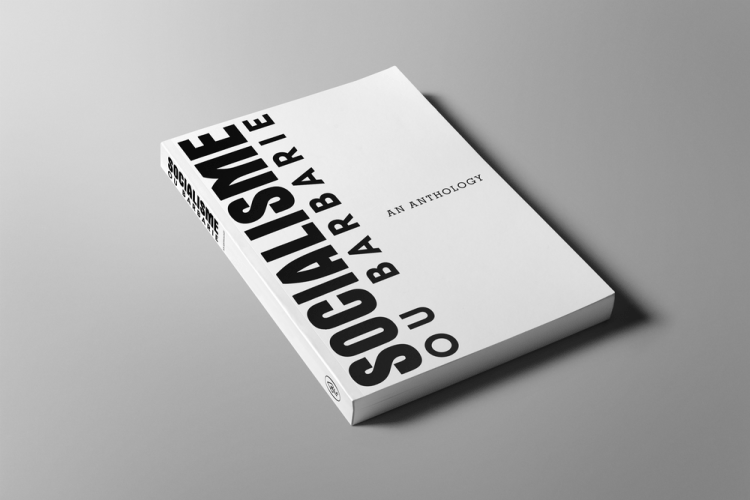
Review: A Socialisme ou Barbarie Anthology: Autonomy, Critique and Revolution in the Age of Bureaucratic Capitalism. Published by Eris (1 Oct. 2018)
Introduction
In 1916, after two years of mass death on the battlefields of the First World War, the Polish revolutionary socialist Rosa Luxemburg declared bourgeois civilization was at a crossroads while humanity faced a stark choice: either socialism or barbarism. The European state system was collapsing because of the terrible destruction inflicted by war that detonated a chain of rebellions and revolutions shattering nations and empires. The apotheosis of this cataclysmic moment was the October revolution – an apparent herald of a deluge that would sweep world capitalism away.
30 years later when a small French revolutionary group with just 20 members formed, adopting Luxemburg’s watchword as its name, the Socialisme ou Barbarie group inhabited an entirely different universe and socialism’s promise had been reduced to ashes by the monstrous existence of Stalinist bureaucratic totalitarianism across Eastern Europe. The ‘moment of Leninism’ in the early 1920s when the 3rd International’s mass Communist parties vied with Social Democracy for the allegiance of the working class across Europe, had long since passed. Fascism had triumphed in Italy in 1922 virtually unchallenged, foreshadowing the victories of Hitler and Franco. The defeats of the 1930s were grievous wounds. In Germany fascism’s ascendancy saw the jewels of the European working class, the SPD and KPD, crushed into dust while Stalinism’s ascendancy signalled a revolution betrayed in the East, itself a prelude to a revolution strangled in its cradle on the Iberian peninsula.
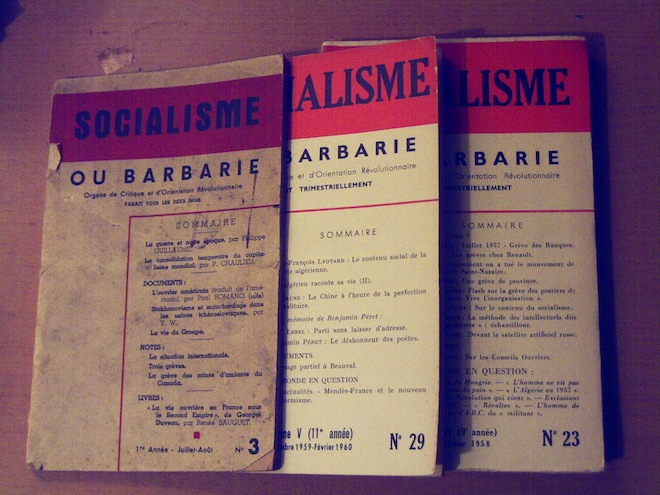
In stark contrast to the grim 1930s and the Second World War, the SouB group, formed in late 1948, led a subterranean existence on the margins of the French working class dominated by the Communists (PCF) and the Socialists (SFIO). There SouB remained for almost two decades before finally dissolving in June 1967 after 40 issues of the ‘Socialisme ou Barbarie’ journal whose strap line had been an ‘Organ of Revolutionary Criticism and Orientation.’ Many of the articles in the journal published between March 1949 and the last issue in June 1965 have enjoyed quite an afterlife as the posthumous reputation of the SouB group grew, translated and reprinted on numerous occasions. A major reason for the SouB group’s burgeoning reputation could largely be attributed to their political and theoretical perspicacity and originality, especially how SouB first re-imagined Marxism, revolution and socialism in a daring, lucid libertarian register that enabled SouB to push beyond Marxism and tentatively propose new directions for reconstituting radical politics, autonomy and democracy. Avenues would be opened up that Castoriadis in particular explored after SouB’s demise.
Over half a century later Eris Publications has produced an invaluable 485 page anthology collecting a variety of articles by many different contributors to the ‘Socialisme ou Barbarie’ journal’s 40 issues (translated from an earlier French anthology into English). ‘Socialisme ou Barbarie: An Anthology’ (2018) provides an indispensable collection with a wealth of invaluable historical background in the notes with introductions accompanying the anthology’s seven thematic sections. This anthology is an essential companion to (or supplement) the equally irreplaceable 3 volume ‘Political and Social Writings’ of Cornelius Castoriadis’ translated and edited by Castoriadis scholar David Ames Curtis who, unsurprisingly, is a moving spirit behind this English translation; or, an addition to the collections of Claude Lefort’s such as ‘The Political Forms of Modern Society: Bureaucracy, Democracy, Totalitarianism’ (1978 French edition, 1986 English edition) that started with two Lefort SouB era articles – a 1948 essay on the contradictions of Trotsky’s politics from ‘Les Tempes Modernes’ journal and a essay on totalitarianism after Stalin.
There are many different contributors to the anthology, not just Castoriadis and Lefort, reminding us SouB was a revolutionary group uniting intellectuals and workers who were revolutionaries first. The SouB group aspired to overcome the impact of the social division between mental and manual labour and workers dependence on intellectuals in their own political organizations. The idea workers were inescapably dependent on intellectuals as the bearers of science, was originally proposed and defended by Karl Kautsky against the challenge of ‘revisionism’ in German Social Democracy. ‘Revisionism’ basically dismissed Marxism and the maximum goal as alien impositions on the working class. Kautsky’s remarks (a gloss on Marx and Engels’s aside in ‘The Communist Manifesto’ observing bourgeois intellectuals able to scientifically grasp the direction of history would defect to the proletarian cause), greatly influenced Lenin’s own understanding of the party (the crucible of science). The alleged inability of workers to generate socialist (re: scientific) consciousness from their own ‘economic’ struggles was originally outlined by Kautsky before Lenin adopted it as Social Democratic or Marxist orthodoxy. Five decades later, such elitist arguments were plainly anachronistic as the social division between mental and manual labour was drastically modified due to changes in the nature of capitalism, the growth of immaterial labour, the advent of universal education, the expansion of higher education and many other developments.
The many articles included in this anthology appear variously under seven themes:
(1) ‘Bureaucratic Society’ – including ‘Socialism or Barbarism’, the statement of intent penned by Castoriadis (Chaulieu) in the first March 1949 issue. The SouB group immediately grasped the epochal significance of bureaucracy for the development of modern capitalism as an expression of the concentration and centralisation of capital and the growing salience of the state.
(2) ‘The World of Work’ – including Paul Romano’s ‘The American Worker’ from 1950, an article that demonstrated the SouB group’s awareness of what was taking place on the shop floor in the US, Britain and elsewhere in the West in the years of economic boom and workers wildcat resistance to both speed up and collaboration between the trade union officials and bosses and so on.
(3) ‘The Crisis of the Bureaucratic System 1953-57’ – addresses the working class challenge to Stalinism and bureaucratic rule in the East in East Berlin, Poland and the 1956 Hungarian revolution when workers councils appeared again in Europe.
(4) ‘The Content of Socialism’ – is devoted to Castoriadis’s long article of the same name which appeared in ‘Socialisme ou Barbarie’ #22 (1957), when Castoriadis basically dismissed planning and nationalisation in the ‘name’ of the working class (‘the dictatorship of the proletariat’), as the programmatic goals of ‘bureaucratic capitalism’. Instead, socialism should be defined positively in terms of working class autonomous self activity and the self management of society that Castoriadis thought should be based in industrial enterprises ie a position privileging the industrial working class over other workers and social strata – a section of workers who were a declining minority given the secular recomposition (and disaggregation) of the working class as a whole. Castoriadis would shortly realize this himself and break with Marxism.
(5) ‘Organization’ – focuses on the dispute between Castoriadis and Lefort on the nature of workers political organisation. The SouB group arguably never fully broke with Leninism or the conviction the working class required revolutionary political organization though the latter was defined in terms of Luxemburg’s critique of Lenin. However Lefort dissented arguing any political organization was incompatible with proletarian autonomy because it would ultimately usurp the working class in any revolutionary scenario. In the 1950s Castoriadis and Lefort debated the question which was still unsettled when Lefort left SouB in 1958.
(6) ‘The Third World’ – as the anthology’s introduction to this section makes clear colonialism and the anti-colonial struggle was never at the forefront of the SouB group’s thinking in terms of global capitalism which focused on modern capitalism East and West and the significance of the bureaucratic trend, at the expense of struggles in the developing world or the Third World as it widely became known as after the Bandung Conference in 1955. However, the anti-colonial resistance in Algeria that began in full earnest in 1954 encouraged Jean-Francois Lyotard to take on the challenge of analysing the struggle – support for the struggle, anti-colonialism, anti- imperialism but also rejecting nationalism and suggesting the FLN was a putative bureaucratic ruling class in the making. Lyotard provided physical aid to the struggle but SouB did not insist on unconditional support for the resistance to French colonialism. The other issue arising from Algeria was the racism of the French working class and the utter failure of the Socialists and Communists to challenge that racism or argue the case for internationalism and solidarity with the Algerian anti-colonial struggle. The French settler state in Algeria conducted a vicious, bloody war against Algerian independence and anti-Arab, anti-North African racism ran deep in France itself (a poisonous legacy surviving in France to this day and extending to Islamophobia). In comparison with the Socialists and the Stalinist PCF who bestrode the working class, the tiny SouB group (less than a 100 members before 1957-58) was utterly marginal. This section has two excerpts from Lyotard’s SouB journal pieces on Algeria written between 1958 and 1961. The other article in this section is on China.
(7) ‘Modern Capitalism and the Break with Marxism’ – is devoted to SouB’s ongoing critical exploration of post-war capitalism’s nature which eventually led to Castoriadis’s break with Marxism tout court. Below, Paths and Bridges provides a brief history of SouB.
Finally, the Anthology has a full table of contents for every article (and author) in all 40 issues of the journal and a short biography for every SouB author anthologised here.
Origins of the SouB Group
Though the Second World War ended with fascism’s crushing defeat, there was no revolutionary reprise of the working class revolt that marked the end of the 1914-18 Great War as most revolutionaries had anticipated. Once a mass presence in the European working class, the surviving groups and currents of revolutionary socialists were a tiny minority (council communists, Bordigists, Trotskyist, anarcho-syndicalists and others), scattered by the calamities of the 1930s and facing a fresh challenge: how to digest the import of ‘total war’, the rise of bureaucracy and the transformation of capitalism. Pre-war expectations were brutally erased by new realities. Maps and compasses from another universe had to be discarded as worse than useless. The perspectives of the Fourth International (FI), founded in profoundly unpropitious circumstances in 1938, were a case in a point. These perspectives had been strongly influenced by Trotsky’s eve of war predictions – war would have a shattering effect on the Soviet Union and the usurping Soviet bureaucracy. Trotsky believed the Stalinist bureaucracy was no more stable than a pyramid standing on its point because it was parasitic social stratum, an excrescence sprung from the working class. However, the Stalinist bureaucracy proved to be far more resilient than expected. The bureaucracy survived Hitler’s military onslaught while the restorationist ‘political’ revolution of a reawakened Soviet working class expected by revolutionaries never happened. Also Trotsky was never able to revise his prognosis as he was murdered by a GPU agent in Mexico City in August 1940. Yet in ‘The USSR and the War’ (1939), Trotsky remarked:
‘If the international proletariat, as a result of the experience of our entire epoch and the current new war, proves incapable of becoming the masters of society, this would signify the foundering of all hope for a socialist revolution, for it is impossible to expect any more favourable conditions for it.’
The SouB group first began life as the Chaulieu-Montal tendency in the Trotskyist Parti Communist Internationale (PCI), the French section of the FI which was formed in 1946. Even by the modest standards of the post-war revolutionary left, the SouB group was never large and so when the Chaulieu-Montal tendency departed the PCI in late 1948 it had just 20 members. A decade later SouB had reached almost 100 members. The tendency was formed by Cornelius Castoriadis (Chaulieu) and Claude Lefort (Montal). Both men were drawn together by their common disagreement with the FI’s attitude to the Soviet Union and the historical role of the Stalinist bureaucracy. So Castoriadis rejected Trotsky’s portrayal in ‘The Revolution Betrayed’ (1936) of the Stalinist bureaucracy as a gendarme ensuring the orderly distribution of the social product among the different social classes and groups of Soviet society in a context of scarcity. Castoriadis didn’t believe the bureaucracy was simply an ephemeral or ‘transitional’ phenomena destined to wither away as the socialist economy finally achieved abundance for all. Rather the tendency and then the SouB group concluded bureaucracy was a major feature of a transformed modern capitalism defined by the growing weight of the state and the bureaucratic trend, presenting a major obstacle to working class autonomy and self activity.
The SouB group was made up of a handful of white collar workers and professional and manual workers most notably the car worker Daniel Mothe, a militant working at Renault’s huge Billancourt factory on the Parisian outskirts while Castoriadis and Lefort were the group’s most significant thinkers. Castoriadis was a Greek citizen (he didn’t become a French citizen until 1970) born in Constantinople in 1922. When Castoriadis was a few months old his parents were forced to return to Greece. During the Second World War the young Castoriadis was a Trotskyist hunted by the Nazi’s and the Stalinists. After the Germans were driven out Greece descended into civil war. Castoriadis fled to France where he resumed his education in Paris. Claude Lefort was a brilliant student of Maurice Merleau-Ponty and became a Trotskyist during the occupation in 1943.
Statement of Intent
In March 1949 the first issue of the ‘Socialisme ou Barbarie’ journal appeared. The eponymous editorial both established the restless critical tone that would characterize the journal for two decades while introducing many of the themes SouB scrutinized throughout its existence. The editorial cum statement of intent (uncredited but written by Castoriadis) began by observing that 100 years after ‘The Communist Manifesto’ (1848) and 30 years after the October revolution, the revolutionary proletarian movement had disappeared, like a river approaching the sea, breaking up into rivulets. A vast gulf separated socialism’s ideals from the tawdry reality of betrayal. In the so-called socialist countries labour camps and repression were the norm. In the West millions of workers were organised in bureaucratic parties and trade unions that functioned as a barrier to social revolution. This editorial introduced a major leitmotif of SouB, the idea the fault line of the modern age was a division between ‘directors’ and ‘executants’ rather than owners of the means of production and the propertyless. Though marginal groups of revolutionaries had ‘survived’ the “general shipwreck”, the FI was blinded by a “spurious faithfulness to the letter of Marxism as a substitute for an answer to the important questions of the day.”
Capitalism’s evolution meant new problems for revolutionaries in terms of rebuilding the proletarian revolutionary movement unknown in 1848 like bureaucracy in the workers movement but also new forms of capitalist organization especially state ownership of production which promised to eclipse private capitalist ownership in the age of “declining capitalism” (the notion of capitalism’s civilizational decadence was at the heart of the orthodox Trotskyist lexicon after Trotsky’s 1938 Transitional Programme). The rising bureaucracy was the social embodiment of these new innovations in capitalism. In fact Castoriadis’s editorial strongly suggested an elective affinity between the goals of the labour movement (nationalisation, planning) and direction of capitalist development. Nationalisation and planning could no longer be regarded as unambiguously progressive goals but potentially heralded new forms of the domination and exploitation (1).
In ‘The Contradictions of Trotsky’ that appeared in ‘Les Temps Modernes’ in 1948 Claude Lefort offered a similar argument to Castoriadis but addressed the evasions of Trotsky’s analysis of the origins of the Stalinist bureaucracy – essentially Trotsky’s prime fault wasn’t only helping pave the way for the counterrevolution’s triumph, (for instance by helping crush the Kronstadt revolt in 1921), or temporizing with Stalin’s faction of the Bolshevik Party by failing to fully bloc with a stricken Lenin when the latter urged a campaign to crush Stalin or subsequently vacillating in the struggle against Stalin and the degeneration of the party-state but fundamentally misrecognising the bureaucracy’s significance, its social and historical import as the embodiment of new forms of class control and exploitation (2).
Intriguingly, the ‘Socialism or Barbarism’ editorial also pointed beyond Leninism though further years of disputes on the nature and raison d’etre of revolutionary organization, elapsed before the most intransigent anti-Leninists and most vocal proponents of proletarian autonomy like Claude Lefort and Henri Simon departed SouB in 1958. Shortly after the group around Castoriadis started relinquishing Marxism and became embroiled in another internal struggle with those unwilling to jettison Marxism including Jean-Francois Lyotard years before he coined the term postmodern or became known as a major figure in the French new wave of post-modern philosophy and social theory. Lyotard’s group split from SouB in 1963 and formed Pouvoir Ouvrier which survived until 1969, outliving its original host. SouB officially dissolved in 1967 though the group had effectively stopped functioning earlier when the final issue of the journal appeared in 1965.
Earlier, against Lefort and others, the SouB majority (including Castoriadis), defended the necessity of revolutionary political organization with their understanding of its nature indebted to Rosa Luxemburg’s devastating criticism of Lenin and the Bolsheviks after the October revolution: the exaggerated emphasis on centralisation, the importance of the revolutionary high command and its ‘infallible’ decisions at the expense of the necessary mistakes of the masses (the struggle was an indispensable school) – a model politically allergic to the authoritarian and anti-democratic biases of Bolshevik practice. There was also a tacit rejection of Lenin’s assumption the methods of struggle of the revolutionary movement had to be symmetrical to those of the state.
Beyond Marxism
SouB’s dazzlingly original attempt to relate revolutionary theory and practice to the world as it had become eventually pushed its most adventurous members to plead the case for going ‘beyond’ Marxism to reconstitute radical social theory. In 1959, Castoriadis (Paul Cardan) drafted ‘Modern Capitalism and Revolution’ (1960-61) laying bare Marxism’s ‘objectivism’ and the inadequacy of its critique of political economy. ‘Marxism and Revolutionary Theory’ (1964-65) consolidated Castoriadis’s critique of Marxism. Castoriadis conceded Marxism’s historical role in foregrounding the ‘social question’ and establishing class politics as part of the social universe. Yet Marxism was no longer a revolutionary force in the world but instead an ideology of putative power. Marxism had not only sought to interpret but change the world and so it could not be exculpated from the consequences of the preceding decades of its practice and influence. Indeed, to do so would condemn Marxism to being “mere theory.” Castoriadis argued similar considerations barred a ‘return to Marx’, effectively elevating Marx above history or insulating actually existing Marxism(s) from criticism; a move that would certainly be a violation of Marx’s own understanding of his enterprise. Marxism had become many Marxism’s, so many pragmatic, delimited or ‘local’ ideologies (as Fredric Jameson once acknowledged) justifying the practice of a wide variety of social and historical forces. Marxism had long since stopped being a ‘living theory’ as the shedding of pitiless self criticism indicated. Fruitful applications of Marxism for grasping social reality had been replaced by endless and arcane discussion of Marxism that treated its theoretical corpus as a substitute object universe. Castoriadis also rejected appeals to ‘method’ as Marxism’s salvation (Lukács). Method was neither separate from history nor from the content of Marxism, its core and auxiliary concepts and hypotheses. The development of the social-historical world was the unfolding of a universe of meaning while the belief sharp logical distinctions separated fact and meaning, was in practice invalid. The contemporary reality of modern capitalism, falsified Marxism – it could not be grasped by traditional or ‘amended’ categories because it simply wasn’t a matter of the redundancy of auxiliary hypotheses but many of the core features and propositions of Marxism. Consequently, Castoriadis concluded revolutionaries faced a choice: remain a Marxist or a revolutionary but it was no longer possible to remain both.
Despite SouB’s invisibility during its lifetime, SouB’s ideas had a huge impact on the revolutionary ferment of May 1968 in France. SouB’s critique of Stalinism and the suffocating role of the bureaucracies at the summit of the workers movement (political parties and trade unions), was far more radical than orthodox Trotskyism’s critique of bureaucracy. Also, the SouB group generalised from the powerful shop floor militancy and wildcat strikes in the US, Britain and elsewhere and the workers revolts against the Stalinist bureaucracy in the East, to present a positive conception of socialism as workers self management resting on working class self activity and initiative. Any alienated, institutional product of working class passivity like the political party or the trade union, invariably strengthened the grip of bureaucracy and officialdom, and was antithetical to autonomy and socialism. Such ideas provided the student revolutionaries of the Sorbonne and Nanterre with powerful critical weapons. For example, Daniel Cohn-Bendit (or ‘Red Dany’) readily borrowed from the iron rations of SouB’s revolutionary politics. In Britain SouB’s politics was an inspiration to the small libertarian socialist group Solidarity (UK) group founded in October 1960 by Christopher Pallis (a surgeon who published as Maurice Brinton) and Ken Weller (a young engineer) and others when first Weller and then Pallis was expelled from Gerry Healy’s orthodox Trotskyist Socialist Labour League. Solidarity (UK) subsequently moved away from Trotskyism and though modest in size briefly played a key role in CND especially its advocacy of a shift in strategy from marching against the bomb, to carrying out acts of mass civil disobedience (advocated with the Direct Action Committees and then the Committee of 100) that aspired to disrupt the unruffled, invisible functioning of the “warfare state.” Pallis was the chief proselytiser of SouB in the Anglophone world from the 1960s onwards, translating nine of Castoriadis’s SouB texts (as Paul Cardan) into English which formed a significant proportion of the 60 pamphlets Solidarity (UK) published in its lifetime (the group finally folded in 1992).
Expiration
In June 1967, two years after the final issue of the journal, the group circulated a notice ‘The Suspension of Publication of Socialisme ou Barbarie’ that announced the dissolution of the group explaining SouB had always been conceived as a “revolutionary political project” that had sought its raison d’etre in, and nourished itself on, struggle and political activity. With 18 years of collective activity and experience behind them those remaining in the group after the departures of 1958 and 1963, wondered if the nature of modern capitalism tended to extinguish political activity due to growing privatisation of social life, that with exception of noisy minorities, “silence” reigned in society. Also the forces countering this trend such as workers autonomous struggles, the self-directing struggles (gestionnaire) championed by SouB, would ominously become increasingly feeble or rather, more accurately, didn’t catch fire in France to the same extent they did in other countries. SouB had expected the shop floor militancy in the US and Britain to happen in France and then acquire a political aspect transcending the sphere of the economic. In fact SouB concluded that such shop floor, rank and file struggles in countries like Britain had proved to be inherently limited or circular, failing to breach the narrow economic sphere of wages and conditions. Yet this was arguably an over hasty conclusion. In Britain from the mid 1960s onwards successive Labour and Conservative governments had wrung their hands about Britain’s lack of economic competitiveness compared to other rival developed economies and how to improve productivity and profitability. Both Labour and Conservative governments identified workers shop floor muscle as the chief impediment to the renovation of British capitalism. Thus governments turned their attention to ways shop floor militancy could be bridled and mooted legislation to curb the trade unions with a mixture of voluntary and involuntary measures intended to enlist the help of the trade union bureaucracies in policing the rank and file. Instead such measures provoked significant shop floor resistance and it was clearly the case that the ‘wall’ between the economic and the political was – in some places at least – breached. In Britain, at least a combination of the economic impact of the breakdown of the post-war ‘long boom’ and the alliance of the trade union bureaucracy and the 1974-79 Labour government, finally broke the back of the shop floor militancy that had been such a feature of the post-war scene in Britain, and incidentally had a profoundly demoralising political impact, helping pave the way for Margaret Thatcher in 1979.
In France in the 1960s SouB saw little evidence of similar struggles and judged the working class politically quiescent (De Gaulle had returned to power in 1958 invited by the National Assembly and granted extraordinary powers to govern as a result of the political crisis directly sparked by pied-noir settler reaction in Algeria). In such an inhospitable context it was impossible to build revolutionary political organization in the absence of a living dialectic between revolutionary politics and struggle. SouB’s circular was damning about the pseudo activity of groups that were blind to the fact that praxis required certain conditions of possibility: a politically confident and attentive working class – instead a “useless and sterile simulacrum of this activity” was the unsentimental verdict (4). In hindsight, after the social explosion of May 1968 in France and events elsewhere (the Italian ‘Hot Autumn’ of 1969, industrial struggles in Britain during Heath’s 1970-74 government and so on), it might have seemed SouB was premature to liquidate itself and there was some attempt to reconvene the group in light of the May evenements but this came to nothing. Yet while May 1968 revived the radical left, the upturn in wider struggles began to lose its impetus in the course of the following decade before the triumph of Thatcher and Reagan confirmed the ebb tide. Finally, we might say that in terms of the broader social and historical canvas, SouB did accurately gauge the longer term post-war secular trends unfolding in the democratic developed countries apparent in our present moment: increasing privatisation, atrophying of the public sphere, decline in political participation, breakdown of political behaviour and party affiliation based on class identity.
Barbarism or..?
In our contemporary universe, two decades into the C21st everything is falling apart it seems. Yet not everything is as perishable as the ‘tradition’ of revolutionary socialism finally proved to be in the face of its mortal enemy, capitalism. Yet a dwindling band of adherents and believers still talk of the relevance of the ‘tradition’ – a certain sign of senescence. Some things remain because they changed while other things change and in doing so vanish. Today it may no longer seem plausible to argue the fundamental choice facing humanity is socialism or barbarism but it does appear there is a fork in the path looming, always assuming that there isn’t something fundamentally flawed or misplaced about continuing to think in such stark binaries in the first place or if there is, that there is still something useful to be gained from such an approach. Scepticism and suspicion is perhaps unavoidable after the postmodern ‘turn’ in social theory and culture with such binaries tainted by the eschatological connotation of a choice between salvation or oblivion but also a revenant of the ‘Midnight in the Century’ (Victor Serge) that ensured the destruction of any glib faith in the fatality of history moving in a progressive direction.
Nonetheless, if the shipwreck of socialism spells the definitive closure of the project associated with the classical workers movement and if the sobriety of our age insistently demands that we set aside all the cathected attachments and satisfactions associated with revolutionary millenarianism, there are still grounds and reasons to conclude that humanity is at a crossroads. Some of those reasons include the nature of instituted-instituting societies (Castoriadis), globalisation, the relatively open ended character of politics in the modern era, the reality of the climate change crisis among others. In fact, the climate change crisis indicates the Great Acceleration (the latest stage of the Anthropocene which began 12-15,000 years ago at the dawn of settled agriculture), is an urgent actuality and that humanity still faces collective choices. Barbarism or extinction, more or less (for what would the practical difference be?), will be our likely fate unless we collectively begin constructing an alternative that would also mean fashioning a different social order to global capitalism though we can no longer confidently state what that alternative order would look like concretely. Averting eco-malign barbarism implies a radical departure from ‘business as usual’ and probably exiting (revolutionary?) capitalism as it is irrevocably predicated on endless growth that must treat the biosphere as the enabling adjunct of capital accumulation. Such a vista or project implies a momentous effort to shape a viable civilizational alternative to the current destructive course that at a minima must be based on collective, democratic decision making linked to extant here and now struggles, for autonomy, recognition and social equality.
The libertarian socialism of SouB, its restless critical spirit, has been a point of departure and an inspiration for ‘Paths and Bridges’ as has the encounter with the thinking of Castoriadis and Lefort after they left SouB, especially their effort to rethink radical politics and the necessity of saying farewell to Marxism, for our far more modest political endeavour. It is this latter post-SouB political and theoretical endeavour that is of the greatest value and honesty compels us to make it clear that ‘adherence’ to the politics of SouB is not really possible. How can anyone maintain fidelity to the politics or outlook of a tiny revolutionary group that dissolved itself over 50 years ago in a different historical universe? Such a stance would practically amount to political necrophilia or hobbyism. The militants, activists and thinkers at the heart of the SouB group could not and did not stand still and neither can we (and certainly not in a spot last occupied half a century ago). Yet there is still a great deal to be learned from the SouB group but more so from the subsequent political and theoretical journey undertaken by Castoriadis and Lefort which represented both a break with, but also maintained strong elements of continuity with the politics of SouB.
Castoriadis’s project for autonomy in particular is valuable in this respect – ‘Paths and Bridges’ considers the numerous local struggles for autonomy taking place across the globe, to be hugely significant in relation to the fate of radical or progressive politics in the present and near future. In our view autonomy encompasses the struggle for recognition (Axel Honneth) and its extension, democracy, freedom, civil rights but also the struggle for social justice. It is a global struggle that has no other centre than civil society or nascent civil society. Apprehension of the goals of this struggle for autonomy and democracy also discloses the agency of this struggle – the citizen (citoyen), a collective formed of particular individuals whose telos in relation to identity implies a cosmopolitan meta-identity derived from autonomy and reciprocal recognition and incidentally, in terms of psychoanalysis, would also imply self knowledge and an ethics of the self and its free development that can only rest on respect for the other as self and its own free development. As Axel Honneth argues (following George Herbert Mead) the struggle for mutual or reciprocal recognition is linked to the reproduction of social life in our present – it underpins a practical a relation-to-self, meaning that an individual would only learn to view herself ‘objectively’ within the wider normative perspective of the inter-subjective sphere. But our present world or nomos falls far too short to allow autonomy to fully flourish. Mutual recognition and autonomy would also be a prerequisite for social esteem and individual differentiation. Such a view of autonomy as a political project with all that it implies about social agency is surely incompatible with Marxism and the idea the working class might as the identical subject-object of history (Georg Lukacs) or the revolutionary subject at the heart of a movement of the immense majority and part of the ‘real movement of history’ (Marx). In the last phase of its existence as a group, SouB started to grapple with the eclipse of the classical workers movement and the quietism of the working class. At present, we consider the evidence of the waning of collectivity (Raphael Samuel) or the atrophying of proletarian solidarity, too overwhelming to ignore, discount or treat as a temporary historical blip. Arguably, despite the ‘proletarianization’ of the globe including the formal expansion of wage-labour in countries like China, other global trends such as the disaggregation of the working class and erosion of proletarian solidarity, have been more decisive. Yet we concede it is possible to envisage labour movements – such as they are – playing a part at the heart of a broader political movement of citizens whose goals would be to continually extend and deepen autonomy and democracy.
Finally, no one who regards themselves as a radical or revolutionary could fail to be provoked or inspired by the SouB group and the Anthology is an irreplaceable resource – an opening not only to the SouB group whose politics anticipated our social universe but a door to Lefort and Castoriadis whose work is a major touchstone for ‘Paths and Bridges’ conception of radical politics and autonomy – a subject that we intend to return to in more detail in the near future.
Paths and Bridges
Notes
(1) Cornelius Castoriadis ‘Socialism or Barbarism’ in ‘Socialisme ou Barbarie: An
Anthology’ (2018), pp.43-64.
(2) Claude Lefort ‘The Contradiction of Trotsky’ (1948) in ‘The Political Forms of
Modern Society: Bureaucracy, Democracy, Totalitarianism’ (1986) pp.31-51.