Guy Debord, Attila Kotanyi and Raoul Vaneigem || 18 March 1962
Translated by Ken Knabb | |
I
“The classical workers movement must be reexamined without any illusions, particularly without any illusions regarding its various political and pseudotheoretical heirs, because all they have inherited is failure. The apparent successes of the movement are actually its fundamental failures (reformism or the establishment of a state bureaucracy), while its failures (the Paris Commune or the 1934 Asturian revolt) are its most promising successes so far, for us and for the future” (Internationale Situationnist no.7).*
II
The Commune was the biggest festival of the nineteenth century. Underlying the events of that spring of 1871 one can see the insurgents’ feeling that they have become the masters of their own history, not so much on the level of “governmental” politics as on the level of their everyday life. (Consider for example, the games everyone played with their weapons: they were in fact playing with power). It is also in this sense that Marx should be understood when he says that “the most important social measure of the Commune was its own existence in acts.”**
III
Engels’s remark, “Look at the Paris Commune – that was the dictatorship of the proletariat,” should be taken seriously in order to reveal what the dictatorship of the proletariat is not (the various forms of state dictatorship over the proletariat in the name of the proletariat).
IV
It has been easy to make justified criticisms of the Commune’s obvious lack of a coherent organizational structure. But as the problem of political structures seems far more complex to us today than the would-be heirs of the Bolshevik-type structure claim it to be, it is time that we examine the Commune not just as an outmoded example of revolutionary primitivism, all of whose mistakes can easily be overcome, but as a positive experiment whose whole truth has yet to be rediscovered and fulfilled.
V
The Commune had no leaders. And this at a time when the idea of the necessity of leaders was universally accepted in the workers movement. This is the first reason for its paradoxical successes and failures. The official organizers of the Commune were incompetent (compared with Marx or Lenin or even Blanqui). But on the other hand, the various “irresponsible” acts of that moment are precisely what is needed for the continuation of the revolutionary movement of our time (even if the circumstances restricted almost all those acts to the purely destructive level – the most famous example being the rebel who, when a suspect bourgeois insisted that he had never had anything to do with politics, replied, “That’s precisely why I’m going to kill you”).
VI
The vital importance of the general arming of the people was manifested practically and symbolically from the beginning to the end of the movement. By and large the right to impose popular will by force was not surrendered and left to any specialized detachments. This exemplary autonomy of the armed groups had its unfortunate flip side in their lack of co-ordination: at no point in the offensive or defensive struggle against Versailles did the people’s forces attain military effectiveness. It should be borne in mind, however, that the Spanish revolution was lost – as, in the final analysis, was the civil war itself – in the name of such a transformation into a “republican army.” The contradiction between autonomy and co-ordination would seem to have been largely related to the technological level of the period.
VII
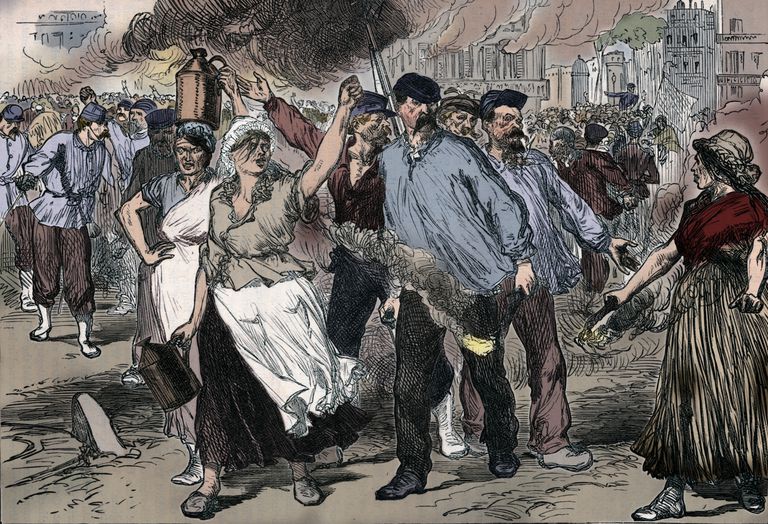
The Commune represents the only implementation of a revolutionary urbanism to date – attacking on the spot the petrified signs of the dominant organization of life, understanding social peace in political terms, refusing to accept the innocence of any monument. Anyone who disparages this attack as some “lumpenproletarian nihilism”, some “irresponsibility of the petroleuses,” should specify what he believes to be of positive value in the present society and worth preserving (it will turn out to be almost everything). “All space is already occupied by the enemy…Authentic urbanism will appear when the absence of this occupation is created in certain zones. What we call construction starts there. It can be clarified by the positive void concept developed by modern physics” (“Basic Program of Unitary Urbanism” Internationale Situationniste no.6).
VIII
The Paris Commune succumbed less to the force of arms than to the force of habit. The most scandalous practical example was the refusal to use cannons to seize the French National Bank when money was so desperately needed. During the entire existence of the Commune the bank remained a Versailles enclave in Paris, defended by nothing more than a few rifles and the mystique of property and theft. The other ideological habits proved in every respect equally disastrous (the resurrection of Jacobinism, the defeatist strategy of barricades in memory of 1848, etc).
IX
The Commune shows how those who defend the old world always benefit in one way or another from the complicity of revolutionaries – particularly of those revolutionaries who merely think about revolution, and who turn out to still think like the defenders. In this way the old world retains bases (ideology, language, customs, tastes) among its enemies, and uses them to reconquer the terrain it has lost. (Only the thought-in-acts natural to the revolutionary proletariat escapes it irrevocably: the Tax Bureau went up in flames). The real “fifth column” is in the very minds of revolutionaries.
X
The story of the arsonists who during the final days of the Commune went to destroy Notre-Dame, only to find it defended by an armed battalion of Commune artists, is a richly provocative example of direct democracy. It gives an idea of the kind of problems that will need to be resolved in the perspective of the power of the councils. Were those artists right to defend a cathedral in the name of eternal aesthetic values – and in the final analysis, in the name of museum culture – while other people wanted to express themselves then and there by making this destruction symbolize their absolute defiance of a society that, in its moment of triumph, was about to consign their entire lives to silence and oblivion? The artist partisans of the Commune, acting as specialists, already found themselves in conflict with an extremist form of struggle against alienation. The Communards must be criticised for not having dared to answer the totalitarian terror of power with the use of the totality of their weapons. Everything indicates that the poets were simply wiped out. The Commune’s mass of unaccomplished acts enabled its tentative actions to be turned into “atrocities” and their memory to be censored. Saint-Just’s remark, “Those who make the revolution half way dig their own graves”, also explains his own silence.
XI
Theoreticians who examine the history of this movement from a divinely omniscient viewpoint (like that found in classical novels) can easily demonstrate that the Commune was objectively doomed to failure and could not have been successfully consummated. They forget that for those who really lived it, the consummation was already there.
XII
The audacity and inventiveness of the Commune must obviously be measured not in relation to our time, but in terms of the political, intellectual and moral attitudes of its own time, in terms of the solidarity of all the common assumptions that it blasted to pieces. The profound solidarity of presently prevailing assumptions (right and left) give us an idea of the inventiveness we can expect of a comparable explosion today.
XIII
The social war of which the Commune was one episode is still being fought today (though its superficial conditions have changed considerably). In the task of “making conscious the unconscious tendencies of the Commune” (Engels), the last word has yet to be said.
XIV
For almost twenty years in France the Stalinists and the leftist Christians have agreed, in memory of their anti-German national front, to stress the element of national disarray and offended patriotism in the Commune. (According to the current Stalinist line, “the French people petitioned to be better governed” and were finally driven to desperate measures by the treachery of the unpatriotic right wing of the bourgeoisie). In order to refute this pious nonsense it would suffice to consider the role played by all the foreigners who came to fight for the Commune. As Marx said, the Commune was the inevitable battle, the climax of 23 years of struggle in Europe by “our party.”
Debord, Kotanyi and Vaneigem
***
Paths and Bridges Afterword 2021 |||
This Paths and Bridges post of the Situationist International’s Theses On The Paris Commune is the first in a series of notable articles on the great Commune for our Commune At 150 anniversary series which falls on March 18. We make no apologies for sharing the SI’s brilliant gnomic text that are packed with insights in their fourteen theses as well as revealing an intransigent style of revolutionary romanticism whose sources have admittedly faded in our bitter times.
As many readers will know the Paris Commune – formed by the Parisian working class and poor – lasted just over two months from 18 March to 28 May before it was bloodily suppressed. We consider the Commune to be a notable chapter not only in working class or socialist history but also profoundly relevant to the struggle for autonomy and radical democracy in our own time.
_____________________
A few specific remarks on the SI’s Theses On The Paris Commune (1962) are in order if only to clarify some points. This is a good moment to ask if the Commune still exists today? Is the Commune, or something like it, still a realistic goal? My tentative answer is both yes and no (or a heavily qualified yes). Perhaps the Commune is no more than a ghostly revenant of a fleetingly brief past event of interest only to ‘antiquarians.’ Yet it is possible something like the Commune is trying to be born in Belarus, Thailand, Hong Kong, Myanmar, Sudan, Lebanon or elsewhere.
In our recent past the Commune might have been trying to make an appearance during the ‘Arab Spring’ in Tunisia, Egypt, Syria, or Bahrain. Certainly aspects of the ‘Syrian Spring’ closely resemble the Commune 150 years ago from the role of embattled revolutionary urban centres (Aleppo, Homs and so on), to the brief green shoots of participatory democracy and finally the frightful counter-revolutionary violence mobilised by domestic and foreign reaction working together hand in glove. In this connection Franz Borkenau suggested the crushing of the Spanish Revolution in the 1930s was the apotheosis of a certain trend in the development of the classical revolution ended by the age of fascism when domestic and international counter-revolution was able to unite in a destructive alliance preventing the revolution’s ‘internal unfolding.’ In a sense internationalism gravitated toward reaction. Whether or not we agree with Borkenau’s fear of the heightened significance of the geo-political context meaning revolution becomes the object of international reaction (surely true from modernity’s onset?), it’s clear contemporary revolution’s face greater adversity because of the growth of the modern state’s firepower.
More importantly we can think of the Paris Commune as both the Commune and not the Commune. The Commune is not the model it was assumed to be. The Commune has been the object of near universal incomprehension: fearful hysteria at one pole animating counter-revolutionary violence (though Marx and Debord would no doubt have insisted the Commune’s enemies understood the Commune perfectly well – perhaps better than the Communards themselves) but also what Maurice Brinton described as the “Balkanisation of utopia”: a selective elevation and veneration which assumed the Commune prefigured the world socialist revolution.
So the Paris Commune was not a singular possibility in the sense of today’s radical (but tacitly plangent) call to arms of ‘Another World Is Possible!’ but rather a multitude of possibilities – possibilities that were bloodily suppressed and lost to oblivion. Paradoxically the disappearance of the socialist goal in our era has not meant the end of revolution. Revolutions still happen but the revolution ‘perplexes’ the traditional left because it doesn’t fit the old models or templates (as Yassin al-Haj Saleh also recently observed). The modern revolution long ago shed the gravitas and historical sweep of the Great Revolutions which helped give birth to, and define modernity. An example? The historical moment when Progress was a viable goal or horizon is now long past. As Adorno expressed the idea Progress, that providential promise of the unfolding of history, turned out to be regression. It seems the revolution today has blank spaces and is missing steps while social struggles are rarely consummated and have to begin again after a period of disoriented groping. Lacking the elan of the Great Revolution’s (the American and the French revolutions or even their Dutch or English prequels) in a world addicted to apocalypse but largely indifferent to dramatic or progressive social transformations, contemporary revolution often arrives abruptly and departs again like a furtive tsunami. Incomplete, perplexing, destructive and leaving few traces – we could be describing the Paris Commune.
The tenuous threads linking the Paris Commune to these modern ‘perplexing’ revolutions isn’t obvious. Previously in the age of the classical workers movement, the Second International and the moment of Leninism – the Paris Commune was retrospectively read through the optic of a particular understanding of historical development, the formation of the working class globally as a class-for-itself, embodying a new collective social order and so on. Linking the Commune to present day battles to defend or extend democracy and the rest, is perhaps a more valid position. We would suggest there is continuity in terms of the weak telos of autonomy (as I describe it) – the struggle to defend or extend the circumference of freedom and autonomy, to extend democracy throughout the world that takes many different forms. Clearly what used to be called the Social Question (social justice) is, in the final analysis, a part of that struggle but primarily because autonomy implies and rests on social equality and vice versa.
So we would conclude by repeating that what remains of relevance today in the Commune’s record are those aspects that were obscured by those who promoted “the Balkanisation of utopia” (Maurice Brinton) mentioned above, those who saw the Commune as a strong link in a historically unfolding chain of events or global narrative with the working class at its heart as Marxism did. If the ‘system’ is a global system at some level, imposing a certain genetic logic of the whole on the parts, it is also true the social, history or whatever, are not ‘closed’ but radically open: there are many locales and spaces, multiple modernities as S.N. Eisenstadt insisted, and that implies many paths (and destinations). Maurice Brinton caught this insight in a slightly different context but it’s worth quoting:
“There is no road to utopia, no one organisation, or prophet, or Party, destined to lead the masses to the Promised Land. There is no one historically determined, no single vision of a different and new society, no solitary economic panacea that will do away with the alienation of man from his fellow men and from the products of his own activity.”
(Maurice Brinton The Balkanisation of Utopia 1965)
We return in more detail to these and similar themes in a forthcoming Paths and Bridges post Is The Revolution Dead?
Jules Etjim
___________
*Above we observed the Paris Commune was incomplete, full of possibilities or potentials which never had a chance to run their course, to succeed or fail, to be trialled or discarded as practical living experiments. In the first theses Debord et al judge the Commune’s failures were its greatest successes, presumably in part because of the unprecedented character of its acts and the vaulting ambition animating those acts. As Marx famously expressed the idea: “the greatest social measure of the Commune was its own existence in acts.” Yet as Len Bracken summarises the common balance sheet of the Commune’s so-called failures – lack of leadership, absence of revolutionary decisiveness (“those who make the revolution half way dig their own graves” Saint-Just – see the tenth theses), primitivism and the other criticisms levelled at the Commune by Social Democracy and Bolshevism, all look far less damning in light of the ‘failures’ of these two traditions.
Perhaps the ‘primitivism’ of the Commune might contain some elements of an antidote to the stubborn problem of bureaucracy and the division between leaders and led that has sorely afflicted workers movements since the beginning of the twentieth century? Yet the issue of bureaucracy as a contemporary problem is likely to be far more intractable than this sunny judgement implies partly because of the point reached by social complexity and social differentiation in our era but also because the idea of global workers movement embodying a social and political agenda for radically transforming society seems thoroughly exhausted. As we essentially argued above, any vision of the role of labour movements in progressive politics or radical democracy or autonomy, must strike a far more modest orientation than has hitherto been the case.
**The second theses contains the brilliant apercu claiming the Commune was the “greatest festival of the nineteenth century.” This insight was at the centre of an unpleasant dispute between the SI (Debord in practice) and Henri Lefebvre. The fourteen theses appeared in Lefebvre’s book on the Commune without the acknowledgement they were written by Debord, Kotanyi and Vaneigem. So the SI blasted Lefebvre for plagiarism. Yet such claims were “bad faith” according to Lefebvre’s sadly wistful memory of the five years of close personal relations and intellectual exchange between him and Debord’s circle. The evidence of mutual intellectual exchange is indisputable – Lefebvre’s Critique of Everyday of Everyday Life (1958) was an influence on the SI’s ideas with Lefebvre’s notion of moments inspiring the SI’s concept of situations for example, while differences were honestly acknowledged between both parties. Lefebvre maintains the Theses were handwritten by him in the company of Debord, Kotanyi and Vaneigem while the specific idea of the Commune as festival was actually proposed by himself. This account is plausible compared to the destructive, sectarian rancour of the SI’s denunciations (essentially Debord). However many retellings takes the side of Debord and the SI. Exemplary in this respect is Vincent Kaufmann’s Poetry In The Service of Revolution (2001). Yet in many ways the subject of intellectual priority is moot as the general idea of revolution as festival (originally proposed by Georges Bataille) was already circulating in French intellectual culture prior to the war and long before the SI Theses were composed. Also as an idea revolution as festival was clearly inspired by ideas circulating in anthropology, sociology and literary criticism – for example, the idea of the carnivalesque or the transfiguration of the plebeian everyday by festivals and Saturnalia where the “law of freedom” or life briefly becomes the organising principle (Mikhail Bakhtin), the Day of Fools (celebratory festivals symbolically turning the world upside down and making the fool King for the Day), sumptuary consumption and gluttony, potlach (Marcel Mauss), revolution as the liberation of expenditure (Bataille again utilising Mauss) and so on.
.

