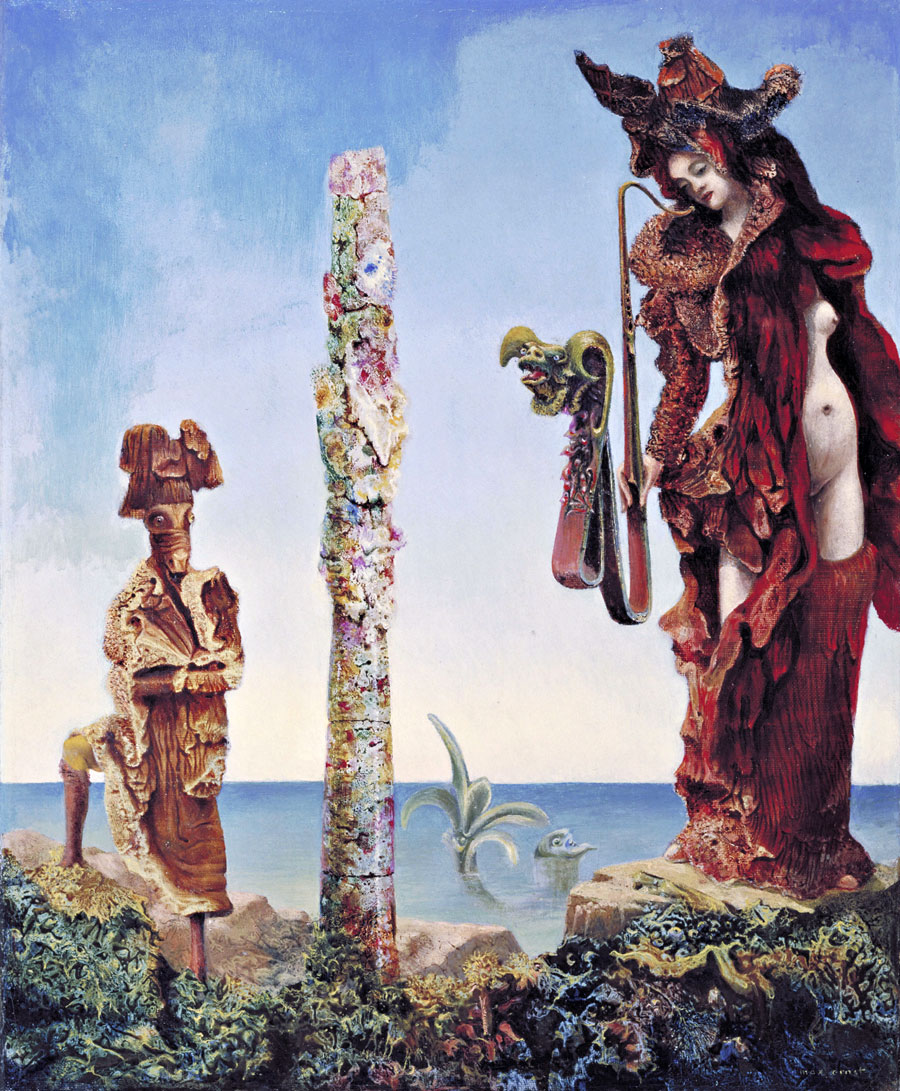
Max Ernst Napoleon In The Wilderness (1941) | MoMA
Paths and Bridges is a blog based in Britain since 2017 that is dedicated to exploring issues in sociology, anthropology, psychoanalysis, philosophy and ecology from the perspective of radical democracy or what Cornelius Castoriadis (1922-1997) occasionally termed the revolutionary project of autonomy. The work of Castoriadis is the main but not the only touchstone of Paths and Bridges.
Put simply autonomy is human freedom – the reflexive freedom of the individual understood as social being and the freedom of the collective. Individual and collective freedom rest on, and nourish their opposite. We think individual freedom or autonomy enables and is enabled by self-actualisation in the modern world while fidelity to autonomy also necessitates a political project placing communal responsibility to others at its heart (care for the self <> care for the other). Such a project is antithetical to possessive individualism, and entails recognition of the ecological and terrestrial limits to our actions (care for the planet that departs from destructive and voracious rational mastery of nature). This project is also antithetical to any totalitarian conception of political community built on separation or defining itself in opposition to the Other (political, ethnic, national, religious). If Marxism has become historically obsolete as the course of the world disclosed, it remains true what was once called the Social Question (and latterly social justice), is inseparable from radical democracy and autonomy.
Paths and Bridges is open not closed – we are curious and not too hung up on rehearsing orthodoxies. Paths and Bridges is allergic to fashion, nihilistic reaction, faux iconoclasm and narcissistic contrarianism.
In the age of post-truth Paths and Bridges prizes truth. With social scientific enquiry truth is the lodestar. However while moments of truth may flash before us the truth never appears. Gregory Bateson suggested we consider science a perspective – science probes but it doesn’t prove. Science might improve a hypothesis or furnish disproof but it isn’t a mirror of our universe. Truth is always local and provisional. Yet though there is no revealed truth we don’t consider truth to be nugatory. Truth is part of the collective human endeavour – what is signified is mediated by social significations – a compass and a horizon but never the property of any single authority.
Paths and Bridges is opposed to fascism, racism and all forms of oppression and authoritarianism and explores and promotes politics related to extending radical democracy and social justice in ecologically sustainable autonomous societies. Yet our basic stance is distant from the call to arms: Another World Is Possible – there are already many worlds, many locales forming the horizon of social networks, practices and relations – while the putative radical project of autonomy, instead starts from an epiphany encapsulated by Maurice Brinton’s observation:
“There is no road to utopia, no one organisation, or prophet, or Party, destined to lead the masses to the Promised Land. There is no one historically determined objective, no single vision of a different and new society, no solitary economic panacea that will do away with the alienation of man from his fellow men and from the products of his own activity.”
Jules Etjim ||| January 2021
NOTE TO READERS: posts appearing on Paths and Bridges were previously written by two different individuals: Joseph Aylmer and Jules Etjim. Joseph Aylmer departed Paths and Bridges in 2020 but his posts remain on the blog thanks to his kind permission.

