/// Notes on 6 May 2021 Elections ///
Reactions to the 6 May elections across Britain have been perverse especially on the part of a London-centric media and press. As you might expect with a Tory dominated press the dominant note loudly carolled Boris Johnson’s latest apotheosis and Labour’s humbling by the precarious if patriotic proletarians of Hartlepool grateful to have found their voice in a country – Brexitannia? – unchained by Brexit. There were few grace notes and so only secondarily does the media dwell resentfully (there are so many tells) on the SNP’s successful campaign in Scotland. But the British media being the British media it also conjured High Noon climaxing with Nicola Sturgeon slapped down by London because her party fell short of a Holyrood absolute majority by one seat. Apparently the success of Sturgeon’s SNP and Welsh Labour led by unflashy Mark Drakeford, had a great deal to do with the benefits of “incumbency.” Make no mistake such journalese is slyly normalising in intent, cynically dimming the SNP and Welsh Labour’s achievement.
The main story of 6 May wasn’t Hartlepool but the continuing slow decomposition of the Union, the gradual unwinding of Britain as its different nations continue pulling apart heading for different destinations and unstitching the unitary Anglo-British state in the process. The gradual detachment of the ‘Celtic fringe’ in the era of globalisation is likely to further stir a growing sense that perhaps we all belong to the ‘fringe’ as well as bringing the day closer when an independent Scotland finally arrives. On that day the possibility of an independent Wales would also acquire fresh momentum. It would be wrong to assume Welsh Labour will always be a prophylactic barrier to national-democratic tide. The party’s leader Mark Drakeford recently ruled out an independence referendum on the basis of Plaid Cymru proposing one as a condition of being prospective coalition partners. Drakeford responded only a Plaid Cymru triumph in a devolved Welsh election would justify an independence referendum. Presently this is a distant prospect as only Plaid Cymru and the Welsh Greens support independence though an existing wing of Welsh Labour committed to independence, could conceivably gain greater influence in the future.

It is a paradox the stock of Welsh independence is rising due to Welsh Labour’s handling of the Covid pandemic. Polling shows Drakeford inspires more confidence than Boris Johnson. Yet Welsh Labour opposes independence. In July 2020 a Plaid Cymru motion tabled before the Senedd calling for an independence referendum was comfortably defeated. Yet before 2018 the proportion of Welsh voters supporting independence ranged between 10% and 20%. By 2020 support for independence had risen and now ranges between 20% and 40% and is even more popular among younger voters.
Clearly Welsh Labour dominates the national stage. By winning 30 of 60 Senedd seats the party was able to equal its record seat share and form a single party government. The Conservatives also enjoyed their greatest seat and vote share in a devolved Welsh election. Both parties took votes from former UKIP voters (UKIP gained 12% in the 2019 general election). In contrast Plaid Cymru’s former leader Leanne Wood lost her Rhondda seat to Labour. The interesting question is what allows Welsh Labour to straddle the Brexit divide? Part of the explanation lies in Welsh Labour’s historic roots in the south Wales valleys and the industrial and coal mining hinterland. Despite economic blight and de-industrialisation Labour has retained links with tight knit working class communities, resisting the tides eroding Labour support elsewhere in Britain.
Welsh Labour did well in constituencies where voters were more likely to have been born in Wales. In contrast the Conservatives did best in constituencies where voters were the least likely to be born in Wales. Welsh Labour has built on established communal ties and cultivated a distinct identity separating it from English and Scottish Labour. Research indicates the addition of Welsh to Welsh Labour is worth 4 extra points of support for the party among prospective voters. Also open ended questions in the 2019 Welsh Election Study revealed a third of respondents identified the Welsh Tories as an English party. So Welsh Labour could count on the advantages of incumbency, success in neutralising Brexit and public perceptions of a distinct Welsh identity.
It’s not inconceivable Welsh Labour could eventually adopt a pro-independence stance. Yet independence is more attractive and viable in the context of EU membership. The SNP frames Scottish independence in terms of the confident emergence of smaller nations as equal partners in the congenial environment of the EU. Crucially Scotland voted Remain in the 2016 EU referendum in contrast to Wales. Yet perceptions of the Conservatives as an English party and Welsh Labour’s adroit management of Euro-scepticism affords the party a degree of immunity to the nationalist challenge..
Britain is breaking up but the reality of a democratic-nationalist tide still rising north of the border is scotomized in the eyes of millions of Britons, especially English voters, who inhabit an imaginary community that has acquired a lurid new energy with the arrival of Brexitannia. Britain suffers a democratic entropy scrutinized by a number of social scientists in recent years – a secular trend eroding the democratic culture essential to any properly functioning, stable representative democracy. Democratic torpor is also visible in other developed countries with mature democratic processes and institutions. Yet Britain’s democratic deficit – over-centralization at the expense of the regions/nations, Westminster’s FPTP electoral system, an overly powerful executive, an overweening partisan media aggressively promoting normopathy, reinforcing the political clout of wealth, the inevitability of Tory rule and the rest, blurs the reality of relative national decline while reinforcing the immense stressors on the Union. Increasingly, ‘want away’ Scottish voters eye the prospect of eternal Tory misrule in London with some impatience.
In such circumstances who would stay when the devolved democratic will is continually blunted or checked by the dominant part of the Union? The democratic deficit reflects Westminster’s FPTP electoral system (the great majority of the seats are English) and is fundamental to maintaining the ultimately undemocratic nature of an antique ‘British’ state. Presently, Boris Johnson’s Tory government is conducting a populist kulturkampf as a distraction from serial policy failure and cronyism. While the Tories enrich their friends by means of the public purse, NHS workers are instead trolled: clapped as ‘heroes’ and awarded a derisory 1% salary increase. All this has so far gone unpunished by an English electorate that appears permanently asleep. This is the backdrop of Whitehall’s insouciant indifference to Scottish opinion. Remaining part of the Union basically means yoking Scotland to the Tories Brexitannia fantasia though in 2016 Scots emphatically voted to stay in Europe (62% remain). It appears Better Together which Gordon Brown has again begun murmuring in Scottish ears like a Horse Whisperer, was selective. In the 2014 Indyref, ‘Better Together’ united a Unionist coalition comprising Scottish Labour, Tories and Lib Dems, and opposes independence. How bitterly ironic Better Together must sound today. Recall that Scots were warned (Project Fear) the experiment of independence would be an economically precipitous step in an interdependent, globalised world though the SNP envisioned Scotland remaining in the EU.
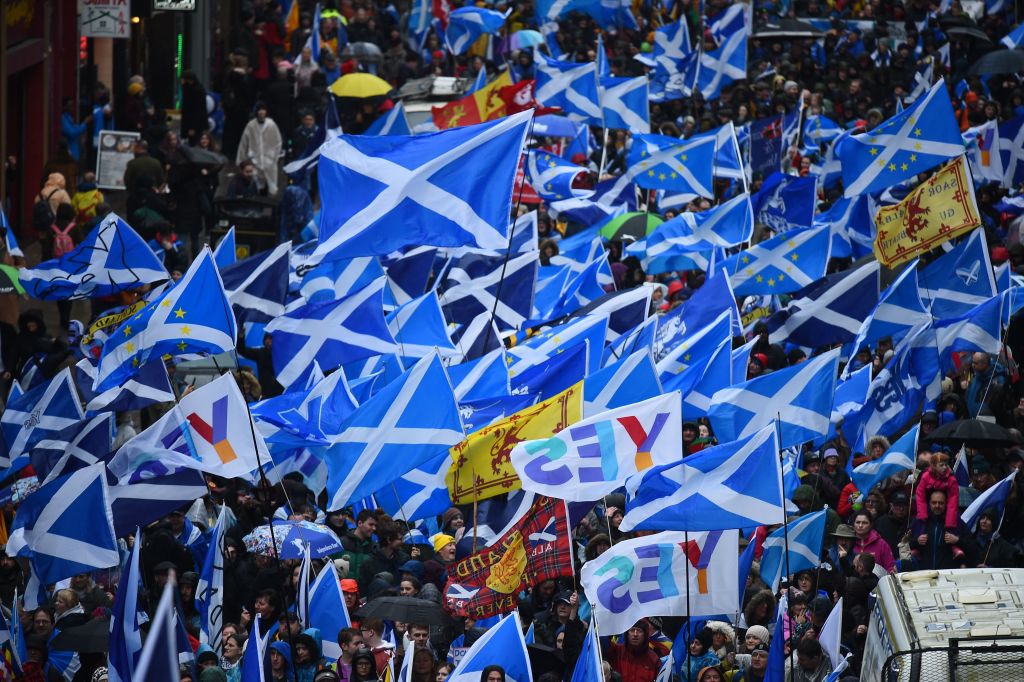
The Tories numerous media well wishers have amplified the hosannas for Johnson far and wide but their journalistic ‘objectivity’ revives to coolly scrutinize the SNPs ‘failure’ to secure a standalone absolute majority in the Holyrood election falling short by one seat. Nevertheless the SNP and the Scottish Greens combined provide a majority for independence in the Scottish parliament.
The SNP won its largest ever vote share in the highest turnout for a Holyrood devolved election. In comparison turnout in the English council elections, Mayoralty and Police Commissioner races was low as you might expect but it was also low in the Hartlepool by-election – just a 42.7% turnout meaning the Tory candidate triumphed by winning just 22% of eligible voters. A serious setback for Labour without doubt but the political earthquake hyperbole should be taken with a pinch of salt. The constituency part of the devolved Scottish election happened under the aegis of FPTP (like the Westminster electoral system) with the SNP winning 62 MSPs from a possible 73 MSPs. A crushing victory means just 11 seats were shared among the three major parties who won seats: Scottish Tories, Labour and Liberal Democrats.
Yet unlike Westminster’s FPTP system, Holyrood’s electoral system comes in two parts – the FPTP constituency based element is balanced by a regional list for electing a further 56 MSPs to Holyrood (8 regions allocated 7 MSPs each) . So each Scottish voter is represented by 8 MSPs each – the 7 regional list MSPs plus the 1 constituency MSP. Crucially the 7 regional list MSPs are elected by a form of Proportional Representation (PR) known as the Additional Member System (AMS) which tries to redress any party’s dominance of the FPTP constituency based part of Holyrood’s electoral system weighing votes both according to the proportion of party support in the regional list but also making adjustments in favour of weaker parties. This last part literally benefits every party except the SNP. So though the SNP won 40.3% of the regional list (AMS) it was gifted just two MSPs taking the party’s Holyrood total to 64 MSPs and one short of an absolute Holyrood majority. Meanwhile the Scottish Tories 23.4% vote share in the regional list (AMS) gained them an additional 26 seats to add to their 5 MSPs in the constituency section and making them the second biggest party in the Scottish parliament with 31 MSPs. The regional list really is a low bar for the smaller political parties to get MSPs, so it’s noteworthy Alex Salmond’s newly formed Alba party was unable to get over the bar, failing to gain any MSPs.
Scotland’s devolved electoral system is a peculiar mix of FPTP and PR, and is designed to prevent one party being too dominant. If Scotland simply had FPTP as the Tories enjoy south of Berwick-upon-Tweed, the SNP would be out of sight as an electoral force though the party remains hugely dominant. Even with some form of PR for the whole Scottish electoral system (obviously it wouldn’t be AMS), the SNP in terms of current support would tower over the Scottish political scene (this is now the fourth successive SNP government). It is a great tragedy England doesn’t have PR given Tory hegemony of England and their ‘winner takes all’ willingness to exploit FPTP and the executive levers of a highly centralised Anglo-British state to continually embark on radically reshaping the country in novel iterations of what the late Stuart Hall anticipating the direction of travel of Thatcherism shortly before the Conservative’s 1979 election victory, described as “regressive modernisation.”
End Days
It has been a leitmotif of Tom Nairn’s prescient anatomy of Britain’s antique multi-national state that break-up has been a long time coming; a political reality that grew increasingly apparent in the post-war years of stalled or failed modernisation and reviving ‘peripheral’ Scottish and Welsh nationalism. Naturally these democratic-national impulses have waxed and waned in the last few decades with Scottish nationalism being particularly strong. Nairn’s The Break-Up of Britain (1977) – no fence sitting question mark – gathered up essays penned in the early 1970s and first issued in 1977. Subsequent reissues have followed (1981, 2003) up to the fourth and latest reissue in May 2021 following the 6 May results. As Ben Jackson observes the root causes of the break-up of the unitary Anglo-British state in Nairn’s analysis underwent important shifts as Nairn’s politics evolved from the 1960s and a then novel application of Antonio Gramsci linked to an unambiguous ‘New Left’ Marxism to what Jackson handily describes as a “Rousseau-style nationalist Republicanism.” Today Nairn’s political outlook is closely allied to the radically reformist constitutional agenda of Charter 88 that also recognises the mortality of Britain’s antique unitary state and whose vision for a radical renovation of society passed through a reversal of the democratic deficit that only served wealth and power.
We can’t fully summarise Nairn’s brilliant diagnosis of the British state’s mortality or the evolution of his views reflected in works such as The Enchanted Glass: Britain and Its Monarchy (1989) and After Britain: New labour and the Return of Scotland (2000) and the few postscripts and remarks he has since offered adjusting his original and large claims but we should mention some major points. Nairn argued the British state was a quite peculiar edifice historically combining consent and coercion to bind the ‘fringe’ nations to the multi-national British state but with the whole only given solidity by being harnessed to a common imperial enterprise in the original phase of globalisation from the C18th to the C20th when Britain achieved pre-eminence as the first global power of modernity.
The relative economic decline of Britain and the loss of its imperial raison d’etre helped stir the revival of nationalism in the 1950s and 1960s. This challenge prompted the ‘centre’ to adopt measures to the keep the centrifugal forces of disintegration at bay. Instead the attempts of the ‘centre’ – misconceived, misdirected and often feeble – have themselves become precipitating factors in the accelerating disaggregation of the British state. In some quarters it will seem strange to insist on Britain’s decline – for example, the country is a rich and powerful country on any measure. Britain is also a desirable destination for migrants and refugees, to those risking everything to cross seas, continents and finally the English Channel to reach Lifeboat Britain – a verdant country that appears in the global Spectacle as a place of undreamed affluence, safety, well being and the rule of law.
It is true Britain is still the fifth largest economy in the world and ranks 15th in the index of human well being. But quite apart from the decades long chastening serial reductions of Britain’s ‘Great Power’ status (the loss of empire and its subordination to the status of junior partner of the enterprise of US global hegemony) there is also the broken, painful evolution on the home front from ‘workshop of the world’ to post-industrial society in the grip of a ‘highly successful’ or rather outsized, footloose financial sector that itself mirrors Another Britain of extreme social inequality, low pay and child poverty (31% of all children were living in poverty according to official statistics in 2019-20). Britain is a paradox – the apparently placid and stable surface of society belies a country of ‘fringes’ and centrifugal tendencies that are still quietly at work.
There is a widespread malaise in part marked by elite dominance and subaltern somnolence but though its not obvious where English voters can go as south of the border appears to be morphing from a Two Party to a One Party State, the same isn’t true of the Scots and the Welsh. Even the put upon Catholic ‘minority’ of the Northern Irish statelet can glimpse the possibility of a 32 county Irish Republic – more tangible today than at any point since 1922 in part thanks to a political and social evolution that began with the 1998 Good Friday Agreement which ended a three decade stalemated armed conflict and introduced power-sharing (latterly interrupted) but also the impact of Brexit (Northern Ireland voted to stay in the EU in 2016). Yet in truth there is still some distance to travel given the importance of the democratic principle of consent and the strength of Loyalist feeling in Northern Ireland that is currently rousing itself politically against London Brexit betrayals. According to the Loyalist imaginary borders in the Irish sea are borders in the wrong place as it allows the treacherous inference to air that Northern Ireland isn’t part of the rest of Britain.
In his 1981 Postscript Nairn noted the failure of the British state to embark on modernisation in the post-war years. In the cockpit of total war the British state ruthlessly subordinated the economy to the imperative of national survival and the production of the means of destruction, directing, commanding and utilising every possible resource to defeat the external enemy. Yet after Labour’s apogee in 1945-51, the state lost its strategic focus. Elsewhere the state played a decisive leading role in the modernising overhaul of economy and society whether helping the German Federal Republic rise from the ashes of war or hothousing development in the emerging economies of South East Asia.
Thatcherism set about reversing Britain’s decline by dispersing the power of the organised working class. This entailed deploying the power of a strong centralised state while promulgating anti-statism and the free market. Unemployment was allowed to rip in a savage deflation of the economy that contributed to the loss of one in four manufacturing jobs between 1978-1985. But the “regressive modernisation” (Stuart Hall) of the British economy referred to above, was unevenly distributed and fell heavily on traditional industrial regions of northern England, south Wales and the central belt of Scotland. Nairn sourly observes Labour opened the door to Thatcherism when Labour’s Chancellor Denis Healy adopted monetarism amidst the 1976 economic crisis that signalled the end of post-war consensus. Subsequent attempts to ‘modernise’ the British state – most notably New Labour’s “campaign of resurrection” – have fallen woefully short, unable to conceal the glaringly archaic nature of the state and failing to redraft or modernise an Anglo-British identity that draws so heavily on a “dazzling folklore from above” – a semi-Disneyfied monarchism and nostalgia for lost empire and Great Power status. For a sharp and acute analysis of this arrangement Nairn’s exploration of monarchy and its ideological significance in The Enchanted Glass (1988) was an early pace setter and can hardly be bettered. In this work Nairn presented the institution of the British Monarchy as a mix of carefully cultivated venerable tradition and unruffled totemic authority whose main arch was the symbolic unity of an island nation.
Importantly the archaism of the state, the lachrymose soap drama of monarchy that is such a keystone of an English centric British national identity that functioned thanks to the syncretic operations of the invention of tradition, has ill concealed the democratic deficit at the heart of Westminster’s FPTP electoral system. This democratic deficit goes hand in hand with an overly centralised state that has proven to be tin eared concerning the wishes of the national ‘peripheries’ according to recent civil service review – a maladroit failing long predating the current Tory ascendancy but certainly exacerbated by their years in power.
It is remarkable how tenacious the illusion Thatcher ‘made things better’ is or that she halted Britain’s decline and stopped the country “going to the dogs” as British ex-pat retirees living in Spain can often been heard to argue. Brexit voting Spanish domiciled English retirees were not the only foreign constituency to offer Saint Maggie their thanks for deliverance. Except it proved to be partial deliverance where Europe was concerned because Britain’s Rebate – or ‘wot Thatcher won’ – proved to be a prelude for leaving the thieves club rather than remaining. Thatcher has had many global admirers who saw her as an indomitable warrior of freedom during the Cold War (selective as General Pinochet was among the peculiar menagerie of ‘friends’ Thatcher welcomed as guests to Chequers), facing down the Soviet menace (US, eastern Europe) and in truth there were – and are – many at home to, and not only in the Home Counties. Yet if Thatcherism was a boon for some like the asset owning classes who exemplify Alain Touraine’s argument how being has succeeded doing in affluent post-industrial societies like Britain, it is still the case the country was not modernised at least not to the benefit of the majority of the populace. The so-called ‘Thatcher revolution’ requires careful definition but in any case it proved chimerical even on its own ideological terms and free markets, possessive individualism, the selective rollback of the state, selling council houses, reducing the power of local government, the 1986 Big Bang in the City, regressive taxation and all the rest, have helped dynamite the Union. It is significant Thatcher was finally laid low trying to impose the regressive Poll Tax on the country and her government considered Scotland to be a suitable testing ground for the tax.
So the sunny appraisals of Thatcherism are in part ideological or relate to the coalescing of a particular social imaginary but they also show how national decline can be misidentified as uplift. There is a strong sense that Brexitannia promises a turbo charged reprise of wildly generated compensatory feel good illusions – hence all that ominous cajoling of those ‘doing the country down’ – again what country? Yet where it might work in enough parts of England it repels in Scotland and Wales and highlights the existing breach and the impossibility of eliminating it. Ultimately the democratic entropy of Westminster’s FPTP is the fuel that will push Scotland to take the final step from devolved Local Government – as Nairn too hastily characterised New Labour’s 1998 devolved government plans to stave off independence in 2003 – to full sovereign independence. This ‘fracturing’ creates the possibility of a wider democratic opening. When Scotland gains independence it will not only increase the pitch of the independence debate elsewhere in what remains of Britain but it will force the people of England to confront the need for fully democratising society and sweeping away our Ruritarian state.
Jules Etjim //// 24. 5. 2021
References
Tom Nairn The Break-Up of Britain (2021, fourth edition)
Tom Nairn The Enchanted Glass: Britain and Its Monarchy (2008)
Stuart Hall The Great Moving Right Show (1979) available in Selected Political Writings (2017)
Ben Jackson The Case For Scottish Independence: A History of Nationalist Thought in Modern Scotland (2020)

