“Whoever obeys the laws lives as a stranger here on earth. Thus we read in Psalm 119:19: “I am a stranger in the earth: hide not thy commandments from me.” Staying true to the law means living as a stranger on earth, even in the Promised Land. The law circumscribes a counterfactual order that compels its people to dwell in the world without entirely being assimilated to it. Monotheism fosters an existential unhomeliness. This estrangement from the world is what is meant by “progress in intellectuality.” (1)
“Modernity has no foundation, since it emerged in and through the destruction and deconstruction of all foundations. In other words, modernity is founded on freedom. There is nothing new in this thought, for in fact all representative modern thinkers and all modern foundational documents (for example, constitutions) confirm and reconfirm it. What I wish to do is to interpret it. The modern world is based on freedom: that is, freedom is the arche of the modern world. Yet freedom is entirely unfit to serve as an arche, because it is a foundation that does not found. As a Grund – to speak with both Hegel and Heidegger – it opens the Abgrund: that is, the ground opens the abyss. And since the modern world is based on freedom, on an arche that cannot found, it remains a world without foundation, a world that continuously has to reinvent itself. This is one of the main reasons why all the constructed models of the modern world are abstract, in the Hegelian sense of the word, and by definition counterfactual, and why all coherent narratives ring true for no more than a few decades.” (2)
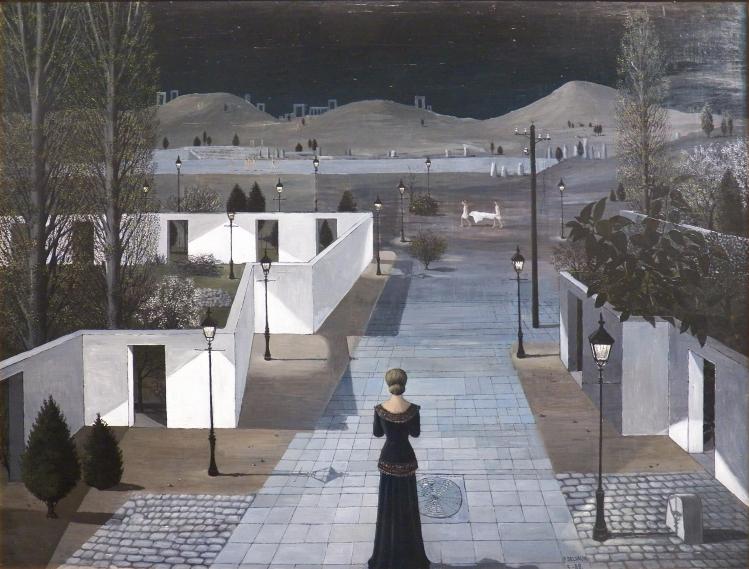
Paul Delvaux, Landscape with Lanterns (1958)
There is a common argument that says that the problem of the recent decades is the eclipse of class struggle politics (from the left) and the rise of cosmopolitanism, ‘identity politics’ (left and right of the political spectrum) and struggles for legal recognition of minority groups. It suggests that a majoritarian resentment has generated a backlash (true) in which forms of majoritarianism – from the resurgent nationalism, to populism and even a crass racist secularism – have arisen. Indeed, this argument is often presented as a form of conspiracy that saw global ruling class power defeat the nation state and/or working class organization and, incidentally or intentionally, promote these ineffectual new politics. However, it might be more true to say that ‘class struggle politics’ fell into meaninglessness following a titanic struggle when the system reconstituted itself while those that identify with this majoritarian resentment are not the victims of power but rather the ensnared in an infantile drama that occasionally serves constituted power and might be the handmaiden to a terrifying resurrection of the basest forms of politics that modernity has precipitated.
In light of 1968 and the various ‘movements of the sixties’ the more advanced representatives of capitalist power understood that a renovation of the apparatus of legitimation was needed. This meant sweeping away the fusty old order of censorship and ‘moral’ watchfulness – succinctly illustrated in France where the cinemas that could not show the banned Vivre Sa Vie ten years before now played Contes Immoraux– while allowing the logic of commodification to colonise growing parts of social life. A mercurial intervention that expanded the horizon of freedom while distorting its meaning and praxis. The economic shocks of the seventies signalled the need to reconstitute the economic foundations of the old order as well.
So, this reconstitution had a number of fronts that are interrelated but not determinate of each other. The end of the social democratic era and the turn toward cosmopolitan capital under American hegemony took place at the same time as the struggles for recognition fought the political representatives of economic transformation. Despite Thatcher and Reagan being socially reactionary, society, including to some degree the future stewards of the system, ultimately decided in favour of the struggles for recognition (minimum programme). How much the ideology of cosmopolitan capital and the notion of human beings as anonymous, fungible and autonomous economic agents dovetailed with the social movements demanding the prising open of the closure of inherited identities, is a moot point that deserves further investigation.
With the fall of the consumerist dream that replaced the social democratic one, some have taken cosmopolitan capital and the struggles for recognition as not only allies but as essentially synonymous. With the end of these dreams and the certainty of an unknown future and the possibility it will not be pacific but malign and tempestuous, the desire for a ‘genuine’ place in the world not threatened by the Other arises from the infantile interior of the self. Due to a general crisis of meaning and ends in modern society, people on the right and left overwhelmingly look for some kind of monolithic power to take them in hand.
No quarter must be given to this tendency. Democracy was forged by working class struggle because the impoverished masses knew they were strangers in this world. The bureaucratisation of the workers movement ended its revolutionary role in so far as it found a place in the world for significations created by a movement of people that were not so much practicing a rejection of the world as were rejected by the world. Similarly, in repudiaing inherited identity, the struggles for recognition of the post-68 era intimated that they were strangers in a world who needed to reconstitute or found themselves as subjects anew. Our groundlessness in this world, the fact we don’t know why we are here, and that we have to give meaning to our own lives, ends and projects, is the very condition of freedom. If being a stranger in the world led in the Axial age to a progress in intellectuality, it also stands for an opening of possibilities.
Letting traditional forms of identity circumscribe us smothers freedom and leads to its opposite, a harsh regime that imposes society’s goals and its subject’s identities from above (and ultimately in heteronomy). The project of human autonomy must always include the struggle for economic equality but economic equality in itself is not the project for human autonomy, as the human personality has needs that overshoots the bodies requirement for decent sustenance and shelter.
The revolutionary project has more than once been broken by an abstract rejection of the world and the concomitant danger of millenarianism. Thus, we cannot reject the world as constituted in toto. A conceptualization of ourselves as strangers in a world that is not our own, and as human beings who can only make good this baffling situation by creating society as autonomous individuals, a situation that cannot be naturalized or justified, nor escaped or overcome, but can only be worked upon is the Archimedean point for the project of human autonomy.
By Joseph Aylmer
(1) Jan Assman, The Price of Monotheism (2010, Stanford University Press).
(2) Agnes Heller, The Three Logics of Modernity and the Double Bind of the Modern Imagination (May 2005, Thesis Eleven Volume 81).

