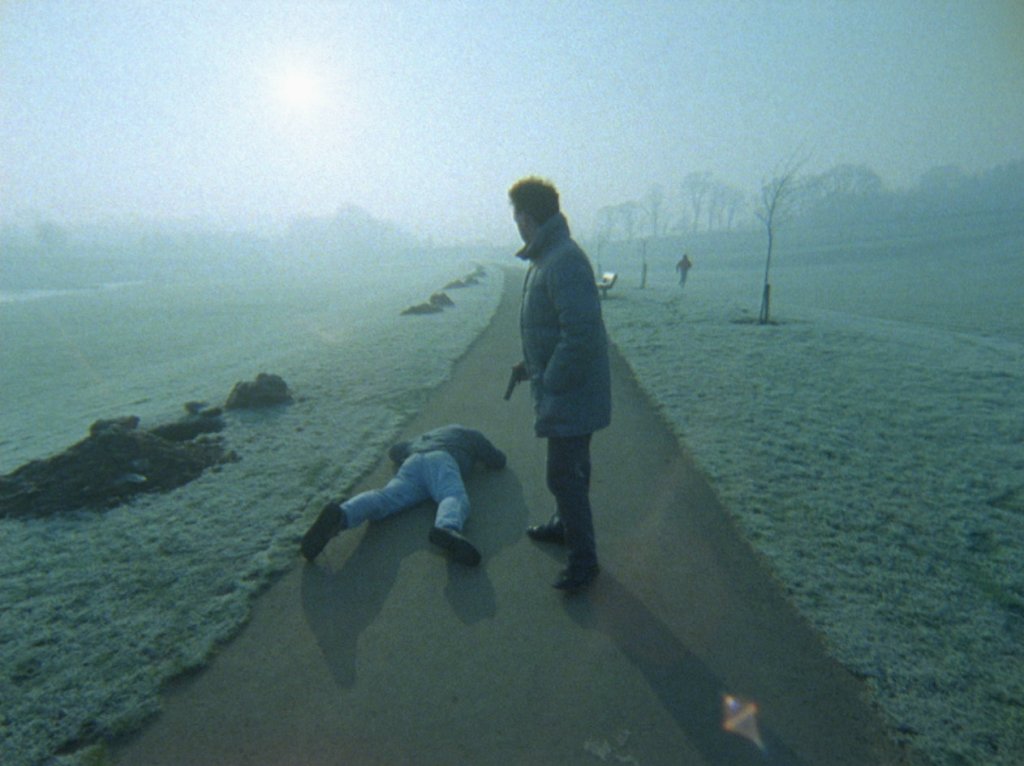
On Political Violence
In these times you could be forgiven for thinking the late Unabomber Ted Kaczynski was riding a triumphal wave in the domain of the ‘spectacle.’ The stream of documentaries, dramas, films, books (including the scholarly variety) could yet mutate from cottage to mass industry and allow Kaczynski to escape the eclipse of toxic notoriety for a different notoriety that doesn’t preclude bouquets.
Perhaps Kaczynski’s nocturnal celebrity is less about him becoming an unlikely model for a diehard militant eco militant and more about the currency of notoriety in the virtual gallery of celebrity culture though we would never suggest spectacular representations are only amenable to univocal meanings. In a conjuncture where the dominant temper of environmental politics is overwhelmingly pacific and non-violent and the establishment work tirelessly to yoke eco activism with ‘terrorism’, a move constituting an overblown effort to criminalise legitimate protest and civil disobedience on behalf of Carbon Capital, it remains an interesting question whether there are any diehard eco militants? If there are they are likely to be as rare as hen’s teeth and singular as the late Unabomber was himself. How many brilliant mathematicians – Kaczynski was appointed the youngest ever assistant professor at Berkeley in 1967 at the age of 25 and on track for tenure – on the cusp of reaching the top of their professional tree give it all up to live among the trees of the Montanan wilderness?
In his highly topical and widely discussed How to Blow Up a Pipeline (2021), penned as a plea for the international ecological movement to move from protest to resistance by sabotaging the physical infrastructure of the fossil fuel economy, Andreas Malm cited the research of Michael Loadenthal who identified 27,100 cases of ecotage and monkey wrenching between 1973 and 2010 by radical eco groups and militants. A striking feature of this cycle of ecological resistance according to Loadenthal, was the care taken in destroying physical infrastructure while avoiding harming or killing people. Five decades of these actions led to four deaths. The Unabomber, a ‘loner’ who was hostile to organised, collective action, was responsible for three of these deaths. The other death was the assassination of Pim Fortuyn during the 2002 Dutch elections. This killing wasn’t directly related to the environment but was carried out by an eco and animal rights activist who said his motive was opposing Fortune’s Islamophobia. An unusual case then.
This ‘leftist’ or radical record stands in stark contrast to the record of alt-right and fascist violence across North America and Europe in the same years. In fact alt-right violence has significantly escalated this century. Concerning political violence as a taxon we distinguish the violence perpetrated by the right from the left which we define as radical violence. Admittedly this distinction isn’t entirely satisfactory and is eminently debatable but here we reluctantly resist unpacking these criticisms as they would take us too far from our immediate topic.
As the climate breakdown deepens, the emergence of a near future Ted Kaczynski Brigade allied to a restive, ‘vengeful’ Gaia (James Lovelock), gains plausibility. More likely still would be the crystallisation of a New Model ecological movement that ditched the pallid non-violence and infirming respect for private property championed by apostles of absolute pacifism like Bill McKibben and Extinction Rebellion founder Roger Hallam. This less herbivorous movement could fit Malm’s recommended militant template with its aim to destroy the infrastructure of the fossil economy (though not people) and frontally challenge the prevailing ‘business as usual’ doxa while steering clear of the Unabomber’s carnivorous nihilism.
As humanity, peddle to the floor, continues to hurtle towards ecocide there are signs eco activists are rethinking their non-violent civil protest tactics. The reason is not the only the continued somnolence of the majority despite the evident and near universal anxiety about climate breakdown but also the willingness of even governments in democracies to utilise draconian, repressive policing, laws and sentencing to crush peaceful, mildly disruptive protest. ‘Saviour’ disobedience is both enervating and demoralising if it fails to spark wider public restiveness
Violence in general whether interpersonal or communal, appears to be an ineradicable distemper of our agonistic age. The mainsprings of violence appear opaque and complex – bearing on the roots and scope of violence in society. Perhaps violence – given our nature is rooted in our archaic hominin ancestry, is an eternal fixture largely kept in check by the “thin veneer of Civilization” (Freud) or some other restraint that is after all only so much restraint. As the Roman dramatist Plautus sourly reflected: “Man is a wolf to man.”
But acknowledging the ubiquity of violence doesn’t entail accepting the inevitable fatality of violence as thinkers like Rene Girard have implied, as a permanent part of human societies. Rather we favour treating violence as a social-historical phenomenon. Therefore we believe explanations of violence resorting to biological reductionism, common as a theme in popular culture – ‘Man’ is the killer ape with an inexhaustible thirst for violence, sadism, death and destruction – is completely and demonstrably wrong headed.
Such pessimistic zoological views share an elective affinity with non-empathic masculinity and the vaunting of the martial that are undergoing a peculiar revival in the developed world – you might say at the extreme fringe of toxic masculinity or the new misogyny – that is a feature of parts of the manosphere, the alt-right and fascism redux but also Populism. For some political violence is seductive and may even exult destruction and death while having no qualms entertaining social ruptures resulting in human pyres. We don’t think it’s entirely exaggerated to speculate this latter violence could foreshadow a ‘pre-emptive’ barbarous terror encapsulating a callous indifference to a world on fire and energised by lurid dreams of violence, burning gasoline and spree shootings.
Of course different things can be meant by violence (not to speak of radical violence) and distinctions within violence as a taxon are important. Consider Slavoj Žižek’s modish understanding of violence presented in Violence (2008) we consider emblematic of a particular leftist ‘common sense.’ Žižek argues violence, capitalism and the everyday are irrevocably entwined. He singles out subjective violence as the most visible of a triumvirate of forms of violence. This equates to acts of physical violence like violent robbery, assault or murder. The other two forms of violence are symbolic violence such as racist or misogynist representations or stereotypes in cultural and discursive forms, and systemic violence such as poorer educational or employment opportunities for certain groups and demographics. The mediatisation of subjective violence, its prominence in news headlines, tends to obscure the other two forms of violence that can’t be seen as readily but are akin to perturbations of the social fabric ensuring they appear like everyday ‘normal’ aspects of social life.
In terms of symbolic violence (originally formulated by Pierre Bourdieu) Žižek observes that representations of violence filtered by a media apparatus which is selective in constructing representations of the social field with such framing itself constituting a form of violence. An example Žižek asks us to consider is representations of a ‘humanitarian crisis’ – hierarchised in terms of ‘newsworthiness,’ how ‘sympathetic’ the victims might be, ensuring othering and scotomisation may also be at work. The effect according to Žižek is a form of violence – a tight complicit link with subjective violence. The inability to see social phenomenon like unemployment or low pay as hidden violence inflicted at distance by the functioning of capitalism is symptomatic. Drawing on the Lacanian distinction between reality and the Real, Žižek contrasted the phenomenal realm of the everyday with the Real which represented the more socially abstract, spectral realm of capital accumulation and valorisation. Peculiarly the Real as causally dominant determinant was more real than the real of the everyday.
Žižek presents violence as an omnivorous social phenomenon. In his hands violence undergoes a conceptual inflation: capitalism is literally violence. The everyday functioning of capitalism and the process of production radiates violence – the separation of the producers from the conditions of production, the private appropriation of the social product created by social labour, the extraction of surplus value and its valorisation constantly fortifying the alien social power of capital, rebounding against the working class and responsible for various malign epiphenomenon rippling through social life. However we are compelled to ask is there no difference between Kansas or Grozny? The Rhineland or Darfur? A social body misshapen by pervasive violence? Ultimately this a nuance lite indictment that sounds radical as critique but is fundamentally superficial.
Žižek’s angle on violence also means he can assume an equivalence in terms of violence between capitalism and the appalling record of the Bolsheviks and no longer existing ‘actually existing socialism.’ The US social scientist R.J. Rummel who coined the neologism democide to describe the killing of citizens/civilians by their government/state, estimated 212 million people had been killed by their governments in the C20th. Unsurprisingly, Rummel thought democracy’s were the best form of government because they tended to kill fewer of their citizens. He also argued wars between democratic polities were far less likely. In contrast a problem for some radicals like revolutionary socialists and Marxists who defend the historical necessity of violence (a different argument than the realism of acknowledging social conflict and violence are aspects of the social-historical) is that a large proportion of people killed by their government in the C20th were killed by notionally communist or socialist states.
Clearly Rummel’s basic argument is not without its own problems. For instance a glaring omission is the failure to address the pre-history of representative democracy in the age of modernity – 1492, colonialism, the Atlantic slave trade and the plantation economies of the Americas, imperialism, world wars – all of which also furnished historical episodes of exterminatory or genocidal violence and most of which were arguably central to capitalism’s global take-off. This is a complex field of historical enquiry with a number of overlapping or adjacent issues requiring some care in disentangling and scrupulously adjudicating but remains bedevilled by partisanship. Space precludes the attempt to address all the issues raised here (we plan to return to them) but an important elementary point – and the start of exploring this question – is to distinguish capitalism from democracy and the historical emergence and evolution of the latter as a political form. Even so it’s a characteristic of the age that democracy (representative, constitutional, parliamentary, liberal and so on) has attracted all sorts of critics who conflate it with violence or capitalism or fail to distinguish it from this or that aspect of its social-historical genesis.
Some contemporary critics belonging to a critical lineage of anti-colonial or post-colonial critical theory like Achille Mbembe, are acutely critical of the historical evolution of representative democracy whose most solid foundations were established in developed countries across Europe and north America. Mbembe insisted democracy was never simply an ever widening zone of inclusion but also exclusionary, particular where it pretended to be universal (or provincial as Dipesh Chakraborty cogently argued), geographically delimited to certain imperial, developed zones of the world in contrast to zones of empire, occupation, overt violence, ‘native’ labour and resources that combined to furnish the unacknowledged enabling conditions of exclusionary representative democracy. Despite the post-war decades of decolonisation “mythical” representative democracy, supposedly pacific, is irrevocably marked by its violent origins – colonialism, war, a “nocturnal” underbelly of racism that has subsequently been transformed and amplified by globalisation. In essence democracy can’t be separated from colonial war without rules, genocidal violence or supremacism in a social universe of violence. There are many admirers of Mbembe’s provocative argument but we consider it overblown, a reductive indictment of democracy weakened by an unsatisfactory pseudo realism that essentially bleaches out the oppositional or disruptive potential of democracy.
Our point here is that an apologia for radical violence derived from a strategic inflation of violence in general, damning capitalist ‘civilisation’ or equating democracy with violence, must be dismissed as glib and flawed – the night when all the cows are black to cite Hegel’s criticism of Schelling’s Absolute. The global system is, and was, a unitary system while communism was a specific project born in a particular conjuncture out of the ambivalent contradictions of modernity itself. An apologia like Žižek’s that downplays communism’s failures and remains stuck in denial about its irrevocable bankruptcy should be firmly resisted. More specifically the historical record of social struggles and revolutions, indicates the dangers of resistance to oppression, social injustice and tyranny descending into a labyrinth of immersive violence – dangers the French Christian anarchist and pacifist Jacques Ellul, best known as the author of The Technological Society (1954) which ironically was an inspiration for Ted Kaczynski’s technophobic militancy, was certainly aware of.
Even so the question remains can radical violence be separated from revolutionary violence? Here we have in mind Reinhart Koselleck’s claim that once revolution as a modality of political action within modernity was established, it tended to require or invent an enemy or reactionary obstacle to mobilise a revolutionary coalition under a centralised revolutionary authority. There are various problems with Koselleck’s argument and a principal flaw is that it focuses on certain sui generis revolutions like 1789 and 1917 and ignores the variegated social-historical conjunctures that generated them, singling out notable revolutionary episodes on the basis of their admittedly consequential revolutionary ideologies (these often purported to be universal). A careful comparative history of revolutions (plural for there is no singular pattern of revolutionary explosions) would be required.
John Locke’s prescription about the right of revolution – it’s certainly not a sociology or fully articulated historical explanans of the phenomenon of revolution – belonging to an oppressed people against tyranny would probably mirror many revolutionary processes in the C20th and C21st. Locke’s right of revolution captures the reality revolutionary outbreaks are often ‘spontaneous’, provoked by the inability of a population to continue enduring oppression, authoritarianism, humiliation and hardship. In other words, revolution is rarely stirred into life by coherent revolutionary ideologies that spring from Othering some group or demographic to mobilise revolutionary passions. On Koselleck’s reading such Othering would indicate the unacknowledged utopianism and ressentiment belonging to any revolutionary ideology. Lacking such ideologies is perhaps why seismic historical events like the ‘Arab Spring’ lacked the élan of the Great Revolutions or the 1979 Iranian Revolution.
The combination of millenarian revolutionary ideologies with radical violence can readily crystallise into ‘offensive’ revolutionary violence – that according to its novel precepts would be necessary and justified to sweep away the ancien regime and usher in the ‘new world.’ Clearly such a stance discloses an exterminatory or totalitarian telos. S.N. Eisenstadt described as the ideologization of terror which he, like Koselleck, connected to the future facing nature of modernity and its immanent social conflicts that were cast in these terms (realising the novel, what is to come) but which also demonstrated continuity with the past by activating and secularising the millenarian potentials of the Axial religions and cosmologies.
Obviously Marxism and its social imaginary is an exemplary instance with its fungible concept of class and providential account of history. Consider any episode of the Soviet experience – for example, Stalin’s ‘Second Revolution’ when the peasantry was forcibly collectivised to extract as much resource and wealth as possible. The party-state apparatus faced an ‘obstacle’ to this process: the ‘middling’ and ‘rich’ kulaks so defined in terms of Marxism’s classist social imaginary, so they could be eliminated by the state. This episode could be said to encapsulate a transition from a revolutionary, oppositional party – to a Party of Order except to describe the Bolsheviks in power as the Party of Order is somewhat of a misnomer given the situation – constructing a new state machine in the context of civil war, social collapse, War Communism, crushing rebellions like the Tambov in 1920 and Kronstadt in 1921. Some historians and partisans of communism claim the Bolsheviks made a virtue of necessity in terms of the use of violence given the Bolsheviks chaotic inheritance but this is a generous reading and downplays important features of Bolshevik ideology which offered an a priori rationalisation for the indiscriminate use of coercion, violence and terror.
If we turn directly to a broader reflection on radical violence – a powerful rejection of the premise radical violence was a legitimate or effective means of fighting oppression, social injustice or a means of countering the violence of rulers and oppressors that was also a cogent defence of pacifism was offered by Jacques Ellul in the 1960s. Ellul’s arguments were perceptive though not wholly convincing in our view but retain some value for their powerful, uncompromising insights about the dangers of the escalatory logic of violence.
Ellul believed violence was closely related to political power and domination and if anarchism was the antithesis of political power and the state, it followed it was opposed to all violence. For Ellul violence as a feature of class societies was “natural,” “inevitable” and “necessary’ for its continued reproduction. As an anarchist Ellul’s anti-statism meant opposing the state while insisting Christian’s had to peaceably oppose all manifestations of violence in the name of the Gospel of Love.
Realism about the inevitability of state violence could indicate popular acceptance of the state’s legitimacy and its monopoly of violence formulated in terms of ‘protecting’ all citizens. Since the 1970s this deep-rooted idea – an Orwellian recognition that the will to dominate moved in lockstep with a broad will to obey (or fear of freedom as Erich Fromm expressed the idea) has been reinforced by Leviathan’s redefinition and the inflation of its role in providing ‘security’ against internal and external enemies, threats to life, developments occurring during what at first sight appeared to be a diminution of the state’s role in a citizen’s welfare as neoliberal ideology increasingly talked of citizen’s own ‘responsibility.’ Paradoxically this neoliberal framing wasn’t incompatible with other social trends infantalizing the citizen. Arguably politics has increasingly converged with political steering of a segmented populace and the dissemination of discourses marked by a psychical flight from reality and truth – notions rendered metaphysically quaint in the universe of post-truth.
Yet a civil populace wouldn’t necessarily always accept the legitimacy of the governing authority. Popular reticence for radical violence could be sloughed off in the face of growing social crisis, oppression or – perhaps more plausibly in the near future – mounting evidence of ruinous ecocide against a backdrop of elite determination to continue with ‘business as usual.’ Then the de facto and de jure monopoly of legitimate violence enjoyed by the state might face a serious challenge. Assuming such a crisis were to develop realism suggests elites would be unlikely to voluntarily relinquish such weapons of last resort but observing the social landscape across the globe, the rise of Populism, ethno-nativism, recidivist nationalism and the alt-right, it’s easier to imagine – for now – a continuing polarisation of the civil populace than the fragmentation of central authority.
In terms of the changing political tides evident in the 1970s, the flight from reality and the dissolution of the Keynesian consensus, ensured this trend could be seen in the way political parties – initially on the right but eventually followed by those on the left – banged the law-and-order drum amplifying claims of rising lawlessness and crime. Law and order panics were partly about renovating conservatism which adopted partisan political steering strategies like Richard Nixon’s Republican Party ‘Southern Strategy’ that determinedly focused on wedge issues to create and consolidate electoral coalitions based on fear, prejudice and scapegoating from the late 1960s onwards. In the 1970s Britain followed suit with the new social authoritarianism of Thatcherism whose makeup was lucidly dissected by Stuart Hall.
Though not irrelevant Ellul’s theological justifications for non-violence are bracketed here as we focus on his five laws of violence. Generally Ellul thought radical violence was a non sequitur as its logic unfolded independently of the specious justifications of radicals. In this respect Ellul’s baleful take on violence is very similar to our own understanding of the dangers of an escalatory logic of immersive violence.
The first law of violence is continuity. Once a group or social movement resorts to violence and conflict attains a certain pitch, it becomes difficult to escape the all-encompassing logic of violence. Using violence or physical force to achieve short, medium or long-term goals is hard to break with if it’s thought practical and necessary for success. In a refractory social universe violence is essentially a ‘short cut’ – violence recommends itself as the appropriate tool or solution though a closer, more sober appraisal of most conflicts would likely reveal this realism was deceptive. In reality the results were likely to be ‘mixed’ at best but a commitment to radical change usually entailed reflexively taking onboard certain ‘historical lessons’ about social change in the past and the internalisation of ‘fables’ suggesting an elective affinity between progress and violence with the latter a midwife of the former.
There is pace Ellul some irony in the fact that some critical perspectives on radical violence, revolution and modernity, have grasped the radical social movements of modernity as descended from the transformation of heterodox religious visions of the cosmos in Christian Europe. These increasingly critical visions contained strong Gnostic and millenarian elements whose telos was the Kingdom of Heaven to earth. The fissiparous sectarian visions of European Christian sects were continually modified by the social-historical (Castoriadis) – the Reformation and its aftermath, the Enlightenment, the Dutch Revolt and the English Revolution culminating in the American and French sequels – the Great Revolutions of 1776 and 1789. S.N. Eisenstadt maintained these millenarian social movements contained in nuce the cultural program of modernity, and an emerging public space that was the concomitant of political life typical of the modern nation-state. This cultural program definitively remade by the Great Revolutions introduced novel cosmologies, flexible ontologies and non-ascriptive identities. Eisenstadt understood the Great Revolutions were a historical concretization of the sectarian, heterodox potentialities of religious systems originally formed in the age of the Axial Civilisations.
Accompanying the peculiar spike or intensification of religious belief that preoccupied Max Weber (especially Calvinism) in the transition to a fully bourgeois universe there was a militant proselytising impulse to re-enchant the world and beat back spiritually empty materialism, before the ‘sea of faith’ began to retreat before the latent rationalism virally released from Protestantism’s core. The Great Revolution’s birthed an age of social contestation, the development of social theory (sociology, anthropology, philosophy and so on) and ideologies linking the present as a political arena and threshold to the future – a future entirely distinct from the present. If social movements, ideological platforms and political parties were a result of the deep lying antagonisms of the modern world then revolutionary ideologies also recycled earlier “transcendental visions” in novel secular forms as critical diagnosis and revolutionary goal.
Eisenstadt later adjusted his evaluation of the weight of Christian heresies in the revolutionary imaginary according to Johann Arnason. The influence of Gnosticism has become a focus of some dispute as to the exact extent of its influence after Hans Blumenthal’s demonstration that revolutionary prescriptions for remaking modernity overcame Gnostic themes more successfully than previously appreciated.
This present or ‘now’ as gateway to the future was treated as an inferior form of existence according to Reinhart Koselleck, ontologically diminished vis-à-vis a future constituting a ‘horizon of expectations’ and the promise of plenitude in terms of social programs, communal goals and political action. We mentioned that such a philosophical-historical optic on Universal History filtered through a millenarian, sectarian political projects could easily foment the ideologization of terror. Evidently Koselleck had the history of C20th in mind as well as the earlier era of the Great Revolutions (1776, 1789). If these were real dangers of particular political programs and goals envisaging global reform or social change transcending the horizon of the present, it can’t be denied present social conflicts reflect real fissures and contradictions of modern society.
In this context the Great Replacement theory disseminated by white nationalists and neo-fascists – that European elites are conspiring to ‘replace’ white populations across Europe with Muslim migrants is Islamophobic, racist and a fabulation. In contrast, climate breakdown and the rest, isn’t a fabulation of climate scientists but a real process that occurred in the past, is happening now and is still unfolding – the first geological era driven by the Anthropos and created by history that will also be the geological era marking the simultaneous end of history and the reimposition of Nature and the geological – if the collective global movement to mitigate CO2 emissions and head off climate breakdown fails. Climate breakdown dictates the formulation of a collective political project eschewing fabulation for sobriety.
In his essay Historical Criteria of the Modern Concept of Revolution, Koselleck traced the consolidation of the concept of legitimate revolution to the early C19th when France and Europe were wracked by social upheavals including wars, revolutions, counter-revolutions, coup d’états and restorations. Earlier during the 1688 Glorious Revolution John Locke formulated a similar if more modest position: a people oppressed by tyranny had a right of revolution. Revolution become reflexive justified its existence by its opposite: reaction, and the imperative need to sweep away the bastion of reaction, the ancien regime which obstructed reform and social change. According to Koselleck once revolution was established as a ‘legitimate’ modality of political action for achieving social change, then it needed an enemy or Other and if the enemy didn’t exist then it was to be continually reproduced in spasms of terror and othering. This was the logic of eternal civil war, hidden and now visible, with revolution and radical violence (as a necessary phase of the revolutionary struggle) now a “metahistorical constant” of the age.
Though Koselleck’s target was Leninism and its adherence to “civil war” and “world revolution”, this parsing of the complex history of modern revolution is too partisan and too indiscriminate to be wholly convincing while any comparative historical analysis of revolutions especially those of the second half of the C20th and the early C21st, reveal some fratricidal bloodletting but also a curious recession of the earlier millenarian ideological distempers that disconcerted Koselleck.
Neither Marxism or Leninism had an exclusive lock on revolution or the field of social contestation – actual revolutions outdistanced the theoretical edifice of scientific socialism. Despite opinions to the contrary, revolution today remains a social-historical actuality as the ‘Arab Spring’ recently demonstrated. We mentioned the C21st revolution lacks the élan of its storied ancestors, the classical or Great Revolutions and we might add they are not at all uniform and therefore only allowing interpretations obeying the “metahistorical constant” championed by partisans of the faded hopes of the proletarian revolution as Koselleck evidently feared.
Ellul’s second law of violence was reciprocity. Those who lived by the sword would die by the sword – and this was the imperishable law of the sword (Matthew 26: 52). Every ‘master’ of the sword in wielding the sword in anger would become the sword’s servant. So ruling by the sword meant being ruled by the sword. One French Christian thinker, Ellul, echoed another, Rene Girard. Girard considered violence – fatefully subject to mimesis – to be a social contagion whose irreparably destructive impact on the socius could only be obviated by the strategic, homeopathic bloodletting of sacrificial ritual. Such acts of sacrificial ritual were formative of civilization itself. Both thinkers were agreed violence was destructive to the socius but whereas Girard’s ‘diabolic’, troubled vision proposed the necessity of strategic violence (sacrifice) for its homeopathic, homeopathic social function in ensuring society survived, Ellul’s ‘angelic’ vision insisted the law of the reciprocity of violence demonstrated that ‘good’ violence as a counter to banish ‘bad’ violence, didn’t exist. Violence fed on violence and efforts to grasp the origins of communal and social conflicts: who was responsible for the first injury, were simplistic as it was a matter of stopping at the historical injury that suited you.
The third law of violence sameness illustrates a pattern in Ellul’s analysis: overlapping links between different forms of violence. Though violence takes place at different levels and forms from interpersonal violence to armed conflicts, violent destructive acts at whatever level retained their fundamental similitude. As we noted above for Ellul violence was always a transgressive, sacrilegious that could lead further into a fallen world – a contagion polluting social life. Used as a ‘progressive’ political instrument it would always undermine the political goals in whose name it was employed. The universal sameness of violence might be read as showing violence to be insatiable and unable to respect any limit. In war or wider social conflicts violence could ostensibly be instrumentally deployed to achieve certain goals. More often than not violence would overshoot the mark. In The Economic Problem of Masochism (1924), Freud suggested the fusion of violence qua destructive instinct with the libido, uncaged sadism and a will to mastery. As is usual with Freud, the phenomenological description might be exemplary but the underlying causal mechanism – a hydraulic model of energy cum drive theory – was anachronistic and unconvincing. When Freud finally explored history and sociology (at least on some readings of his intellectual evolution) and reached the threshold of massenpsychologie his explanation of aggression’s vicissitudes remained inconsistent especially in trying to explain social conflict or its absence. Even so the notion of a covert sadistic surplus hinting there was more to violence than meets the eye, retains great power as an insight. In summary on sameness let us recall Rene Girard: a man is most like another man when he is consumed by anger.
The fourth law of violence is simply violence begets violence – “nothing else.” There is no ‘good’ violence – radical violence wouldn’t deliver a just or non-violent society and those who claim so “lie” Ellul insists. Ellul was writing in 1969 during the glacial stasis of the Cold War. He believed liberal or representative democracies would become like the totalitarian enemies they were fighting in a period when the convergence of the superpowers was a widely remarked on.
The fifth law of violence is bad faith. Invariably, cynics aside, all those who use violence feel compelled to justify its use and this is certainly true of the left and radical violence even if framed as revolutionary defence or combating violent reaction. Ellul also emphasised an important psychological truth about violence that its proponents were usually in denial about: “violence had its source in hatred and signified hatred.” Occasionally leftist ideologues like Stokely Carmichael were gauche enough to admit this, or even exalt, hatred as a spur to violence. Andreas Malm even praises violence as a purgative or cleansing force with his suggestion now might be the time for a Fanonian climate movement to succeed the Gandhian one but only sows confusion in doing so as we will see below because Malm generally recommends destroying property and the infrastructure of the fossil economy rather than people.
Equally claiming radical violence would be tolerable if it was unleashed with the alleged dispassion or purity of intent of a Robespierre, falls far short of any credible justification. The dispassion of individual radical actors (or otherwise) is virtually meaningless as it is the disposition of groups and social movements that is the important question. But perhaps the problem here is confusing the line between terror and more limited forms of radical violence? The latter could be based on an explicit ethic or set of rules. Etienne Balibar claimed that not all political violence could be easily avoided in the real world. Even so Balibar proposed leftists adopt a politics of civility and unambiguously reject cruelty. Yet it seems a firmer framework would be needed given the prophylaxis of a politics of civility would be unlikely to match the dangers of immersive violence. Balibar’s realism isn’t sufficiently realistic in this respect and a pallid politics of civility would only anticipate the apologias you would expect following ‘unfortunate’ excesses. Hard bitten insurrectionary realism and revolutionary romanticism alike may champion radical violence as necessary, cathartic, purgative or a moment of collective self-actualisation but such rhetoric would only have confirmed Ellul’s suspicions that we are dealing with bad faith.
Yet examples abound for a plausible defence of the violence of the oppressed. Numerous commentators have invoked Locke’s right of revolution or similar in the case of the oppressed black majority and apartheid in South Africa as exemplary. Making the case for armed defence Andreas Malm referred to the Warsaw Ghetto Uprising in 1944 when a heroic ‘armed’ Jewish resistance (handguns, a few rifles, improvised grenades and explosives) faced daunting, hopeless odds resisting the final liquidation of the ghetto. The previous summer a quarter of a million Polish Jews had been transported to Treblinka and Madjanek. Thousands of defenders were killed – many suffocated or burnt to death as the Germans moved from block to block with flamethrowers and incendiaries. The German casualties – disputed official figures – were far lower: 17 soldiers killed and 93 injured. But few would seriously dispute it was better the uprising happened and regrettable that it had so few arms.
So rejecting the position of an absolute prohibition against taking life or killing based on the unambiguous historical example of the 1943 Warsaw Ghetto Uprising (and similar events) hardly seems difficult but more importantly it shows some care is needed: grasping the dangers of immersive violence and commitment to non-violent politics need not rest on an ethical repudiation of violence tout court. Beyond this baseline the real analysis and arguments (including ethical) begin. We are speaking of the possibility of a commitment to a non-deadly violent resistance or political, ethical articulation of its basis with sufficient realism that admits injury and death can’t always be avoided. Accidents, unintended consequences are of a different order to, say, a deliberate policy of political terror though as we know the Ruling Order everywhere denounces all sorts of oppositional activity as ‘terrorism.’ Malm cites the example of eco militants Jessica Reznicek and Ruby Montoya who sabotaged the Dakota Access Pipeline in the US by drilling holes in the pipeline and so on, at various points, publicly confessed, were arrested, tried and are now serving respectively 8 and 6 years in federal prison. Denounced as ‘terrorists’ Reznicek and Montoya’s lengthy prison sentences (and huge fines) are draconian and designed to discourage and demoralise others thinking of destroying the physical infrastructure of the fossil economy.
Ellul’s overall case against political violence and radical violence in particular has many weaknesses not least schematicism and the intrusion of highly debatable judgements. To take one example from various dubious arguments – in summing up the fourth law of violence: violence begets violence, Ellul claims the struggle against Hitler’s racism had the effect of spreading racism throughout the world, that propaganda against fascism helped universalise fascist ideology while in “fighting racism by violence we have all become racists.”
Sharp, insights on the logic of violence aside, such arguments are truly woeful. The defeat of Hitler and fascism was also a defeat for scientific and biological racism. It also indirectly aided the post-war unravelling of European colonialism. Ellul does clarify his argument here by pointing out that the French Resistance struggle against German occupation of France was also culpable of aiding the massacre of thousands of Algerians at Setif in 1945 and almost 100,000 people in Madagascar in 1947. It’s to Ellul’s immense credit that he shone a light on the crimes of French colonialism but this bald criticism isn’t wholly convincing after close inspection. Perhaps such violent colonial crimes highlight the contradictions of the French republican tradition and the racism of French society, the limits of its faux universalism and its entanglement with nationalism, rather than the contagion of violence itself?
Our point is simply an important factor here was the interposition of colonial racism. The resistance struggle against fascism and occupation, was a school for various ideological world views to crystallise including principled anti-colonialism. Equally, existing ideological world views might simply be reinforced – French republicanism and nationalism for example. Ellul’s abstract point neglects the social-historical context and ignores actual social actors and their ideological programs. Inexplicably, Ellul omits to mention that during the Second World War, Algeria as a French department was politically dominated by pied noir settlers and loyal to Vichy France while French colonies in Equatorial Africa went over to De Gaulle after the French surrender in 1940. Resistance to German occupation wasn’t the school of racist political violence in Algeria post-1945 but the unbroken continuity of colonial rule and its coercive apparatus certainly was. Some of the Algerian FLN’s future leadership and cadre served in De Gaulle’s Free French forces and learned from France’s wartime defeat the French state could be beaten and the end of French colonialism was in sight.
Nonetheless Ellul’s criticism of radical violence retains great value but we must dismiss any absolutist or pacifist rejection of radical violence as unrealistic. Clearly Ellul’s basic idea is violence in all its forms, is a pervasive contagion in a fallen social universe and only an absolute rejection of violence, political violence including radical violence, is appropriate as a response from the progressive or radical camp of anti-statism and the oppressed. Despite the value of Ellul’s scrutiny we emphatically reject his conclusions for lacking realism and likely to inculcate a potentially frightful paralysis or prostration before tyranny.
Jules Etjim // August 2023
Some texts mentioned here
Jacques Ellul Violence (1969)
Andreas Malm How to Blow Up a Pipeline (2021)
Reinhart Koselleck Futures Past: On The Semantics of Historical Time (1990)
Slavoj Žižek On Violence: Six Sideways Glances (2008)
Achille Mbembe Necropolitics (2019)
Ted Kaczynski Industrial Society and Its Future (1995)
Michael Loadenthal The Politics of Attack: Communiqués And Insurrectionary Violence (2017)
S.N. Eisenstadt Fundamentalism, Sectarianism and Revolution: The Jacobin Dimension of Modernity (1999)
The photo at the top of this piece is a still from Alan Clarke’s short film Elephant (1989) which was first shown on BBC 2 (Britain) in January 1989 and chillingly recreates 18 ‘sectarian’ murders from the Troubles in Northern Ireland with minimal dialogue in its brief 38 minute running time. The political killings or murders are casually shown without divulging who the gunmen or the victims are.

