Written by Maurice Brinton and Phillipe Guillaume ||| May 1961
The Commune…from Marx to Trotsky
“Each time we study the history of the Commune we see something new in it, thanks to the experiences gained in later revolutionary struggles…” Thus wrote Trotsky in 1921, in his preface to a book about Tales which was to become basic reading for a whole generation of French revolutionaries (1).
The “tricks of History,” as Marx delighted to call them, have amply confirmed the correctness of Trotsky’s statement. We can now examine the Paris Commune in a new light – in the light precisely of the rich experience of Bolshevism and of Trotskyism. We mean, more specifically, in the light of their failure. Stated more concretely, the proletarian revolution of 1871 must now be re-evaluated in the light of the degeneration of the Russian Revolution and of the positive lessons of the revolutionary struggle of the Hungarian Workers Councils in 1956 against bureaucratic society in which the means of production were completely “nationalized.”
Trotsky could hardly have foreseen these developments when he wrote his prophetic words in the heroic days of 1921. This however in no way detracts from their absolute correctness.
For Trotsky and Tales the great defect of the Commune was the absence of a revolutionary leadership. “The Commune,” Trotsky emphasized, shows us “the incapacity of the masses to choose their own path, their indecision in the leadership of the movement, their fatal inclination to stop after their first successes…” How can this be overcome? Trotsky is quite explicit: “It is only through the help of the party, basing itself on the whole history of the past, theoretically foreseeing the paths of development and all itsb stages, and extracting from them the necessary formulas for action, that the proletariat frees itself from the need to constantly restart its own history…” He summarizes his views with his usual logic: “We can look, page by page, through the history of the Commune. We will find in it only a single lesson: there must be a strong Party leadership” (MB and PG emphasis).
The present generation of revolutionaries have lived through or studied the history of the last forty years, and have experienced all the ills that have flown from the hypertrophy and subsequent degeneration of such a “leadership” – even when it has proved victorious in its struggle against the bourgeoisie. They have witnessed its gradual separation from the masses and its steady conversion into a ruling group, as fundamentally opposed to the basic wishes of the masses themselves to administer society as any previous ruling group in history. For the revolutionaries of 1961 the Paris Commune of 1871 should be seen as an historical precursor of the essentially anti-bureaucratic mass movement that swept through Hungary in 1956. The measures taken by the Communards to prevent the emergence of a bureaucracy from within their own ranks were to be taken up again by the Budapest workers in 1956. Both revolutions posed the question of who was in reality to manage both production and society in no uncertain terms.
It is interesting to contrast the Bolshevik appreciation of the Commune with that of the Commune’s great contemporaries, Marx and Engels. In his Civil War in France, written as the last Communards were being slaughtered by the forces of the victorious Versaillese, Marx does not once attribute the defeat to the absence of a “strong Party leadership”. He is vastly impressed by its positive achievements. He describes the Commune as “essentially a working class government, the product of the struggle of the producing against the appropriating class, the political form, at last discovered, under which to work out the emancipation of of Labour.” He does not say that it was the Party who discovered this particular form, a form which neither he nor any other member of the First International had either foreseen or prepared for. The masses in struggle themselves created this form of organization, just as in 1905 they were themselves to create the Soviets, at first denounced by the Bolsheviks as “sectarian organizations.” There is no question of the party, or anyone else for that matter, “theoretically foreseeing the paths of development and all its stages…” Twenty years later, in 1891, Engels was to write, “what is still more wonderful is the correctness of much that was done by the Commune composed as it was Blanquists and Proudhonists” (2). In other words the everyday experience of the masses impelled them to take measures of a class character. They generated their own social consciousness, assisted but not dictated to by conscious revolutionaries of various kinds.
The Commune was militarily crushed, having held power for just over two years months. Its defeat was an extremely bloody one. It is scarcely surprising that Trotsky, president in October 1917 of the Revolutionary War Committee in Petrograd, brilliant military strategist and creator of the Red Army, should have been exasperated by the Commune’s lack of military success, by its vacillations, by the “inefficiency” of a number of its leaders and by its total lack of a clearly thought-out military policy, when confronted by a cynical bourgeoisie prepared ruthlessly to destroy it and to “restore order for a generation.”
What is less permissible however is that the same Trotsky should have lent military authority to Tales’s effort systematically to denigrate the most creative and positive aspects of the Paris Commune. But the real culprit here is not even Tales. It is Bolshevism and Trotskyism themselves. If as they tell us, “the crisis of society is the crisis of revolutionary leadership”, it is easy to equate the history of the Commune with the history of its leadership. From this postulate everything flows quite logically…and in particular the defeat of the Commune! Or so they would have us believe!
History, on this basis, becomes an easy subject. The social composition and the prevailing ideologies of the Central Committee of the National Guard and the Commune itself were extremely diverse. The predominating influence was that of the radical, patriotic, anti-clerical petit-bourgeoisie. The members of the First International lacked ideological clarity. The Blanquists, the most determined revolutionaries and the ones most prepared to struggle, lacked any positive social conceptions. To these facts should be added the backward structure of the Parisian proletariat of the time. Industrial concentration, which had been achieved many years previously in the textile mills of Manchester and which was to be achieved some decades later by the Russian proletariat in the great Putilov works in Petrograd was only just beginning in Paris (3).
But such an emphasis on the leadership of the Commune immediately leads to an insoluble contradiction. If history is an account of the achievements or shortcomings of revolutionary leaderships, how can we explain that the Commune, with its petty-bourgeois leaderships, was capable of introducing to the modern world the most advanced conceptions of proletarian democracy? Why did Marx refer to it as “the glorious harbinger of a new society?” Why did Engels state that the measures taken by the Communards would, in the last resort, have led “to the abolition of class antagonism between capitalists and workers”? Why did he taunt the Social-Democratic philistines with his famous “Look at the Paris Commune. That was the Dictatorship of the Proletariat!”
The Commune introduced the eligibility and revocability of all officials and the payment to them of working men’s salaries. These are profoundly revolutionary measures. Their application will inevitably undermine and destroy any bourgeois (or bureaucratic) state machine. These demands introduce complete popular domination of the civil administration, of the army and judiciary. They lead to the creation, from below, of a completely new kind of social organization. The October Revolution, in its early days, sought to implement these demands. The developing Stalinist bureaucracy sought to ruthlessly destroy them. Nearly a century after they were first put forward by the Communards, they still form the basis of all genuinely revolutionary struggles.
Marx stated that the Communards had “stormed heaven”. Tales explains that the story of the Commune is the story of the failure of a radical-anarchist-petty-bourgeois leadership! His “explanation” is also peddled today by the crudest Stalinists. This is no accident. In March 1961 during the ninetieth anniversary celebrations in Paris, Garaudy, Stalinist senator for the Seine department and university pen pusher in the cause of Stalinism (completely unknown in England…and rightly so), declared: “The greatest lesson of the Commune is that the working class can only overcome its enemies under the leadership of a revolutionary party. It is essential to grasp this fundamental precondition of revolutionary victories at a time when some people under the pretext of a creative development of Marxism-Leninism are leading us back to the worst illusions of pre-Marxist socialism, to petty bourgeois anarchism, to Proudhonism, or to Blanquist adventurism…” Sundry Trotskyists and non-Trotskyists Leninists would agree with every word of this. In doing so they reveal themselves to be worthy successors of those Marx castigated as “mere bawlers, who by dint of repeating year after year the same set of stereotyped declamations…have sneaked into the reputation of revolutionists of the first water.”
How did it come about, we could ask these gentlemen (or at least those of them who refuse to accept that Russia is not in any sense a socialist society) that in the twentieth century all revolutionary movements, despite their repeated victories over and expropriations of the bourgeoisie, and despite the drastic changes they have introduced in the property relations, have failed to bring about socialism, that is a fundamental change in the relations of production, in the relation of man to man in his labour and in his social life?
To answer this question one needs a very different conception of history than that of Tales or of the Bolsheviks. A serious study of the Commune, which we cannot here undertake in full, will suggest some of the answers. The real history of the Commune is the history of the masses themselves, struggling for fundamentally different conditions of existence, and not primarily the history of leadership. Seen in this light the history of the Commune has still be written.
The Commune: A Creation of the people
The workers, artisans and ordinary people of the period did not conceive of social life, least of all their own, in terms of universal concepts, but in terms of action. Nine workers out of ten still do so today. Action is their language. It is in fact the only language of which they have acquired complete mastery. For intellectuals words are often a substitute for action. For workers, actions are a form of speech. To add to revolutionary theory in the course of revolutionary action is the essential task of the revolutionary proletariat (4). This was the immortal contribution to revolutionary theory of the Parisian workers in 1871 and their successors, the Hungarian workers of 1956. Such was the language of the Commune, which socialists must now attempt to decipher.
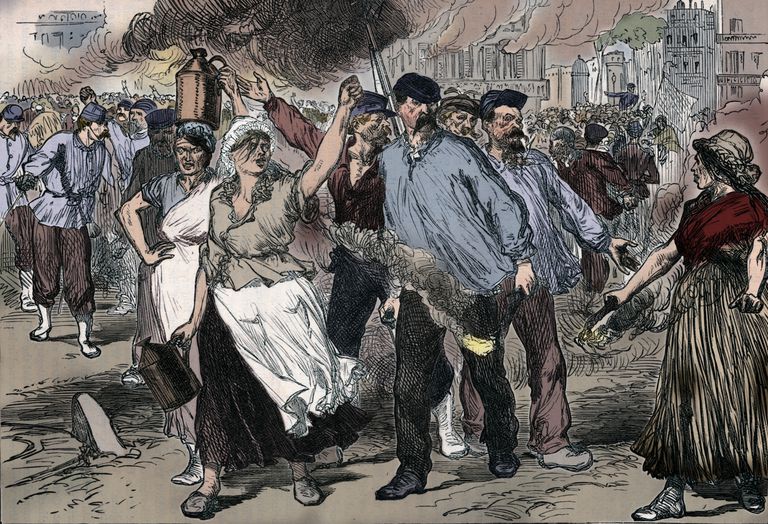
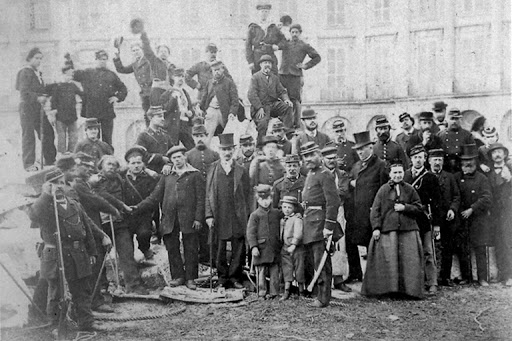
The decisive date in the history of the Commune is March 18 1871. Thiers sees the armed workers of Paris as his main obstacle to the conclusion of a peace treaty with Bismarck, and as a potential danger for the whole of bourgeois France. He decides to send ‘loyal’ battalions to remove the cannons held by the National Guard at Montmartre, Butte, Chaumont and Belleville, cannons bought by public subscription during the siege. The operation starts successfully in the early hours of the morning. After a little firing the guns at Montmartre are captured. But time passes. The operation has been bureaucratically and inefficiently planned. The necessary gun-carriages don’t arrive to remove the captured guns. The crowd begins to grow. Women, children, old people mingle with the troops . The National Guard, hastily summoned, arrives. An extraordinary confusion reigns. Some soldiers of the 88th regiment start talking to the Guard. When General Lecomte, losing his head, orders his troops to open fire, it is already too late. The soldiers refuse to fire, turn their rifle butts up, join with the people. The language of acts has been heard. Soldiers and civilians have fraternized.
But acts have a logic of their own. The soldiers have compromised themselves. They take General Lecomte as a hostage. A little late General Thomas, “the butcher of 1848”, is spotted in the crowd. Tempers mount. Both generals are shot by their own soldiers (5).
Thiers orders the withdrawal from the town of the standing Army. There is a precipitous retreat, in complete confusion, to Versailles. The major part of the civilian administration, government officials, senior officials in charge of food supplies, of the post, of lighting, of sewerage, of public assistance, of public health and of the thousand and one other aspects of life in a big city, leave Paris precipitously in the course of the next few days. An enormous social vacuum is created. Everything has to be created anew, from next to nothing, from below. And a war has to be fought at the same time.
We must dispose of the myth, which has gained much credence in the Bolshevik circles, that alone a revolutionary Party would have had the “correct answers” at such a moment. “If there had been in Paris a Party leadership”, Trotsky wrote, “it would have incorporated in the retreating armies…a hundred or a few dozen devoted workers giving them the following directives: work up the discontent of the soldiers against their officers and take advantage of the first psychologically favourable moment to break the soldiers from their officers and bring them back to Paris to unite with the people.”
Trotsky speaks with the wisdom of hindsight and somewhat distorts the real facts. Tales himself tells us that “March 18…started by the collective and anonymous action of the masses and ended in acts of individual initiative, isolated militants rallying the support of (local) committees of the National Guard.” On March 19 leading Blanquists such as Eudes and Duval “proposed an immediate march on Versailles” but their proposals “encountered no echo on the Central Committee.” A far sighted minority had a fairly clear idea of what was required. That the majority were not at stage prepared to follow their advice was a regrettable fact, but was also an objective element in the real situation. To argue that “if there had been a revolutionary Party, this or that would have followed” is like arguing that “if my aunt had…she would be my uncle.”
What of the creativity of the Commune? What were its prevailing moods and the level of consciousness of its participants? These are clearly enumerated in Engels’s 1891 introduction to Marx’s The Civil In France. We don’t apologise for reproducing the relevant passage, in full:
“On March 30 the Commune abolished conscription and the standing army, and declared the sole armed force to be the National Guard. in which all citizens capable of bearing arms were to be enrolled. It remitted all payments of rent for dwelling houses from October 1870 until April, the amounts already paid to be booked as future rent payments, and stopped all sales of articles pledged in the municipal loan office. On the same day the foreigners elected to the Commune were confirmed in office, because of “the flag of the Commune is the flag of the World Republic.” On April 1 it was decided that the highest salary to be received by any employee of the Commune, and therefore also by its members themselves, was not to exceed 6,000 francs…On the following day the Commune decreed the separation of the church from the state, and the abolition of all state payments for religious purposes as well as the transformation of all church property into national property; as a result of which, April 8, the exclusion from the school of all religious symbols, pictures, dogmas, prayers – in a word, “of all that belongs to the sphere of individual’s conscience” – was ordered and gradually put into effect. On the 5th, in reply to the shooting, day after day, of captured Commune fighters by the Versailles troops, a decree was issued for the imprisonment of hostages, but it was never carried into execution. On the 6th, the guillotine was brought out by the 137th battalion of the National Guard, and publicly burnt, amid great rejoicing. On the 12th, the Commune decided that the Viceroy Column on the Place Vendome, which had been cast from captured guns by Napoleon after the war of 1809, should be demolished as a symbol of chauvinism and incitement to national hatred. This was carried out on May 16. On April 16 it ordered a statistical tabulation of factories which had been closed down by the manufacturers, and the working out of plans for the operation of these factories by the workers formerly employed in them, who were to be organized in co-operative societies in one great union. On the 20th it abolished night work for bakers, and also the employment offices, which since the Second Empire had been run as a monopoly by creatures appointed by the police – labour exploiters of the first rank; these offices were transferred to the mayoralties of the twenty arrondissemonts of Paris. On April 30 it ordered the closing of the pawnshops, on the ground that they were the private exploitation of the workers, and were in contradiction with the right of workers to their instruments of labour and to credit. On May 5 it ordered the razing of the Chapel of Atonement, which had been built in expiation of the execution of Louis XVI.
Thus from March 18 onwards the class character of the Paris movement, which had previously been pushed into the background by the fight against the foreign invaders, emerged sharply and clearly. As almost only workers, or recognized representatives of the workers, sat in the Commune, its decisions bore a decidedly proletarian character” (Marx).
The Commune was born of the exasperation provoked by the prolonged siege of Paris and the disgust engendered by its capitulation without a fight. Nationalist or even chauvinist feeling might have been strong in the Paris of 1871. Yet the Commune “admitted all foreigners to the honour of dying for an immortal cause” and made a German working man, Leo Frankel, its Minister of Labour. It “honoured the sons of Poland by placing them at the head of the defenders of Paris” (Marx) (6).
Much has been made the advocates of the “hegemony of the Party” of the fact that few, if any, of the social measures taken by the Commune were consciously socialist ones. To accept that they were would of course deny the exclusive function of the Party, that of bringing “socialist consciousness” to the working class. What did the Communards think of their own activities? The very first proclamation of the Central Committee of the National Guard, on March 18, said: “The proletarians of Paris, amidst the failures treasons of the ruling class, have understood that the hour has struck for them to save the situation, by taking into their own hands the direction of public affairs…they have understood that it is their imperious duty and their absolute right to render themselves masters of their own destinies, by seizing upon the governmental power.” We would suggest that this reveals an extremely high degree of political consciousness, a degree which was again to be achieved by the Hungarian workers in 1956. One of the essential reasons of the degeneration of the Russian revolution was that the Russian masses were unable to sustain this degree of revolutionary consciousness for more than a few months. Under the mistaken belief that they could “leave it to the Party” which they had themselves created out of their flesh and blood, they retreated from the historical arena. The bureaucratic degeneration set in with the Party as its nucleus.
Marx himself was aware of the importance of self conscious activity. He refers to “the new era of history” which the Commune “was conscious of initiating.” The great positive achievements of the Commune were no isolated or artificial gestures, but were measures reflecting the popular will and determined by it. Tales, our “Bolshevik” historian, makes fun of the love of the masses, at the time, for what he calls “symbolic acts.” To illustrate his point he quotes the destruction of the monuments. This is because he has never understood this language of acts, through which ordinary people express themselves. When it pulled down the Vendome Column, which Marx referred to as a “colossal symbol of martial glory”, the crowd was expressing in actions the very notion which completes internationalism, namely anti-militarism.
The Meaning of the Commune
Almost every measure taken by the Commune can be explained through an understanding of the deepest daily experiences of the masses. Such was decree limiting to 6,000 francs a year the top salary paid to any member of the revolutionary government (incidentally, such a salary was in practice ever received by anyone). Such also was the decree stipulating that workshops abandoned by the employers should be taken over by then working class organizations and run by them, for the workers themselves.
These two measures were among the most characteristic taken by the Commune. Bolsheviks have argued interminably on the compensation clause. Today we realise how academic such a discussion really is. What the workers felt at the time was the importance of themselves managing production and distribution. As long as they managed what mattered indemnity to the previous owners, an indemnity whose effects would be restricted in time in time anyway? Ninety years later the Chinese bureaucracy was to discover all this anew…and in its own interests. Having bureaucratically ensured to itself the effective management of industry, it allowed itself the luxury of compensation – and even at times even of employing – the previous owners as salaried executives!
Marx was quite conscious of these deep going aspects of the Commune. “When the Paris Commune took the management of the revolution in its own hands,” he wrote, “when plain working men for the first time dared to infringe upon the governmental privilege of their ‘natural superiors’ and under the circumstances of unexampled difficulty performed their work modestly, conscientiously and efficiently…the old world writhed in convulsions of rage at the sight of the Red Flag, the symbol of the Republic of Labour, floating over the Hotel de Ville.” The distance separating this evaluation of the role of the Commune and that of Trotsky who saw the “only lesson” of the Commune to be the need for “a strong Party leadership” could hardly be greater!
As for the strivings of the Commune towards an equalization of wages, and its demands for the eligibility and revocability of all representatives, they reflect a fundamental preoccupation with the question of destroying at its very roots the hierarchical organization of society.
Since then much has been written and said about “soviets” and “workers councils.” But it would seem the real nature of these new forms of social life has been forgotten by those who stand in admiration before their bureaucratic caricatures. Discussing the Commune Marx wrote:
“Instead of deciding once in three or six years which member of the ruling class was to misrepresent the People in Parliament, universal suffrage was to serve the people, constituted in Communes, as individual suffrage serves every other employer in the search for workmen and managers in their business. And it is well known that companies, like individuals, in matters of real business generally know how to put the right man in the right place, and, if they for once make a mistake, to redress it promptly…Nothing could be more foreign to the spirit of the Commune than to supersede universal suffrage by hierarchic investiture” (Marx).
“Hierarchic investiture!” Here is the hub of the whole problem. How is the hierarchical structure of society to be destroyed and superseded? The Commune showed in its acts how this was to be done. At all levels, all functionaries and officials were to be elected. And all were to be removable by those who elected them!
Direct election and immediate revocability are clearly not panaceas for the solution of all problems. But in themselves they carry the seed for the most profound transformation of society. An officer or a magistrate whom one elects and whom one controls at all times is already no longer fully an officer or a magistrate. This is the yardstick by which one can begin to measure the “withering away of the state.” The real content of this withering away is precisely the progressive elimination of hierarchical investiture and of hierarchical institutions.
Engels was quite emphatic on this question. Again referring to the Commune he stated “the working class must…safeguard itself against its own deputies and officials, by declaring them all, without exception subject to recall at any moment” (our emphasis).
There has been much misunderstanding about the significance of the “communal” regime, some of it patently dishonest. Thus Trotsky, correctly criticizing some of the leaders of the Commune, could give vent to his sarcasm: “Paris, you see, is but one commune among many others. Paris does not wish to impose anything on anyone. Paris dos not struggle for anything other than the ‘dictatorship of example.'” But he continues quite wrongly: “The Commune was but an attempt to replace the developing proletarian revolution with by a petty-bourgeois reform: communal autonomy. This idealist chatter, of the type indulged by parlour anarchists, was in reality a cover for cowardice when confronted with revolutionary action which needed to be carried out ceaselessly and to the end…” (7). Marx had seen deeper than this. He pointed out that the Commune had (already in May 1871!) been subjected to a “multiplicity of interpretations” but that its essential features were that it was “a working class government” and “a thoroughly expansive political form, while all previous forms of government had been emphatically repressive.”
The most significant aspect, however, of the Paris Commune is that it created social forms which in a sense define socialism itself, social forms which serve as yardsticks for proletarian revolutions passed, present and to come. These forms provide criteria for analyzing the social nature of any particular regime. Nearly a century later, societies can still be looked at according to the categories established by the Paris Commune. And it is most revealing how clearly things fall into proper perspective when one confronts the Russian and Chinese realities of today with the first, short, hesitant experience in 1871 of a genuinely proletarian revolution and of genuine working class power.
Paris 1871-Hungary 1956
The Hungarian Revolution of 1956 is seen in a completely new light when looked at with the experience of 1871 in mind.
There are both superficial and deep analogies. The central facts of the Hungarian revolution were firstly the active participation of the masses and secondly the anti-bureaucratic and anti-hierarchical of the most spontaneous and deepest going demands of the working class, demands which emerged more and more clearly as the Workers Councils became the sole revolutionary force, in the later stages of the struggle.
In the first stages of both revolutions one sees the civilian crowds, women, children, old people massively erupt on to the scene. Their total participation paralyzes for a while the intervention of the enemy. In both revolutions temporary conditions exist for genuine fraternization.
The Hungarian workers in 1956 immediately put forward demands for workers’ management of the factory, for a drastic reduction in the wage differential and for the abolition of piece rates. Like the Parisians they get straight down to the essentials. Managers are elected and subjected to continuous, direct control. It matters less, in this respect, that a number of the previous managers were re-elected. What is essential is the radical transformation of all existing relations between men.
On a more tragic plane, in their fate each revolution resembles one another. In both cases it is a desperate, bitter struggle, fought out street by street, to the last drop of blood, without compromise, without submission, as only men can fight who know what they are fighting for and who have themselves determined the objectives of their struggle. Despite military defeat, which the revolutionaries in both circumstances came to see as more or less inevitable, it was a timeless ideal they fought for, an ideal to be defended unconditionally, in a fight in which inevitable death was almost welcomed as a release.
In both revolutions the threatened classes resorted to bloody repression. This was done with the calculated ferocity which ruling classes resort to when their most fundamental prerogative is threatened, namely their right to rule. The iron fist then emerges from the velvet glove. Class society reveals itself in its true colours – as the perpetual, systematized, organization of violence by the minority against the immense majority. That Thiers was “more liberal” than Napoleon III is about as relevant in this respect as the fact that Khruschev was “more liberal” than Stalin.
During both civil wars moreover, bystanders stood cynically on the side lines (Bismarck and Eisenhower) protesting at the use of so much violence, and forgetting that this class violence was but an image of their own.
The tragic defeat of the Hungarian revolution, like the tragic defeat of the Paris Commune, both call for reflection. Their lessons are innumerable. The need for an efficient co-ordination and for an organization capable of ensuring it should be obvious to all. But what kind of organization? How is it to be evolved? What are its relationships to the masses? This is the whole question. When we speak of organization we mean an organization evolved through struggles by the communes, by the soviets, by the workers councils themselves.
In his preface to the book by Tales, mentioned at the beginning, Trotsky wrote:
“Before the broad masses of the soldiers can acquire the experience of well choosing and selecting commanders, the revolution will be beaten by the enemy, who is guided in the choice of his commanders by the experience of centuries. The methods of amorphous democracy (simple eligibility) must be supplemented and to a certain degree replaced by measures of selection from above. The revolution must create an organ composed of experienced, reliable organizers in which one (8) can have absolute confidence, and give it full powers to choose, designate and educate the command” (Trotsky).
In this last quotation from Trotsky two little words epitomise, in a way, the whole subsequent degeneration of the great proletarian revolution of 1917: the words “from above.” No one denies the need for selection, particularly in so crucial a field as the field of armed struggle, to which the whole fate of the revolution is tied. Obviously the command must be selected. Training, aptitudes, experiences vary enormously. The proletarian heritage is heterogenous in the extreme. But is a question of selection from below.
Selection from above has a remarkable tendency to transform itself from the exception to the rule. it is carried over by its own momentum, from wartime into peace time. It spreads from the regiment into the factory. from the barracks it invades the factories involved in war work and the workers councils themselves. From the military “High Command” it takes a brisk step into the “High Command” of the Party. It becomes systematized. It becomes the “hierarchic investiture” of which Marx spoke and which is one of the essential features of all class society. And as the principle proceeds on its way the masses soon retreat from the historical arena, leaving it to others who “are more efficient”, who “know better”, to act “on their behalf.” The degeneration has begun. The seeds of the Stalinist regime are sown: the co-option of the bureaucracy by the bureaucracy itself. Engels was almost prophetic in his foresight when he insisted that “all officials, without exception, must be subject to recall at any moment.”
A new generation of young revolutionaries must now seriously turn the lessons of the Paris Commune and the lessons of the great contemporary analogue, the Hungarian Revolution of 1956. Scattered, misinterpreted, deliberately misused for ends that are not the ends of the Revolution, the basic documents of both are to be found by those wishing to find them (9). They should be studied. Both revolutions are of fundamental importance to the socialist movement, and to an understanding of the class struggle in our epoch.
SOLIDARITY, 1, 6, (May 1961).
NOTES
(1) C. Tales La Commune de 1871 (Paris: Libraire du Travail, 1924).
(2) Engels introduction to Marx’s The Civil War In France (1872).
(3) “In 1886, at the apogee of Parisian expansion in this period, the total population was 1,825,274. There were 570,280 workshops (as against 64,816 in 1847 and 101,171 in 1860), owned by 65,987 masters, employing only 442,310 workers (besides 34,846 clerks and 23,251 servants). This meant that the average number of workers per shop was only 7.7 sinking from 13 in the building and metal trades to 1.4 in the food industry. By far the largest number were employed in the garment industry: 306,567 (208,675 women); and building owing to Baron Haussmann’s reconstruction of the capital, employed most men, 125,371 (63,675 women); and the various luxury industries, upon which the repute and prosperity of Paris mainly depended, employed 63,617 workers. In all, workers (468,337) and their dependents (286,670) made up about 40 per cent of the population of Paris” (F. Jellinek, The Paris Commune of 1871 (London: Gollancz, 1937).
(4) The idea revolutionary theory is something static, enshrined once and for all in the writings of the four great teachers, something to be derived from the study of books, and the idea that socialist consciousness has to be brought to the proletariat ‘from outside’ (Lenin) by the bourgeois intelligentsia, which is the “vehicle of science” (Kautsky), are both profoundly reactionary and profoundly anti-dialectical, in the deepest sense of the term.
(5) As Marx so clearly put it: “the inveterate habits acquired by the soldiery under the training of the enemies of the working class, are not of course likely to change, the very moment these soldiers change sides.”
(6) Dombrowski and Wroblewski.
(7) Trotsky’s introduction to Tales La Commune de 1871.
(8) Who is this anonymous and mysterious “one”? Who is to bestow “absolute confidence” in the revolutionary organ and the revolutionary organizers? Is it the masses? Is it the Party “acting in the interests of the masses”? Is it the Party leaders “acting in the interests of the Party” as a whole? Is Trotsky’s ambiguity on this point entirely accidental?
(9) See R.W. Postgate Revolution From 1789-1906 (London 1920) and Socialisme ou Barbarie Vol IV, Nos 20 and 21.
___________________________________________
Paths And Bridges Afterword 2021 /// Commune At 150
Only a few words of brief commentary are necessary here. Firstly Brinton and Guillaume’s account of the Paris Commune leans heavily on Marx and Engels for its appreciation of the Commune’s historic significance. Solidarity was only months old when this joint article appeared and the group was yet to ditch Marxism for full fledged libertarian socialism. Not that repudiating Marxism inevitably meant casting Marx aside in his entirety. It was Marx after all who famously declared he was not a Marxist as Marxists of many different hues remind us ad nauseam without quite taking Marx at his word.
Despite our authors ‘enthusiasm’ for Marx aspects of the latter’s analysis and role are overlooked. Marx and Engels were superior observers of the Commune than Trotsky and the Third International (as Brinton and Guillaume show all the resources of half a century of scholarship didn’t immunise Trotsky against offering anachronistic banalities such as the ‘fateful’ absence of centralised revolutionary party). But Marx and Engels were also active in trying to build solidarity and support for the Commune and influence its leaders during its existence. From England they both communicated with leading figures in the Commune like Leo Frankel and Louis Varlin.
Marx and Engels pushed the IWMA’s General Council to embrace the Commune and take a lead in organising solidarity in Europe and North America during its short life and to organise aid to refugees fleeing the vengeful bloodletting when the Commune was crushed. The IWMA’s GC issued a number of addresses against the Franco-Prussian war, appealing to proletarian internationalism and for fraternization among French and German workers. Over the months various GC addresses appeared in the in British newspapers and the press in Geneva, Zurich, Augsburg, Vienna and New York. Letters urging support for the Commune were also sent to various prominent public figures like Thomas Huxley and John Stuart Mill.
But it’s Marx’s political judgements about the Commune that are best known and these can be reduced to two related conclusions: firstly, the Commune was the first historical instance of the political rule of the working class and, secondly, the Commune marked a new historical era when the revolution would no longer aim to lay hold of, or perfect the bureaucratic state machine but instead break it up and replace it with political forms that were more democratic because they went beyond representative democracy. There is no space to explore the fate of this idea in the classical workers movement, what it meant in practical terms or whether it was viable other than note the idea of breaking up the existing bureaucratic state machine would not be fully articulated again until 1912 when Karl Kautsky (the leading intellectual authority of Marxism and the German SPD) defended the primacy of the SPD’s parliamentary path to power against Anton Pannekoek who appealed to Marx’s Commune lessons to underline his own case that aspiring to take over the state machine or waiting to achieve a parliamentary majority without mass strikes and the maximum mobilisation of workers, was a fatalist recipe that could only result in defeat of the workers movement. Clearly we – and the contemporary revolution – are distant from such strategic arguments conducted in a world that is long gone.
So Marx considered the Commune to be a harbinger of the ‘Social Republic’ – its “true Secret” despite a “multiplicity of interests” claiming it for their own, was that it was at heart a “working class government.” Marx observed the revolution did not always take place in ideal circumstances. The violence the Commune attracted from the camp of reaction could never be an argument against revolution or embarking on struggle despite the danger of reprisals. This is an argument that resonates today in our social universe if we recall the counter-revolutionary headwinds faced by the ‘Arab Spring’ since 2011 especially in Syria or the great odds oppositions face challenging powerfully entrenched authoritarianism like Belarus or Myanmar where the sheer murderous scale of the violence the state can unleash, greatly hampers social rebellion, feeding the phenomena of the arrested revolution where the potential space for grassroots or participatory democracy to appear, is severely curtailed. In an age where revolution has long lost its elan and global apocalypse is easier to imagine than progressive social transformation, repression renders it even more difficult for revolution to fully announce itself or reflexively set out goals or articulate a vision.
Finally, the Commune might be an unexpected model in our age – or at least aspects of the Commune if not Marx’s ‘Social Republic’ – where the socialist goal has disappeared with the eclipse of the traditional workers movement but rebellions and revolutions which ‘perplex’ the traditional left, still miraculously occur. That they do so is in no way a vindication of Marxism but does throw up many questions for social movements and radical politics. These are are just some of the themes Paths and Bridges visits in a forthcoming post Is The Revolution Dead?
18 March 2021