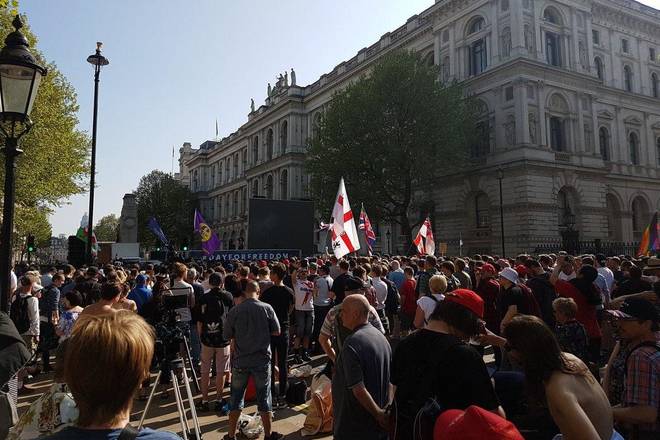
The recent ‘Day for Freedom’ rally in Whitehall may mark a qualitative change in far-right politics in Britain. Under the banner of ‘protecting free speech’, the rally drew a crowd consisting of more than the football hooligans and drunken racists that have been the mainstay of far-right street politics in Britain over the last decade. Somewhere between 2000-4000 people may have been present at the event – which was addressed by various ‘alt-right’ internet personalities, UKIP leader Gerard Batten and ‘headlined’ by former EDL leader ‘Tommy Robinson’.
Ostensibly a protest against the ‘political correctness’ of those that wish to censor criticism of Islam and denigrate ‘white Christian culture’. The participant quoted in The Guardian who also mentioned ‘cultural Marxism’ was closer to giving the game away. When political life in the UK is log-jammed by the commitment of both major parties to a patently irrational withdrawal from the EU in fidelity to a referendum based on lies, shamefaced misinformation and imperial nostalgia, it isn’t altogether surprising that the far-right is getting a shot in the arm. I would argue that both Brexit and the modern far-right in Europe exemplify the same phenomenon – ‘the politics of fantasy’ (a term coined by Carl Schorske1).
‘Robinson’, also quoted in The Guardian, claimed “The people of this country have been silenced for 20-30 years with the tag of racists. They have managed to silence people so that they are too scared to speak up when they see things that are wrong.” It’s a curious argument when the disgustingly Islamophobic and racist Daily Mail, Express, Sun and Star newspapers are available in every high street in the country – plus the most racist government in years deporting people in flagrant breach of the law.
The event was supported and promoted by RT (formerly Russia Today), the Kremlin’s English language news channel which specializes in disinformation and apologia for Russian state war crimes as well as those of its allies (particularly the Syrian Regime’s genocidal war on its own population). RT itself mixes unconvincing polemics against neoliberalism with hard right ‘analysis’ that promotes conspiracy theories and justifies the Kremlin’s expansionism as a response to Western Imperialism.
In Europe, the Russian state’s policy, outside of states that are available for ‘capture’ like Bulgaria and Greece2, is not so much the promotion of itself as a civilisational vanguard or even a maligned actor but the destabilisation of liberal democracy. For instance, (just to give a few examples) from funding parties such as the French National Front and Hungary’s Jobbik to the despicably cynical stirring up of religious and ethnic animosities in Bosnia and Herzegovina, the aim is contributing to the hollowing out of democratic values through the spread of misinformation and ethnic nationalism.
The fascist Generation Identity group were apparently present at the Whitehall rally. According to The Intercept they are “a far-right youth movement that originated in France, campaigns against what it calls the “great replacement” – a theory that white European countries are going to be taken over by Muslim migrants. According to the group, “Islamic parallel societies” and mass immigration will lead to “the almost complete destruction of European societies within just a few decades if no countermeasures are taken.”
Repackaging fascist ideas in the language of civilisational struggle against Muslims is a strategy of various ‘post-fascist’ hard right electoral parties across Europe. With its clean-cut image, Generation Identity is trying to do the same with a pan (white) European fascist street politics. That Muslim immigration to Europe has been driven by the outcomes of European colonialism in the past or by the violence of post-colonial states in the present is neither here nor there, neither is the fact that Muslims remain subject to state harassment and oppression across the continent – this ‘politics of fantasy’ has to project that situation in reverse in order suggest a highly libidinised spectacle of Majority victimhood.
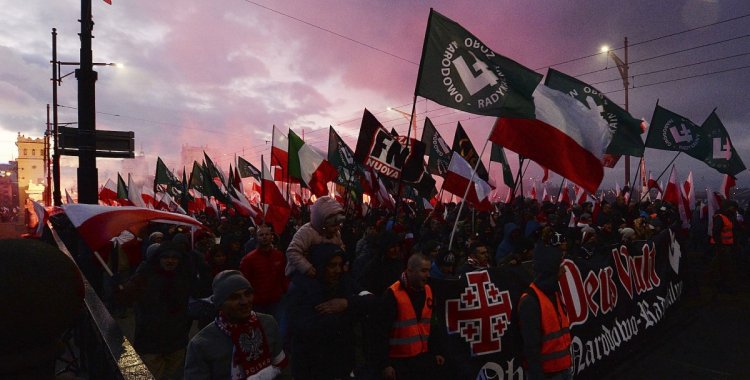
Warsaw: 60,000 people participated in a demonstration against Islam and refugees in November 2017
Prevalent in all these arguments, whether fascist or nationalist and populist (like Brexit), is the idea that a weak-willed, blind or treacherous elite are allowing ‘the nation’ be destroyed by immigration and foreigners. Similarly, a minority but politically influential civil society (liberals and the left) which apparently favours foreigners over the ‘indigenous’ culture (Britishness, Englishness, whiteness) are a fifth column within ‘the nation’. This is ‘the politics of fantasy’ in Britain today.
Peter Homans, in his fantastic book on the origins of psychoanalysis3, draws on both the Amercian psychiatrist Robert Lifton4 and the German psychoanalyst (and member of the medical commision at the Nuremberg trials) Alexander Mitscherlich’s work5 on Nazism to suggest that for the Nazis – unlike the psychoanalytical movement which faced up to it in a depth psychological way – the loss of a (at least partially fictive) common culture of the past with the advent of modernity was considered so psychologically painful because it suggested the irreversible loss of a genuine place in the world that could neither be mourned or accepted. Instead, we find a rejection of reality and the projection of a delusional fantasy which blames some (inevitably racialised) ‘other’ for the ‘loss’.
Homans is worth quoting at length
“…by denying the painful psychological consequences of the social and historical changes that were taking place – in other words by refusing to mourn – the German Nazis became intolerant of chaos. Instead they sort to reinvent with great rapidity and astonishing creativity a total common culture in which a sacred symbolic structure overcame time, the sense of transience and diachrony… For them, the manic defence and persecutory activity successfully energised a new cosmology which abolished the ability to mourn and what I would call “the ability to be depressed.” It was if they had said, There has been no loss at all.”6
The persecution then later murder of the Jews while embarking in a total war for land and resources became the starting point for a fantasy future with a newly secure and righteous place in the world for the men and women who became the movement behind Hitler and his close subordinates. It was a venture to remake the world in the image of their own fantasy projection when the ‘loss’ of their own paramount place in the world was too painful to face. Janine Chasseguet-Smirgel wrote7 about how totalitarian regimes abolition of otherness – racial minorities especially – leaned on a desire to recapture the perfection of pre-oedipal life, with just the mother-child dyad standing for all reality. It is important to note here that while the fantasy of a ‘pure’, ‘clean’ and undifferentiated country may lean on the universal desire to return to dyad (or womb), this in no way mitigates the actions of racists and fascists. The fundamental fact of their hatred and inhumanity cannot be excused by this. Indeed, it is that a universal wish finds itself expressed in this way that designates fascists and fascist ideologies as special dangers to society. This same wish in mediated form has often been expressed in art, music and in political struggles for equality. All this proves is that human beings do need to feel at home in the world or else develop psychological frameworks for dealing with the groundlessness of modernity (Jan Assman has suggested that development of monotheism and the associated articulation of transcendental and mundane orders that replaced cosmotheism in the Axial Age was a similar sort of historical shift from one way of being in the world to another8).
While a squalid shitshow like Brexit or a racist hooligan mob in London seem a bit of a bathetic comparison to the baroque evil of the National Socialists, it is important to appreciate that the imperial nostalgia of Brexit and British fascists does ultimately rest on the desire to dominate and control others. It is not ‘freedom of speech’ wished for here but freedom from free speech, from hearing the reality of the modern world, different tongues, different accents and those of us who have an open attitude to a new historical situation where identity is not determined in a heteronomous manner but is mediated and informed – at least partially – by the autonomy of the person. Real freedom means being an autonomous subject that can fight for the values one believes in while dealing with disappointment. What Brexiteers and the fascists want (no matter how they might differ in other ways) is freedom for their delusional fantasy of domination, closure, separation, and national-racial superiority. It’s the fear of the condition of modernity – that we live in a groundless world not a sacred or determined order – that motivates them.
Whether by constitutional means or otherwise they wish to have their investment in this fantasy endorsed and legitimised. Whether its a white Britain where the British were a ‘people-as-one’ (in the sense used by Claude Lefort) or a reinvestment in the most backward ideologies of the past – empire, conquest, and domination – their quest of hatred is a quest for place and meaning. Across the world, we see a similar phenomenon, white Americans voting Trump out of a nostalgia for a time when blacks were passive victims or the curious phenomena of right-wing populists in Eastern Europe wistfully looking back at the Stalinist monoculture.
I would argue at the current juncture the rise of a fascist street movement in Britain that unites genuine neo-nazis with the racist hooligans of the former EDL is a bigger danger than the post-fascist populism of the electoral type seen on the continent. This is because the thing that the EDL and its associated splinters were lacking was ideological clarity and an effective centre (essentially leadership). It’s clear from the Whitehall rally the online savvy ‘alt-right’ and neo-fascists like Generation Identity are making a genuine attempt to capture this street movement. This must not happen.
The most effective recruiting grounds are the Brexit heartlands – as anyone who knows them the de-industrialised smaller towns and decaying monocultural seaside resorts are ripe for a right-wing social movement that would allow the psychic boredom, hatred, and lust for violence of white men to merge into something greater, more powerful and find that ‘place in the world’ that their desperate fantasies are about. Mass politics is always a question of psychological merger, where the isolated and alienated individual can find a social whole that transcends unpleasant individual circumstances and makes identity a group phenomenon.
This has to be countered on the streets with a vision of freedom that promotes individuality, freedom, diversity, and love. This cannot be a bureaucratic movement but a democratic one that will work through its difficulties in public in meetings and demonstrations. The politics of fantasy is a result of the failure of introspection. Where it is too painful to come to terms with the mess of our own lives and the way we have been thrown into the world in often extremely difficult circumstances. Psychoanalytic theory, as a hermeneutics of love, can be helpful here. To renounce preeminence, to be just another – no better or worse than anyone else. To value oneself as a subject striving to grow wiser. To value the opinions of other individuals and groups. To identify with groups but hold off – to the extent it is ever possible – complete psychological merger. All these things are an important means of creating an anti-racist and anti-fascist politics.
Thinking of fascism and right-wing populism as the politics of fantasy is useful. Liberal and Marxist accounts of these phenomena fail because they cannot grasp the radically non-functional nature of fascism, which finds its power in the space between the internal world of the individual and the social world of reality proper. The politics of love that counters the politics of hatred is one where we are together for each other not as ‘us’ against the world of others but as ‘us’ in a world of otherness. Mourning our lost preeminence (the pre-oedipal) and facing a world where our own societies, identities, and futures are an undetermined ‘open book of the essential powers of man’ if in that phrase we can decouple Marx’s radical humanism from his communism and economic-functionalist view of wo/man and history. That is the politics of freedom.
by Joseph Aylmer
Notes
1 Carl Schorske, Fin-de-siècle Vienna (1979)
2 Mark Galeotti, Controlling Chaos: How Russia manages its political war in Europe (2017)
3 Peter Homans, The Ability to Mourn: Disillusionment and the Social Origins of Psychoanalysis (1989)
4 Robert Lifton, The Nazi Doctors: Medical Killing and the Psychology of Genocide (1986)
5 Alexander Mitscherlich & Margarete Mitscherlich, The Inability to Mourn (1984)
6 Homans, ibid
7 Janine Chasseguet-Smirgel, The Archaic Matrix of the Oedipus Complex in Utopia (1986)
8 Jan Assmann, The Price of Monotheism (2010)


Pingback: Escape From Brexit Island | Paths & Bridges