Fascism, Populism, Nationalism, Closure and ‘the Politics of Fantasy’

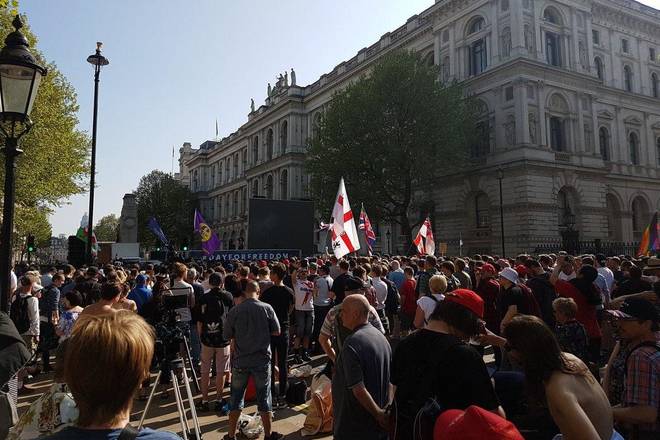
day-for-freedom-march

The recent ‘Day for Freedom’ rally in Whitehall may mark a qualitative change in far-right politics in Britain. Under the banner of ‘protecting free speech’, the rally drew a crowd consisting of more than the football hooligans and drunken racists that have been the mainstay of far-right street politics in Britain over the last decade. Somewhere between 2000-4000 people may have been present at the event – which was addressed by various ‘alt-right’ internet personalities, UKIP leader Gerard Batten and ‘headlined’ by former EDL leader ‘Tommy Robinson’.

Ostensibly a protest against the ‘political correctness’ of those that wish to censor criticism of Islam and denigrate ‘white Christian culture’. The participant quoted in The Guardian who also mentioned ‘cultural Marxism’ was closer to giving the game away. When political life in the UK is log-jammed by the commitment of both major parties to a patently irrational withdrawal from the EU in fidelity to a referendum based on lies, shamefaced misinformation and imperial nostalgia, it isn’t altogether surprising that the far-right is getting a shot in the arm. I would argue that both Brexit and the modern far-right in Europe exemplify the same phenomenon – ‘the politics of fantasy’ (a term coined by Carl Schorske1).

‘Robinson’, also quoted in The Guardian, claimed “The people of this country have been silenced for 20-30 years with the tag of racists. They have managed to silence people so that they are too scared to speak up when they see things that are wrong.” It’s a curious argument when the disgustingly Islamophobic and racist Daily Mail, Express, Sun and Star newspapers are available in every high street in the country – plus the most racist government in years deporting people in flagrant breach of the law.

The event was supported and promoted by RT (formerly Russia Today), the Kremlin’s English language news channel which specializes in disinformation and apologia for Russian state war crimes as well as those of its allies (particularly the Syrian Regime’s genocidal war on its own population). RT itself mixes unconvincing polemics against neoliberalism with hard right ‘analysis’ that promotes conspiracy theories and justifies the Kremlin’s expansionism as a response to Western Imperialism.

In Europe, the Russian state’s policy, outside of states that are available for ‘capture’ like Bulgaria and Greece2, is not so much the promotion of itself as a civilisational vanguard or even a maligned actor but the destabilisation of liberal democracy. For instance, (just to give a few examples) from funding parties such as the French National Front and Hungary’s Jobbik to the despicably cynical stirring up of religious and ethnic animosities in Bosnia and Herzegovina, the aim is contributing to the hollowing out of democratic values through the spread of misinformation and ethnic nationalism.

The fascist Generation Identity group were apparently present at the Whitehall rally. According to The Intercept they are “a far-right youth movement that originated in France, campaigns against what it calls the “great replacement” – a theory that white European countries are going to be taken over by Muslim migrants. According to the group, “Islamic parallel societies” and mass immigration will lead to “the almost complete destruction of European societies within just a few decades if no countermeasures are taken.”

Repackaging fascist ideas in the language of civilisational struggle against Muslims is a strategy of various ‘post-fascist’ hard right electoral parties across Europe. With its clean-cut image, Generation Identity is trying to do the same with a pan (white) European fascist street politics. That Muslim immigration to Europe has been driven by the outcomes of European colonialism in the past or by the violence of post-colonial states in the present is neither here nor there, neither is the fact that Muslims remain subject to state harassment and oppression across the continent  – this ‘politics of fantasy’ has to project that situation in reverse in order suggest a highly libidinised spectacle of Majority victimhood.
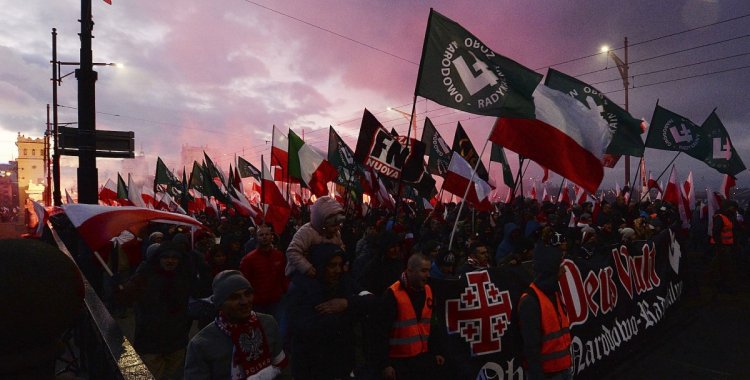
nationalism-has-been-strong-in-poland-for-centuries-and-especially-since-the-fall-of-communism-in-the-country-in-1989-catholicis.jpg

Warsaw: 60,000 people participated in a demonstration against Islam and refugees in November 2017

Prevalent in all these arguments, whether fascist or nationalist and populist (like Brexit), is the idea that a weak-willed, blind or treacherous elite are allowing ‘the nation’ be destroyed by immigration and foreigners. Similarly, a minority but politically influential civil society (liberals and the left) which apparently favours foreigners over the ‘indigenous’ culture (Britishness, Englishness, whiteness) are a fifth column within ‘the nation’. This is ‘the politics of fantasy’ in Britain today.

Peter Homans, in his fantastic book on the origins of psychoanalysis3, draws on both the Amercian psychiatrist Robert Lifton4 and the German psychoanalyst (and member of the medical commision at the Nuremberg trials) Alexander Mitscherlich’s work5 on Nazism to suggest that for the Nazis – unlike the psychoanalytical movement which faced up to it in a depth psychological way – the loss of a (at least partially fictive) common culture of the past with the advent of modernity was considered so psychologically painful because it suggested the irreversible loss of a genuine place in the world that could neither be mourned or accepted. Instead, we find a rejection of reality and the projection of a delusional fantasy which blames some (inevitably racialised) ‘other’ for the ‘loss’.

Homans is worth quoting at length

“…by denying the painful psychological consequences of the social and historical changes that were taking place – in other words by refusing to mourn – the German Nazis became intolerant of chaos. Instead they sort to reinvent with great rapidity and astonishing creativity a total common culture in which a sacred symbolic structure overcame time, the sense of transience and diachrony… For them, the manic defence and persecutory activity successfully energised a new cosmology which abolished the ability to mourn and what I would call “the ability to be depressed.” It was if they had said, There has been no loss at all.”6

The persecution then later murder of the Jews while embarking in a total war for land and resources became the starting point for a fantasy future with a newly secure and righteous place in the world for the men and women who became the movement behind Hitler and his close subordinates. It was a venture to remake the world in the image of their own fantasy projection when the ‘loss’ of their own paramount place in the world was too painful to face. Janine Chasseguet-Smirgel wrote7 about how totalitarian regimes abolition of otherness – racial minorities especially – leaned on a desire to recapture the perfection of pre-oedipal life, with just the mother-child dyad standing for all reality. It is important to note here that while the fantasy of a ‘pure’, ‘clean’ and undifferentiated country may lean on the universal desire to return to dyad (or womb), this in no way mitigates the actions of racists and fascists. The fundamental fact of their hatred and inhumanity cannot be excused by this. Indeed, it is that a universal wish finds itself expressed in this way that designates fascists and fascist ideologies as special dangers to society. This same wish in mediated form has often been expressed in art, music and in political struggles for equality. All this proves is that human beings do need to feel at home in the world or else develop psychological frameworks for dealing with the groundlessness of modernity (Jan Assman has suggested that development of monotheism and the associated articulation of transcendental and mundane orders that replaced cosmotheism in the Axial Age was a similar sort of historical shift from one way of being in the world to another8).

While a squalid shitshow like Brexit or a racist hooligan mob in London seem a bit of a bathetic comparison to the baroque evil of the National Socialists, it is important to appreciate that the imperial nostalgia of Brexit and British fascists does ultimately rest on the desire to dominate and control others. It is not ‘freedom of speech’ wished for here but freedom from free speech, from hearing the reality of the modern world, different tongues, different accents and those of us who have an open attitude to a new historical situation where identity is not determined in a heteronomous manner but is mediated and informed – at least partially – by the autonomy of the person. Real freedom means being an autonomous subject that can fight for the values one believes in while dealing with disappointment. What Brexiteers and the fascists want (no matter how they might differ in other ways) is freedom for their delusional fantasy of domination, closure, separation, and national-racial superiority. It’s the fear of the condition of modernity – that we live in a groundless world not a sacred or determined order – that motivates them.

Whether by constitutional means or otherwise they wish to have their investment in this fantasy endorsed and legitimised. Whether its a white Britain where the British were a ‘people-as-one’ (in the sense used by Claude Lefort) or a reinvestment in the most backward ideologies of the past – empire, conquest, and domination – their quest of hatred is a quest for place and meaning. Across the world, we see a similar phenomenon, white Americans voting Trump out of a nostalgia for a time when blacks were passive victims or the curious phenomena of right-wing populists in Eastern Europe wistfully looking back at the Stalinist monoculture.

I would argue at the current juncture the rise of a fascist street movement in Britain that unites genuine neo-nazis with the racist hooligans of the former EDL is a bigger danger than the post-fascist populism of the electoral type seen on the continent. This is because the thing that the EDL and its associated splinters were lacking was ideological clarity and an effective centre (essentially leadership). It’s clear from the Whitehall rally the online savvy ‘alt-right’ and neo-fascists like Generation Identity are making a genuine attempt to capture this street movement. This must not happen.

The most effective recruiting grounds are the Brexit heartlands – as anyone who knows them the de-industrialised smaller towns and decaying monocultural seaside resorts are ripe for a right-wing social movement that would allow the psychic boredom, hatred, and lust for violence of white men to merge into something greater, more powerful and find that ‘place in the world’ that their desperate fantasies are about. Mass politics is always a question of psychological merger, where the isolated and alienated individual can find a social whole that transcends unpleasant individual circumstances and makes identity a group phenomenon.

This has to be countered on the streets with a vision of freedom that promotes individuality, freedom, diversity, and love. This cannot be a bureaucratic movement but a democratic one that will work through its difficulties in public in meetings and demonstrations. The politics of fantasy is a result of the failure of introspection. Where it is too painful to come to terms with the mess of our own lives and the way we have been thrown into the world in often extremely difficult circumstances. Psychoanalytic theory, as a hermeneutics of love, can be helpful here. To renounce preeminence, to be just another – no better or worse than anyone else. To value oneself as a subject striving to grow wiser. To value the opinions of other individuals and groups. To identify with groups but hold off – to the extent it is ever possible – complete psychological merger. All these things are an important means of creating an anti-racist and anti-fascist politics.

Thinking of fascism and right-wing populism as the politics of fantasy is useful. Liberal and Marxist accounts of these phenomena fail because they cannot grasp the radically non-functional nature of fascism, which finds its power in the space between the internal world of the individual and the social world of reality proper. The politics of love that counters the politics of hatred is one where we are together for each other not as ‘us’ against the world of others but as ‘us’ in a world of otherness. Mourning our lost preeminence (the pre-oedipal) and facing a world where our own societies, identities, and futures are an undetermined ‘open book of the essential powers of man’ if in that phrase we can decouple Marx’s radical humanism from his communism and economic-functionalist view of wo/man and history. That is the politics of freedom.

by Joseph Aylmer

Notes

1 Carl Schorske,  Fin-de-siècle Vienna (1979)

2 Mark Galeotti, Controlling Chaos: How Russia manages its political war in Europe (2017)

3 Peter Homans, The Ability to Mourn: Disillusionment and the Social Origins of Psychoanalysis (1989)

4 Robert Lifton, The Nazi Doctors: Medical Killing and the Psychology of Genocide (1986)

5 Alexander Mitscherlich & Margarete Mitscherlich, The Inability to Mourn (1984)

6 Homans, ibid

7 Janine Chasseguet-Smirgel, The Archaic Matrix of the Oedipus Complex in Utopia (1986)

8 Jan Assmann, The Price of Monotheism (2010) 

Some Remarks on Hannah Arendt’s On Violence In the Age of the Syrian Revolution and Counter-Revolution


Prado_-_Los_Desastres_de_la_Guerra_-_No._03_-_Lo_mismo

Lo Miasmo, from The Disasters of War by Francisco Goya

I

Much can be gleaned revisiting Hannah Arendt’s ‘On Violence’ (1970), both about Arendt’s intellectual journey – it is very much an extended footnote to the earlier ‘On Revolution’ (1962) – and her opinion on a variety of topics that retains some value in our global moment today especially after the Arab Spring and the Syrian revolution. The latter has ground on now for seven years while the most frightful counter-revolution unleashed by Bashar al-Assad and his allies, appears on the threshold of triumph. Below we touch on Syria and briefly explore Yassin al-Haj Saleh’s commentary in his important work ‘The Impossible Revolution: The Tragedy of the Syrian Revolution’ (2017) that traced the parabola of revolution and counter-revolution, especially Saleh’s novel use of Thomas Hobbes concept of the ‘state of nature’ (1).

‘On Violence’ (1970) was a coda to Arendt’s thinking about the relation between organized violence (war, revolution) and politics. Its backdrop was the glacial stasis of the Cold War, the nuclear arms race and the US’s changing geopolitical status from young revolutionary Republic to imperialist colossus bestriding the globe. The more immediate backdrop was provided by the revolutionary nationalist struggles in the Third World and its echo in Europe and North America with the New Left radicalism and the non-violent civil rights movement that shortly metamorphosed into Black Power as the ghettos of the US northern cities combusted.


Arendt acknowledged Lenin’s prognosis the C20th would be the epoch of wars and revolutions but with one fateful proviso: the technological development of the means of destruction had reached such a point that achieving political goals by violence (for example, inter-state war) was fraught with danger. Arendt was apprehensive about the Cold War, the arms race and the potential for mutual nuclear annihilation – a logic EP Thompson dubbed exterminism. For a brief time after the Soviet Union’s collapse in 1991 it seemed this prospect had receded with history apparently expiring and talk of the coming American century and the definitive arrival of Pax Americana globally. A quarter of a century later the landscape is entirely different with largely unforeseen US senescence in sharp contrast to the irresistible rise of China and Russia injecting unexpected instability into the international order at the moment the US is helmed by an ‘America First’ proto fascist President who is readily repudiating the post-war global order that the US erected to secure Pax Americana.

Returning to the postwar Cold War it’s worth reminding ourselves nuclear weapons never entailed the obsolescence of war. Plenty of ‘proxy’ wars were waged at distance (at least from the perspective of the superpowers) while the proximate causes of conflict often involved home grown insurgencies trying to throw off old colonial powers or their superpower benefactor. In Vietnam after the French defeat at Dien Bien Phu in 1954 the US, long admired by Ho Chi Min, took over the reins hardly suspecting the blood and treasure it would expend to head off the reunification of north and south Vietnam. Despite the nuclear standoff there were many ‘hot wars’ across the globe in the post-war decades. Similarly after 1991 and the collapse of the Soviet Union, war and genocide (Rwanda, Darfur, Myanmar) bloomed like poisonous weeds revealing a novel landscape in war and organized violence that Mary Kaldor argued reflected the advent of globalisation including the emergence of significant non-state actors utilising violence for political or avowed religious goals, decentralised violence and a tendency that blurred the distinction between combatants and non-combatants (2).


Arendt argued violence and war had long stimulated technological change and that as the pursuit of political goals was shaped by means-end logic, the technological development of the means of destruction threatened to overwhelm ends. In fact such means were often more salient in shaping the world than the ostensible end justifying those means (3).

The Second World War revealed that old verities about war as the continuation of politics by other means (Clausewitz and Engels) had become redundant in the age of ‘total war’ and the military-industrial complex. There was a Weberian even neo-Marxist flavour to Arendt’s view, her vision of modernity echoing Weber’s ‘iron cage’ that suggested the social universe was dominated by logics eluding people’s control. In fact the US had blazed the trail as pioneer and the “heritage of the American Revolution” had been “forgotten” as the US was drawn into the geopolitical fold and back toward the ancien regime Europe (4). Incipient senescence was obscured by the US’s arrival at the apex of global domination but thermonuclear war threatened the death of politics and suicide.

Arendt’s reflection on violence’s role in global politics clearly had a Eurocentric bent with a definite global hierarchy simply assumed. Perhaps this was partly because the US’s role as a dispenser of violence globally (and at home) placed it centre stage given its status as first among the imperialist superpowers. Yet Arendt did grant the Third World agency and demonstrated prescience about the changing balance between power and violence foreseeing a time when “small groups of individuals” could upset the strategic balance. More conventionally Arendt saw “poor countries” as less vulnerable to violence than powerful countries whose technological superiority could be liability especially in “guerrilla wars” (5).


Arendt’s reading of Marx’s attitude to violence and revolution reads like the pre-1914 Social Democratic orthodoxy defended by Karl Kautsky in debates against Rosa Luxemburg and Anton Pannekoek in Die Neue Zeit and elsewhere. So Marx’s stress on the transition from one social order to another, the role of revolution as midwife considered secondary to the deeper structural transformation that was the indispensable precondition of the former, were all emphasised. Arendt sought to deflate the New Left’s elan and its adventurist celebration of violence citing their embrace of Sorel, Sartre and Fanon. According to Arendt, Sartre, author of the preface of Fanon’s The Wretched of the Earth went further than Sorel’s praise for the general strike half a century earlier, in his “glorification of violence” but seemed unaware of the gulf separating him from Marx on violence’s efficacy. For Sartre violence had the potential to anneal. Arendt strongly objected and she disdained the faddish elevation of lumpen-proletarian violence as virtuous that clearly had no foundation in Marx (6). Yet the distinction between Marx and Sartre was perhaps not as profound as Arendt believed. A century of revolutions and national liberation struggles separated Marx and Sartre (7). Also David Macey defended Fanon as more nuanced than Arendt allowed. Fanon wasn’t simply a detached apostle of the purgative effect of revolutionary violence but heavily involved in the struggle against French colonialism in Algeria while France’s ruthless prosecution of the war ensured that violence was everywhere (8).

Yet the New Left adventurism Arendt identified was real and as the 1960s unfolded the credibility of non-violence among radicals in the US waned. Non-violence had been central to the strategy of the black civil rights movement led by Martin Luther King in the South, though the strategy’s raison d’etre was broader than a simple ethical commitment to Gandhian pacifism. Rather the cool calculation was that the billy clubs, teargas and dogs of the white local power structure appearing on national TV, would provoke the intervention of the Federal government and the National Guard (9). 

The largely symbolic embrace of violence by the campus left was partly nudged by the repressive intolerance of the police. Arendt judged that this was a clash of generations rather than opposed “tangible interests” though the student rebellion was also part of a global phenomenon that reflected a growing apprehension about the future (technological development, exterminism). Beyond the campus the emergence of militant Black Power especially in the Northern ghettoes exposed the polarisation of US society. As Rick Perlstein illustrates Nixon exploited the anxieties about ‘law and order’ (racism, authoritarianism) and canalised the white backlash to secure victory in the Presidential race in 1968 (10).


Arendt decried the black militancy and violence and in doing so betrayed a distinct lack of sympathy for the struggle against racism. Exercised by concessions to militant black students by university authorities Arendt assumed academic standards were threatened. These self interested (ultimately self harming demands) of black students were a contrast to the “disinterested and usually highly moral claims of the white rebels” whose default strategy of eschewing violence through “participatory democracy” won them no favours with the authorities who only seemed to respect violence and coercion (11). Arendt’s lament is ironic in light of the severe repression black militancy faced beyond the campus and across the country including the FBI’s clandestine COINTRELPRO program of provocation, assassination and incarceration of black activists and revolutionaries. Pace Fanon slave rebellions were rare, they rarely triumphed though they encapsulated the age old dream that the last would finally be first. The violence and rage they mobilized was an index of the misery, a wish of the oppressed to raise themselves to the seat of the oppressor. Essentially nothing benign sprang from humiliation, nothing but a “mad fury” that no one could possibly benefit from. It is hard to overlook Arendt’s condescension toward Fanon but to dwell on the futility of slave rebellions in the past was beside the point and smacked of mandarin elitism. What did Arendt think the national liberation struggles blazing like wild fires across Africa and Asia, were? Arendt was on firmer ground rebutting the idea the Third World was monolithic social reality rather than an ideology but her negative demystifying critique was not accompanied by any awareness of the global import of the national liberation struggle (12).


Overall Arendt was determined to pour the iciest water on the sentimental illusions of the New Left, exposing their ideological regression and – at least in this domain – counter–posing the realism of Marxism to their castles in the air. Not that Arendt wished to pen encomiums to a Marxism that rested on a foundation constructed from nothing more than a metaphor: that each age, stage or mode of production was the child of the age, stage or mode of production preceding it and that history’s direction was progressive. As a philosophy of history (Hegel turned the right side up), Marxism was clearly superior to many rival conceptions of history such as the circular eternal recurrence or decadence that presupposed an irretrievable Golden Age. Arendt claimed the concept of progress and this–worldly perfectibility of man (perfectible but never perfect) was unknown before the C17th though it had become a dogma by the C19th with Marx’s version marking a secularisation of Christian eschatology. The pathos at the heart of historical materialism wasn’t appreciated in the first bloom of optimism but as defeats accumulated and history revealed a crooked line of march it became apparent this was a detached, “melancholy” vision of history. The deferred hopes and most intimate desires of past and present generations would only be realized for future generations. In this spirit Arendt cited Alexander Herzen who observed that later generations benefited from the labour and sacrifices of earlier generations (13).


Something of this pathos, the mourning for the suffering and lost possibilities of past lives attached itself to Walter Benjamin’s ‘Theses on The Philosophy of History’ (1940), whose powerless spectator, the Angel of History, looked back at the destruction wrought as it was blasted forward in history, blind to the future. Benjamin’s celebrated Theses looked askance at the illusions of progress and the idea the German working class had Progress in its pocket. Fundamentally the C20th was a grim refutation of any optimism about the inevitability of historical progress. Arendt argued science’s advance no longer meant progress but instead destruction and threatened humanity’s future. In the post-war years the young generation revolted against science and the banalities of progress that could no longer feasibly serve as a ground for revolt partly because of the accelerated rate of technological and social change but also because revolt’s nature was that it interrupted the course of the predictable. War and revolution was not the only the means of interrupting the inevitable – all action had this character (14).

Arendt challenged the consensus of the entire political spectrum, that supposed violence was a manifestation of power. Both Marx and Weber had similar definitions of the state linking power and violence – essentially armed bodies of men in Marx’s case and possession of a monopoly of ‘legitimate’ violence in Weber’s case. C. Wright Mills opined that the ultimate manifestation of power was violence. But Arendt considered this consensus in political thought “strange” and baffling – and idiosyncratically insisted that violence in its myriad forms was the result of the failure, absence or loss of power. It was false to paint the superstructure of society including law as simply a mediated expression or effect of the power of the state whose heart was violence. Basically Arendt objected strongly to viewing violence as a synonym for power – it was a too reductive and conceptually loose. Arendt cited Bertrand de Jouvenel’s Power to support her contention. De Jouvenel enquired whether the state would disappear if war itself vanished or, put another way, whether inter-state violence had always accompanied the existence of states (15). Interestingly contemporary debates among anthropologists and ethnologists about the origins of war point increasingly to evidence of violence that looks like war between pre-state bands or groups before the emergence of the state, contradicting Marxist influenced anthropologists who equated the rise of class society with the emergence of the state, organised violence and warfare proper, a state of affairs that supposedly supplanted matriarchal or ‘primitive communism’ (16).


Crucially power was not reducible to force, coercion or violence though power clearly rested on violence in many circumstances. When force was qualified by say, the law, force was no longer force. For Arendt we lived in the age of Nobody, an age when the domination of humanity had reached its most formidable level because of the bureaucratisation of the state that encroached on the life world and marked a mutation in the nature of power. Rule by Nobody was perhaps the most tyrannical rule of all because no one was answerable to the decisions that were made. Arendt saw this development both in terms of a specific social logic but also against the larger historical backdrop of what made civilization possible. Thus according to Arendt (without any reference to Freud) there was an “inborn instinct” for dominance and aggressiveness but another corollary of human psychology was obedience, an innate inclination to obey authority or the ‘strong man.’ Yet Arendt also appealed to J.S. Mill’s On Liberty and the human propensity to resist domination (17).


Law wasn’t necessarily shaped by power and relations of domination-obedience. Both the Greek city states and Roman civitas aimed to end the rule of ‘free’ man over ‘free’ man (notwithstanding the fact these polities rested on the unfree labour of slaves). Thus antiquity was a great inspiration to the republican tradition of the C18th and C19th. The rule of law rested on the consent of citizens, it was a safeguard against violence and insofar as obedience to the law was an established fact it was antithetical to the tutelage of man to man (18). Yet all political institutions and relationships were subject to decay and the institutions of representative democracy were no different – once a vigilant citizenry fell asleep they were no longer the masters of those who governed. Still something like “majority support” existed just as it did in a monarchy for the reign of the sovereign did not simply rest on inertia or coercion but mainly opinion or “majority support”. Power always needed numbers or mass support – no matter how grudging or how that support was imperfectly measured (19).

In contrast violence always needed weapons as the example of Assad’s ability to retain power in Syria demonstrates – in the absence of mass or popular support, Assad was compelled to resort to the terror of arms to crush the popular rebellion against him. His lack of popular support meant a chronic lack of manpower that translated into heavy reliance on Russian, Iranian and Hezbollah manpower and weaponry to maintain his rule. Finally Arendt also itemises the fine distinctions between power, strength, authority and violence though the distinctions were not watertight the “real world.” We shall not repeat that argument here except to note Arendt’s observation that no single individual ever really exercises sovereign power alone, that power is the property of a group and that insofar as the individual (King or Queen, Dictator, President and so forth) is “in power” it is because they have been ‘entrusted’ with power and authority, and these possess proximate limits and are transitory (term, death, removal and so forth).


So Arendt’s position on power, law and violence and their shifting social and historical relations can simply be summarised: violence isn’t a synonym of power and law isn’t a form of, or mask for violence. In addition the exercise of power always implies a degree of support or consent though this support can be quite tepid, coerced and difficult to ascertain. Although Arendt certainly doesn’t explicitly argue this the sense of her overall case is that ‘popular’ support or consent is quite conceptually elastic. ‘Popular’ support may rest on the ‘manufacture of consent’ or apathy or both. Thus ‘popular’ support wouldn’t necessarily win any plebiscites and it can always be withdrawn in a number of different ways, most dramatically by revolution. A coup d’etat, military overthrow and so on, by contrast implies an elite action that doesn’t wish to overthrow power per se but remove some of the governing personnel and reshape the modalities of governing. There are clearly some affinities with Antonio Gramsci’s exploration of the logics of class rule in capitalism and the nature of hegemony – and both thinkers share a common interest in the tradition of political thought. Arendt acknowledged the seductions of the traditional notion that violence is power’s last resort or power is a “velvet glove” sheathing violence and that violence is only a special case of power. But for Arendt revolution refuted such an equation (20).


II

 
Brody-Arendt

Hannah Arendt

Though Arendt believed the means of destruction and the violence in the hands of the state had grown immeasurably in the course of the C20th, she disputed whether such trends nullified revolution. According to Franz Borkenau considering the Spanish revolution, fascism’s advent made counter-revolution international but also ensured that revolution would face the most modern, ruthless destructive power available. Crucially the revolution would not be able to unfold according its own internal logic as it had in the past. That age was now over (21).

Arendt’s defence of the continuing potential for revolution in modern times admirably exemplified the best of the radical humanist, liberal tradition. She pointed to the thirty years that elapsed between the defeat of the Spanish revolution and 1970 and the mixed record in terms of the revolutionary balance sheet and argued that revolution had always faced daunting odds: “in the contest of violence against violence the superiority of the government has always been absolute” (22). Ultimately violence and arms rest on the “power structure of the government” and when this collapses so does the coercive power of the forces of the status quo. The course of the Hungarian revolution demonstrated her view – Molotov cocktails against guns and tanks but still governmental authority collapsed allowing arms to fall into the hands of the revolutionaries. However the example of the Hungarian revolution was not as unambiguous as Arendt believed as Russian tanks decisively crushed the revolution allowing authority to regain control. Also Borkenau didn’t argue revolution was an impossibility per se but that developments in the devastating power of violence and the internationalization of counter-revolution, now impinged on the internal logic of revolution.


Is it possible to reconcile Arendt and Borkenau’s views? The short answer is no, or rather to concede the contradiction exists in real life. The relevance of Borkenau’s argument has clearly grown as Assad’s merciless scorched earth war against the Syrian people tragically indicates. The unfolding of the Syrian revolution has also revealed the destructive power of counter-revolution whether national or geo-political has grown immeasurably posing a grave danger to the success of any revolution today. Unsurprisingly a major theme of Yassin Al-Haj Saleh’s important book ‘The Impossible Revolution: The Making of the Syrian Tragedy’ (2017), was its focus on the rise of the counter-revolution. Saleh addressed problems similar to those Franz Borkenau who grappled with the fate of revolution in the C20th through the prism of the Spanish revolution and the defeat of the Republic. As early as September 2011 Saleh warned the Syrian revolution was reverting to what he called, appropriating Thomas Hobbes concept, a primordial ‘state of nature’: the increasing nullification of politics marked by the inflation of a nihilistic politics of survival, the proliferation of sectarianism all arising from the brutal character of the conflict. Assad’s violent counter-revolution has strangled politics in Syria and on the verge of triumph today, threatens to spread throughout the global polity like a virulent cancer. There are some intriguing parallels between Saleh’s urgent analysis of the ‘state of nature’ and Giorgio Agamben’s theorisation of the ‘state of exception’ that the Italian thinker believes increasingly dominates life today. There is no space to examine Saleh’s argument any further here (we do that in a companion piece), other than to note Assad’s counter-revolution casts an even longer shadow than it did in 2011 when Saleh first faced the problem, and offer the observation that once we have allowed even allowing for the specificity of the Syria tragedy, aspects of that tragedy anticipate our collective global future.


III

Returning to Arendt – the revolution also demonstrated that superior organisation and the issue of consent is at the heart of ruling power’s authority and the question of violence is secondary. Arendt suggested May ’68 supported her point – the essentially non-violent student rebellion, a rebellion mainly directed at France’s creaking higher education sector (Arendt doesn’t mention the workers occupying their factories) led to the “disintegration” of power before the astonished students (De Gaulle even fled to West Germany though he was attempting to rally the High Command of the army). This classic “textbook” example of the “revolutionary situation” was exemplary in revealing how power (and authority) marked the essence of government, the ultimate horizon of society and that violence in contrast could only ever be a tool. As Arendt pithily summarised the case against the violence-power equation: what needs justification by something else cannot be the essence of anything. Violence can be justified as a means to achieving a goal but it is never regarded as legitimate (23).

Another proof of Arendt’s argument that power ultimately rested on consent was the case of totalitarianism. Stalin’s Great Terror had only a limited efficacy and the whole apparatus of the police state and the gulag, eventually undermined power as the Terror ate its own children, creating a self-defeating paralysis at every level of society. Violence couldn’t build power it could only destroy power. Violence was the resort of power when power was threatened or lost sight of the necessity to carefully husband violence. This apprehension about violence’s inherent limits eventually helped trigger the process of de-Stalinisation (24).


A notable aspect of Arendt’s ‘On Violence’ (1970) is that it appeared when the subject of violence and the sources of human aggression was ‘hot’ topic among the American public, the recipient of research in the universities and the subject of think tank summits (mentioned by Arendt in passing), to the Federal Commissions on civil rights, racism and the riots that indirectly addressed violence, to the antiwar movement and finally the slew of paperbacks that foregrounded human aggression and its roots in humanity’s animal inheritance – popular titles by the likes of Konrad Lorenz, Robert Ardrey and Desmond Morris among others.

Arendt was sceptical about behavioural and zoological approaches to human aggression not because she denied humanity was a part of the animal kingdom but because of the banality such claims. Also natural and social scientific research on aggression made human aggression more of a “natural” phenomenon than Arendt would willingly concede and she dismissed any move to assimilate aggression as an instinctual impulse to hunger or the sexual instincts a position that also entailed a rejection of ‘hydraulic’ theories suggesting aggression was a manifestation of an instinctual drive composed of quanta of energy that could become dammed up if not discharged. This approach treated man like an animal with the addition of reason – in fact this is what made man dangerous; an “aboriginally instinctual being”, a toolmaker able to devise ever deadlier weapons that were ever more efficient at killing more and more people (25).


Importantly, not all human violence was irrational or pathological. Rage and anger were not the automatic reactions to hunger, dehumanization or poverty and this fact indicated the complexity of human aggression. It was not always automatic and when violence occurred it was often deliberate, reasoned – a course of action considered first or imagined among other possible scenarios before it was pursued as a course of action. People possessed a sense of justice and that faculty was greater than the self, it was social and didn’t simply pertain to an injury or wrong to done to them but also encompassed others – their family, their community and so on. Empathy was a part of reason and rationality and their absence for detachment, sang froid was potentially dangerous – to act rationally comprehension was necessary and that implied the capacity to be moved, the faculty of empathy (26).

Arendt also took aim at anger as irrational outburst but once again demonstrated how insensate she was about racism in the US. Thus Arendt complained about the uselessness of white guilt (if all whites were guilty then no one could be guilty), how it was exploited by Black Power whose representatives were guilty of “reverse racism.” Clearly the militant politics of Black Power evinced weaknesses not least romanticism, adventurism, machismo and idealism but while conceding grievances were legitimate Arendt claimed black people risked descending into a “fantasy” – a position that smacked of white privilege. What of black people’s endless capacity for restraint in the face of white racism? What of their stoicism? (27)

There is an intriguing, passage on death that recalls some of the themes of Arendt’s The Human Condition (1958). In her earlier work Arendt introduced the concept of “natality” – the idea humans as embodied, mortal beings were thrown into the world, they appeared and disappeared (were born and died and between that beginning and end, they lived). Death as life’s horizon added to the vitality and intensity of life and there was nothing as intense as the “practice of violence.” Arendt shrewdly observed that collective violence whether war or revolution transcended individualism, they both created an in-group, a community or a bond made through violence – the brotherhood of the battlefield. In fact the group, community or collective conferred a sort of immortality on people – an intensified form of the sort of meta-identity that nationalism that provided. Death was the loneliest possible event of anyone’s life; an abrupt coda but as part of a collective enterprise like war this prospect could be transformed. Yet death obviously was still overwhelmingly a negative. The Greeks saw mortality as a spur to immortality in works and deeds. Politics was a means to escape the equality of death (and oblivion), for distinction and some kind of immortality (28).


With the signal exception of Thomas Hobbes no philosopher or political thinker had built their theoretical or political position around death Arendt claimed (for Hobbes the equality of fear derived from the universal ability of each to kill, driving the denizens of the state of nature into the commonwealth). But death was no real basis for a political community pace Fanon and Sorel who painted violence as a necessary part of life and life by extension as an analogue of struggle. For Sorel (heavily indebted to Bergson) violence was essential to the elan vital and when the struggle ended, decadence reigned – a diagnosis that constituted part of Sorel’s critique of an enfeebled bourgeois civilisation (29).

In contrast the values embodied by a revolutionary working class who as society’s “producers” were the opposite of a dispirited bourgeois and both recapitulated the ideals and promise of an earlier age (honour, glory, idealism) heralding the coming social order. So violence in the form of the proletarian general strike had a purgative function: cleansing souls and renovating social life. Yet fidelity to such a vision of social transformation and championing a radical working class that literally produced bourgeois society (Sorel), couldn’t credibly be sustained for various reasons according to Arendt, not least because of subsequent changes in the nature of capitalism, the role of technology in elevating productivity, the expansion of other classes and social layers and other trends, all conspired to introduce heteronomy into the working class. Insofar as such radical ideologies survived they did so because small groups like student militants tenaciously clung to ideas that were ultimately anachronistic. The working class had been politically and socially incorporated into capitalism; it was no longer an alienated, helot class while the promotion of violence as a “life-promoting force”, an irreplaceable spring of creativity owed more to Nietzsche and Bergson than Marx (30).


If this is how matters stood with violence in Arendt’s eyes what of its close relation revolution? Arendt strongly rejected identifying revolution with violence via organic metaphors depicting a “sick society” or likening revolutionary violence to surgical procedures and so on, because it suggested that violence was a cure all for social maladies or that violence was the inevitable backstop of the struggle for social justice. Organic metaphors proposing an elective affinity between revolution and violence also covertly twinned the social and natural worlds – thus reifying history. Yet Arendt banalised an interesting objection to the conceptually loose use of organic metaphors in social theory by allowing her anxieties about Black Power’s uncompromising rhetoric to surface. Arendt believed such confrontational stances threatened to deflate any potential alliance between blacks and whites against racism. Yet it was to Arendt’s credit she knew that the non-violent tactics of the civil rights movement couldn’t possibly survive contact with the realities of life in the ghettoes of the North. Yet the neuralgic anxiety surfaced when she accused James Foreman of a Black ‘racism’ that could stoke a white backlash and even aid the articulation of a full blown anti-black racist ideology that could underpin a ‘law and order’ crackdown on black radicalism. This was an astonishing patrician argument from Arendt. Was the widespread racism black people suffered something less than racism because it wasn’t coherently articulated? Similarly Arendt bluntly dismissed “ill-designed integration policies” because “their authors” (elites) easily escaped their consequences and suggested the racist backlash against such policies was the “rational reaction of certain interest groups” protesting against having to “pay the price” (31).


Yet Arendt did detect the white backlash looming on the horizon led by Richard Nixon and the Republican Party and grasp the significance of Nixon’s law and order jeremiads. In opposition to the campus radicals, Black Power and the Democrats, Nixon would invoke the ‘Silent Majority’ and as Johnson’s Democrat administration sank, torpedoed by domestic challenges at home and the war in Vietnam, Nixon surged to power in November 1968. Of course Nixon’s triumph as head of the Party of Order was rooted in white racism that underlined the profound divisions in US society. The very depth of fractures prompted a typically Arendtian consideration of the stubborn intractability of conflicts between opposed groups. The interests of the individual weren’t amenable to modification by persuasion or appeals to longer term interests or supra-individual interests. This was partly a feature of “natality”, thrown into the world as a discrete individual and partly because of the absence of any widespread appreciation of res republica (these two facts were no doubt related) (32).

There was a certain irony in the fact that though violence was ultimately ineffective as an instrument of revolutionary or global change, it could nevertheless foreground a glaring but hitherto ‘hidden’ injustice and therefore securing reform or certain short term goals. Yet violence used for short term goals might just as easily lead to bad laws and ill advised reforms, hurriedly enacted to appease certain interests or groups and in Arendt’s worst scenario, simply lead to a more violent world. Arendt detected a certain convergence between East and West. In the East they demanded freedoms the West took for granted. In the West, government was being transformed into administration and republics into bureaucracies while the public sphere withered. Party machines were supplanting the public and opinion formation was choked by media concentration. What made ‘man’ a political animal was action and the capacity to unite with others to act together and achieve change. But certain social trends were nullifying that democratic process. In Arendt’s philosophical anthropology no feature of humanity was so central in defining humanity as the capacity to act (including consciousness and language). The corollary of the capacity to act was creating something new but Arendt feared that in an increasingly bureaucratised, administered social universe, this capacity was endangered. Arendt suggested that blockages preventing effective action arising from “progress” might be the cause of recourses to violence? So exalting violence might simply be a symptom of the decadence and the degeneration of representative democracy. Similarly calls for violent action were a form of ersatz action. Arendt diagnosed the declining resilience and eroding authority of public institutions. In north America the main trend was towards the centralization of power in the executive branch at the expense of the legislative branch of government and of the government at the expense of the people. Inevitably Arendt believed such trends would produce a backlash as the decay of government and public authority in a society that had fallen under a peculiar spell where the impossible such as the moon landing could happen on condition that the possible – “everyday needs” – would never be delivered. Insofar as this was true in contemporary society then power was a more diminished currency and the circumference of action narrowed while the seduction of violence grew (33).


It was a bleak prognosis that fifty years later after the ‘neoliberal’ turn of the late 1970s, the disappearance of the Soviet Union, the brutal demonstration of American power in Iraq and Afghanistan, the visible decline of that power, the rise of authoritarianism and populism globally, the rise of nihilistic organised violence perpetrated by non-state actors, climate change become visible and the rest, seems to find many confirmations in the hollowing out and retreat of democracy before these myriad challenges. Yet it remains the case that action of a kind similar to that envisaged by Arendt, action of the greatest number, action united to reason and abjuring nativism and racism, action allergic to violence as a means to an end, is still the best, in fact the only course, for any radical politics that aspires to enlarge realm of freedom and autonomy. But this is a case Paths and Bridges will return to make again soon.


This commentary on Arendt, power, violence and perhaps the leitmotif of our age – the state of emergency follows on from the themes of the previous post on Revolution and Military Repression. A companion piece to this essay will soon follow to discuss Yassin al-Haj Saleh’s book more explicitly.


By Jules Etjim


Notes

(1) Yassin al-Haj Saleh The Impossible Revolution: The Making of the Syrian Tragedy (2017) – probably the most significant contribution to understanding the nature of contemporary revolution, written in recent years.
(2) Mary Kaldor New and Old Wars; War in the Era of Globalized Violence (2004 edition).
(3)Arendt (1970), p.4.
(4) Ibid. p.6.
(5) Clearly Arendt has the Vietnam war in mind.
(6) Arendt (1970), p.20.
(7) Ibid. pp.12-13.
(8) David Macey Frantz Fanon: a Biography (2012), pp.470-71
(9) See David Garrow Bearing The Cross: Martin Luther King and the Southern Christian Conference League (1988).
(10) See Rick Perlstein Nixonland (2012).
(11) Arendt p.18.
(12) Arendt pp.20-21.
(13) Arendt pp.26-27.
(14) Arendt pp.30-31.
(15) Arendt p.36.
(16) For opposed views concerning whether warfare occurred before the rise of states and inter-state violence see Lawrence Keeley War Before Civilization (1996) and Ken Otterbein How War Began (2004).
(17) Arendt pp.38-40.
(18) Arendt’s gendered language is deliberately retained for a variety of reasons. Firstly it underlines the historical context of Arendt’s essay. Secondly, it unwittingly points to an invisibility that often reflects a real obstacle preventing women from fully participating in the social world.
(19) Arendt p.41.
(20) Arendt p.20.
(21) Arendt pp.47-48. Also see Franz Borkenau The Spanish Cockpit (1937).
(22 Ibid. p.48
23) Arendt pp.48-52.
(24) Arendt pp.55-56.
(25) Arendt pp.59-62.
(26) Arendt p.63.
(27) Arendt p.65.
(28) Arendt p.68.
(29) Arendt pp.72-74.
(30) Arendt p.74.
(31) Arendt pp.77-78.
(32) Arendt pp.82-83.
33 Arendt pp.80-87.