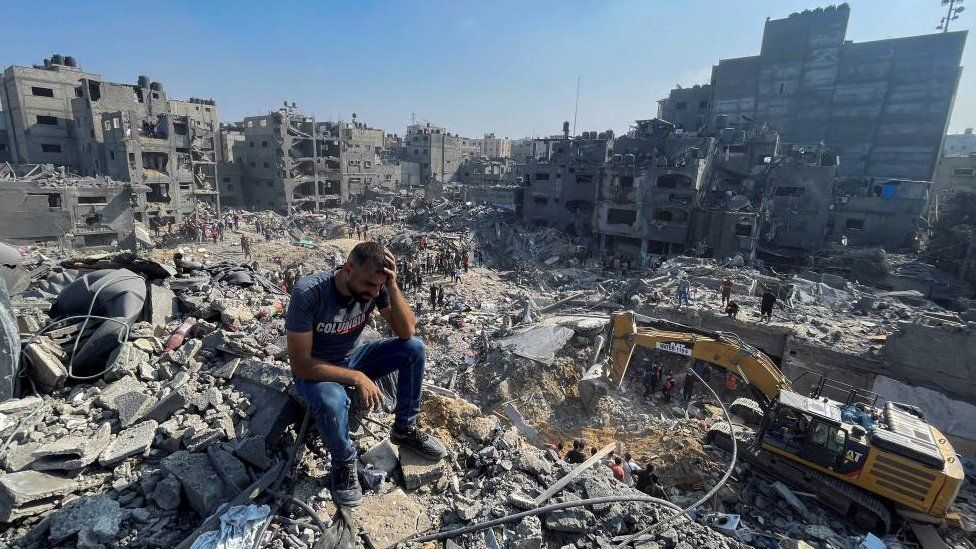
It is almost three months since Hamas’s 7 October attack on Israel was followed by the hell visited on the Palestinian people of Gaza by Israel’s armed forces. Israel embarked on the systematic destruction of the already impoverished Gaza Strip – an area less than half the size of the metropolitan Hiroshima and more densely populated than Hong Kong. As everyone now knows Gaza is the suffocating home to 2.2 million Palestinian’s, half of them children.
At the time of writing roughly 18,000 people have been killed in Gaza – two thirds of those women and children. Significantly Israeli military casualties number less than 200 soldiers killed. This one sided conflict is conducted in the name of the Israeli state’s widely proclaimed right to self defence but in truth Israel’s armed forces have long enjoyed an unequalled impunity thanks to granite support Tel Aviv receives from Washington and other Western capitals and the tacit acquiescence of the mostly authoritarian rulers and elites across the MENA.
The indiscriminate nature of Israel’s onslaught against Gaza has fed growing disquiet and protest across the world. Some complain the Israeli state has violated international strictures on the ‘proper’ conduct of war (or jus in bello). Israel itself describes the devastating assault on the Gaza Strip as war (or a war on terror – truly a gloves off war of terror) but this isn’t war in the ‘old modern’ sense of the armies of rival sovereign states confronting each other. This ‘old modern’ picture paralleled the rise of the modern European state system – and could be called the Westphalian system. As Paths and Bridges has argued elsewhere, the Westphalian system of military conflict between discrete sovereign states exploded long ago. In the C20th and C21st war burst the boundaries of conflict limited to a specific theatre. The rupturing of the old boundaries was apparent with the total war of the Second World War. War between sovereign states often bled into domestic or civil conflicts. The exemplary war of the Westphalian system was perhaps the immobile war of position of the First World War though its breakdown was already prefigured at the end of the Franco-Prussian war when the Paris Commune was crushed but also the furious colonial violence that followed the European ‘Scramble for Africa’, the Boer War and the conquest of South East Asia.
Our own age is one where wars indiscriminately target civilian populations and the basis of everyday life. This trend has been apparent in Iraq, Myanmar, Chechnya, Syria, Yemen, Ukraine and now the Gaza Strip. Concerning war the appeals to ‘proportionality’ are mocked by the cruel reality of the dizzying, devastating acceleration of the martial in the C21st that has disclosed the growing power and impunity of Leviathan or, this is only a seeming paradox, the inflation of non-state para-military forces or ‘war-machines’ in those liminal zones of the global system where the sovereign authority of Leviathan is either absent, seriously contested or outsourced as with the Wagner group in Syria or Africa or the US military in many different places across the globe.
But if Israel is violating jus in bello (is this concept meaningful?) by prosecuting a ‘war’ that is really the collective punishment of Gaza’s 2.2 million population, Hamas also violated jus in bello and in doing so betraying the Palestinian national movement by the cruelty of the 7 October attack. What political or moral justification could there be for the pitiless slaughter carried out by Hamas fighters – mostly young men who had likely left the Strip for the first (and last) time in their lives? 1,200 mainly Israeli civilians were killed at the Re’im music festival, Be’eri, Kfar Aza, Nir Oz and elsewhere, including families, children, the elderly, young men and women some of whom were tortured, raped, mutilated and summarily executed. Paths and Bridges unequivocally states our conviction there is absolutely no future for a progressive or left politics that thinks it can selectively justify or excuse violence like the murder and rape of civilians or airily invokes the talismanic violence of the oppressed to excuse the worst of crimes. Neither are appeals to realism or necessity to justify the loftiest political goals credible.
Invoking the violence of the oppressed to say the murder of civilians is legitimate not only mocks the Palestinian cause but our humanity and our empathy and sympathy. Indeed this faculty helps us to realise the relevance of the context to Hamas’s 7 October attack, the historical arc from Israel’s bloody foundation eight decades ago shaped by ethnic cleansing and forcible transfer of the Palestinian people, to the present day oppression and occupation of the Palestinian people in Gaza, West Bank and East Jerusalem (not speak of the Diaspora across the MENA).
Therefore despite Hamas’s cruel actions nothing can excuse Israel’s collective punishment which continues the policy of repression and oppression. Hamas has been accused of using Gaza’s population as a sacrificial pawn in their struggle against the Zionist state. Hamas probably anticipated Israel’s brutal reaction. Now Gaza is at the centre of an unfolding humanitarian crisis with electricity, food, water and health provision severely hit by Israeli bombs and missiles. Various UN agencies have warned that cholera and typhus outbreaks among the population are imminent.
So it bears repeating that despite Hamas’s callousness only the light minded would charge the group with primary responsibility for Gaza’s destruction. The Age of Leviathan sees apologias for the ruling powers and the martial state drowning out critical voices and disrupting even the strongest moral or political compass. That Israel, the MENA’s only nuclear armed state, acts like Imperial Rome is lost on many observers. When Israel has finally finished blasting Gaza it will only remain to sow its soil with salt. Israel’s ferocious violence exposes those urging support for the MENA’s ‘only’ democracy – indeed Israel is more accurately described as a “flawed democracy” while in the region it is no longer entirely alone as a democracy (Lebanon, Tunisia, Iraq, Algeria, Turkey) albeit these countries are equally if not more “flawed” as democracies. Sadly the existence of ‘democracy’ albeit limited while hardly negligible, doesn’t automatically entail political amity.
Equally some of the rage at a distance displayed on ‘behalf’ of the Palestinian people is often unbalanced. We have in mind those who see Israel as uniquely iniquitous, who argue its revanchism is enabled by the major imperial power of the age, the US (itself often presented as though it were the only imperial power of the age). Such assertions are drastically one eyed when similar imperial tendencies or authoritarianism are apparent with countries like Russia, China or Iran (ignored or excused as intelligible reactions to Washington’s actions).
Some critics of Hamas consider the group totalitarian, it’s fundamentalism typical of that modern phenomena of religion-as-ideology, a group animated by a restless a desire to retain unchallenged dominance of the Palestinian national cause. Perhaps but Hamas exists because of the founding dispossession of the Palestinian people. It’s likely the group retains mass support – no matter how pro forma or halfhearted that support might be – because of the grim siege imposed by the Israeli state that turned Gaza into what has long been acknowledged across the world to be an “open air prison”. Therefore it’s hard to avoid the conclusion that Hamas’s 7 October attack were borne of desperation.
Paths and Bridges believes Hamas calculated that its appalling 7 October action would revive a ‘moribund’ Palestinian cause, sidelined in recent years by global indifference and Israel’s effectiveness in euthanising Palestinian resistance. On our reading Hamas’s initiative was a desperate one: to dent the seemingly impenetrable impunity of Israel’s ruling right wing government already dedicated to escalating the illegal settlement of the West Bank. Perhaps Hamas wished to head off the Israeli-Saudi rapprochement assiduously promoted by the US State Department. Perhaps Hamas believed attacking Israel would spark a wider regional conflict and renovate its political goals. Also Hamas’s ideological sang froid shouldn’t obscure the truth that talk of evil erases the social-historical context of the Israeli-Palestinian conflict. Equally Israel had choices other than flattening Gaza but chose collective punishment and ethnic cleansing (or as some argue, genocide), a choice that can’t simply be dismissed as a traumatic reaction because its use of overwhelming fire power, fits with existing policies designed to shatter resistance and marginalise the Palestinian people.
Israel’s military response in the Gaza Strip (and it’s actions in the West Bank and East Jerusalem before and after 7 October), are not only a dramatic upping of the ante but echo decades of Israeli policies designed to completely reduce, demoralise and atomise the Palestinian population. The containment and finally erasure of Palestinian national agency has long been a major Israeli policy goal. Indeed Israel stopped thinking of the Palestinian people as their partners in a final peace settlement and insofar as Israel ever did think in these terms, this reflected the effectiveness of Palestinian resistance.
Across the world more and more voices can be heard denouncing Israel for ethnic cleansing or even genocide including a number of the UN’s special rapporteurs after the UN Secretary-General Antonio Guterres called for a immediate ceasefire (a move still resisted by the US despite the noises it makes about the welfare of Gaza’s civilian population). Predictably Guterres was denounced as a Hamas spokesperson for his call. In the democratic West, promoter of human rights and international law, talk of genocide is absent in official governing circles and muted in the legacy media. The US, Britain, France and Germany are among Israel’s most unwavering allies. In the wider world the West’s position invites cynicism. It is hard to avoid the sense of a double standard at work when Russian missile, drone and rocket attacks on Ukrainian cities, towns, hospitals and dams are forthrightly condemned in Western capitals and denounced as war crimes (as they should be) while Israeli bombing is apologetically parsed. Where Western heads of state have aired misgivings about Gaza’s civilian casualties (as Israel’s honest friend) this is anxiety with the growing public restiveness at the scale of the Israeli army’s onslaught that has prompted huge public protests across the world. The nightly TV news and images of blasted moonscapes can’t fail to remind much of the public of earlier carnage in Iraq, Chechnya, Syria, Ukraine.
The ‘border’ between Gaza and Israel is a cordon sanitaire; a ramified infrastructure for holding a population captive – simultaneously Inside and Outside. The imprisoning of Gaza’s Palestinians, have seen Israel denounced as an apartheid state. Many critics underscore Israel’s exceptional status among the world’s states as an oppressive entity whose origins and existence rested on a people’s dispossession. Israeli’s are either in denial or indifferent about the facts of their society’s foundational violence whose bloody historical cartography is littered with place names like the infamous Deir Yassin but also Tantura, Khisas, Bilad al Shaykh and many other Palestinian towns and villages that were subjected to brutal Zionist violence and terror perpetrated against largely defenceless civilians. Of course Israel claims Gaza is not occupied (unlike the West Bank there have been no Israeli settlements since 2005) and yet the Israeli state controls all essential aspects of the Strip’s life. It is illegal for Gazan’s to leave the Strip, imports and exports are controlled by Israel as well as it’s airspace. Significantly international law regards the Gaza as occupied.
Leaving aside the debate about whether Israel is best described as a ‘settler state’ or whether the term apartheid captures the nature of Israeli society, arguments about Israel’s ‘exceptionalism’ can’t be entirely swerved. On the one hand, Israel’s exceptionalism as an oppressive entity is doubtful given the C21st presents a crowded field given the rising global tide of illiberalism, ethnic cleansing, exterminatory violence, where Leviathan’s bio-politics utilise political steering to recruit the People to a largely unacknowledged war of counter-insurgency against the people. Meanwhile ailing Western political liberalism proffers apologies for Israel and by denying its oppressive nature incidentally discredits the case for representative democracy on the global stage (including the respect for human rights and international law) against the malign menace of the new authoritarianism.
While Al-Shifa hospital in Gaza City was being bombed Al Jazeera reported that a 100 or so Israeli doctors had publicly defended bombing Palestinian hospitals and medical centres as legitimate because they were supposedly terror nests. These doctors who publicly supported bombing Palestinian hospitals were not simply reacting vengefully to Hamas’s 7 October incursion but articulating deeper sentiments in Israeli society. Just months ago politically embattled Netanyahu was threatening to sack his Defence Minister Yoav Galant when the minister sided with the movement defending Israel’s tattered democracy against the Orbanisation of Israeli political life. Yet at the start of Israel’s attack on Gaza, Galant – still in his ministerial post – claimed Israel was fighting “human animals” in Gaza.
The justifications for Israel’s frightful violence, the right to self defence or the idea Israel is locally prosecuting the global ‘war on terror’, are choking the truth. Orwellian doublethink and post-truth are rule in these barbarous times. Yet the Age of Leviathan isn’t as simplistic as leftist thinking might suggest. We reject the dubious notion of an axis of resistance comprising Iran, Russia, China and social movements like Hezbollah who are said to be supposedly challenging Washington’s hegemony or countering NATO expansion, as profoundly mistaken as a basic analysis of the world system, of the conflict between states and how the weak telos of the battle for democracy, freedom and autonomy including the struggle against oppression and authoritarianism, fits into the monstrous rivalries between Leviathans, on the domestic and global stage.
Paths and Bridges basic reading of this period is a world dominated by competing, over mighty Leviathan’s intoning lullabies to the Security of the Citizen (naturally implying the existence of the Other) as part of the mechanism of ‘political steering’ while directly engaging in, or discreetly supporting eternal manoeuvres of pacification against civilian populations in the name of the ‘War on Terror’. As Paths and Bridges observed in 2017 concerning Bashir al-Assad’s brutal counter-revolution against the 2011 ‘Syrian Spring’ (with the support of Russia, Iran and the murderous sectarian Hezbollah), the Baathist state pursued various strategies for winnowing ‘hostile’ social demographics and groups while hothousing or leveraging ‘friendly’ social groups to maintain the status quo. A hallmark of the period has seen Leviathan crafting and implementing governmental policies for the symbolic and physical erasure of the Other. Assad’s thanatocratic counter-revolutionary onslaught against the Syrian people can be regarded as an outlier on the spectrum of governmentality. Israel seems to have adopted policies vis-a-vis the Palestinian people with a similar objective – total atomisation and passivity of populations. The telos of such policies is totalitarian.
The reduction or destruction of populations is generally framed via authoritarian or totalitarian ideologies that present such groups as uniquely evil or undesirable. In recent decades there have been numerous one-sided conflicts between Leviathan and vulnerable populations that have rapidly become exterminatory or even genocidal. In Chechnya, Moscow first auditioned the shattering military tactics it would employ rescuing Assad against the ‘Syrian Spring’ and later in the invasion of Ukraine. Another instance was the genocidal persecution of the Muslim Rohingya minority in Myanmar that actually escalated under the government of Aung San Suu Kyi (Myanmar’s democratically elected head of state who defended the military’s actions though the latter was clearly very much in the driving seat of this brutal campaign) before the military ousted her government sparking a wider civil conflict that rages today. Other horrific episodes in this C21st authoritarian trend include China (incidentally backers of Myanmar’s military) which continues the cultural genocide of the 12 million strong Muslim Uyghur population in the Xinjiang province.
This politics of erasure is alive and well in Israel. We mentioned the Israeli doctors who publicly supported bombing Palestinian hospitals and the talk of the IDF fighting “human animals” that encapsulate in nuce the dominant attitudes of Israel’s political summit. It is surely significant Benjamin Netanyahu has been Israel’s most serially successful Prime Minister having served three different terms across 16 years and now leading Israel’s most right-wing government in years, full of extremist religious zealots whose support for a Greater Israel practically translates into backing illegal settlements on Palestinian land. In the West Bank Palestinian’s are being forcibly expelled from their farms by illegal settlers backed by the Israeli army. The ascendancy of such anti-Palestinian sentiment reflects settled Israeli opinion towards the Palestinian people and the determination of successive governments in Tel Aviv to thwart a final, just peace while burying the aspirations of the Palestinian people for a political settlement that would include a viable state (and a viable future) alongside an Israeli state.
Any honest observer or partisan of genuine lasting peace not built on winners and losers, would readily admit successive Israeli governments have promoted policies designed to marginalise the Palestinian people and cancel something like the political settlement promised in the Oslo Accords peace process 1993-95 when the PLO recognised the state of Israel and Tel Aviv accepted the PLO as the legitimate representative of the Palestinian people. Despite its flaws, the Oslo Accords set out a roadmap to a peaceful political settlement based on accepting UN Resolutions 242 and 338. How far we have retreated from this point in the intervening years.
The distance travelled in the years since is shown by the real balance of power which favours Tel Aviv. Earlier commitments were ditched thanks to Washington’s connivance but also indifference in Arab capitals like Cairo, Riyadh and Amman. Israel’s actions in the West Bank show the real intent of its policies. The West Bank is presided over by the Palestinian Authority led by Fatah’s Mahmoud Abbas which nominally rules Areas A and B. In the mainly rural areas (designated Area C) forming 60% of the West Bank, the Israeli Defence Force (IDF or army) has and is currently supporting the “cleansing” of Palestinian farms and villages. Over 300 Palestinian’s have been killed in the West Bank since Hamas’s 7 October attack. Israeli peace activist Hagai El-Ad described the intimidation and violence of illegal Israeli settlers (many religious extremists) and their IDF backers in the West Bank, as one which had created a “coercive environment” compelling Palestinian’s to leave their land.
Israel’s stealthy, incremental strategy in the West Bank has escalated since 7 October with 13 Palestinian rural communities forced to fold. Typically Palestinian’s in the rural West Bank are denied water and electricity in already challenging conditions. Also Israeli authorities often deny building permits or permission for solar panels (donated by overseas relief agencies). This not so stealthy land grab and creation of facts on the ground, has been happening for 20 years and can’t simply be laid at the door of ‘bad’ illegal Israeli settlers but requires enablers and accomplices in the Israeli judiciary and the IDF. Meanwhile the world (including Washington and the US State Department) contrive to largely ignore this campaign of illegal settlement. The Economist estimated that there were as many as 500,000 illegal Israeli settlers in the West Bank (other estimates cite as many as 750,000 – both are staggering numbers). Every illegal settlement established in the West Bank or elsewhere, is another nail in the coffin of a possible viable Palestinian state.
If we try to imagine what presently feels inconceivable – a political endgame to the Israeli-Palestinian conflict, we must remember that unlike the British in India or Kenya or the French in Algeria, Israel will be at the negotiating table but it won’t be scurrying away across the ocean. Instead it will be the closest neighbour of any future Palestinian state. This truth reinforces the sense that talk of Israel as a settler state with the implication that it’s an artificial entity, even a ‘white European’ transplant in the MENA, is not only misleading (and a wish fulfilling reverie that Israel will vanish) but false.
Israeli’s and Palestinian’s will have to make peace together. As distant as such a settlement appears this would probably be some two-state solution notwithstanding the widely held opinion even among its former advocates and champions that it’s dead as a strategic goal. Ironically, in terms of a final peace it is Israeli citizens who are blinder to this possibility – eyeless in (or on) Gaza you might say than Palestinian’s themselves. This is because of the strength of the reactionary, authoritarian, illiberal mindset of Israeli’s towards Palestinian’s reinforces and is reinforced by a permissive environment for the Israeli government’s continuing efforts to erase Palestinian agency, efforts that have baleful implications for Israeli democracy itself.
Whatever Hamas’s motives were in trying to upend the suffocating status quo, the challenge to Israel’s attractions to the lures of impunity and consummating the Palestinian people’s dispossession has brought the conflict to a major crossroad. Ironically it is Hamas rather than Israel that has been more willing to talk and Hamas that essentially accepted UN Resolution 242 and the implied two-state solution therein. In contrast Israel’s governmental and defence establishment obviously felt Palestinian resistance was increasingly toothless.
A final thought – Paths and Bridges believes the Palestinian struggle to be part of a broader, global ‘battle for democracy’ or autonomy. This social-historical project to conquer democracy or autonomy (or defend its existing, often limited beach heads) is neither the real movement of history or akin to the providential socialist goal of Marxism but something far more modest, open ended, fungible, multi-faceted and marked by what we would describe as a weak telos. Recent flash points in this ‘battle for democracy’ include the 2009 ‘Green Revolution’ in Iran, the 2010-11 ‘Arab Spring’ across the MENA, Belarus, Hong Kong’s democracy movement. This particular ‘democratic wave’ has largely been thrown back but one of the most intriguing if under appreciated developments of this democratic wave was the unmistakable political churn in Islam offering further evidence of a radical reform minded Islam committed to pluralism and democracy. This trend was exemplified by the Muslim Brotherhood in Egypt but also political developments in Tunisia, Algeria and the short lived Local Co-ordinating Committees of the Syrian Spring that briefly revealed the possibilities of grassroots democracy in action.
Globally democracy today is embattled and faces serious external challenges like the new authoritarianism of China and Russia but also internal challenges like the disintegrative effect of Populism whose rise across Europe (Brexit, Orban in Hungary, Poland, Meloni in Italy, the march of the right in France, Germany, Spain, the Netherlands and so on), in the US (Trumpism), South America (Bolsonaro in Brazil and Milei in Argentina), has exposed a democratic entropy and creeping illiberalism at the heart of ostensibly democratic societies. The shortcomings of representative democracy as well as our specific historical moment are revealed by the support Israel has received for its barbarous campaign in Gaza across Western capitals.
This ought to be remembered when critics point to the limits of ‘democratic’ developments across the MENA we mentioned above. In contrast Paths and Bridges consider such developments to be significant. Israel’s political class was extremely nervous about the impact of the ‘Arab Spring’ and the prospect of facing Arab neighbours where a restive population unprecedentedly empowered by democracy would feel duty bound to come to the aid of their Arab-Muslim-Palestinian brothers and sisters with the urgency that had hitherto eluded Arab autocrats and elites. The election of Morsi of the Muslim Brotherhood as Egypt’s President clearly filled Tel Aviv with much trepidation because it threatened the basis of the Camp David agreement (though Morsi affirmed his commitment to continuing peace with Israel), the tacit pact between the two militaries of Egypt and Israel and Cairo’s attitude to Israel’s policies toward the Palestinian people. Tel Aviv prefers to deal with tyrants and autocrats that it can do business with rather than popular, democratic governments that while unlikely to abandon peace with Israel (MENA’s only nuclear armed state after all), would still be likely to upset the apple cart by at least challenging Israel’s persistent sabotage of a lasting peace with Palestinians. This sabotage extends to Israel openly and covertly collaborating with, and encouraging anti-democratic forces across the MENA despite the hollow boasts it is the regions ‘only’ democracy.
A setback for Israel in Gaza, the West Bank and elsewhere is vital for the cause of the Palestinian people and their long struggle for a viable Palestinian state. It’s also vital for the cause of democracy and autonomy everywhere including that potential Palestinian state and in Israel itself.
Jules Etjim December 2023-January 2024

