In Memoriam – James Lovelock 1919-2022 and Bruno Latour 1947-2022
I
Donald Trump’s political comeback was stunning and depressing in equal measure. Stunning, firstly, because it was unexpected after Trump’s democratic ouster from office in 2020 and his narrow failure to illegally prevent Biden’s victory being certified. Somehow Trump avoided jail for this and his other misdemeanours and then won the GOP Presidential nomination again as a known quantity. This time no one could suggest American voters didn’t know who the GOP candidate was.
Secondly, Trump’s triumph aided by Brother Musk’s deep pockets (the deepest pockets), has thrown a major tectonic shift into relief as many commentators have observed. Yet we should add Trump Unbound with the levers of the most powerful Leviathan on the planet at his disposal, few constitutional or legal constraints on his actions and the actions of his coterie of supporters, embodies that tectonic shift in motion. Trump will be malign decisionism in action wreaking havoc and chaos everywhere. 2016 could perhaps have been interpreted as a fluke especially in the full flush of Biden’s victory in November 2020. But such a reading has proven deeply complacent. 2024 certainly can’t and it underlines certain ‘realities’ are here to stay for the foreseeable future. There is increased geopolitical turmoil as a more ‘transactional’ world of war, Great Power coercion, re-territorialisation driven by Leviathan, comes into view. It was only two years after Trump’s first term ended that Putin invaded Ukraine after annexing Crimea in 2014. The relative stability of the glacial Cold War – at least in the First and Second World’s – after the ascendancy of Pax Americana and Soviet Union’s collapse, seems distant in time.
We might say history which famously ‘ended’ in 1991 heralding a ‘New American Century’ (to simplify a simplified thesis) has returned kicking and screaming. As the Chinese proverb (appropriately enough) goes: we live in interesting times. China’s rise and the US anxieties stirred in the face of a genuine peer competitor whose rise the US itself did so much to facilitate, has only added to the sense of a world shifting on its axis.
War’s return to Europe with Russia’s invasion of Ukraine is, ominously, steadily becoming globalised. There is a sense in which Ukraine faces the new authoritarianism of the ‘quad’: Russia, China, Iran and North Korea though Beijing who has talked of “no limits friendship” in backing Putin is the most circumspect and cautious of Russia’s immediate allies. In recent weeks North Korea sent 10,000 soldiers to fight on Russia’s behalf. Yet Europe is also the continent where anxieties about Trump’s return run higher (and with good reason) though as Timothy Garton Ash also observed even Europe is divided where Trump is concerned as the angst is greatest in the more socially liberal, affluent, north west zone of Europe.
Against this backdrop any peace especially one arising from Trump’s ‘art of the deal’ finessed between Kiev and Moscow is unlikely to satisfy any party least of all the Ukrainians and would be highly unstable. Trump’s pick for US Secretary of State Marco Rubio warns that all sides will need to ‘compromise.’ This probably means that Ukraine – over which the US exercises real leverage because of the aid it supplies in contrast to Putin – will have to accept the loss of territory Russian forces already occupy. Indeed what more leverage could the US use against Putin after the sanctions of the last three years – sanctions that were evidently burdensome but pushed Russia closer to China and fruitfully compelled Moscow to cultivate relationships with a number of countries throughout the world?
A wider European war can’t be precluded given Putin’s imperial ambition and roll of the dice on restoring Russian power. It’s unlikely Putin will dial down the Russian state’s reckless mayhem and asymmetric warfare being waged across Europe that was to be extended to the US according to some intelligence reports. Having talked in the past of the US quitting NATO and even recently encouraging Putin to invade any NATO country that failed to ‘pay its way’, a returning Trump only adds to a sense of existential uncertainty. Yet there is a gaping incoherency at the heart of a strategy marrying a “pivot” to confronting China as the US’s chief peer threat, a course supposedly compromised in the recent past by the US’s commitment to globalisation according to Rubio in his senate confirmation hearing, while embracing an ‘America First’ transactional approach toward the very allies the US will presumably need to stand against China. Similarly allowing Putin a freer rein in Europe could only hamper efforts to contain China. GOP foreign policy is marked by two horses pulling in diametrically opposed directions: the traditional hawkish internationalism of the GOP with a Trumpian disdain for mutually beneficial approaches to trade and security among allies.
Even so there is irony in describing Trump as the Great Disruptor because if so he has clearly taken lessons from the OG: the man in the Kremlin, the same man who will probably still be running his country when Trump’s second term is finished – always assuming the US Supreme Court doesn’t make Trump the POTUS for the rest of his natural born days with the blessing of a partisan GOP now cool with throwing the battered body of American democracy under a Greyhound bus. More seriously, Trump is taking some cues from Putin to judge from his talk of seizing Greenland and Panama (presumably the country would come with the canal) and economically “reducing” Canada to a compliant client by means of eye watering tariffs. Trump menacingly proposed Canada should become the 51st state of the United States and with some levity Sydney Blumenthal, a former Clinton aide, observed Trump had probably not thought through his annexationist whimsy of a country whose 10 different provinces would add 10 states to the United States and deliver the US to a Democratic Party majority indefinitely – always assuming American democracy hadn’t finally been snuffed out altogether.
II
In Suetonius’s The Twelve Caesar’s, the Roman chronicler dubiously claimed that the mad and bad Emperor Caligula had once declared war on Neptune and the sea, ordering his mutinous Roman army in northern Gaul to stab and spear the waves and return to Rome triumphant with seashells as spoils of their conquest.
Similarly there is one war Trump can never win even if he were to ‘win’ every battle. Tragically though humanity, or the Anthropos would also be the loser in the war against Gaia or the planet.
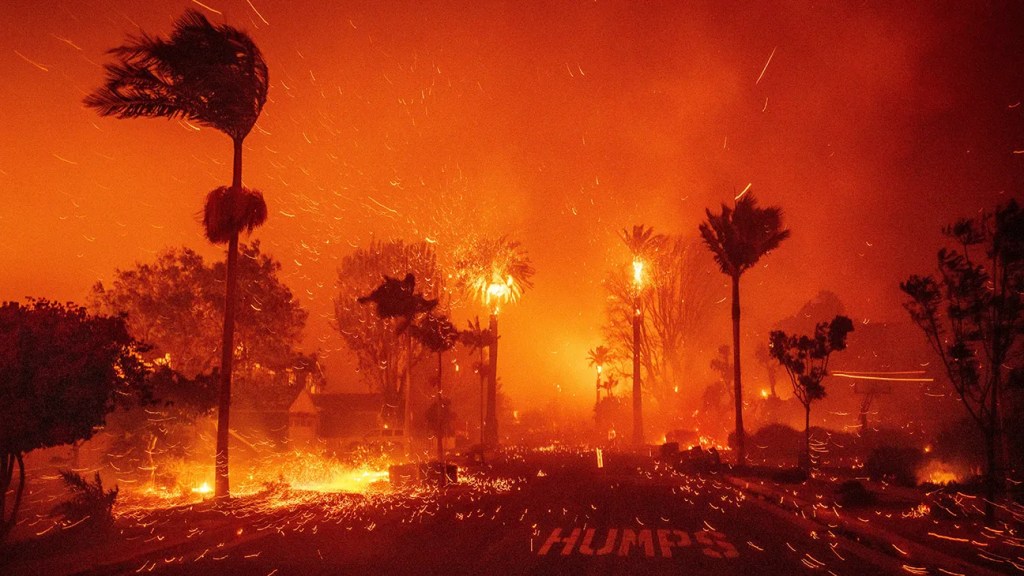
Climate breakdown is the stubborn reality Trump denounces as a great hoax. The wild fire apocalypse in Los Angeles and southern California is only the latest dizzying episode of an unfolding global catastrophe whose perpetrators – Big Oil or Carbon Capital – are among Trump’s biggest backers as he has promised to ‘drill, baby, drill.’ In office Trump will roll back or nullify as many of Biden’s environmental protections as he can. He will also try reverse Biden’s halting transition to Net Zero and decarbonising the economy. Trump would probably pull out of 2015 Paris Agreement for a second time. Also Trump has promised the US’s protected wildernesses would be opened up to oil and gas exploration and, perversely, exploit the global warming that is melting ice in hitherto inaccessible regions of the Arctic. This is also part of the attraction of seizing the world’s biggest island: Greenland.
Anticipating Trump’s arrival in the White House, major US banks and Wall Street asset management firms are opportunistically dropping their ‘commitments’ to Net Zero. For decades Big Oil funded global warming denialism and their ‘dark money’ helped poison US politics. Significantly, denialism was always ‘for the birds’ – intended for the consumption of politicians and the public, giving people permission to look away from what they increasingly grasped was true: burning fossil fuels was warming the planet and destroying the basis of life. In 1977 ExxonMobil’s board was informed CO2 emissions were already causing warming by their scientist James Black after the corporation spent $1m on his research. Black added there would only be a few years before remedial action – ending CO2 emissions – would be required. ExxonMobil responded by sitting on the findings and subsequently pumped millions of dollars into denialism.
Moves to silence climate scientists and sideline institutions dedicated to conducting climate research are likely to intensify. Yet Trump’s efforts to drown the truth in misinformation and censorship and sabotage the mitigation of GHG emissions won’t stop the sea level rises threatening US seaboard cities and regions like Florida. Denialism won’t prevent the atmosphere storing greater energy with warming that is then unleashed in more intense, extreme and frequent weather events.
The last 10 years have been the hottest since climate records first started to be kept in the mid C19th. Yet these years will be cooler than the years we will face tomorrow. In Earth Systems Science (2016), climate scientist Timothy Lenton suggested that if (2016) known reserves of oil and gas were fully exploited the planet would be hothoused a further 10ºC – a catastrophic increase likely to extinguish all life.
The late Bruno Latour proposed thinking of life as literally existing in a bubble or a thin film – what we call the biosphere. Yet the blossoming of modernity introduced a specific model of science as a way of seeing the world – science wasn’t only about understanding the world but was the handmaiden of forces that reduced the world-as-Nature, to an object to be mastered, subdued and exploited. Galileo’s infinite cosmology displayed a similar reifying logic observing the Earth from point X outside of the Earth, in empty space. This point in empty space was characterised by Latour as the ‘view from Sirius’ – assuming the Earth was an external object. Those occupying such an imaginary location were no longer able to fully appreciate they to were part of the earth.
Latour made the case for a new Terrestrial ecological politics that would necessarily be local (as opposed to global and above the heads of the great mass of humanity), down to earth, ploughing a furrow and rooted in the soil but not ‘Blood and Soil’ – a vision heavily influenced by James Lovelock’s Gaia theory. Lovelock saw the Earth (Gaia) as an interconnected dynamic self-regulating homeostatic system while life in its myriad forms was actively present in all physical, biological, geochemical processes. Essentially Gaia was one great living organism whose overriding momentum was the production and reproduction of life. Lovelock’s Gaia hypothesis was a milestone in the emergence of the various disciplines of Earth Systems Science.
Lovelock has often been criticised for coquetting with mysticism: invoking Gaia, the Greek Goddess of Earth (a suggestion of his friend William Golding in 1968). Critics were usually repelled by Lovelock’s characteristically bleak assessment of humanity’s capacity to tackle climate breakdown. Lovelock claimed the savage ‘reactions’ or events, typical of climate breakdown were Gaia’s “revenge” against humanity. This included the Covid-19 pandemic that anticipated deadlier pandemics. Many scientists maintain devastating pandemics are rendered increasingly likely due to activities such as intensive farming incubating pathogens, the overuse of antibiotics in livestock, the dangers of ‘wet’ markets where viruses are more easily able to make the leap across the species barrier. If humanity were ‘cut down to size’ we could only blame our hubris. We leave aside whether Lovelock was guilty of misanthropy or simply being realistic about humanity’s collective failures. Downcast about humanity’s capacity for action Lovelock’s profoundest idea was that Gaia had agency.
For Latour Gaia was local and stricto sensu the local was finite and yet in the modern industrial age of urbanisation, population explosions and rapacious capital scouring every corner of the world in a restless dour pursuit of economic growth, the Earth is treated as though it were an infinite carbon sink. Eternal growth was the enemy of the biosphere and biodiversity. Officially modernisation, globalisation and the occulted force of Progress justified themselves in the name of One Common Humanity until those very forces shattered the belief we were all travelling toward a common future together. Universal progress was exposed as a myth with the fratricidal fracturing of the Anthropos.
Gaia can’t encompass the “wicked universality” of globalisation which according to Michel Serres in The Natural Contract counted as an unspoken declaration of war against Nature and, therefore, against ourselves. The reality of the Great Acceleration, neo-liberalism, Carbon Capital’s ascendancy, the dominance of the World Bank and the IMF and business as usual whatever the cost, all assumed several earths where instead there was only one finite, if fecund earth. What was ‘seen’ allowing for the effect of the socially necessary scotomization of the New Climate Regime (Latour), was Gaia reacting and doing so with increasing ferocity. If human civilization was to survive everything would have to change. Instead continuing unsustainable growth and CO2 emissions have delivered the Sixth Mass Extinction event since life first appeared 3.7 billion years ago. We are living in the midst of this event or hyper-object at this very moment.
The previous mass extinction event was extraterrestrial in origin when an asteroid slammed into the Yucatan peninsula 65 million years ago. Vaporised rock and debris, hurled high into the atmosphere, blotted out the sun preventing photosynthesis and sealing the fate of non-avian dinosaurs and many other creatures at the end of the Cretaceous period. The present day Sixth Mass Extinction isn’t driven by external factors like its immediate predecessor nor directly by obscure geo-physical processes such as the worst mass extinction ever known: the ‘Great Dying’ 251 million years ago which killed off most insect species. The ‘Great Dying’ was so severe vertebrates took 30 million years to recover. The causes of this event are hotly debated today by scientists with volcanism, anoxia and runaway GHG emissions like methane (or a combination of these) all seen as probable culprits. But there is no mystery about the perpetrator of the Sixth Mass Extinction: the recent activity of ourselves, homo sapiens.
Dramatic mass extinctions have profoundly influenced the evolution of terrestrial life on Earth. Today it’s estimated that 99.9% of all species that ever lived, roughly 5 billion different species, have now vanished. Of course we can’t be sure how many species of animals existed since life began because the fossil record contains ‘gaps.’ At present it’s estimated there are between 10 and 15 million existing species though only 15% of these have been recorded or classified.
Are we passing beyond the Holocene? The Holocene as a geological ‘steady state’ was remarkably conducive to the flourishing of human civilization before we arrived at the threshold of a more turbulent geological epoch. How long before it’s the settled scientific consensus that anthropogenic climate breakdown has ushered in the Anthropocene? There is a sense in which the war against climate breakdown denialism is over not because any ‘intellectual’ argument was won or lost but simply because Trump’s second coming will underwrite business as usual when this needs to be quickly abandoned. Trump as ally of Carbon Capital will double down on extracting as much oil and gas as possible and shatter international efforts to mitigate CO2 emissions and the transition to Net Zero.
The profound limitations of globalisation exposed the hollowness of international rules of governance but the renewed power of Leviathan, the revival of revanchist nationalism and recidivist separation against the backdrop of climate breakdown, promises further war including resource conflicts for increasingly scarce resources like water and food. Social breakdown would very likely strengthen the grip of Carbon Capital allied to the most powerful states like the US. The chaotic logic of Trumpian governance suggests climate breakdown will be denied on the one hand and slyly invoked on the other to justify cruel adaptationist policies and martial adventures that would essentially throw the majority of humanity overboard. Such Schmittian politics – the politics of imperial Rome redux might well justify wars to annex territory and seize resources. The most powerful Leviathans foreground their biopolitical role in the provision of Security to a populace that is territorially bounded by Leviathan. Increasingly this populace is defined in national or ethno-national terms with the perverse revival of a sort of milquetoast Blut und Boden.
It’s worth recalling that the cruel adaptationist strategies of powerful nation-states rest on a cynical calculus: the differential impact of climate breakdown that has so far impacted poorer, less resilient societies that were not the primary emitters of GHGs like the Pacific island states or Bangladesh. But as climate breakdown proceeds this picture can only alter as we have seen with large swathes of affluent Los Angeles wiped off the map by wildfires. Global temperatures are set to continue rising and the destructive wildfires we have witnessed in the last few years in California, north western US, Canada and southern Europe – not to speak of the other extreme weather events – lie ahead. Therefore climate breakdown will eventually prove to be the ultimate leveller. Today small Pacific island states could soon disappear because of sea level rise but tomorrow it will be Florida. No society, no matter how wealthy or powerful can indefinitely outrun climate breakdown or the reaction of Gaia.
There has been a great deal of reflection and lively debate on humanity’s relation to Nature. Talking of a relation implies something that is ultimately separate to something else. It implies a dualism – an error for some because it perpetuates the idea that Nature is an external object. In the Promethean modern age Nature as external object was a condition of instrumental, exploitative social action that was destructive of Nature or ‘Pristine’ Nature (a nostalgic dualism). This criticism also extends to the idea that our rapacious instrumental exploitation of Nature requires the denial of our own Nature, of our inner Nature, animal Nature or corporeal Nature, sundered and turned against ourselves. Yet a polyphony of meaning attaches itself to the idea of Nature. On the Anthropos <> Nature relation a certain discursive dualism is inescapable but it’s also evidently true that Nature has an independent objective existence, its own causal laws and so forth and while humanity may be part of Nature if we were to vanish Nature would continue to exist. Theodor Adorno liked to talk of the “preponderance of the object” as a counterpoint to, and to undercut humanity’s destructive narcissism and egoism which was critically seen as underwriting an ineradicable species specific form of maladapted social action.
This relation might also be thought of in another way ultimately making it a non-relation. Consider Timothy Morton’s profound concept of the hyper-object (or hyper-objects): material entities, objects and processes that are vastly extended in time and space and simply far beyond the narrow compass of human existence and our perceptual awareness limited by the extremely local finitude of our species diurnal existence. An infinity of phenomena fit Morton’s definition of hyper-object like black holes, the Sun, the Amazon rainforest but one illustrative example Morton cited was global warming that could manifest itself in an El Niño event or a wildfire but was also far, far wider in scope.
Shortly before his death in 2022 Bruno Latour hymned the virtues of termites: social insects whose complex collective activities were radically carbon neutral, taking from nature as part of nature without producing destructive waste. Latour proposed termites could be some sort of model for how humanity could proceed if – as Latour insisted – we came back down to earth and discarded the reifying view from nowhere that stopped us seeing the realities of the earth and life.
Adaptation without serious efforts at mitigating global CO2 emissions are illusory. Latour saw in James Lovelock’s Gaia hypothesis a refusal to de-animate the planet. In terms of its active processes, causal chains and the constituents of life in the widest sense, Latour detected many agents – allowing a political or ecosophical reorientation to be formulated in a sharp contrast to Lovelock’s sour perspective that posited a reactive, even ‘vengeful’ Gaia but was deeply sceptical about humanity’s willingness to break from its civilizational torpor.
Yet it must be admitted there is a kernel of truth or inspiration in Lovelock’s darkest speculations about climate breakdown that aren’t entirely lacking some consolation or the solace of stoicism for the portion who are able to face the fierce Sun of reality: ultimately all of Caesar’s ‘victories’ and the future ‘victories’ of Caesar’s successors (assuming reaction continues to triumph) will come entirely to nought as Gaia strikes back. If the terminus of the Sixth Mass Extinction is to be humanity’s extinction, our disappearance or species ecocide would still see Gaia and life survive, recover and again flourish.
Jules Etjim / / / January 2025

