Review: How To Blow Up A Pipeline (2021) Andreas Malm
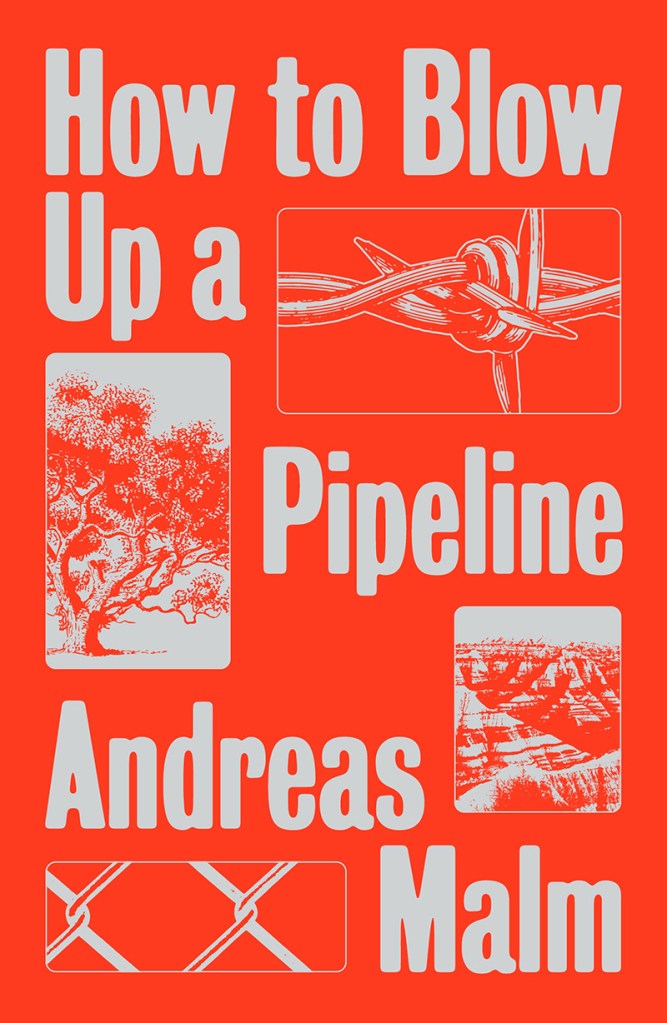
As climate breakdown intensifies with the hothousing of Gaia, the topic of ecology and violence becomes more heated thanks to the debate sparked by Andreas Malm’s How To Blow Up a Pipeline (2021). Despite a breezily provocative title Malm’s slim book isn’t an anarchists cookbook or a monkey-wrenching manual but instead a case for extending economic sabotage (ecotage) in democratic societies, and doing so within a mindful political practice, in proximity with a New Model ecological movement. In this respect it’s very much of its time in eschewing revolutionary rhetorics of a different age of rising, frontal struggles against capitalism.
This is a cute argument, and Malm, a Swedish climate scientist and environmental activist, doesn’t unpack its plausibility so much as urgently insist the ecological movement shift from protest to resistance using violence to prevent civilisational suicide by galvanising the collective public action that could force governments to implement steep cuts to CO2 emissions.
We are asked to imagine a near future when the ‘supplications’ of climate scientists have changed nothing and school children are still undertaking climate strikes, carrying their eloquent placards ultimately ignored as fossil fuels continue to be drilled and pumped from the earth with further CO2 emissions adding more momentum to the Great Acceleration. What should we do then? Do we simply give up and accept extinction? Or is there a new phase of resistance beyond the present cycle of ecological struggle?
Surely violence would be unavoidable? The absolute pacifism of a herbivorous ecological movement in the developed world, championed by figures like Bill McKibben in the US and Roger Hallam (founder of Extinction Rebellion) in Britain, is too cautious, overly respectful of private property and afflicted by an ingrained prejudice that violence is always wrong – a platform reinforced by a selective reading of progressive turning points like the Civil Rights struggle in the US or Gandhi’s struggle against British colonialism.
But is political violence a legitimate weapon in a representative democracy? Unsurprisingly the crux is exactly what Malm means by violence.
Malm is not the incendiary child of the anarchist bomber Souvarine, who preached the nihilistic destruction of the world of property and class in Zola’s Germinal. Instead, Malm’s eloquent case for violence is modest, focussing on ecotage or the destruction of the physical infrastructure of the fossil economy. Killing is categorically ruled out. At no point does Malm suggest that elite commitment to ‘business as usual’ or fossil-capital’s determination to exploit every last known carbon reserve justifies harming or killing those who might be denounced as ‘agents of ecocide’ despite the high stakes if the drilling continues unchecked.
In Earth System Science (2015), climate scientist Timothy Lenton underlined the strong mitigation measures necessary to reduce CO2 emissions to zero. He noted simply stabilising emissions will still leave CO2 levels at twice the pre-industrial levels at 560ppm, while existing international targets on cutting emissions are – notionally at least – more ambitious. Limiting the rise in global warming to 2°C (above the international target of 1.5°C) would require actively removing CO2 from the atmosphere by the end of the century. Even more sobering Lenton calculates that if currently known carbon reserves (5,000 billion tonnes) are treated as an absolute ceiling on future CO2 emissions, these would add 10°C to average global temperatures, a level far in excess of what would extinguish life on the planet. Hence the demand: Leave it in the ground!
Malm himself insists reducing CO2 brooks no compromise while the task of tearing out the embedded infrastructure generating emissions won’t be accomplished by half measures. The severity of climate breakdown demands ‘breaking the spell’ of ‘business as usual.’ Fossil fuel assets must be mothballed now and habitual investor expectations of fabulous fossil profits crushed.
Malm’s advocacy of political violence as direct action and ecotage shunning terror and killing is generally unambiguous, but there are ellipses we will return to. Yet the actual record of ecotage and monkey-wrenching is remarkably pacific. Malm cites the research of Michael Loadenthal who recorded 27,100 actions of ecotage between 1973 and 2010. These actions led to four deaths.The late Unabomber Ted Kaczynski was responsible for three of them (Kaczynski was a sociopathic outlier and never belonged to a group). The other death was Pim Fortuyn’s assassination during the Dutch elections in 2002. The assassin was an environmentalist and animal rights activist who explained his motive was Fortune’s Islamophobia – an untypical case.
This radical record of violence sharply contrasts with the record of Alt-Right and fascist violence across North America and Europe in the same period (this violence has even intensified since 2010). The earlier cycles of eco-activism took place in a relative social void, according to Malm. These acts were often low-level and ‘promiscuous’: vandalising local McDonalds, daubing banks, jamming up ATMs, attacking restaurants, farms, car lots, liberating mink from farms, and so on. From the 1980s to the early 2000s this militant ecology (ecotage, hunt saboteurs, communal squatting, communes, off-the-grid travelling, DIY punk culture) “drank from two ideological wells”: deep ecology and animal liberation.
A deeper affinity often united these two overlapping constituencies – a Year Zero conviction that industrial civilisation was unsustainable and should be swept away or humanity as a whole would be endangered. Extreme neo-Malthusian versions of this outlook either welcomed a global population crash or shrugged at the prospect. As Malm observed in White Skin, Black Fuel: On The Danger of Fossil Fascism (2021) over-population was always elsewhere, in the developing world that – surprise – was the main drain on finite resources. Hence the logic of the reactionary ecology of Garrett Hardin who outlined the ‘tragedy of the commons’ in 1968 (an ‘intellectual’ field that presently thrives in the age of Populism and fascism redux) which invidiously defined the ‘West’ as a ‘lifeboat’.

So climate breakdown also implies the existence of other counter-projects like those of the nativist alt-right or ethno-nationalism who ‘fever dream’ eco-malign futures and cruelly adaptationist strategies involving a great winnowing of the Anthropos. Warped fascist phantasies of an ‘Eco Fortress’ think nothing of throwing black and brown humanity overboard.
Right populists and fascists know their societies (responsible for the overwhelming bulk of historical CO2 emissions) retain greater resources and resiliency while the impact of global warming has so far hit less developed societies more severely. Even so, this seems to be changing. The heat dome over the US, the fires in the Canadian wilderness, and the scorching heatwave across southern Europe this summer hint that no society will indefinitely outrun climate breakdown. These fantasies have filtered into contemporary politics in the age of post-truth and denialism. The seeds of ‘fossil fascism’ and totalitarianism are apparent if other, saner alternatives don’t win out. Hyper-masculinist White nativism is indifferent to a world on fire, while its dreams are full of human pyres, burning gasoline and spree shootings.
We can see this reactionary violence as the handmaiden of a spectral fossil capitalism. Innumerable ties bind these groups to the right-wing media outlets like Fox News, the metastasizing fundamentalist Christian right and the heartless unthinking think tanks seeded by faucets gushing the green stuff of sociopathic billionaires such as Robert Mercer and the Koch brothers (David died in 2019). As fossil capital continues to obstruct tackling climate breakdown and realising Net Zero, an irresistible question is posed: is it time for a new strategy of non-lethal political violence and direct action?
Following the money is the tell. Let us keep in mind added CO2 is burning forests now, and at the heart of that conflagration is wealth and class. Malm presents many eye-popping details distilling this point – when the green stuff is outsized it is no longer mere money but social power. In 2017 alone forty-four different individuals inherited $186bn. In comparison, the fourth largest fund devoted to adaptation in what is referred to with increasing dissonance as climate change was worth just $2.78bn. Similarly, Malm observes that the lifestyles of the rich and the burgeoning middle class are costing us the planet. For example, in 2018 if SUV owners had been classified as a country they would have ranked seventh highest for CO2 emissions.
Drawing on a distinction made by Henry Shue between luxury and subsistence emissions Malm explains the poor of the world need energy but not carbon (or the profits from carbon). Put simply humanity can’t afford the rich – their yachts and private jets contribute truly eye-watering amounts to annual CO2 emissions. Neither does this ressentiment yet harbour a Populist urge to ‘eat the rich.’ Nowhere does Populism really extend to such radical classist solutions except perhaps the ‘faux socialism’ of anti-semitism violently denouncing the George Soros’s of the world – a stance that will never fundamentally threaten wealth or power or offer genuine environmental social justice.
Luxury emissions are ‘low hanging fruit’ for any mitigation agreement intended to achieve Net Zero. But nowhere is there a serious effort to cut these emissions. What we have is honeyed words and prolix national and international commitments to Net Zero, renewable energy and sustainability from the world’s major powers that are a hoax on humanity. Efforts to block environmental action sees climate denial joined by climate delay: cuts are always for the day after tomorrow, always for other, ‘bigger’ polluters while national coal, oil and gas reserves are in practice inviolable.
Malm thinks a great weakness of previous cycles of eco-activism was substitutionism. A disconnect existed between the clandestine monkey-wrenching activists with little patience for the sleepy ‘masses’ or the respectable ecological movement. Yet accusations of elitism aimed at monkey-wrenching eco-activists are often overdone, and attention should be paid to those circulating these criticisms, especially when ‘eco hairies’ and ‘tree huggers’ are contrasted to Us: the hardworking drones trying to put food on the table and pay the mortgage.
So Malm rejects political terror – say, for example, targeting CEOs of oil corporations or anyone who could be cast as an ‘agent’ of the fossil economy. In 2019 XR badly misjudged a protest targeting London commuter trains in Canning Town – criticised by Malm and considered a mistake by XR’s leadership. It’s clear a notion like ‘agents of ecocide’ could be elastic enough for some eco-militants to be persuaded sacrificing themselves and culpable Others was justified in light of the stakes.
Concerning these terrestrial stakes, the consensus of climate science is built on the accuracy of its data. It is real in contrast to the obfuscating ‘science’ serving fossil capital. Equally this science is light years from the fables of denialism or even the Great Replacement theory megaphoned by the alt-right across North America and Europe. Malm critically calls out XR’s naif fear of challenging the prerogatives of private property. The fate of private property is profoundly consequential as it introduces the subject of leaving capitalism and what sort of social transformation that would entail. How could capital or private property conceivably survive a transition to an ecologically sustainable, steady state society?
So political care is essential in moving from protest to resistance, using violence to destroy the machinery of the fossil industry without harming individuals. Demonstrating realism Malm acknowledges ‘excessive extremism’ or violence would be a gift to fossil capital and undermine attempts to build an effective, mass ecological movement in democratic societies. As the stakes increased, lethal political violence could offer ample reasons for states to increase repression or resort to a strategy of tension (strategia della tensione), currying hostility among the populace and erecting barriers between ‘ordinary’ citizens and the ecological movement.
A fateful strategic choice facing green politics in the developed world has either been accommodation or recuperation: entering democratic politics, diluting the message, becoming a lobbying, fundraising machine, or eco-saviour militancy at the margins of society. And when it isn’t shirked there is a less palatable message that civilisation will have to be completely reordered if it’s to survive. Perhaps both choices were symptoms of the limited traction of ecology until this point though such judgements await a more nuanced balance sheet of the movement.
Malm himself contrasts civil disobedience and direct action. The first ‘moral suasion’ has dominated ecological politics since the early 70s. Though ‘moral suasion’ alone isn’t enough, it’s a crucial element of democratic politics which must be retained alongside a movement for the destruction of the infrastructure of the fossil economy. Lethal political violence has to be shunned. Yet despite a legion of posthumous admirers the sociopathic nihilism of the late Unabomber isn’t a desirable model of resistance.
Malm skewers the peculiar complaint that civil disobedience, protest and direct action erode democratic norms. We don’t disagree that it’s blatantly cynical airing such criticism given governmental inaction on their climate promises. In recent decades, while citizens were offered security (contra welfare), civil liberties and freedoms associated with democratic societies were rolled back further.
We mentioned Malm’s ellipses on lethal political violence. Firstly, Malm admits any struggle adopting a strategic commitment to non-lethal violence, couldn’t absolutely guarantee no person would be harmed or killed. This is evident from past social struggles like that against slavery, colonialism or breaking the back of apartheid in South Africa, to choose some random examples. Often those deaths were on the side of the oppressed. The sacrifices are overwhelmingly made by those fighting for eco (and social) justice.
Consider the murder of environmental defenders. A recent Global Witness report estimated 1,733 environmental and land defence activists were murdered, often with impunity, in the decade since 2012 (GW report this is almost certainly an underestimate). 40% of these assassinations were of Indigenous people protesting or in conflict with agribusiness, logging, mineral or mining concerns. More than half the global total was in Brazil, Mexico and Columbia. In Brazil between 2012-21 342 killings took place with 40% of victims Indigenous and Afro-Brazilians. 85% of these murders were perpetrated in areas of the Amazonian basin where deforestation was most severe.
In his conclusion Malm speculates that the moment might have arrived for the “cleansing force” of a Fanonian ecological movement to replace the prevailing Gandhian approaches. We consider talk of a Fanonian ecological movement to be an unfortunate lapse likely to obscure Malm’s overall argument. Malm effectively exposes the flaws of pacifists who appeal to historical precedents like Gandhi and the Indian independence movement who neglect to mention inconvenient historical details like the role of violence in making India ungovernable, helping sink British rule. A democratic, deliberative ecological movement would debate such strategic issues instead of treating ideological prohibitions put in place by venerable ‘grey-beards’ as inviolable.
The French Christian anarchist and pacifist, Jacques Ellul, warned against the dangers of radical violence and resorting to terror to achieve progressive social goals – those precious social goals would retreat before the escalatory logic of such violence, of mimesis and tit-for-tat violence. This is a serious consideration. Dangers are contained in strategies of symmetry embracing lethal political violence to challenge the state’s monopoly of violence or destroy its power with their own counter-violence. Leninism is one such model of radical symmetry that as a set of ideological assumptions has persisted in bastardised form as zombie Stalinism. Lenin was even recently commended to environmentalists by veteran eco-socialist Derek Wall in his dire The Climate Strike (2021).
The logic of lethal political violence might even be formulated as defensive action, or Etienne Balibar’s milquetoast ‘politics of civility’. For Balibar realism dictates killing is unavoidable but we should avoid unnecessary cruelty and terror. But this frankly is an inadequate prophylaxis that simply fails to address the risks inherent in escalatory immersive violence. Equally, there is a danger that millenarian ideologies lead to the crystallisation of violence conceived as an inescapable means to sweeping away the old world, part of the warp and weft of historical development. Such a stance embodies a potential exterminatory or totalitarian telos, or what S.N. Eisenstadt termed the ‘ideologization of terror’.
Such controversies remind us the global struggle to avert climate breakdown is also a struggle between democracy and authoritarianism. The fight for environmental social justice dictates an extension of democracy and autonomy. Democracy also has a role preventing eco-activists from running too far ahead of the wider movement. Clarity about the limitations of lethal political violence is vital.

A recent inspirational example of ecotage Malm discusses is that of Jessica Reznicek and Ruby Montoya, who jammed up machinery and drilled holes in the Dakota Access Pipeline in the US with “careful loving hands.” They adopted non-lethal, violent tactics only after the movement exhausted the legal avenues of peaceful protest and civil disobedience. Reznicek and Montoya eventually held a press conference and confessed their acts of ecotage, having delayed the pipeline for months as well as considerably raising its construction cost. Reznicek and Montoya are now serving respectively eight and six year ‘terrorism enhanced’ sentences in federal US prisons as well as facing multi-million dollar fines – clearly a provocative, draconian sentence. The ‘terrorism enhancement’ aspect of their sentencing was introduced for offences deemed ‘domestic terrorism’ after Timothy McVeigh detonated a bomb outside a Federal building in Oklahoma City in 1995 (McVeigh was eventually executed in 2001 for killing 168 people including 19 children). In contrast Reznicek and Montoya have never harmed a single individual.
Such exploits leave Malm hopeful. Perhaps Reznicek and Montoya’s exemplary ecotage is more than a straw in the wind, promising a social movement necessarily serious about upping the ante against the fossil-industrial complex in the midst of a burning world.
Jules Etjim
August 2023
References
‘Last Line of Defence’, Global Witness, globalwitness.org, 2021-09-13, accessed 2023-08.
Andreas Malm, How To Blow Up A Pipeline (2021)
Andreas Malm and The Zetkin Collective, White Skin, Black Fuel: On The Danger of Fossil Fascism (2021)
Michael Loadenthal, The Politics of Attack: Communiqués and Insurrectionary Violence (2017)
Jacques Ellul, Violence (1969)
Timothy Lenton, Earth System Science (2015)

