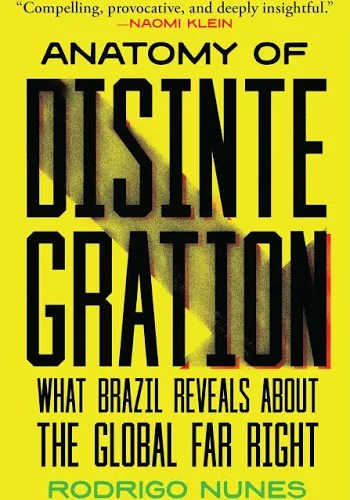
A Review of Anatomy of Disintegration: What Brazil Reveals About The Global Right (2026) by Rodrigo Nunes
I
In the first round of Brazil’s Presidential election on 4 October two candidates advanced to the second round runoff which will take place on 25 October. They were the incumbent leftist Lula da Silva, leader of the Workers Party (PT) and his far right challenger Flávio Bolsonaro of the Liberal Party (PL), the eldest son of Lula’s Presidential predecessor Jair Bolsonaro who is currently serving a prison sentence after his conviction by the country’s Supreme Federal Court for trying to organise a military coup to thwart Lula’s inauguration. Jair Bolsonaro, a former army captain and Senator is backing his son from his prison cell.
Flávio won the first round with 47% of the vote on a 78% turnout while Lula won 45%. Lula promised his supporters he would go “into extra time” to defeat the far right candidate but the 80 year old former metalworker and trade unionist has a proverbial mountain to climb. No second placed first round candidate has previously ever won the final runoff. If Lula who was twice a runner up (1994, 1998) and three times a winner (2002, 2004 and 2022), succeeds this time it will be his greatest escape and feat.
Whatever the shortcomings of Lula and his PT government in his last term in office especially the economic and financial concessions granted to big capital and the ceiling placed on future public spending in obedience to budgetary responsibility which will seriously restrict the redistributive intent of any future reformist administration assuming Brazilian democracy will still be in any condition to allow such a possibility, the political stakes domestically and globally couldn’t be greater. This at least is a familiar refrain of the international commentary much of which reflects alarm that the far right distemper of Bolsonarismo, after the disgrace of père Bolsonaro, is set to make what appeared an unlikely comeback with the all the grim consequences for an embattled Amazon basin and its indigenous people and therefore the global environment, that would surely follow.
II
But there is another lens to examine the grave impact of an election triumph for Bolsonarismo than another blow to faltering global efforts to mitigate GHG emissions, and that is what Bolsonarismo tells us about the nature and prospects of the global far right. This phenomenon has been explored in exemplary, thought provoking fashion by a Brazilian leftist and academic Rodrigo Nunes who offers a variant of the ‘provincialisation of Europe’ thesis that can be extended to North America as the developed core of late late capitalism is challenged by the rise of various powers in the global South – most notably China whose arrival as a superpower underscores declinist narratives focusing on the US’s relative senescence. But it’s the political fallout with the rise of Populism and the far right globally, which captures Nunes’ attention. Nunes offers a number of arguments about the nature of the contemporary global right, and the relevance of what is happening in Brazil, Argentina and other south American countries gripped by the march of the far right. In a reversal of the usual assumptions of social scientists, Nunes proposes the so-called periphery shows the old core of the developed world its future: the Brazilianisation of the world.
Domestically, Bolsonarismo is an inflection of the right, a confluence of a specific emerging political economy, the shortcomings of the Workers Party (PT) government and a window of opportunity for Brazil’s elites to roll back the democratic settlement of 1988. But there is also the imitation of Trumpism with a recognition the hemispheric political weather has undergone a change due to the radically changing political landscape of Brazil’s superpower neighbour. Nunes insist Bolsonarismo and Brazil’s trajectory – a sizeable populist revolt against the previous political settlement, the growing social weight of certain upstart fractions of capital: extractive industry, logging etc, yawning social inequality and blooming precarity – aren’t developments on the ‘margins’ of the system but are a mirror of our global present and future, of social decay and disintegration against the backdrop of climate breakdown. More parochially Nunes suggests père Bolsonaro’s career, army captain, senator with years on the political margins as a ‘wild man’ offers a suggestive anticipation of the likely tighter fit between repression, economy and state, issuing in forms of “overseer capitalism” for the beckoning social-historical ‘state of nature.’ Already a new model of “predatory accumulation” is taking shape across the world, of a differentially distributed ‘state of nature.’ All this sounds like the grim antechamber to species ecocide or similar.
Nunes’ argument suggests about an elective affinity between Trumpism and Bolsonarismo, the relevance of the latter for the global far right’s trajectory but doesn’t directly address China’s direction of travel, either its efficacy as a political model (authoritarian surveillance state capitalism) or its economic model (state as economic overseer) but the conclusions he reaches on the likely arc of the global system suggests an even darker ‘landing point’ than a future in which some optimists see China as an orderly harbinger for a new sustainable economic and social order – ie., a transition to Net Zero with China (the country consumes over 50% of global supply of coal, more than the rest of the world combined) based on its increasingly rapid production of EVs and the scaling up clean energy technologies which it is also assiduously exporting to many countries in the global South who are in turn keen to escape a disciplinary Carbon regime whose backstop is Trumpian governance. Instead Nunes’ talks of monopolisation and the extraction of rents as means of accumulation, the outsourcing of aspects of the state’s current roles, its infiltration by lobbies and organised crime and the possible arrival of a far right authoritarianism that operates as referee of divergent social interests. Many of these trends are already evident across the world.
In his conclusions Nunes’ eloquently lays out the civilizational stakes. Basically, Brazil exemplifies the global disaggregating tendencies of a new phase of neoliberalism, neither the conservative neoliberalism of Reaganism and Thatcherism but also lying beyond the progressive neoliberalism of Blair and Gerhard Schröder marking Labourism/Social Democracy’s historic accommodation to the market. Even this latter model is breaking down due to powerful economic, social and political tendencies: growing national revanchism, breakdown of a rules based ‘international community’, yawning economic inequality and the spread of precarity to hitherto immune areas of employment and social life – a process likely to speed up as Big Tech deploys AI which is notable for the complete absence of a convincing promise of universal uplift. Distant is the memory of the original ‘utopian promise’ of the networked world heralded by the internet’s original introduction. Instead we are told daily, in so many words, much of humanity is either supernumerary (not Musk, Thiel et al of course) or we may all have to make way for an artificial super intelligence.
In any case everywhere public poverty and private affluence shape political life and where democracy exists it’s either embattled or faces extinction – a possibility in Brazil if Flàvio achieves power or is remade into an authoritarian Majoritarian or ‘managed democracy’ after the model of Viktor Orban’s Hungary, with the far right either in the saddle or knocking at the door of government. As Nunes underlines a society of far greater risk and precarity, dedicated to insulating capital’s interests both from subaltern challenges and climate breakdown, is compatible with “degraded democratic institutionality.”
This is quite some development after the 2008 financial global meltdown which shook capitalism and briefly promised to be terminal for neoliberalism. Instead global finances debt was socialised and essentially loaded on citizens backs while the state delivered punishing austerity on behalf of finance. Neoliberalism came roaring back in mutated form. Indeed for all those who in recent years declared neoliberalism to be dead or redundant, or pronounced they were bored with neoliberalism, the latter is still not yet done with us. Perhaps what is relevant is the enduring supremacy of capital and the novel mutative form neoliberalism has taken.
It’s interesting Nunes’ speaks of the far right and resists using the term fascism. He’s clear we aren’t experiencing a rerun of the 1920s-30s. This far right is historically distinct and novel but diverting doctrinal disputes about fascism’s nature are unhelpful when the left is becalmed. Increasingly, right-wing ideologues and their visions of a right Great Acceleration, no longer pay lip service to constitutionalism or consensus. Aware of a broad ‘crisis of legitimation’ the far right spy an opportunity as Lords of Chaos to peddle policies and programs previously unthinkable in the mainstream realm. But the peculiar political obsessions of someone like Curtis Yarvin that attract notable figures like J.D. Vance or right wing talk of “patchwork” sovereignty highlighted by Quinn Slobodian are mere “window dressing” Nunes argues compared to the sysytem’s deeper disaggregating tendencies which create the chaos the far right has thrived on.
A paradox of global capitalism’s recent development is on the one hand there has been a ‘return’ of revanchist nationalism and a greater willingness by the state to pursue re-territorialisation and war as a tool of state power. Trump’s Tariff policy isn’t merely an economic instrument but also an act of aggression intended to punish and reduce the country they are imposed on. As Paths and Bridges insisted Trump unbound without the tenuous constraints of his first term, would embody malign decisionism in action and wreak “havoc and chaos everywhere” in an uncertain world of Great Power coercion and geopolitical turmoil.
Nunes argues its evident there has been a breakdown of certain functions of the state and the idea that it offered universal protection to all citizens. Revanchist nationalism foregrounds the state’s military role as domestic precarity grows. The social policies of the right withdraws or privatises former sources of support, exacerbating atomisation in a social universe where individuals are increasingly compelled to act like ‘entrepreneurs of the self.’
Here a social-historical ‘state of nature’ beckons – the Risk Society, riskier and writ large. One slowly unwinding response to the 2008 financial and economic meltdown is emerging national autarkic revanchism to judge from Populism’s programs in the global North and South which probably indicates the relevance of the state’s bio disciplinary role and willingness to use domestic repression of opposition framed as ‘law and order’ and latterly the ‘war on terror.’ Fatefully much of the mainstream left followed the ‘liberal centre’ and giving credence to such discourses despite being supremely congenial to conservatism and the far right. Echoing other contemporary thinkers Nunes claims the boundary between biopolitics and necropolitics becomes a frontier of competition – which is to say entwined as precarity in the broadest impacts the lives of billions including those previously ‘affluent’ denizens of the developed world. In a transactional world of revanchist nationalism and climate breakdown, wars, displaced populations and genocide, what Achille Mbembe described as zones of death, of biopolitical precarity, in turn spread and inevitably encroach upon zones of the civic and pacific as barriers and borders become more permeable. The right has cultivates the anxieties generated by the encroachment of the Other and yet the differential impact of climate breakdown that drives war, social conflict and the movement of displaced populations, was created in the global North.
Yet the revived salience of Leviathan and revanchist nationalism, the renewed importance of the state, isn’t a pure and simple throwback to an earlier of stage of state capitalism. Neo neoliberalism or zombie neoliberalism, or whatever we call it now, means the state can live with the privatisation or outsourcing of various functions it used to provide. Clientalism, nepotism, graft, corruption and other plutocratic tendencies are spreading to nation-states previously seemingly immune to what was regarded as pathologies of underdevelopment. One is reminded of the late Alain Touraine’s argument contemporary developed societies were undergoing a process of de-modernisation while mere ‘being’ had displaced ‘doing’ as the phenomenological-ontological horizon of our moment.
The far right lean into the chaos they create and the economic and financial storms generated by the system itself. A notable feature of global politics is growing polarisation as the former consensus breaks down. In the US, Nunes acutely observes Obama style liberalism is effectively defunct or “devalued coin.” The polarisation of US politics and society isn’t just a breakdown of the bipartisan consensus between the Republican and Democratic Party but is an “asymmetrical polarisation”. It is the right that has exploited the crisis and legitimation crisis of the system they were largely responsible for creating in the first place. The right has grasped the nettle, proposed the unthinkable and redefined what is possible. The right ‘radicalised’ while the left temporised. Nunes lucidly explains the ‘centre’ much of the left still appeal to, has evaporated. The right’s cause was helped by its willingness to be ‘radical’, proposing the unthinkable while the left, finding itself virtually the sole occupant of a vacated centre ground and an earlier status quo, struggles to shrug off its previous stance – a marriage of vaguely progressive managerialism and the market, comfortable with wealth and offering a milquetoast politics of recognition exemplified by Blairism – becomes fatefully identified with what is broken. And no wonder when its cautious pragmatism was established on the basis of accepting the terrain and rules largely drafted by the right before it decided to move on.
III
The main focus of Nunes’ book is the central role social media or platform capitalism has played in mainstreaming far right talking points and politics, the emergence of a ‘carnivalesque’ fascism delighting in transgression and adeptly exploiting the psychical and the perverse. But what are the actual mechanisms driving the asymmetrical polarization marking political competition in Brazil, delivering Trump and MAGA in the US, Brexit in Britain and the rise of the AfD in Germany to name only a few instances?
Nunes points to a process of schismogenesis (coined by Gregory Bateson) taking place where two sides of an argument increasingly define themselves and their identity in opposition to the other (1). In Nunes’ mind this development resulted from “two epochal events” of the late aughts – the 2008 financial meltdown and platformization. Social media’s platforms function on the basis of logics of algorithmic recursivity and, according to Nunes, these ‘train’ individuals over time to act in the same way helping create and curate identities and, by extension, the formation of in-groups. Once this process of “inverse mimesis” has achieved lift-off then in-groups are likely to define themselves in opposition to other groups in less than benign fashion, so that unchecked, out-groups become pathologized, the enemy. From the point of view of the left while the right is the enemy, such a process make it more difficult to detach the contingent, causal voter or soft supporters of the right from the dyed in the wool racist or convinced fascist. These gentle reproaches to sections of the left (and his flagging up of the seductions of digital platform rabbit holes) are a welcome reminder from Nunes about how we (the left in-group) must be wary of taking refuge in identity and purity in a complex political environment requiring fleet footed responses from our side. We might add in-group whether online or offline must resist the censorious environment of the ‘charmed circle’ – the scorched earth milieu which while maintaining ideological purity, repels many others.
As mentioned, the mainstreaming of the far right wouldn’t have been possible without the 2008 financial meltdown and the ensuing entropy of mainstream politics that has also engulfed the left. For Nunes, the super-charged digital rhetoric of the far right aided its political capture of social media’s attention economy also helped by the loaded algorithms of the dominant platforms owned by Big Tech and a sociopathic billionaire class cosplaying Hitler and Goebbels. These platforms have rapidly established themselves in the social life of billions across the planet. Currently almost 70% of the global population are hooked up to social media and this continues to grow 2-3% annually with Gen Z (16-24 year olds) and young millennials (25-34 year olds) forming the most active cohorts. Gen Z, numbering about two billion people globally, were the first to grow up with smartphones and high-speed internet.
The sense of Nunes’ argument is that social media’s digital platforms aren’t simply a medium or transmission belt for what was frankly formerly a poisonous politics cultivated by cranks and creeps at the social margins – the politics and ideologies of the far right, are in our hypermodern times at the centre of our social lives, meaning social and digital lives are all but inseparable while the nature of this particular digital architecture discourages alternative, say, more collegiate or collective, ways of using social media. Many will recall the original ‘utopian promise’ of a networked world in the internet’s frontier days despite whether they fully shared these hopes or otherwise. Who today clings to such roseate illusions now social media has lost its utopian bloom?
But the wildfires of Populism and far right ideologies couldn’t have spread so effectively without the continuing reverberations of the 2008 global financial meltdown and later the impact of the COVID-19 pandemic. The former, briefly, promised the ditching of neoliberalism and what Bruno Latour described as the “wicked universality” of globalisation. This wasn’t the sly antisemitic trope that sadly thrives everywhere. Latour didn’t object to globalisation per se, or what he called globalisation-plus but the top-down, uniform globalisation negating national sovereignty everywhere as stable employment coupled with life chances was wiped out, and whose suzerainty resided in Wall St., Beijing, the City of London, Brussels and so on (2). Tepid reformism wringing its hands about yawning social inequality which nevertheless regarded deindustrialisation and the rest as inevitable threatened to give way to more authoritarian, unpalatable alternatives such as Naomi Klein’s “fascist clown State” offering the libidinal compensations of punching down at migrants and asylum seekers, Bread and Circuses, except perhaps a little less bread and more mixed martial arts, livestreaming executions as well as Netflix (3).
IV
To conclude this review Nunes’ criticism of the left is broad. Some of his criticism (or advice), was noted above: the dangers of identity’s seductions and sectarianism reinforced by the left’s embattled situation and compounded by social media’s schismogenesis. Nunes doesn’t bemoan the left’s poor record in power, its compromises and retreats, the eschewing of revolution for reform or ‘gentler’ management of the system but he does strongly hint at these political horizons by underlining the left’s lack of realism before zombie neoliberalism and the disaggregating tendencies of late late capitalism. Instead much of the left has made itself prisoner of a different incapacitating ‘realism’ utterly inadequate in the face of the climate breakdown emergency.
The implication is the left itself needs to quickly adopt a new radical stance. In Britain the advent of Andy Burnham, his arrival as the Labour governments PM after Keir Starmer’s abject failures is welcome and even surprising in some respects (calling out Israel on Gaza, its settler violence in the West Bank, broaching Brexit’s hit on the economy and rejoining the EU) but Burnham’s economic inheritance like Starmer before him, is unenviable. There is little room for manoeuvre for a modest reform program let alone something more muscular and this is compounded by the impact of Trump’s dismal adventures in Persia on government borrowing costs. Yet for all the brave talk about breaking with Thatcherism’s failures (correct), good vibes and caution remains the overriding leitmotif as the issue of nationalising the truly rotten water companies illustrates – still being swerved despite its popularity with the public (though it’s still a possibility). The recent announcement allowing drilling in the Jackdaw oil field in the North Sea underlines the policy timidity.
Nunes discusses the staple of political theory ‘Overton’s Window’ (or contingent ‘window of opportunity’) and basically suggests there is a potential coalition or bloc for radical change that would be in a progressive, left direction. Currently the right are posing as the party with radical solutions (their anti-migrant, ethno-nationalist fever dreams will mean the continuation of disaggregation and chaos). Nunes notes Overton’s political window isn’t static or immovable and it changes with time as it has done in recent decades with the impact of the economic and political shocks of the system. A symptom of such shocks is surging Populism in the global North and South, which also reveals how this window has dramatically shifted. The left need to find their own radical political vision – one that could win those who aren’t invested in left identity including detaching some of the ‘soft’ support gravitating to the right – especially those who are involved in an ever sharper struggle for survival at the bottom of society who are offered the modest compensation of exercising their “antisocial wills” (owning guns, driving above mandated speed limits and so on) and even sadism, trends which are a result of decades growing poverty, inequality, atomisation, promotion of me, Self and I and the rest – a habitus that currently migrates to the right and far right but whose own claims to radicalism are a grim counterfeit and imposture.
Jules Etjim 20-25 October 2026
Notes
(1) Gregory Bateson Steps to an Ecology of the Mind (1972).
(2) Bruno Latour Down to Earth: Politics in the New Climatic Regime (2018).
(3) Naomi Klein Doppelganger (2025) p.12.

