Review: Christopher Bollas ‘Meaning and Melancholia: Life in the Age of Bewilderment’ (2018)
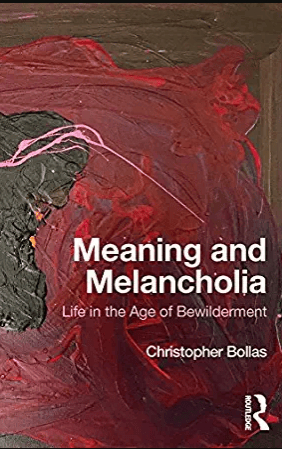
In this small but densely packed book teeming with vivid observation and bold, gnomic argument, Christopher Bollas, talked of in some quarters as one of the greatest living psychoanalysts, grapples with the psychosocial malaise afflicting our contemporary civilization as it lies stretched out, as it were, on the proverbial analyst’s couch. Frames of mind – Intellectual climate change – Bollas’s limpid, centaur like sentences: ceaselessly coining new concepts and neologisms, ensure his text is packed with many fireworks in its hundred and twenty nine pages. The downside of such admirable economy is most points are never really unpacked or fully developed. Though Bollas’s arguments are often provocative this doesn’t detract from this arresting, thought provoking intellectual ride.
Bollas’s bold, diagnostic intent is not dissimilar to Freud’s late, great cultural books like The Future of an Illusion, Civilization and Its Discontents and Moses and Monotheism and though Bollas doesn’t replicate Freud’s panoramic sweeping back and forth between humanity’s archaic past and modernity, he is far more politically pointed and engaged than Freud was ever prepared to be. Inevitably the leaps are not always convincing but the speculative brilliance on show makes it easy to forgive such lapses. In Freud’s case the spur prompting the wider examination of civilization and culture was the catastrophic blows the First World War rained down on the bourgeois world which had shaped him. Similarly Bollas identifies a gaping void at the heart of our civilization so starkly exposed in 2016 by Trump’s America First electoral triumph and Brexit in Britain. Both earthquakes were symptomatic of a quickening global political tide energising the renascence of the populist right and fascism. It is to Bollas’s immense credit that he grasps the grave threat posed by a Trump Presidency and the return of fascism globally. Of course Bollas is also striking shapes not that dissimilar to earlier criticism of Americanism which reflected resistance to the seductions of the Coca-Cola Empire. However the continuing ‘boom’ of this critical, diagnostic discourse in recent years has thrived on a new axes, boosted by the startlingly visible decline and decadence of the American Republic exemplified by the arrival of the Narcissist in Chief in the Oval Office in 2016 but apparent even before this High Noon.
Though an American Bollas very much belongs to the ‘British School’ or Object Relations branch of psychoanalysis pioneered by Melanie Klein and her followers and based at the Tavistock clinic in London (where Bollas worked and trained for a period).
Bollas considers Trump and Brexit to be symptoms of Splitting and enjoyment. While more than half the American citizens who voted rejected Trump and were distressed by his victory, Trump’s voters were ecstatic. Nevertheless they shared some of the sense of loss felt by anti-Trump voters. Trump voters have cut out a part of their selves and disposed of it while Trump’s victory is partly the fruition of a longstanding “psychological distress.” Here Bollas echoes other critical summaries of our times specifically focused on the rapid transformation of the Self that has paralleled social media’s dramatic global inflation meaning instant connectedness displaced reflection and introspection. Powerful psychosocial forces are shaping our culture. Bollas believes the extant psychological topography is evolving into customs, axioms and patterns of thought solidifying organizing structures able to generate discrete mentalities or forms of behaviour. Some of these mentalities “cripple being” revealing the existence of certain baleful, structuralized frames of mind. An example Bollas cites is the structuralized depression which was imposed on generations of African Americans and passed on as an “unconscious principle” and dominating how they were to live during and after slavery.
Bollas argues psychological axioms may constitute culture via frames of mind. Certain frames of mind aided Trump while his electoral victory as an event was also a psychosocial ‘split’: the manic euphoria of the winning side contrasting with the depression of the losing side. Similar psychosocial trends stretch back to the birth of modernity. The First World War caused a profound plague of loss, unresolved mourning and mass melancholia accompanying widespread anger, despair and disorientation. Today life has been hollowed of meaning while ‘recreation’ for millions is dominated by forms of avoidance and pain dulling: painkillers, drugs, alcohol, fitness regimes, pop psychologies, swinging and forms of self guided existence as an alternative to religion.
The C21st is now dominated by “myopic utilitarianism” as a universal ‘social amnesia’ sees life to sink to existence. In the virtualsphere of social media, form seizes the heights as content becomes vestigial. Meanwhile religion as ideology, armed faith and fundamentalism revive in allergic reaction to thinking and autonomy. Neoliberalism’s rise paralleled a loss of faith in collective progress and the individual’s ability to be the mediators of their own lives. Instead many embraced the “narcosis of self-abandonment.” Freud’s early 1920s rethinking of the topology of the psyche suggested a new theory of Super Ego, Ego and Id sought to explain how our archaic drives were regulated. Similarly the arrival of Id Capitalism (Bollas) was the moment unregulated capitalism pushed regulated capitalism aside. The gulf between reality and the American Dream yawned wider.
Before 1914 the ‘future’ was a desirable destination but over a century later Western societies had exchanged the search for individual or collective meaning for material comfort. A social epidemic of pain marked by generalized anxiety, depression and profound disorientation prevailed while Trump was evidence of a universal malaise also incidentally supplying a post facto justification for “psychological analysis.”
The greatest danger of our age is war and violence and Bollas observes “…it is a sad fact that our psychology allows us to take pleasure in killing, especially in mass slaughter.” A key psychological enabling mechanism for aggression is Projective Identification ie. projecting our own murderous wishes on to the Other as a prelude to unleashing violence as in the exemplary example of Bush and Blair’s WMD fables. Like past critics of violence as a political weapon (like Claude Lefort and Jacques Ellul for example), Bollas recognises how the mechanism of Projective Identification also harbours a wish to rid society of complexity while violence flourishes with the simplification of reality. The ferocious violence of this modern age of uncivil war which recapitulates the archaic past, is the abattoir of truth.
Before modernity’s arrival, religion was central to ‘meaningful’ life but from the C18th onward the locus of meaning migrated to ordinary life and people now had to search for, or construct their own meaning. Authority and tradition were no longer the pre-eminent forces shaping belief with the breakdown of the old rigid classes and estates of an overwhelmingly agrarian society. The C19th ushered in age of organized memory and self observation. There was an explosion of culture (museums, libraries, literacy) and the idea of the mutually reinforcing development of individual and society took hold. This expansive new world created an opening psychoanalysis. Freud’s The Interpretation of Dreams (1900) delved into the unconscious and dreams to disinter their polyvalent meaning. But by the mid C20th the elan of this cultural explosion was already waning. The destruction of the First World War was a watershed. Germany, which had rapidly industrialised in the last half the C19th and became politically unified five years before the Franco-Prussian war, greeted war’s outbreak in 1914 with manic celebrations. Defeat for Germany was devastating. Gustav Le Bon, a pioneer of mass psychology and a powerful influence on Freud, had already underlined the arrival of the ‘crowd’ with modernity ushering in the age of gross politik. According to Le Bon the individual in the crowd essentially regressed and as the religious sea of faith receded, new modes of thinking started to appear.
Bollas suggests Europe’s development was like an accelerating electric tram allowing certain psychological states or ‘frames of mind’ to blossom in opposition to the ‘persistence of ancien regime’ (Arno Mayer). This novel ‘frame of mind’ was inflected by narcissism and exulted belief in the Western world’s superiority which in some forms would hatch into mania (fascism and war) though the ultimate apotheosis of this runaway trend didn’t arrive until the Second World War. Freud himself struggled to assimilate the brutal impact of the First World War, its shattering of the lofty ideals of European ‘civilization’. Writing to Lou-Andreas Salome, Freud lamented: “I know for certain that for me and my contemporaries the world will never be a happy place. It is too hideous…humanity seems to be really dead.”
This crisis was the backdrop for the psychological mechanism of ‘splitting’ to flourish Bollas claims. In the C19th the mechanism of ‘splitting’ allowed Christian European civilization to coexist with the barbarism of colonialism and imperialism. In psychoanalytical terms ‘splitting’ of the Self or the object is an ordinary mental action including compartmentalisation that usually allows individuals to ‘function’ and get work done. ‘Splitting’ is a form of psychical homeostasis: often what is split off is painful, it has to be dumped or banished but such processes could also diminish the mind, provoking a vicious cycle of flight from painful, refractory reality. In essence such evasions could be symptomatic of difficulties tolerating the imperfections or complexity of reality. It could also prompt delusional grandiosity apparent in the murderous ‘Projective Identification’ classifying black Africans as primitive and savage and therefore legitimate targets of unspeakable colonial violence. A near impregnable European sense of superiority and entitlement enabled the murder of millions. ‘Splitting’ was also central to aesthetic modernism. Dramatists like Strindberg captured the complexity of life and vacillated between various positions undermining the integrative capacity of the Self. Bollas contrasts the democratic ‘frame of mind’ able to tolerate differing elements of the whole mind and cognitively using vacillation to empathise with the other – to a closed or manic ‘frame of mind’ that exalted the violence as in exultant plague of the First World War. ‘Splitting’ and Projective Identification of the Other as ‘enemy’ ensured the Other-Enemy embodied the hated parts of the Self that one wished to be rid of. The obliteration of the Other – murder – was ‘cleansing’ or cathartic, allowing the manic Self to be rid of depressive elements but such catharsis was short lived at best. In Kleinian fashion a manic defence desperately sought to ward off depression but depression was destined to return nourished by the Self’s desolating loss of belief in the mind’s goodness. Murder – as means of relief and banishing depressive elements, instead intensified depression and would never provide stable psychical respite.
The period from the First to the Second World War marked a Rubicon for the human psyche. The trauma of war, civil war and fascism was almost unfathomable. Life literally was meaningless as Camus and Sartre apprehended because the living were dead inside, realising Freud’s fear. Bollas continually underlines psychoanalysis’s historicity and in this spirit explores the concept of the Borderline Personality Disorder (BPD) or ‘borderline personality’ introduced originally by Phillip Knight in 1953. The ‘borderline personality’ – exemplified ‘splitting.’ One part of the mind was unaware another part held diametrically opposed views – a globally relevant vision also applicable to nations and inter-state relations. This wasn’t to be confused with ambivalence either. Rather see-sawing between negative and positive mental representations typified the ‘borderline personality’ who might also display symptoms of manic depression. For example, in the immediate post-war years the US basked in the prestige of being the world’s ‘liberator’ after fascism’s defeat and the roll out of the Marshall Plan for Europe. Yet the US was also a global “war-machine” and its supposed raison d’etre to defend liberal democracy and the free market was belied somewhat by aggression in Vietnam. America was bewildered: why doesn’t the world like us? The ‘borderline personality’ split was highlighted by reaction to 50,000 US war dead – lachrymose self pity – in contrast to the sociopathic disregard for the millions of Vietnamese war dead (combatants and non-combatants, not to mention the death toll in neighbouring countries).
The split within US society between an Ideal America (land of the free, Manifest Destiny, the American Dream) and paranoid America (white supremacism, intolerant Christian fundamentalism) was mirrored by the global love/hate attitude to the US. Bollas follows Freud’s fundamental thesis stating social life requires the diversion of sexual and aggressive drives to the Super-Ego (the origin of conscience but also the starting point of culture and civilization). So Bollas draws an intriguing distinction between oppressed ideas and repressed ideas. The latter could lie dormant but return from the past reanimated while oppressed ideas might reflect the over–determination of the outside (Adorno’s preponderance of the object) – for example, black colonial subjects internalising the racist imperial ideology of the ‘mother’ country Fanon studied, or Bollas’s “unthought known”, the oppressive, refractory weight of the always already social world impinging on intra-psychic life. In one sense the manic frame of mind was a defence – depression and splitting with one part of the mind immersed in events and another part dissociated and elsewhere. This was how most individuals were able to carry out murder or atrocities in war. The threat of imminent death already generated a state of dissociation. The dissociated Self walked hand in hand with the other (damaged) Self, helping it along like a friend though Bollas proposed the net effect was indifference to the mental suffering of the damaged half. Why else allow the damaged other Self carry out ‘bad’ acts or atrocities? This in nuce was splitting (individual and communal): “American innocence has been built upon the house of cards of self-idealization. Vulnerable ultimately to the incontestable evidence of its capacity for grievous wrongdoing, the Vietnam era opened up a fissure in American identity that has never been healed” (37).
According to Bollas’s judgement, (echoing an angsty trope of native criticism), the American mind is unable to reflect on its guilt in the war’s aftermath and in the “cold Civil War” (Carl Bernstein) still dividing America, the nation’s imperial crimes are buried deep, ignored in acts of refusal and deferral amounting to dissociation that might prevent shock but also bars critical discussion of the departure from the ideals of the Republic. Bollas believes that America’s crisis has a deeper fundamental meaning: a loss of faith in a progressive tide and economic uplift. In the C21st Americans and Europeans seek substitutes in the absence of meaning including drugs, alcohol, Netflix, alternative religions and so on. Bollas boldly claims the citizens of the developed world have immersed themselves in material comforts and recreation incidentally liquidating introspection as Normopathic life becomes universal and mental functioning including empathy and curiosity, withers before encroaching depression.
In this context Bollas reflects on the relation of the Self to globalisation and draws attention to the contrast the sociologists Elliott and Urry’s drew between ‘globals’ and ‘locals’ in their study ‘Mobile Lives’ (2008). ‘Locals’ are fixed to a specific spot and less able to participate in social networking. In contrast ‘globals’ travel extensively and experience “meetingness” and are able to exploit the material and social advantages of globalisation and burgeoning social and capital networks. What ‘globals’ embrace is the focus of grievance for ‘locals.’ In the contemporary world the I contains multitudes, a legion of specular selves enjoying many virtual relationships, transforming human beings who increasingly inhabit multiple worlds. Wherever we go our virtual companions accompany us: the self has become the “transmissive self” allowing us to transmit our private selves to the world via various social media devices – phones, iPads, laptops. We are the extensions of our devices and when we upgrade them we effectively upgrade ourselves. In this new world we are asked to assume a role in a wider network, to identify with a thing or a part transforming our position from passive to an active position. As an example Bollas cites the anticipation surrounding the launch of the latest iPhone where transmissive object meets transmissive self. Bollas claims a downside of this emerging “global self” is the Self’s eclipse by group psychology that is regression in a novel form, enabling dissociation and allowing people to go back and forth between their actual and virtual selves and participate in social networks that offer the recognition and affirmation we crave.
The universe of social media with its multiple virtual worlds inevitably impacts on our interior world. Refuge is sought in psychical enclaves in contrast to the earlier dizzying modernist experience when people sought out the derangement of the senses and encountered the shock of the new living in the city (London, Paris, New York, Berlin). The retreat into enclaves (to slow life down and blunt Accelerationism) amounts to a sort of gentrification of the psyche. Yet the speed of life will not be thwarted as private space diminishes. As people desert interiority they no longer dwell in literature or music as they once did. In a derivation of Le Bon and Freud’s arguments about intellectual regression in the context of the group, Bollas proposes that shallow horizontal ‘thinking’ destroys vertical thinking (hierarchy and authority derive from expertise, reflection and introspection). Indeed the medium of social media, the virtualsphere, reduces everything to same level from storms in the US to revolution in the MENA. Differentiation retreats before the homogeneity that is the telos of globalization. Bollas thinks modernism brought people together to be different but the trend of homogenisation today proceeds because people fear being different – now “being on the same page” is at a premium.
Such tendencies unleashed by social media and globalisation have profound implications for meaning today. Meaning is being eliminated as sight replaces insight – we see but we don’t see, a malign tendency Bollas dubs as sightophilia. As corporations colonize the lifeworld they put a lock on the present and the future while the self undergoes “subjecticide” losing autonomy and agency and becoming an object among many objects. What remains of the Self or subject has an elective affinity with the object universe – she wants to become an object. “Refractive thinking” dislodges reflection as thought dissolves into fragments. Over a century ago psychoanalysis zeroed in on the ‘return of the repressed’: how unwanted psychical contents reappeared in disguised form. Bollas considers this psychical process has been joined by the ‘return of the oppressed’: where the Self is assailed by new oppressive forms of thought. These new forms of ‘thinking’ qua defence against thinking and the avoidance of psychical pain, reflect a novel Self that starts to crowd out the old Ego, expunging reflection and perception. In such a situation the analyst’s challenge is how to restore interest in being a subject again? In short the task of therapy (the revitalizing “Freudian pair”) is to dissolve these oppressive patterns of ‘thinking’ in order to help the Self or subject grasp what a subject is and who they are in opposition to the traps of a “normopathic universe.” Therapy has an ethical dimension or goal, an essential kernel that recalls Socrates adage: a life unexamined is a life not worth living.
Bollas is at his most arresting in applying his general psychoanalytical critique of the age, to the phenomenon of Trump, the global rise of the right and the revival of fascism, all of which are critically regarded as a reaction to globalisation, and a flight from complexity into the oceanic realm of simplicity and identity. In the US Trump’s supporters are united by a specific ‘frame of mind’ – many are voting for racism but – closely related – also wish to banish complexity which we might translate as reality which implies both a backward looking nostalgia for ‘simpler’ times (all white neighbourhoods, full employment) and forward looking fascist social engineering. Trump represents everything bad within the Self: sexism, misogyny, racism, homophobia which he does little to conceal and this is what makes him ‘authentic’ in his supporters eyes in contrast to the career politicians. It was cathartic to hate Obama or gay marriage or environmentalists and this collective hate has a manic aspect in that it lifts people out of depression – at least temporarily – while aiding the evacuation of the mind by getting rid of the faecal objects of complexity (reality). Thinking, facts, genuine knowledge of the world only brings misery. Millions are offered the opposite by the Trump and the Republican party and they prefer it. It is no accident that Trump voters are the least likely to be college educated or value a degree – a badge of pride for some but actually an expression of their inferiority complex.
Clearly the psychical ‘relief’’ is vicarious and short lived as paranoia will inevitably assail the minds of those drawn to the racist, populist right and proto-fascism throughout the developed world. Those belonging to a group may partake in a process of paranoid projection: hatred for the Other based on the projection of dubious ideas and feelings onto others. Bollas cites Bush and Blair who worked themselves and their supporters up into a frenzy (not unlike Orwell’s daily two minute hate) over Saddam Hussein’s WMD. Yet the subsequent “shock and awe” rhetoric exposed the reality that the US and Britain didn’t really believe their own characterisation of the existential threat Saddam posed. The US could wax lachrymose: we are the ‘good guys’ as “might is right” held sway. While “violent innocence” and sanctimony walked hand in hand the “good guy” (or bully) was: “setting up Hussein as a toilet for the projection of American shit.” Today, Trump makes little effort to hide his mental processes as his racist trolling of the “squad”, four young Democrat Party women of colour sitting in the House of Representatives, has forcefully highlighted. These young Democrats have been powerful critics of Trump’s administration, particularly of Trump’s deliberate war against migrants, setting up barbaric detention centres where children are separated from their parents and people are forced to live in overcrowded facilities described as “cruel and unlawful” by Amnesty International and likened to concentration camps by Alexandria Ocasio-Cortez, one of the Democratic Party “squad” who was racially abused by Trump. It is clearly far from politics as ‘normal’ in the US – and it has not been since Trump ran for the Republican party Presidential nomination and won it. Trump is a racist but he is also a clear and present danger to US liberal democracy. Significantly Trump isn’t simply a fascist or ethno white nationalist outlier but sits in the Oval Office wielding immense power in the US but also immense influence abroad. Clearly Trump and the Republican party have no compunction whatsoever in using racism in a determined campaign to win a second term in 2020 and will use racism (and misogyny and homophobia) to energise and mobilise white Americans against the multi-racial coalition of voters heavily reliant on minorities that the Democrat Party challenge to Trump will rest on. There are plenty of instances of Trump’s racist Projective Identification for example when he accused Mexican migrants of being rapists that was really his own confession: ‘I am a Rapist’. Similarly Make America Great Again (Trump is allowed to criticise America unlike his political enemies) might be translated as Make Myself Great Again.
According to Bollas, the Military-Industrial-Psychological Complex is manned by Republican and Democrat “hawks” devoted to ceaselessly stoking hatred in established objects of Projective Identification and hunting for ‘new’ enemies who – lest the citizen forgets – never desist from trying to find ways to destroy America. The efficacy of having an Eternal Enemy feeds the repetitious search for new enemies and the cultivation of enmity reinforcing a paranoid, martial ‘frame of mind’. This is a bold if speculative insight on Bollas’s part and we would only add that if the ‘Spectacle’ or theatre of national politics demands Eternal Enemies then the homeostasis of the system is best served for most of the time by a Virtual Enemy. After all no rich or developed country can really afford to fight the modern age’s equivalent of the Peloponnesian War (it lasted 27 years). Such psychoanalytically functionalist reasoning hardly precludes the descent into a ‘real’ or hot war. The war launched against Iraq by Bush and Blair’s coalition was real but for the citizens on the home front in America, the war was instead ‘real’, a mediated specular double of the fury unleashed in Iraq, announcing a new phase of the spectacle.
More conventionally Bollas argues that succumbing to paranoia is an ever present danger though as a psychical stage it’s usually left behind as we attain maturity. Misery and unhappiness can always spark paranoia. Not all paranoia is ‘bad’ or negative – in Kleinian accounts of the development of the Self from infant to maturity, paranoia is an aspect of the development process that has to be psychically mastered and transcended as part of acquiring control of our internal and external universe, fusing love and hate and learning to accept the world’s complexity. In that important developmental sense as Bollas rightly argues, there is a positive paranoia. However, Bollas also warns against the cri de coeur of the Self: self pity. Paranoia feeds on the negative in a psychical process that is memorably described as “intrasubjective breastfeeding.” In an argument, again of Kleinian provenance Bollas suggests this entails the condensation of “hateful feelings” towards the outside world and “intense love” of the breast that “provides succour to the internal world.” This poisonous paranoia may manifest across a spectrum of behaviours: from addictive enjoyment of the “double expresso of hate” provided by shock jocks like Rush Limbaugh to the paranoid turning inward before the violent projection outward of the young men who carried out the Columbine massacre (significantly unlike ISIS these young men didn’t actually hate America). Massacres like Columbine are at the extreme end of the paranoid spectrum but millions also channelled paranoia when they voted for Trump and in doing so dangerously found confirmatory strength in numbers.
It is not only paranoia that can return and become outsized Bollas argues as certain ‘frames of mind’ can also be reanimated with the repurposing of older ideologies espoused by passionate new ideologues. As an example Bollas points to the mainstreaming of deregulation promoted in the US by fringe far right groups like the John Birch Society and suggests deregulation wasn’t an unmotivated ratiocinated policy but sprang from a hatred of the Federal government that is today deeply rooted in many US ‘Red’ states. Deregulation as a malignant political ideal that would eventually have real world consequences had a psychological correlate: the dismantling of all psychical regulation. Trump’s personal behaviour exemplifies the abandonment of self regulation – hence the constant lowering of the bar of acceptable political discourse with his sexism and racism. Bollas argues that the Republicans embody “Id capitalism” at its most naked while issues such healthcare and taxes, reveal them to be the most cold hearted sociopaths. For years now tax cutting and reducing regulation have been overriding political goals. There is also an acute sense of loss in America; that the ‘Golden Age’ of US growth and global supremacy lies in the past. Europe and South East Asia modernized, caught up and then started to leave the US behind. Bollas believes Americans largely share this sense of loss and are in the grip of a psychodynamic depression: loss of self belief, depression and feelings of helplessness. In this context the slogan Make America Great Again has more than a whiff of compensatory mania about it. Bollas suggests “ideological clinical depression” is at work while groups who support Trump or (like Brexit) are assailed by morbid states of mind. Essentially such manic depressive ideological outlooks are not simply ideological or political but also a psychological problem.
The malaise of the West and the developed world runs deep. In terms of Kleinian theory and Object Relations, the West ‘split’ from its manic depressive side (the D-Position in Melanie Klein) and projected it on to the post-colonial world and its people. The Western military-industrial complex, had a manic component: retain power and hegemony. Yet World War Two and the atom bombs dropped on Hiroshima and Nagasaki were the definitive full stop to the roseate picture of the West embodying humanity’s Progress. Today the manic depressive splitting of the ‘borderline personality’ has two elements: one of which idealizes the world and the other denigrating the world. Controversially Bollas thinks the left/right political divide may be largely be accounted for by this splitting process. Those on the left basically identify with grievance and feed off misery. So Bollas understands left politics – uncharitably and a tad reductively – as a form of ressentiment (a critical argument present in Hegel and Kierkegaard but associated in its substantial form with Nietzsche though the most sophisticated version was elaborated by Max Scheler who wanted to insulate Christianity from Nietzsche’s charge that it was a slave morality animated by ressentiment like socialism). In this context Bollas aims some cautionary remarks toward ‘Identity’ politics viewed characteristically in terms of psychodynamics: both a welcome push back against oppression and prejudice but also a search for belonging and meaning. The danger in ‘Identity’ politics lies in splitting or allowing the differences between women, blacks or LGBT for example – to become walls or for oppression to become an additive badge of distinction undermining solidarity and separating people who should be natural allies. Bollas doesn’t really unpack his cautionary critique but it is worth noting that he is a veteran of an older form of Sixties radicalism having been an active participant in the Berkeley Free Speech Movement (Bollas positively contrasts this experience to the moralism of contemporary campus leftism). In Bollas’s view this is a symptom of the universalisation of the ‘borderline personality’ and the fission of the normopathic Self. Trump and the right feed on efforts to evade the depressive side of life (perhaps this is one reason climate change denialism is such a fixture among hardcore supporters). Trump occupies the space of the death drive in dismissing the scientific facts – facts that constitute depressive Bad News and no doubt account for some of the popularity of Fox News which insulates its legion of loyal viewers from contact with reality. One positional good that a citizen of a developed country might have the luxury of enjoying is a paranoid retreat into an affluent silo while jettisoning any burdensome empathy with the global poor, exploited and oppressed, to create an alternative to reality. In an important sense as the global catastrophe of climate change comes into ever sharper relief, Trump and the Republicans double down on their promise of “normopathic materialism.”
How can such malign psychosocial forces be countered? Bollas suggests two approaches. The first, mentioned in passing, is social psychotherapy to address the psychosocial pandemics of contemporary life, to launch an assault on melancholia, depression and anger. The other approach is closely linked: therapy or the “talking cure” of the dyadic “Freudian pair” is analogous to democracy. Bollas approvingly cites J.S. Mill’s assertion that people were capable of rational reflection (a universal quality of the mind) and that the reflexive self inevitably made mistakes but in discussion with other reflexive subjects would be able to correct those mistakes. Bollas might have cited Habermasian arguments for the immanent rationality and democratic efficacy of communicative reason but he doesn’t take this route. Instead democracy is treated as a specific ‘frame of mind’ – a dialogue whose telos is a mutually beneficial enlightenment that banishes repression. Intriguingly Bollas points to the valuable lessons about groups and democracy that he learned while training in ‘Bion groups’ in the early 1970s at the Tavistock clinic. In this experience the whole group were responsible for any single address or remark made in the group and group leaders like a stenographer or clerk of record had to hold onto complex situations, register contrary arguments and resist trying to smooth out disagreement in the service of analytic listening. Wilfred Bion pioneered the idea of psychoanalytic group work and a working methodology that aimed to create a working democracy though Bion regarded his own efforts as a failure – see Bion’s dense and elliptical ‘Experiences in Groups’ (1961). The group encompassed all the good and bad impulses found in the Self (and wider humanity) and were simultaneously, spaces where the democratic process could potentially unfold and a space for the therapeutic process.
Bollas mounts a strong argument for the importance and reality of the democratic ‘frame of mind’: we all have an urge to express our views, to speak freely. Admirably, the ‘Arab Spring’ is offered as an example when people gathered on the street, in town and village squares or centres, and formed groups basically resting on democratic processes. Democracy is regarded as a ‘frame of mind’ but also something deeper and stronger. As Fukuyama noted between 1970 and 2010 democracies actually grew from 35 to nearly 120 or 60% of the world’s countries. The triumph of democracy would not happen because of Reason pace Hegel but instead the “reasoned self” would emerge from an “internal democracy” of many competing ideas as part of the development of the self. Bollas’s conception is not that distant from the sort of argument proposed by Axel Honneth in ‘The Struggle for Recognition’ and it is eminently Kleinian in that proposes the existence of an internal psychical universe of objects and an external object universe that the Self negotiates in the course of its development. Indeed the portrait of the mind – chaotic and shaped by powerful subterranean forces like the unconscious – presented by Bollas is one where democratic and totalitarian strivings conflict and interact and interact with the external world. Democracy is a potential within us all but requires careful nurturing in a collective or a specific institutional framework to flourish. The danger is that in the US (and elsewhere) liberal democracy is increasingly embattled and under immense pressure largely because of a profound sense of loss, of the appearance of a vacuum where meaning was supposed to reside at the heart of life. Instead a “shared bleakness” prevails; a sense that we have lost something and lost our way. In such a situation the essential twin pillars of democracy and a psychotherapy whose reigning sign is “know yourself” are both central to renewal, renovation and our survival as a species. As Bollas concludes:
“This work has attempted to explore a vital need to return to the creation of meaning, in our lives and in our societies, by making use of psychological insight within the experience of democracy. This offers a platform for national and international discourse predicated not on the free market of disturbed states of mind, but on a new form of collective understanding in which human beings can turn once again towards becoming humane beings” (129).
Jules Etjim

