A Moon of Nickel and Ice, Directed by Francois Jacob. Canada/Russia (2017)
The project, so intrinsic to capitalism, by which the world is conceptualised as resources, dead matter to be used toward the goals of accumulation and the transformation of the world, chrematistics and mastery, is sometimes laid so wide open in all its irrationality, that it brings into stark relief the madness of the civilisational complex we call modernity. Perhaps, now climate change threatens societal destruction, this has become understood on a wider basis. Up until now the question of why we seek to live this way has been mainly posed by ecological or religious thinkers – or both, like Jacques Ellul – or by “peripheral” communities at the sharp end of environmental destruction and social exclusion, who once lived by social significations totally incompatible with the ‘rational mastery’ master narrative at the heart of capitalism, and plainly see it as not rationality but dizzying delusion.
At the massive open mines of the Australian outback, on the levelled bauxite mountains of Orissa or in the Amazon perhaps there’s a clearer view? As for the Russian Arctic North, its history is perhaps the most entwined with the madness of the modern project. Though Communist Party bureaucrats from Lenin and Trotsky on would have considered the quest to master this massive landmass and draw from it the base materials of development as the epitome of sense, perhaps the young women and men from Lviv or Riga taken there under guard saw it for what it was, capitalist ideology spiralling out of control. Treated as much as objects as that which drew out of the Earth, they must have seen the madness as well as the cruelty there. To us now, it surely can be no more ‘rational’ than an Aguirre’s quest for El Dorado.


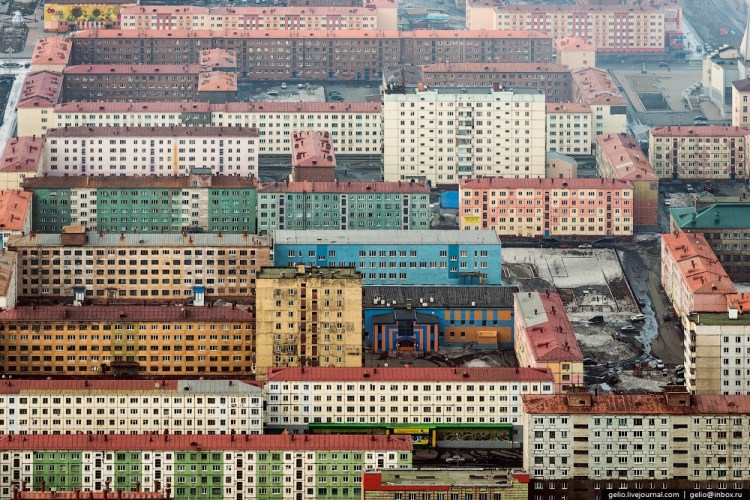
In this three places stand out. Magadan, the ‘gate of hell’ on ‘the island’ (so called as it was only accessible by boat despite being on the far eastern coast of Eurasia) from where prisoners were forced to mine gold and uranium at fifty below in the Kolyma mountains.(1) Vorkuta, where prisoners were sent from Moscow by train, until the railway ran out then marched hundreds of miles out into the wilderness alongside malarial waterways too shallow to navigate, to mine coal in prison camps at the Usa river basin (2). And Norilsk, created to mine the nickel from the Putorana mountains and process it in massive metallurgical plants, the northernmost city in the world, closed to outsiders and only accessible by plane or via the Arctic Sea. It is the subject of Francois Jacob’s documentary, ‘A Moon of Nickel and Ice’.
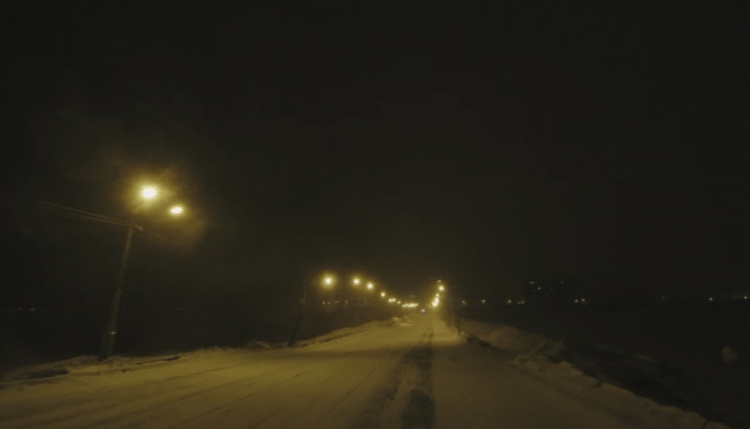
The foundation of these places read like some adventure story for trainee state bureaucrats, as free-wheeling explorers tapped the state to fund their expeditions into the endless permafrost horizon, with the promise of riches to follow. On having discovered deposits in the north of the remote Taymyr peninsula, such men put on Commissar uniforms to return with the state and 1200 prisoners to found Norillag (Norilsk Corrective Labour Camp). We are told that none of the 1200 survived long enough to be buried in graves. Seeing the frightening frozen windswept darkness filmed from a car window it is easy to see why.


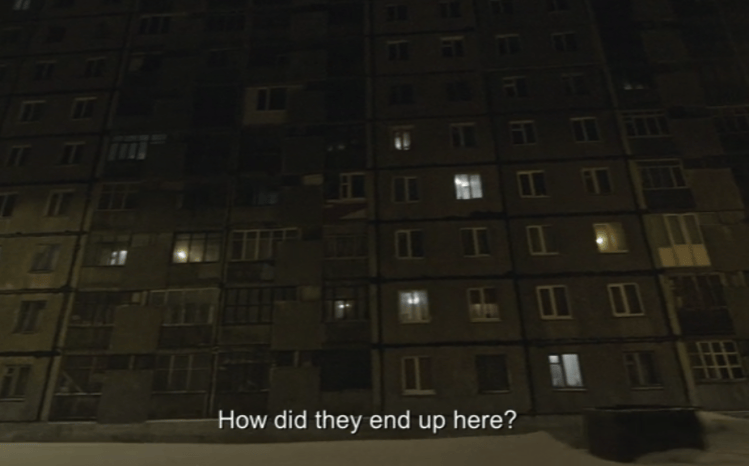
The dilapidated housing blocks and the antique-looking but functional mines, a thousand kilometres from the next nearest city, are a testament to human endeavour, in addition to man’s ability to treat his fellows as chattel, creating human mega-machines of awesome co-ordination with the whip hand. A pinnacle of creation of a dark kind, summoning awesome imaginative powers to build prison camp mines 400 kilometres above the Arctic circle in the name of the loftiest aims. Now a city of 200,000 souls, the most polluted place on Earth.
Through Jacob’s lens we meet various inhabitants, who he wisely allows to speak freely without a master narrator to endorse or contradict them. A Lithuanian with a tragic past who left his family to work here alone. A photographer-designer who says his home city was built through a kind of oppression that mirrors its merciless environment, he has recorded and commemorated its history in a book. Workers who joke their medical notes are as thick as a Tolstoy novel. Theatre makers who are used to playing to packed crowds for want of anything else to do (once commonplace in Soviet monogorods). A man whose grandfather was sent to the camp in 1937 as part of a purge of the Soviet intelligentsia. An articulate young writer who seems to see most clearly of all from the penury of her mother’s flat. A survivor who recalls he was known only by a number while he worked in the mines.
And we notice the long and thin street length concrete apartment blocks, overground pipes, metal towers, smokestacks and the thick sheets of ice. A camera tracks through empty evening streets, filled with florescent light, as a resident wonders where all these people came from and why they are still here.
To return to the question of man and nature, the ecofeminist philosopher Val Plumwood drew a very clear relationship between the domination of nature and the domination of people (and treating people and nature as objectified resources). She claims the dualistic relationship of dominator and dominated is based upon a denied dependency on the subordinated other. This shapes the imaginary contours of all social relationships whether human/nature, culture/nature, power/subjects (subject/objects), male/female and reason/nature. The second in these pairs is denigrated as inferior to justify its domination. For the bosses and bureaucrats that founded Norilsk the workers don’t think, the Party thought for them. Power plans and orders, the workers’ execute, or are executed.
“Dualism can be seen as an alienated form of differentiation, in which power construes and contructs difference in terms of an inferior and alien realm” (3)
Counter-revolutionaries, class enemies and non-historic peoples here are the inferiors to be worked to death in the name of the Party. Stalin in his Kremlin could hardly have considered those mining in the Far North or the environment they struggled in any differently to those who ran rubber plantations in the Congo or a Brazilian Minister of Mines and Energy. Indeed, the landscape of Norilsk and its outlying areas look like a scene from apocalyptic science fiction, used up and bled dry. Prisoners, workers and nature are the resources for power projects independent of their purview.
“The natural world and the biosphere have been treated as a dump, as forming the unconsidered, instrumentalised and unimportant background to ‘civilised’ human life; they are merely the setting or stage on which what is really important, the drama of human life and culture, is played out. In the dominant view, the biosphere forms the taken-for-granted material substratum of human existence, always present, always functioning, always forgiving; its needs do not have to be considered, just as the needs of other species generally do not have to be considered, except as they occasionally impinge upon or threaten the satisfaction of our own. Systematic devaluation and denial are perceptually ingrained in backgrounding, involving systematic not noticing, not seeing. The way in which we background nature is evident in our treatment of it in a range of areas; for example, it is backgrounded in standard treatments of human history. It is also backgrounded in standard economics where, notoriously, no value is given to anything natural or to resources as they stand before they acquire use-value or before human labour is applied, where no account is taken of natural limits and ecological factors are treated as ‘externalities’.” (4)


We hear that 650,000 prisoners passed through this place between its foundation and 1956. Those men and women built the camps they lived and worked in, then the city itself, with their bare hands. We see chilling drawings of the way it looked; see the crumbling remains of the timber barracks and working quarters where 250,000 died. 150,000 bodies were apparently dumped at the edge of the tundra where a Golgotha now stands. Instrumentalised bodies, not beings, as disposable as slag.
We also hear something of the Norilsk Uprising. When in 1953, 16,000 men and women went on strike for 69 days while the post-Stalin leadership panicked before putting it down with characteristic brutality. Like the Vorkuta uprising of the same period, its failure nevertheless spelled the end of the Stalin era GULAG system of mass slave labour. The rebels were mainly Ukrainians, Balts and Georgians, people who knew a lot about national as well as personal oppression. Little known and written about outside of memoirs and specialist histories, these uprisings have a place in the history of the project for human freedom and autonomy yet to be articulated and reconstructed. However, considering the extremity of the regime of domination and heteronomy in the Arctic camps, they stand as a high point in the history of rebellion. Yevhen Hrytsyak’s memoir of the uprising is, as far as can be ascertained, yet to be translated into English.


Though the means have changed dramatically, even now Norilsk Nickel admit they have to trap people to stay, encouraging the young to make families knowing they will be likely to be forced to stay in Norilsk in order to provide for them, taking up extremely demanding work at -40 outside or in the blazing heat of the foundries. The young people in the film say they wish to leave, though many suspect they are trapped and will end up like their parents. Unsurprisingly, considering the state-private nexus in Putin’s Russia when a resident we have already met stages a memorial for the 1953 revolt he is fined and made to do community service by the local courts.
In a town where the company decides everything, a GULAG town turned company town (to steal the title of Alan Barenberg’s fascinating history of Vorkuta), this past of slave labour is not publicly alluded to, and one can’t help to wonder how that sits in the psyche of those who call Norilsk home. Marina Arutyunyan has written on how the mass killing of the purges, collectivisation and the GULAG means that Russia is a society of recent descendants of victims, guards and killers, living together (often in the same family). How this past has been repressed in the Russian collective memory, and how these things must inevitably return is, for Arutyunyan, central to the continued support for authoritarian government among many Russians. One can only speculate about how this must play out in a city like Norilsk.


The setting makes this a film of great formal beauty, wisely shot and cut in a plain and unobtrusive way, with awesome inspiring tracking shots of landscapes, apartments buildings and industrial enterprises intercut with close ups of faces, drab interiors and everyday existence. The ever present voices of Norilsk residents on the soundtrack speak plainly of life on the periphery of civilisation. There for an export economy that extracts commodities crucial for modern capitalism in a place built purely on the mad logic of a heteronomous system in which progress means the destruction of the planet.
Though residents see the town is dying one can only hope that the day this city is finally left to the tundra and the smokestacks have stopped billowing, it isn’t because the world is doomed but because a collective decision has been made that places and practices like this should not exist.
by Joseph Aylmer
Notes
(1) See Varlam Shalamov, The Kolyma Tales; Janusz Bardach, Man is Wolf to Man: Surviving the Gulag (1999)
(2) Alan Barenberg, Gulag Town, Company Town: Forced Labour and its Legacy in Vorkuta (2014)
(3) Val Plumwood, Feminism and the Mastery of Nature (1993).
(4) Plumwood, Ibid.

