“The island and the enclosed town therefore form a representation to which historical factors have given a form and a substance but which are nonetheless linked to the unconscious fantasy, which is non-historical and which we seek to uncover…
The island and the enclosed gardens within it constitute a representation of the maternal womb in which the child finds an immediate satisfaction of his needs. So a return to the uterus and a new fusion with the mother are experienced. The inhabitants of the enchanted islands are therefore a horde of brothers who have taken possession of the mother, having banished the father.”(1)
Janine Chasseguet-Smirgel
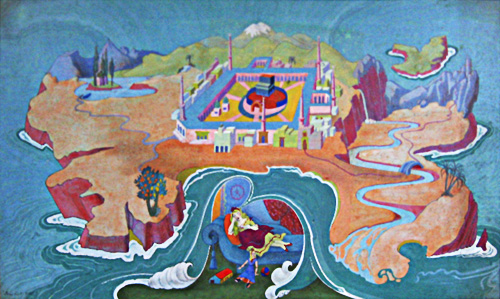
Ithell Colquhoun, Decoration for a Childrens Waiting Room (1936)

Arnold Böcklin, Isle of the Dead (1886)
Origins of Brexit?
Many reasons have been given for Brexit – reasons that when aggregated might account for why a slim majority of the British people backed Leave in the June 2016 referendum (a majority of the 72% of eligible adults who actually voted). Yet we think there was one significant reason behind the Leave vote and it was identified by most observers shortly after. That reason was racism – and it enabled the Leave campaign to effectively turn a referendum on continued EU membership into a plebiscite on immigration and stoke Islamophobic fears about Turkey’s ‘imminent’ accession to the EU.
Many commentators searching for the longer term factors behind Brexit have invoked a political backlash against Britain’s ruling elite and political class. Only recently Will Hutton pointed to the role of the 2008 financial crash in eroding public confidence in the economic system and polity. The economy was radically reshaped in the 1980s via financial deregulation, privatisation and the removal of regulatory safeguards in the banking sector that would have prevented the risk and speculative excess that laid the ground for the financial crash. Instead the state was compelled to step in and nationalize the banks bad debt and liabilities at the eye watering cost of unknown billions to the British taxpayer and households.
Yet the global financial collapse might have been more severe – remarkable given its effects are still apparent in the hit taken by incomes and living standards in Britain, a decade later. As noted, the state – or rather its treasuries in the US, the UK and elsewhere decisively intervened by quarantining risk and bad debt and by reducing borrowing costs to zero and providing almost limitless liquidity (quantitative easing) and other measures. In 2010 Cameron and Osborne squeaked into government with the aid of the Liberal Democrats, formed a coalition and declared the necessity for vicious belt tightening and austerity. The diagnosis was profligate state spending and it was dubiously suggested this was the root cause of the 2008 meltdown rather than the unregulated avarice of the financial sector. As a confidence trick it displayed real chutzpah. When Nick Clegg and the Liberal Democrats ‘swallowed’ this bogus fable, students and households were thrown under the bus as the price for their ministerial posts and Cameron and Osborne’s credibility received a great boost. The 2008-9 national mood music that firmly blamed a footloose banking system was shredded in 2010.
But does this Brexit explanation hold water? Leave voters were supposedly the most distrustful of experts, elites and Westminster’s political class but otherwise displayed remarkable trust in the establishment – accepting Cameron’s argument that excessive state expenditure on services and welfare had to be drastically reined in. Cameron and Osborne had in mind the relatively discreet spending undertaken by Blair’s New Labour government on tax credits, Sure Start, eliminating the NHS waiting list (spending that was hugely popular), though it’s hardly likely they believed their own economically illiterate propaganda that Blair and Brown were somehow responsible for the global financial crash (the Tories had supported the measures Brown took to stave off the financial meltdown).
Finally such explanations not only err in their economic determinism or in elevating the economic above the political, social and cultural but obscure the fact the ‘economic’ is itself mediated by the ideological, cultural and the political. If the ‘economic’ was experienced immediately or as the dominant factor of experience, then economic shocks would be apprehended with lucidity. No two economists can fully agree on what the ‘economy’ is doing, why should ordinary citizens be of one mind? In principle we reject the primacy of the economic – a prejudice of Marxism and historical materialism, which is guilty of reductionism because the assumption everything flows from the material production and reproduction of social life, also assumes aspects of the social imaginary of society, the cultural or religious for example, are secondary or nugatory because the ‘economic’ is their truth, when instead in many instances its clear they have their own autonomous logic.
Neither is the idea of social inequality as an underlying driver of Brexit, particularly credible as an explanation. Social inequality might be an important factor but only in complex ways via the social and cultural significations and representations of individuals and social groups, meaning they are contested and admit of different views.
Struggles for recognition can strengthen or lead to the formation of social groups, fostering collective political will formation that refer in a feedback loop to common ethical or political horizons. So, a careful analysis of complex social reality is always necessary. Scotland demonstrates this point well. Every region of Scotland voted Remain in contrast to the far more sceptical English and Welsh. This suggests – to simplify greatly – that different political or cultural factors were shaping the ‘economic’ in Scotland to those operating in England and Wales. Also it is clear that Britain’s ruling elite and state managers care little for Scottish opinion or welfare and arrogantly assume Scotland will ultimately submit to the likely painful separation from the EU. Unionist disregard for Scottish wishes is likely to provide extra impetus to a second independence referendum. An establishment Unionist campaign that tried to repeat ‘Project Fear’ (jobs, industry and investment lost if Scotland separated from the rest of the UK) would mark a monumental hoax, blatant hypocrisy and ‘bad faith’ and yet it is hard to imagine the British establishment taking another course. As a possible hard Brexit looms possibly with a potential ultra-Thatcherite government, opinion in Scotland may favour steps to escape the dysfunctional relationship with the British state, and gain independence.
Yet there are some limits to the formation of solidaristic social groups via struggles for recognition, at least those modelled after more traditional collective struggles. The waning of worker’s struggles with the reorientation of the labour market away from the types of employment that provided a heuristic environment for the productivist centred ideologies of Social Democracy and Labourism (for myriad reasons not all determined by the strengthening of British capital vis a vis labour as is often assumed) has paralleled the all but total dominance of the ‘culture industry’ in mediating reality for most people. Indeed, as is often the case, it has been those excluded from the social imaginary’s normative horizon as mediated by the ‘culture industry’, that have proved the most effective partisans keeping alive the struggle for recognition. For example, the struggles of Black and LBGT peoples and other oppressed groups, have achieved the most conspicuous success stories of the last few decades, by prising open the closure of inherited social relations and opening up a space for the creation of new identities that allowed more autonomous, less psychically painful lives. We would argue that Brexit (like the Trump camp in American society) is a reaction against these struggles by those who cannot accept the legitimacy of new identities anymore than they can tolerate seeing Polish shops in their locality or overhearing Romanian in the local shopping precinct.
We have left aside the actual conduct of the referendum by both the Leave and Remain campaigns – for example, is clear now the Leave campaign illegally overspent, used Facebook data to micro target racist messages, accepted billionaire donations and still unknown sources of funding while Russian state social media avatars, also promoted Leave. Clearly all these factors impeded open, transparent and informed debate – a minimum for authentic, democratic will formation to take place. However one pivotal reason influenced the way people voted and that reason was racism. It was the rocket fuel of the Leave campaign, an ugly reality starkly underlined when the fascist Thomas Mair killed the Labour MP Jo Cox outside her constituency surgery a week before the poll.
Racism and Brexit
Much of the commentary leading up to the EU referendum sought to assure us the campaign debate would focus on prosaic constitutional arguments but as anyone who really understood British society was aware even before the campaign began in earnest, racism was likely to dominate. The general tendency to see racism as a moral failing or, as on the left, a tool of the powerful to maintain class rule by dividing the body politic and creating a constituency resistant to radical reform and supportive of the status quo, is of some relevance perhaps but if we were to end our argument here, we wouldn’t go any deeper than the surface of the referendum while the subterranean drivers of the issue would remain obscured.
Racism in Britain has deeper roots that prefigure the political. As we noted at the time of the campaign, long before the murder of one of the country’s most impressive anti-racist MPs, the referendum was a straight thumbs up or down to sanction more racism. This view was confirmed immediately after the result with many interpreting it as legitimising racist opinion. For these individuals when racism reaches a certain threshold and is seen as everyday doxa, it is no longer even racism. After all what is a referendum if not the ultimate act of legitimising a form of political speech and making the unreasonable seem reasonable? The referendum result enabled bigots who would have previously hesitated, to openly air their prejudices. Private and not so private whispers desiring amplification and those who believed the right to be openly racist, had been won back by the conduct of the national ‘debate’ and its result, therefore felt empowered.
This should be honestly acknowledged as sections of the left have floundered getting to grips with the hatred that underpinned the referendum and the post-referendum political conjuncture. This left – supporters of the so-called Lexit – has been in denial about the racist furies unleashed by the referendum. Brexit demonstrated that the established political parties do not automatically represent the views of economic power or straightforwardly ‘privilege’ the material interests of the dominant elite. The left often assumed Tory leaders would never endanger the economy, that despite the Little England mentality of its members and some of its MPs, a combination of Tory pragmatism and the Tory-Business troika would prevent the ‘lunatics’ taking over the asylum. Some leftist claims that EU migrants immigration status would be secure due to the functional needs of the economy echo capital’s own ideological claims about its inherent rationality.
Perhaps David Cameron shared this calculation and believed he could deliver a referendum on Britain’s EU membership, simultaneously winning for the Remain campaign and exorcising the demon of Britain’s EU membership as a toxic issue within the ranks of the Tory party. However the whole referendum campaign and subsequent events have demonstrated that economic interest by definition is not homogenous and that what constitutes economic interest is also selectively shaped by aspects of the social imaginary, by politics or ideology and the latter is not identical with former. A startling example was Boris Johnson – still Britain’s Foreign Secretary at the time – reportedly remarking “fuck business” to restive audience of policy experts and anxious representatives of capital reluctantly pushed into publicly lambasting the government’s failure to reassure business, home and abroad, that their needs – a relatively smooth transition to post-Brexit arrangements with the EU that didn’t endanger their markets, their supply lines, raise costs or threaten their bottom line – were uppermost in negotiating Brexit with the EU. There was a broader cultural matrix of significations at work overriding ‘economic’ concerns while incidentally disclosing that politics was not “concentrated economics” as Lenin had once said. Rather, politics legitimises certain ways of being in the world, politically articulates the categorisation of meaningful significations on the level of social power and regulates the boundaries of acceptable opinion/action.
We have seen that political power can stake out social coalitions based on significations and representations cutting across social and class divisions. Brexit like Trump’s US triumph on a platform that pitted ‘America First’ against the forces of globalisation championed by most sections of US capital and the return of exclusionary nationalism, represent the destruction of the idea of capitalism as a total system. Indeed, the ‘rationality’ of capitalism is itself a fiction, a truth strikingly confirmed by the warming of the planet. What is evident here is not the logic of the system running out of control – the orthodox opinion – but the anonymous aggregation of various power structures and the ultimately blind, partially successful pursuit of power projects (including those with a popular component) producing unintended consequences that instrumental reason could not foresee (domesticated as ‘side effects’ from the dominant perspective). When the ‘rational’ illusion cannot be sustained any further as has happened several times in several places in the history of capitalism, then the potential for a terrifying interregnum appears. As Claude Lefort argued:
“…when power appears to have sunk to the level of reality and to be no more than an instrument for the promotion of the interests and appetites of vulgar ambition and when, in a word, it appears in society, and when at the same time society appears to be fragmented, then we see the development of the fantasy of the People-as-One, the beginnings of a quest for a substantial identity, for a social body which is welded to its head, for an embodying power, for a state free from division” (2).
In capitalism, where the dominant operational perspective is instrumental reason the criterion of success is simply economic growth and preventing society collapsing, rather than realising the ends of goal orientated action. ‘Things’ only tend to fall apart when they are too heavy to be caught, while the creativity of society remains capitalism’s enabling condition preventing social collapse. Indeed contra accelerationist opinion, the torpid pace of daily life creates spaces for countless makeshift solutions from below demonstrating that social collapse is rare though entropy might yet be the fate awaiting us all. In any case this only captures the zone of rational action. The Marxist critique famously acknowledges the possibility of social collapse as the mutual ruin of the contending classes but, as always with Marxism, we are given a projection of the problem into the economic-functional realm and here social crises are ultimately a disturbance of material life which can either end in progression to a higher level of economic rationality or collapse to a lower level.
It is a characteristic of capitalist ideology (including that prisoner of capitalist rationality, Marxism) that mass psychology is seen as a reflection of socio-economic trends and social crisis as an epiphenomenon of the economy. We have today what Cornelius Castoriadis identified as the collapse of meaning in society. The phantasm of everlasting growth and Progress resting on this premise, is a historical shipwreck but what ran aground was not the economic trend per se but an ontological vision.
The articulation of ontological visions that order social life more generally and where we derive our understanding of who and what matters has had to deal with the collapse of the capitalist future of eternal growth (and the socialist future of material abundance). Today a cultural ordering that is ultimately values based and excludes the Other, is uppermost. It is clear now that a historical analysis of political power in capitalism as an instrument of economic power is itself an untenable ideological construct. The encroaching entropy of capitalist modernity in the absence of a new ontological vision of what society’s means and ends – or fundamental raison d’etre – are, leads to a collapse into a metastasising universal hatred and scapegoating of the Other(s) which springs from the most archaic levels of psychic life.
Why Racism?
“Racism is the offspring, or a particularly acute and exacerbated avatar – I would be tempted to say a monstrous specification – of what, empirically, is an almost universal trait of human societies. What is at issue is an apparent incapacity to constitute oneself as oneself without excluding the other, and this is coupled with an apparent inability to exclude others without devaluing and, ultimately, hating them” (3).
Cornelius Castoriadis
Famously Castoriadis revised Sigmund Freud’s argument in ‘The Future of an Illusion’ that many aspects of social life reveal a tendency to lean on the desire to return to an unmediated state of self-representational pleasure before socialisation. Misoxeny (or the hatred of strangers), Castoriadis argues is a form of self-hatred projected outwards. The pre-self and socialised self dichotomy is transferred from a psychic to a social relation, first as self and others, and later, when socialisation is more or less ‘complete’, as ourselves and others. The archaic self of limitless representative pleasure despises the socialised self for its compromise with reality – the domain of non-pleasure. The perfect ‘I’ (or ‘I’-mother) that needed no one else, at least as far as itself alone was concerned, here re-emerges to claim that our group needs no others as the Other is calamitous, evil, ignorant, the lazy and so on. The others – those who speak different languages or have different cultural traditions, must be devalued. If this obloquy was not directed at the Other, it would represent a tremendous narcissistic wound to the archaic, perfect self. This self would have to tread the painful path of becoming another and adopt a democratic, cosmopolitan worldview that essentially derived from the recognition of the Other. Patently this is a difficult, painful path for many.
It is surely no coincidence research often indicates that racism in Britain is strongest where there are fewer black or brown people, migrants or East Europeans. ‘Distance’ would appear to exacerbate racist and xenophobic anxieties while any reminder of the reality of urban Britain, of its multicultural cities, is a rude intrusion on the archaic, narcissistic self. Also the Tory party has long relied both explicitly and implicitly on racism to form a reliable social base and voters. Only recently it was revealed that Tory ministers suppressed many different academic studies since 2010 demonstrating that migrant workers didn’t impact the wages and employment of ‘native’ workers. Again we see two contradictory imperatives clash: the Tories requirement for an unenlightened electoral base and business’s need for access to cheap, flexible labour. But there are pockets of Britain like Boston in Lincolnshire where a relatively rapid influx of East European workers into a monocultural area has fuelled support for the right. An interesting aspect of this racism is that competition for employment can hardly be the ‘cause’ of local hostility and racism. Castoriadis’s psychoanalytical conception of the hatred of strangers as the projection of self hatred is far more convincing as an explanation – ‘local’ people suddenly have to ‘tolerate’ Polish shops or hearing the Romanian language in town. Moreover, the question of work retains some relevance but not how the left might imagine – not in competing for the same employment, effecting wages and conditions and so on – but rather the presence of migrant workers living both among and apart from ‘locals’, breaks a spell because it is an unwanted disclosure that the fruit and vegetables found in the local supermarket is derived from the low paid labour of Eastern European migrants.
The Far Right Rises
The voyage to Brexit Island is only a tendency of the psyche but like the appeal of Viktor Orban’s Fortress Hungary, the AfD’s weird mix of German nationalism, Nazi apologia and Stalinist nostalgia, and Matteo Salvini’s migrant and Roma free Italy, it is a path that many people across Europe are increasingly gravitating towards. Salvini claims the escalating violence against migrants and refugees is an “invention” of the left and declares the “good times” are over for “illegals”.
In successive national elections across Europe, parties of the populist right, many emerging from the fringes of the far right and neo-fascism, have appeared on the political scene. One aspect of the right’s renascence is how the logic of electoral participation has dictated a degree of convergence with more traditional elements of conservatism, leaving the ‘post-fascist’ far or populist right looking little different from the ‘respectable’ mainstream electoral parties, in their business suits. At least this is the picture on the continent where fascist street movements exist but where ‘post-fascist’ right populist electoral parties enjoy far greater presence in town halls and local or national parliaments, than is the case in Britain.
The latest advance for the far right is Sweden after the populist, anti-immigrant Sweden Democrats (SD) won 17.6% of the popular vote for the Riksdag in September 2018. The SD was founded in 1988 but didn’t break through the 5% threshold to give it seats until 2010. Some commentators have suggested the poll indicates a polarisation between the left and right in the electorate rather than an unambiguous triumph for the far right. Formally this might be so but part of the gloom felt by many relates to the fact that a party rooted in neo-Nazism won increased support though it did not do as well as some commentators had feared. Since the last election 163,000 migrants and refugees arrived, many of them Muslims, and the SD painted these migrants as an existential threat to Swedish life, social peace, language, culture and identity but also a drain on the already tight resources of the welfare state. In contrast though Sweden’s Social Democrats (SAP) are still the largest party (28.4%), a feat pulled off in every national election since 1917, the poll result was SAP’s lowest vote share for a century. All the parties constituting the Left bloc and the Right bloc have won support hovering just above 40% mark and that means the SD which doesn’t currently belong to the Right bloc could potentially play the role of political kingmaker though potentially weeks of negotiation separate this election from a final agreement on a viable coalition or minority government.
This latest breakthrough for the ‘post-fascist’ populist right happened in the same week Viktor Orban, Hungary’s prime minister, defied the EU in the European parliament in Strasbourg which is on the verge of triggering article 7 that sanctions a member state for violating EU principles by removing its voting rights. Hungary is charged with undermining an independent judiciary and media and discriminating against the Roma community, asylum seekers and refugees. Orban’s response was to attack EU hypocrisy on the migrant and refugee issue and suggesting Hungary, a “member of the family of Christian nations for a thousand years”, was being punished for refusing to become a “country of migrants.” Unsurprisingly Orban vowed to continue ‘defending’ Hungary’s heavily policed borders.
Across Europe political recidivism is growing as populist parties of the right stoke hostility to migrants and refugees. A grand rapprochement of all the most base, backward, reactionary political views and instincts is taking place. In France Marine Le Pen pushed the Front National to the next electoral level after losing the Presidential contest against Emmanuel Macron a year ago. The Front National has now been rechristened the Rassemblement National (National Rally) in a move to increase the party’s electoral influence. Marine Le Pen has downplayed the anti-Semitic, anti-Arab roots of her party in a tactical bid to gain more ‘respectability’, a key to winning votes beyond the support the party already enjoys but elsewhere ‘post-fascist’ populist parties of the right are ramping up the anti-migrant, anti-refugee and Islamophobic rhetoric.
Significantly the ‘post-fascist’ populist and far right’s advocacy of an undifferentiated nativist heimat eliminating difference and erecting walls against the Other, is mirrored in the peculiar odyssey undertaken by sections of the left across Europe that has started to repudiate multiculturalism as a flawed imposition of the liberal centre and so on. While the right sees migrants and refugees as carriers of lawlessness and miscegenation, and wants to police and discipline the Other as a prelude to expulsion from Fortress Europe, the left appears warm and welcoming. Yet though the left often attacks Islamophobia when it rears its ugly head in Europe, it has turned its back on the ‘Arab Spring’, the revolts of the ordinary people across the MENA, against authoritarian, kleptocratic and – in the case of Syria – genocidal rulers. These revolts have been denounced as US, Saudi or Israeli inspired regime change, or led by Salafist jihadis, against anti-imperialist or secular governments.
In other words a major part of the left has denied the people of the MENA their agency and is guilty of the most egregious orientalism and Islamophobia. Yet as we noted on the domestic front the left’s Islamophobia isn’t so apparent. At present a majority of the left wishes to ‘integrate’ refugees and migrants into social life in Europe but also complains of the strain on the welfare state (though it remains true that most of its fire is directed at austerity) and the threat migrant workers pose to ‘native’ workers wages and conditions. In Britain a decade ago Gordon Brown talked of British jobs for British workers, prompting considerable criticism from the left. Today Jeremy Corbyn, who in his heart believes the EU is a bosses club, has coquetted with abandoning the free movement of labour (one of the EUs four pillars – free movement for goods, labour, capital and services) and decried low paid migrant workers under cutting the wages, conditions and employment of ‘British’ workers though the extensive research undermines this staple of the right.
The logic of a powerful subterranean desire to return to the pristine intra-uterine realm of the womb exemplifies the nativist fantasies of the ‘post-fascist’ populist right but also has its analogue on the left which decries globalisation, neoliberalism, the EU as a bosses club, and suggests an exit from this world is possible for a simpler, undifferentiated utopia or community. So social equality is a desirable good for many reasons not least because it is a reciprocal condition for the autonomy and democracy to flourish but for large sections of the left, social equality is explicitly or implicitly thought to be a higher good than autonomy or democracy because it is an unconscious place holder for a political community where difference has been eliminated. Globally there is a rising almost irresistible majoritarian sense of entitlement – a coalescing determination to build a social order fundamentally based on the exclusion of the Other. In many ways this reactionary “politics of fantasy” (Carl Schorske) marks a collective psychotic break with reality. For example, Brexit was more popular among the older people who were energised to vote for it in 2016 and who desire a pristine faux Britain that supposedly existed somewhere in the past. The return to the womb is simultaneously restorative and phoney.
The only answer to this baleful new ontological vision is a critical position that rejects both the unconscious fantasy of a pure place in the world and the hatred of others it often engenders and, also, the capitalist vision of unlimited growth (and its counter-cultural echo in Marxism). Rather, we need struggles for recognition within the open framework of democratic political and economic arrangements that firmly push back against the archaic psychic drives that are increasingly surfacing from the depths after the collapse of meaning in late capitalism. Also a commitment to accepting the future is fundamentally unknowable is necessary to replace the rose tinted backward looking reactionary gaze or the determinism of the grand future orientated historical narratives, that either mark fantasies of ‘purer’ times or ideological constructs, promissory notes for a utopia, that in reality would only deliver suffering, violence and murder.
by Joseph Aylmer and Jules Etjim
NOTES
(1) Janine Chasseguet-Smirgel, ‘The Archaic Matrix of the Oedipus Complex in Utopia’ in Sexuality and Mind (1989, Karnac Press).
(2) Claude Lefort, ‘The Question of Democracy’ in Democracy and Political Theory (1988, Polity).
(3)Cornelius Castoriadis, ‘Reflections on Racism’ in World in Fragments (1997, Stanford University Press).

