Introduction
Three hundred years since the Enlightenment began and who would question that violence as an inheritance of humanity’s past appears to be an ineradicable feature of our agonistic age? 1 The realism of antiquity that “man is a wolf to man” (Plautus) may not have wholly colonised the consensus omnium but it always finds some favour.
The role of violence in civilization’s emergence is a topical question and one thinker who proposed an indissoluble link between violence and the emergence of society, culture and the sacred, was the social theorist, literary critic and philosopher Rene Girard (1923-2015). In recent years Girard’s once unfashionable but ambitious project has attracted growing attention. Indeed rebarbative wars and stalemate civil wars, ethnic cleansing and genocidal conflicts have bloomed like poisonous flowers across the globe with this age old reality displaying many new sociological features exemplifying globalisation and post-modernism.2 This is a historical moment where the confluence of a variety of forces and events – the continuing fallout from the collapse of the Soviet Union, the after shock of 2008’s economic turbulence, the palpable decline of US imperial power after ill-starred adventures in Iraq and Afghanistan, the eruption of the ‘Arab Spring’ (revolutions of new type that ‘perplex’ the traditional left) that faltered in the face of ferocious counter-revolution – have added some plausibility to Girard’s argument.
Stepping back to consider the arc of pre-history and history, violence was at the centre of the humanity’s hominization in Violence and the Sacred (1972) and Things Hidden Since the Foundation of the World (1978). 3 Surprisingly for a French thinker Girard was never particularly fashionable though his dogged reflection on violence as generative catalyst drew on anthropology, psychoanalysis, archaeology, ethnology, ethology and literature. But a number of factors distinguished Girard from post-war French social theory, primarily the fact Girard was essentially a Christian thinker, a sophisticated defender of the faith who unabashedly utilized science to trace the logic of mimesis and the scapegoat mechanism. In a notable 1978 review of Violence and the Sacred (1972), Hayden White accused Girard of seeking to roll back the Enlightenment and dispel the disenchantment of the modern age by reawakening Judeo-Christian religious consciousness. Yet White’s narrative rests on the unexamined and flawed assumption that the Scientific Revolution, the Enlightenment and modernity would scatter the forces of tradition, religion and the sacred. But that other aspect of modernity: the nation state and national identity have provided all these a new lease of life in the age of ideology, of the fight for freedom and the flight from freedom.4
Yet Girard’s posture was perhaps more complicated (and much less messianic) than White’s hostility warranted. Though Girard proposed in THStFotW (1978) that Christianity was able to nullify the scapegoat mechanism 5 with the revelation of the universal truth that all scapegoats were innocent (Jesus: “they hate me without cause”) 6, Girard’s Catholicism was muted by an appeal to the scientificity of his enterprise. Girard later insisted religion, as accumulated wisdom, was itself a form of science that arose as the sacred emerged in the process of hominization, as part of the attempt to comprehend and tame the forces of the natural and social world. Basically Girard’s position reflected acceptance of the modernist critique of scientism but didn’t entail a nihilist or romantic repudiation of science per se. So Girard explicitly affirmed the real beyond the text in contrast to the more excitable proponents of post-modern theory, underlining the distance from the fashionable French social theory that was shaped by the ‘linguistic turn’. Instead Girard’s intellectual formation partly stemmed from older French sociological traditions but also the fact he spent his academic career in the US since 1946.
Below Girard’s distinctive arguments are summarised as they were presented in VatS (1972) and extended in THStFotW (1978). This brief precis is followed by some critical reflection on Girard’s two leitmotif ideas: firstly, mimesis or mimetic desire and how it leads to intractable, destructive conflict and violence (Girard’s sacrificial crisis) and, secondly, how the selective violence of the sacrificial mechanism functions to mortify global violence and in doing so provides the genetic ground of culture.
Mimesis
In VatS (1972) Girard plundered a variety of sources – the Old Testament, Greek and Roman myth, anthropological, ethological and ethnological research, to elucidate the social and historical meaning of human sacrifice, the scapegoat mechanism and the meaning of those temporary, cyclical disturbances of the social world that Girard termed the sacrificial crisis, that was the starting point of his analysis. Yet underpinning the scapegoat mechanism was a phenomenological master concept: mimetic desire or mimesis and it is here we begin.
Essentially for Girard desire was imitative and a fundamental relation of mimesis dominated social existence. Every individual shared basic needs rooted in a common biological desideratum but beyond the somatic there was also desire. Desire was social and the satisfaction of desire was necessary to achieve plenitude. Desire was more or less intense and its object began as lack, something coveted. Girard dismissed the notion of desire’s great confinement that was such a leitmotif of French social theory in the post-war years – the idea that laws and prohibitions combining to bind desire should be thrown off to allow the authentic individual to “blossom forth.” The idea desire was uniquely individual was modernity’s illusion. In reality if desire was a fixed quantity as was often assumed then it would hardly differ from instinct. How did desire take shape? Where did the objects of desire come from? 7 Girard’s stance recalled Freud’s – the repression (husbanding) of desire was a necessity, enabling social life proper.
How did we each know what we wanted? How did we learn desire? It was by the “example of his own desire” that an individual conveyed to others the object’s desirability Girard claimed. 8 Each individual learned what was desirable from the Other but crucially what they internalised was the imitative behaviour (mimesis) of the Other itself. Therefore the desire for a specific object (in the Freudian universe the object of desire could also be another individual) did not derive from the object per se but from another’s desire for the object. Surprisingly perhaps we coveted sameness and similarity in the specific object and so mimesis and desire were strongly linked, as Girard concluded: “two desires converging on the same object are bound to clash.”9 So a furtive but universal imitation (furtive because every individual in the modern age regarded themselves as an individual) led to sameness/similarity in society but instead of this conformity of desire issuing in harmony as you might at first expect, sameness fed global rivalry, opposed interests and conflict. The ultimate source of these rivalries in the mimetic mechanism was inevitably shrouded in a degree of obscurity because social actors were unable to acquire the lucidity to apprehend the universality of mimesis and its part in the fission of reciprocal antagonism. In Girard’s terms the Other was first of all the Model (in Freudianism the imago – parents, the original imago, were exemplary in this respect though other Models followed), the Model for desire destined to be your rival. A mimetic crisis – the conflict of rivals – was also a crisis of undifferentiation (the attenuation of difference) because rivals were almost identical – doubles in fact. The mimetic mechanism’s power was at its purest among the small bands and groups of pre-history. In contrast modernity distorted the mimetic mechanism. More generally the historical emergence of stratified, hierarchical societies functioned as a partial prophylaxis to mimetic desire because certain objects could not be acquired by the majority of the populace in the context of scarcity. Feudalism demonstrated how scarcity ensured only the most basic needs of the peasant majority could be met, though Rabelais’s literature revelled in a liminal plebeian world of gluttony. 10 Girard did not dispute that scarcity also promoted the class struggle but Marx was accused of scapegoating the bourgeoisie or in Nietzschean terms deemed to be driven by ressentiment.
The other two ‘masters of suspicion’ (as Paul Ricoeur christened them) Nietzsche and Freud were also indicted for embracing the scapegoating logic. Historically class and social stratification implied difference, often quite rigid, and the resulting differentiation of desire attenuated the mimetic mechanism. Mimesis was still operative but functioned crookedly. Modernity saw an “array of models” but social mobility and the attenuation of class and status meant those at ‘lower’ social levels increasingly desired what those at ‘higher’ social levels had. The emergence of the state also saw the instantiation of Law and therefore an end to the Hobbesian ‘war of all against all’. Law as transcendent power and authority played a part in curbing mimesis and reciprocal violence. Modernity saw the rise of mass society and the citoyen on the one hand, and an object universe created by modern manufacture, on the other. But the productive fission of the objects of desire available to all, hardly weakened mimetic desire or the potential for mimetic conflict according to Girard. In a critical appraisal that echoed Herbert Marcuse’s refusal of the ‘affluent society’, Girard claimed that the near universal availability of commodities diminished the desirability of these objects. Commodities were desired, purchased but quickly discarded. Consumer society rested on the plunder and consumption of the Earth’s resources in a sacrificial, ecologically-malign zero sum game, to manufacture objects that were increasingly unwanted. The paradox of consumer society was that it simultaneously corrupted its citizens (false wants, hollow desires, useless activities proliferated) but also turned them into “mystics” increasingly able to apprehend that consumption would never satisfy their desires. 11
This critical theme was evidently quite congenial to the spiritual concerns of certain strands of ‘social’ Catholicism.
Violence
For Girard mimetic desire led to the threshold of violence. What might be regarded as the dominant, ‘romantic’ view that held desire to be singular and unique to each person, was a prejudice of an individualistic age. Reflection revealed desires varied little across society due to mimesis, and paradoxically, what individuals held in common in the realm of desire was what finally prompted conflict (leaving aside the vicissitudes of mimesis in the context of modernity). The Other became our rival because the Other was firstly a Model, a mirror of mimetic desire where we learned the desirability of the object. As we noted, Girard concluded that your Model qua rival was the cause of your desire and their desire was the mirror of your desire rather than the supposed object of desire itself which was secondary and thus, strictly speaking, nowhere.
In his reading of Sophocles Oedipus Rex, Girard noted how Tiresias and Creon following in Oedipus’s steps assumed that in acting in good faith as honest arbiters they could avoid becoming embroiled in the social crisis engulfing Thebes and draw its sting. But it was testament to Sophocles’ realism that they were destined to fail. Inevitably individuals as social actors were blind to the interests and injuries of others except their own. 12 Standing outside a conflict made empathy easy but inside a dispute it was always the Other who was responsible for the first blow either by striking first or provoking the blow they received. Girard was insistent that there was no difference between those who struck and those who received the blows. Reprisals would soon be forthcoming as part of the telos of the mimetic mechanism and the deadly rivalries generated. 13 In Oedipus Rex Oedipus kills his father Laius at the crossroads (Oedipus is unaware that Laius is his father). Girard observes that though Thebes as a Greek city state existed in specific historical dimension, that tragedies like those of Sophocles also captured the transition from an archaic to a more rule based social order while Oedipus and Laius still inhabited a “universe of reprisals” where male relationships rested on reciprocal violence and the infinite possibility of reprisal. 14
More generally violence arising from the mimetic mechanism, was part of a diabolical phenomenology of social life, an interminable “plague” that periodically destroyed community. Violence shredded the fabric of social life and even threatened the dissolution of society (as it often had in pre-history) but reciprocal violence arising from the mimetic mechanism also had a genetic function laying the foundations of culture. Later Girard would acknowledge the other side, the angelic phenomenology of social life that revealed how the mimetic mechanism also functioned as an instrument of cultural transmission. Imitation (nascent mimesis) which the pioneers of child psychology and development like Jean Piaget had failed to fully appreciate, was not simply negative but crucial to a child’s ‘learning process.’ 15 Without this ‘good’ mimesis there would be “no human mind, no education, no transmission of culture.” 16 Even so Girard continued to elevate violent mimesis as he believed commentators were most likely to deny this reality even when it appeared in symbolic or culturally attenuated forms.
Ritual Sacrifice and the Sacrificial Crisis
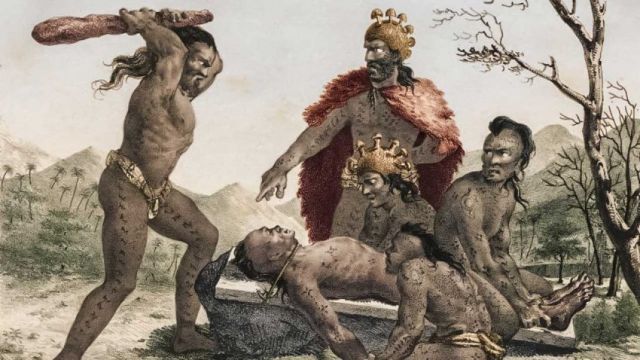
Turning to the question of ritual sacrifice is to turn to beginnings. Though the mimetic mechanism was the obvious logical starting point for understanding the long process of hominization and the emergence of culture, Girard himself began by exploring the genesis and significance of ritual sacrifice.
Firstly we are alerted to the double aspect of sacrifice: the sacred and religious on the one hand, and the transgressive on the other. Paradoxically both sides were mutually reinforcing as it was transgressive to kill another human being while killing revealed a debased sacred character at its heart because a prohibition on taking human life was broken. Girard viewed violence and aggression as universal as it was in the animal kingdom while no “man” resembled another more than when he was angry. The archaeological and anthropological record demonstrated violence was a feature of pre-history. Violence aroused was difficult to appease and could rapidly acquire a devastating destructive power in small pre-state bands. In VatS (1972) Girard appealed to the field of ethology as well as various social scientific disciplines to support an essentially Hobbesian or realist view of aggression as part of humanity’s behavioural repertoire, an adaptive tool rooted in, and surviving beyond our animal past. Like Freud, Girard supported a hydraulic model of aggression with energia flowing from a specific physiological-biological economy until it had reached a certain point and needed an outlet. Girard approvingly cited Konrad Lorenz, author of On Aggression (1966). Lorenz’s popular work originally appeared in West Germany in 1963 anticipating a slew of similar books about the animal-zoological basis of human behaviour by writers like Desmond Morris and Robert Ardrey though Lorenz focused on aggression as an adaptive tool in the behavioural repertoire. 17 As Girard observed in 2008 Lorenz’s ethological research cast some suggestive light on the transition from the animal to the human world, and the appearance of culture and the symbolic realm, by producing evidence of ‘instinctual scapegoating’ in some animals. 18
The mimetic mechanism was fundamental to the long process of hominization. The universality of mimetic desire, the inevitability of conflict tore at the delicate social fabric of emerging human societies. Girard speculated that at some point in pre-history the small bands and groups of early hominids hit on the scapegoat mechanism involving the selective use of violence in ritual sacrifice to cauterize the threat of wider violence afflicting the group. Killing the sacrificial victim was an outlet for the violence the mimetic mechanism generated and prophylaxis for further chronic aggression that could potentially destroy the group given its precarious existence. The scapegoat mechanism eventually evolved into the practice of ritual sacrifice aiding the social integration of the group – a position akin to Durkheim who emphasised precisely this role of ritual in his Elementary Forms of Religious Life and the Totemic System in Australia (1912). The scapegoat mechanism helped to constitute community, culture and the sacred realm of primitive religion. In many ways Girard’s position was similar to Freud’s speculative belief in Totem and Taboo that civilization and culture derived from the murder of the tyrannical Father by the primal horde of brothers who subsequently shared the females thus creating the first prohibitions against incest so laying the basis of religion, law and exogamous social relations (social structure, culture). Girard demurred from much of this speculative argument and believed Freud had recoiled from discovering the mimetic mechanism. Later Girard would explicitly reject Freud’s unlikely ur-scenario though Freud’s genius was duly acknowledged. Alluding to Darwin’s theory of evolution Girard suggested that over the course of tens of thousands of years there were probably countless ur-scenario’s. Ritual slowly emerged after a long gestation, a process of trial and error – the scapegoat mechanism was part of the natural order (as Konrad Lorenz had suggested from observation of geese and the evidence of instinctual scapegoating) as well as the foundation of culture but it was supposed there were many sacrificial crises before it became established. Echoing Darwin only the “fittest” bands and groups would have survived to eventually generate culture and religion.
Girard explored this process via different disciplines, undertaking close readings of a variety of myths and origin narratives. The sacrificial victim as a surrogate was not necessarily human. As Stephen Pinker observed in his benign if not arguably complacent work on the civilizational pacification of human aggression, the Israelites boasted their God was superior to the deities of neighbouring tribes because He only demanded the sacrifice of sheep and cattle and not their children. Yet human sacrifice was clearly a part of their recent past as this prohibition from Leviticus 18:21 revealed: “You shall not give any of your children to devote them by fire to Moloch, and so profane the name of your God.” 19
Similar to ritual sacrifice of humans, animal sacrifice also emerged as a probably symbolically inferior means of appeasing the violence that threatened the stability of the band, horde or group. Indeed animals were probably regarded as symbolic analogues of human beings. Girard cited the example of the Neur who saw their cattle herds as a mirror of Neur society. Each cow had a name that mirrored a person suggesting to Girard that a substitution was at the heart of Neur animal ritual sacrifice implying it was false to separate animal from human sacrifice. They were not so far apart as some imagined. In fact supposing animals to be legitimate sacrificial objects partook of the sacrificial logic. The main problem of ritual sacrifice was ascertaining why there were victims in the first place. Also though animals were regarded as an analogue of people and sacrificing them was a sacred act, animals were not assimilated to people. The Neur did not sacrifice men for cows.
In pre-history if serviceable or substitute victims such as animals were not available then the “pollutant” of violence might not be contained. This is one possible meaning of the Bible story of Cain and Abel. Cain, a farmer slew his brother Abel, a shepherd. Suggestively as a shepherd Abel was able to occasionally sacrifice the first born sheep, discharging his violent impulses but Cain had no such outlet. 20 Animal sacrifice allowed violence but was also revealed as a screen for deflecting violence that would otherwise be aimed at group or band members. Abel had an outlet but Cain did not – Cain was a murderer. 21
Girard was sharply critical of the ‘standard’ anthropological treatment of ritual sacrifice. Its framework was supposedly inadequate because sacrifice was usually apprehended as a violent mediatory act between a human community and their Deity or Deities, so that the specificity of the sacred ritual was disregarded as ritual sacrifice belonged to the past and could be “relegated to the realm of the imaginary”, an anachronistic curio. The Cambridge Ritualists and Frazier treated ritual sacrifice as related to Cosmology and seasonal change as an analogue to changes in human society. But such a perspective put the cart before the horse as Girard believed the reciprocity of violence ran deeper. Only when people discerned the alternating pattern of order and disorder in society did they make a link to the rhythms of Nature. 22
Mauss, Hubert and Levi-Strauss were all rebuked for viewing ritual and sacrifice through a rationalist lens. 23 Critically focusing on the sacred content of ritual sacrifice exposed a rationalist will to repudiate theology but this materialist critique of primitive ritual and religion unintentionally confirmed the veracity of theological explanations. The violent economy of sacrifice generated misunderstanding from the beginning because its efficacy derived from concealing the underlying social conflicts (mimetic rivalry) that ritual sacrifice as symbolic, sacred act only obliquely addressed. Girard often proposed that violence was a “contagion” or a “plague” – with the reciprocal violence arising from the mimetic mechanism inevitably leading to a periodic sacrificial crisis.
Modern interpretation was influenced by an innocent rationalism that lightmindedly overlooked the import of collective violence. Finding a sacrificial victim who could simultaneously be a receptacle for all the evil “pollutant” and a socially symbolic cure, also entailed a certain level of dissimulation or socially necessary illusion for ritual sacrifice to be fully effective. According to Girard, Mauss and Hubert correctly emphasized the universality of ritual sacrifice but it was not due to diffusion but the global nature of mimesis. 24 Freud’s solution to Oedipus was a brilliant interpretation but ultimately misleading because it was not the libidinal impulse that was being repressed but rather mimetic violence. As Hayden White suggested in his critical reading of Girard’s method, sexuality was not the latent meaning of Oedipus Rex or other Greek myths but part of the “surface of the text”. We might say following White that in Girard’s system “purifying violence” chased out impure violence. 25
How the surrogate victim was selected was a profound problem in itself. Typically the victim of ritual sacrifice was a part of the community – the Same – but might also relatively marginal like a child, adolescent or an older woman – the Other. As we know for Girard, sacrifice of the surrogate victim protected the group, band or village from even deadlier internal violence. It was hardly coincidental that the relatively powerless were selected to forestall the escalating violence that might have taken the form of revenge or blood feud.
The Gospel Truth
Girard’s diabolical phenomenology, mimesis and reciprocal violence were paradoxically the foundation of society, culture and the sacred but Girard was also convinced that civilization’s ultimate viability rested on humanity abandoning violence. In his sequel to VatS (1972), Things Hidden Since the Foundation of the World (1978), Girard offered a close reading of the sacrificial theme in the Gospels and suggested the Biblical texts shone an unambiguous and powerful light on the sacrificial mechanism. The primary revelation of the Gospels was its proclamation via the crucifixion of Jesus, the Son of God, that all sacrificial victims and scapegoats were innocent. The crucifixion of Jesus was emphatically not part of the dominant sacrificial logic. 26
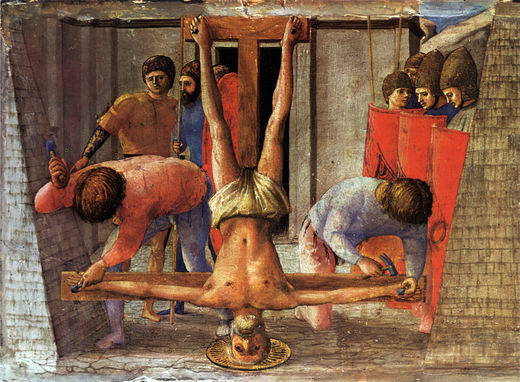
In the Girardian universe the Gospels were a form of biblical disenchantment exposing the sacrificial character of the prevailing myths and religious systems. In contrast, the God of the Old and New Testament was a God of Love. God was not vengeful and He was not responsible for the mimetic mechanism. The apocalypse was a strictly human dynamic that unfolded from the social logic of mimesis. 27 God had not offered up his Son for sacrifice and the fundamentalist reading of a fire and brimstone God was misplaced, derived from wrongheaded readings, the transmission of error strewn copies of the Gospels and the antiquity of the Old Testament – though even here Girard disputed fundamentalist readings of the Old Testament and insisted we were still dealing with a God of Love. It isn’t necessity to scrutinize Girard’s theological reasoning or examine the plausibility of his reading of the Biblical texts other than to mentally note there is a characteristic, symptomatic Girardian tendency to proceed by informing us how we should read certain disputed passages of texts, Girard will posit what is primary (and secondary) in any ethnographic or anthropological study before giving his own reading with its strategic insertion of the themes of mimesis and the scapegoat mechanism. This procedure of amendment before the Girardian reading can properly be imposed is particularly jarring with Girard’s insistence that there is no real gap between the Old and the New Testament. In any case Girard warns us the Gospels should not be read with medieval eyes or as an allegory of God’s punishment of humanity. This biblical passage quoted by Girard was exemplary in this respect:
“You have that it was said: ‘You shall love your neighbour and hate your enemy.’ But I say to you, Love your enemies and pray for those who persecute you, so that you may be sons of your Father who is in heaven; for he makes his sun rise on the evil and on the good, and sends rain on the just and the unjust” (Matthew 5: 43-45).
Neither were the Gospels implicated in a sacrificial universe except insofar as they directly challenged the sacrificial framework while humanity rather than God, was deemed responsible for the violence and miseries afflicting humanity. In a counterintuitive leap Girard suggested the Gospels provided a “practical atheism” 28 because the God shining forth in the Gospel texts was both a God of love but also significantly a non-interventionist God – He resisted the interference that might implicate Him in mimesis though God did send his Son to Earth to disabuse humanity of the efficacy of sacrificial violence. God was not the sort of deity who walked alongside humanity or dwelled in an ancient tree.
Concluding Remarks
Girard’s ambition to explain the basis of ‘civilization’ matched that of one of his major inspirations, interlocutors and rivals: Freud. Both men alluded to the scientific nature of their respective enterprises though one feature distinguishing Girard’s project was its aim to rehabilitate Christianity. According to Hayden White – citing as evidence ‘Desire, Deceit and the Novel’ (1962) and ‘Violence and the Sacred’ (1972) before the full blown Girardian appeals to the anti-sacrificial message of the Gospels of 1978 – Girard was waging a war against modernity as his insistence on the “necessity of religious belief” to ward off social chaos, revealed. White was hostile to the message there could be no society without religion. The arrival of the scientific age meant religion pragmatically required a defence using the weapons of science. According to White, Girard was the inheritor of a strand of French sociological thought preoccupied with reason’s inability to overcome inertial tradition and time honoured social practices. These had revealed the importance of identity and belonging. This may perhaps have been the case – there were parallels with the admired Durkheim for example whose work on ‘primitive’ religion showed how ritual aided social integration. Yet Girard had also happily accepted elements of the modernist critique of rationalism and married it to a quite traditional conception of the scientific enterprise that certainly could not be bracketed with French social theory after the ‘linguistic turn.’
White noticed that Girard in generalising from ethology, ethnology, anthropology, sociology and literary analysis, daringly reversed the usual interpretive modus operandi. For example in the anthropological field, a particular cosmological weltanschauung might usually be regarded as the latent meaning of, say, a ‘primitive’ bands perceptual framework. But in a theoretical move disavowing puritanism Girard would offer a worldly critical reversal of such an interpretive procedure and suggest that these aspects were not repressed at all but part of the manifest content. They were easily read off the social text or social practice because they were there on the surface all the time. It was mimesis and the sacrificial logic that provided the latent content and the hidden drama. In terms of ‘primitive’ society this simply indicated the primacy of ritual (and therefore ultimately religion) over myth. Again here we can see the essential outline of Girard’s overall critique of psychoanalysis which was particularly severe with Freud’s reading of the Oedipus myth. But then Girard wished to create a superior monistic cosmology to surpass that of Freud (and Marx and Nietzsche) – an intriguing echo of Girard’s own theory of Doubles: your Model and ultimately your enemy.
Let us be clear we entirely reject Girard’s “monistic cosmology” as White dubs it. The major weakness of Girard’s master concept of mimesis despite a certain superficial plausibility or localized utility, is its insatiable aspiration to explain everything. Girard’s whole argument is not falsifiable as any modest scientific theory might usually expected to be. In terms of his own specific specialism: critical cultural or literary theory, White argued that Girard’s ‘theoretical imperialism’ had been apparent in his first 1962 book on the modern novel. Modern literary interpretation was too sophisticated to grasp the import of the narrative parabola of, say, Don Quixote’s or Madame Bovary’s life, whose “conversion in death” Girard uncomplicatedly read as parables of the Christian revelation. This fundamental “truth” had been obscured by the “romantic lies” born of the secular sensibility of the modernist critic. In somewhat hyperbolic fashion White offers the jaundiced suggestion that for Girard such obscurantist romanticism was propagated by a humanity drunk on pride. Yet it is difficult to avoid the conclusion Girard’s reading eschews the complexity and ambiguity of the text but instead denudes the text of meaning by imposing an external univocal meaning on it.
Leaving the relatively modest field of literary or cultural theory for one moment and the question of how much Girard’s take on the modern novel marked the first occasion for him to audition the theme of mimesis and its generative role in culture and the Christian revelation, it becomes clear that Girard’s fundamentally reductive argument only possesses traction if the necessarily diabolical phenomenology is treated as a powerful, omnipresent logic in social life. In other words Girard has to resist any concession that mimesis might only be a “weak” mechanism or simply one local element of social interaction among others or else the sacrificial crisis qua event loses its potency and influence. More importantly it would lose its status as a plausible explanandum of the emergence of culture from the many ur-scenarios Girard speculated must have taken place over thousands of years during pre-history. Girard was the first to concede that many factors blocked or deflected the working of the mimetic mechanism (chiefly social differentiation arising from the advent of civilization) but insisted its sway was more powerful in earlier, smaller, undifferentiated human groups. It is peculiar that such countervailing counterfactuals are not regarded as fatally invalidating mimesis when elsewhere its global nature is so vaunted.
Above we noted in relation to Girard’s characteristic procedure is to propose how the text should be read – why dominant or common readings are erroneous or part of the dissimulation necessary to conceal the latent working of the traumatic logic of the scapegoat mechanism. Thus Girard gathers much secondary material from the field of anthropology and subjects that material to his own interpretive reworking. Hayden White also noted how Girard took the “raw data” of ethnology and anthropology and inserted it into an a priori “interpretative grid”. Of course so far as White was concerned there was no such thing as “raw data” as an object existing externally to mediatory order of language. Thus Girard was reshaping material that had already been shaped. While Girard sharply disagreed with anthropologists like Claude Levi-Strauss, more serious was his accusation that anthropology had not taken ritual or myth seriously because the anthropological field was dominated by a secular will to disenchant the sacred spell and a peculiarly modernist blindness to lost ‘truths’ that the ancients or ‘primitives’ understood perfectly well such as the “contagious” or “plague-like” nature of destructive violence (understood perfectly well except when social illusion was functionally necessary to conceal this traumatic truth – characteristically Girard has it both ways). Yet there was and is a great deal more to the field of anthropology than, say, the Cambridge Ritualists or Mauss and Hubert. In fact in no other field of the social sciences has the realm of myth, ritual, the sacred and early religion, been taken so seriously.
One anthropologist who took the subject of the sacred and ritual sacrifice extremely seriously was Victor Turner (incidentally Turner also a Christian). Turner paid close attention to the particularities of belief in the sacred and ritual practice during fieldwork in West Africa linking it, for example, to the literary symbolism of Dante or Roman sacrificial practices and underwent an intellectual odyssey that rejected structuralism and Durkheimian functionalism as inadequate in capturing the complex social logic and beliefs of ritual and ritual practice (characteristically Turner was more impressed with Durkheim’s conception of collective “effervescence” originally meant for understanding the French revolution, which stressed the part played by agency in generating new social structures). 29 The work of Turner and others marks a far more serious engagement with the sacred and ritual than Girard’s dismissive, selective balance sheet of the field.
Turner’s concept of communitas reminds us that Girard has failed to satisfactorily account for the genesis of social solidarity among hominids and early man. Naturally it is open to Girardians to claim social solidarity is derivative of mimesis or that social solidarity retains strong elements of coercion directly derived from the internalisation of prohibitions governing group behaviour mediated indirectly by the scapegoat mechanism. Except Girard says remarkably little about social solidarity and ultimately I think this is because the mimetic mechanism cannot satisfactorily explain social solidarity. Mimesis and the sacrificial mechanism it generates supposedly promotes social integration (Durkheim also thought ritual was socially integrative) and yet Girard’s conception is strongly coloured by ethology so the individual in the group is very much a fearful, selfish egoist whose Models are also putative rivals. It’s hard not to conclude the mimetic mechanism is simply too one note to capture the complex tapestry of social life.
Finally the weakest link of the mimetic mechanism which ought to disqualify Girard’s theory from offering an explanation for culture and society, is its basic component: desire. Essentially Girard is absolutely emphatic – desire is derived from mimesis or imitative behaviour. We desire the objects we desire because others desired the same objects. So the key relation of our desire toward an object is mediated by the desire of the Other, the Model and rival. What characterises the objects we desire is not the difference that would affirm individuality but similarity and sameness which exposes the conformity at the heart of the mimetic mechanism and our desire. So we learn desire from our Models – the Model qua rival was the cause of our desire not the object. There is a certain surface plausibility to Girard’s argument – it could be read as a simple insistence that desire is socially mediated which may well be true but is a different to Girard’s position. The mimetic mechanism means that desire cannot proceed from ourselves. By contrast we maintain we can subjectively desire a specific object without the mediatory intercession of the Other as Model and/or rival. The fundamental connection between desire and mimesis was one reason Girard emphatically rejected Freud’s conception of desire (and crucially the libidinal economy underpinning it). Sadly we cannot interrogate Girard’s criticism of Freud’s Oedipus complex which points to the various adjustments Freud made to his theory to render it more coherent but we can address two issues in lieu of that systematic rebuttal of Girard’s interpretation. It was Girard’s judgement that Freud had been close to grasping the logic of mimesis when he explored the Oedipus complex in 1910. But instead of deriving desire from the mimetic triadic structure of the family with the parents conceived as proto-Model’s – essentially Girard’s position, Freud took a different, more ‘materialist’ position. Firstly Freud presented desire (instinct) as a libidinal aim whose ultimate somatic basis was the nervous system and though he emphasized the “source of the instincts” lay in the physiological apparatus Freud also insisted it was strictly outside the scope of “psychology.” 30 The proximity of the child qua child rearing to its mother ensured the child’s libidinal aim (instinct, desire, want) acquired its First Object in its mother. Generally it was inevitable the mother would be the child’s first Love-Object, the dominant object of the child’s infantile libidinal strivings. The child’s libidinal attachment to its mother signalled the unfolding of the Oedipus complex – an important ontogenetic stage in a child’s psychosexual development. This conception was quite different from Girard’s mimetic model of desire – significantly only Freud’s conception of desire could explain that fundamental feature of human sexuality – its polymorphous perversity. 31 It is symptomatic that in one passage dismissing Freud’s Oedipus complex, Girard defends the innocence of the young child trading on the enduring scepticism towards Freud’s acknowledgement of the existence of infantile sexuality or the idea that a young boy might have unconscious murderous wishes towards his father, the rival for his mother’s affections.
Clearly some desires are mimetic originally but it actually stretches plausibility and logic to suggest that all desire is derived from the rivalries generated by the mimetic mechanism. The critic of Girard who suggests there are desires not mediated by a Model, does not have to be swollen with the sin of pride or narcissism or even the conceit of illusory individualism, to point this out. So desire can genuinely be our own in the sense that it is not mediated by the rival and desire can indicate authentic difference and not simply the illusion of difference. Also in the actually existing social world individuals know many other individuals with different temperaments and personalities so that in Girardian terms any individual would be confronted with a multiplicity of possible Models holding in turn many, many choices and many, many objects or goods of desire. Therefore an individual is still faced with having to make any number of choices, deciding what they want, what their desires are, what they wish to achieve and though those choices are socially mediated to a greater or lesser degree, they are predominantly their choices and their desires. Ultimately the complexity of the human social universe capsizes Girard’s deterministic, reductive mimetic mechanism and if mimesis is a demonstrable aspect of social life it is so in a much more etiolated, weaker form than Girard imagines and thus falls far short of the global explanatory power than was claimed for the concept.
NOTES
1 Perhaps surprisingly one such dissenter is Stephen Pinker
2 Mary Kaldor captures some of the changes in the nature of war in New and Old Wars: Organized Violence in the Global Era (1999).
3 Girard’s earlier Deceit, Desire and the Novel (1962), organised around the central category of mimesis, marked a straw in the wind of his later more extensive argument.
4 Hayden White’s belated review of Violence and the Sacred (1972, 2012) appeared as Ethnological ‘Lie’ and Mythical ‘Truth’ (1978)Diacritics Vol 8. No.1 Spring 1978, pp. 2-9.
5 Those terms italicized in the text – for example sacrificial mechanism or surrogate victim – are important concepts used by Girard in his work.
6 Girard Evolution and Conversion: Dialogues on the Origins of Culture (2017) p.150. Hereafter abbreviated to E&C (2017).
7 Ibid. pp.43-4.
8 Girard VatS (1972, 2012) p.164.
9 Ibid.
10 Intriguingly Girard – whose starting point was European literature and mimesis including Dante, Shakespeare, Stendhal, Dostoevsky and so on – appears to have barely discussed Rabelais.
11 Girard E&C (2017) pp.58-9.
12 For Girard’s reading of Oedipus Rex see VatS (1972, 2012) pp.77-99.
13 Ibid. pp.178-9.
14 Ibid. p.52.
15 Girard in E&C (2008, 2017) p.43.
16 Ibid. p.56.
17 For an account of the reception surrounding Lorenz’s popular work, its context and the relevance of Lorenz’s wartime fascist sympathies in relation to his elaboration of the nature of human aggression, see Dagmar Herzog Cold War Freud: Psychoanalysis in the Age of Catastrophe (2017) pp.123-50.
19 Leviticus 18:21 quoted in Stephen Pinker The Better Angels of Our Nature: A History of Violence and Humanity (2012) p.161.
20 Neither is it is an accident that Cain and Abel were brothers according to Girard’s overall argumentative schema, as they would have been rivalrous doubles.
21 VatS (1972, 2012) pp.4-5.
22 Ibid. pp.107-8.
23 Ibid. p.7.
24 Ibid. p.102.
25 Hayden White Ethnological “Lie” and Mythical “Truth” in Diacritics Vol.8. No.1 Spring 1978 p.4.
26 Girard in THSTFOTW (1978) p.172.
27 Though to talk of “social logic” in relation to Girard’s mimetic mechanism is somewhat paradoxical given that it creates the social in the first place.
28 Ibid. p.174.
29 See Turner’s discussion of Durkheim – the context, exploring agency and social solidarity in contrast to alternative Hobbesian optic of individuals like Konrad Lorenz and Rene Girard – in Victor Turner’s essay Morality and Liminality in Blazing the Trail: Way Marks in the Exploration of Symbols (1992) p.137.
30 “Psychology” was not concerned with the physiological apparatus, the source of the instincts but rather their ideational-symbolic form in the mental apparatus but it did presuppose this material basis. Freud makes this point in his essay Instincts and Their Vicissitudes (1915).
31 Girard discusses Freud’s Oedipus complex in VatS (1972, 2012) pp.191-217.

