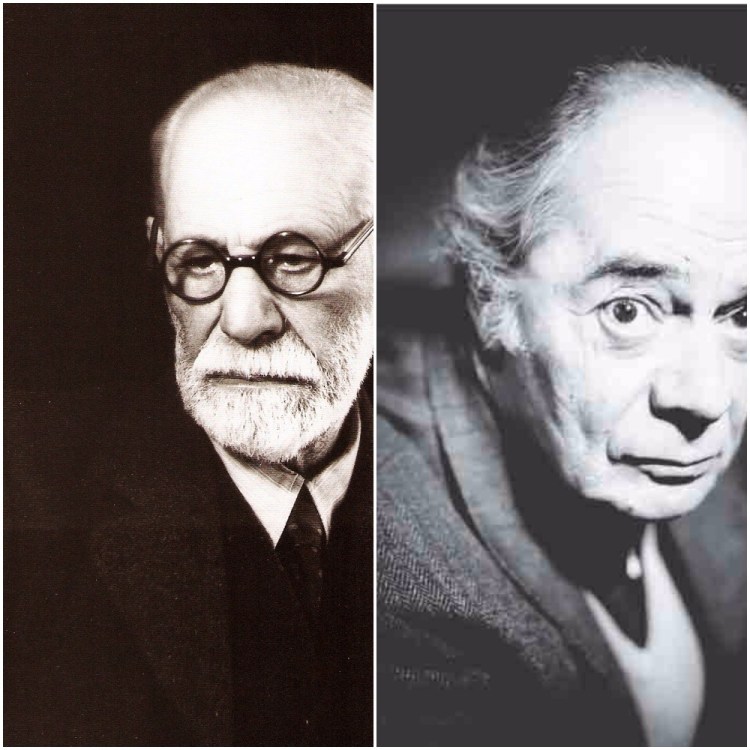
“For Freud ‘primal’ or originary – urphantasien – fantasies (those of inter-uterine life, of the primal scene, of castration and seduction) have an autonomous existence in the individual independent of his real lived personal history” Janine Chasseguet-Smirgel/Béla Grunberger (from ‘Freud or Reich’).
How does the hatred and xenophobia of the current period – Trump, Brexit, continental post-fascism – lean on the tendency for destruction in the human psyche? There is little left standing from the past in terms of imaginary significations that would serve to abrogate this destructiveness: democratic socialism, self-organisation, cosmopolitanism, internationalism, tolerance. While the significations that dominate – nationalism, nativism, self-interest – are analogous with deeper wishes for the destruction of the non-me, the hatred of the other. As many psychoanalytically minded theorists have noted this is often connected with a wish for reunification with the primary object, the annihilation of everything that does not conform to one’s own wishes – and on the social and political plane in authoritarian political movements where the ‘archaic’ mother one wishes to merge with is represented by a leader, a great idea, the nation, the party and at worst, a violent monistic mass movement.
Following Freud’s line of thought on the pre-Oedipal, particularly the idea of ‘primary narcissism’ which stresses the perfection of intrauterine life and, later, the period before the child has conceptualised itself as a separate being (from the breast and the mother), Janine Chasseguet-Smirgel described the psychic basis of identification with demagogues and participation in mass authoritarian (and especially totalitarian) politics as attempt to recover that sense of undifferentiated oneness.
As Joel Whitebook has pointed out:
“Freud believed that once this original stage — which consists in a state of omnipotent perfection, containing no privation, difference or otherness — is dissolved, individuals strive “to recover” its unity throughout their lives. This striving, it must be stressed, is as such neither psychologically nor morally good nor bad, but thoroughly ambivalent. When it is mediated and sublimated and recreates that unity at a higher more differentiated level it can lead to the highest achievements of the human spirit: philosophy, music and religion, for example. But when it is pursued directly, without mediation, this “monster of unifying madness,” as Castoriadis has called it — which seeks to eradicate all difference and recapture the state of primary oneness directly — can lead to the severest forms of individual and social pathology, from clinical psychosis to political totalitarianism.” (From ‘Omnipotence and radical evil: on a possible rapprochement between Hannah Arendt and Psychoanalysis’)
The hatred of difference, the desire to destructiveness and the obliteration of the non-me is a wish for omnipotence, the newborn is omnipotent, knows no difference and it can create what it wishes, in the limited realm of its experience, in phantasy. Difference is what comes to it by unpleasure, the external world invading its private world forcing it to be socialised, being successful in this.
This is all intimately related to the drive death. Not in the sense that Freud often wrote about it, a phylogenetically transmitted preconscious wish to return to an inorganic state, but as Chasseguet-Smirgel and Castoriadis (in politics most unlikely bedfellows) both suggest, in the desire to crush difference and make everything conform, breaking down everything else to make it the same non-contradictory mass (like in the Sadean orgy). For Trumpism the groups that represent the other – mexicans, muslims, trans people and others – must be attacked if not destroyed (the same tendency afflicts Da’esh no doubt), the urge toward unification back to when one did not have to account for external reality uses whatever material it can. In Western history one can no doubt find a great deal of material to lean on – white supremacy above all, whilst having to banish the elements (from town hall meetings to civil rights) that stand against such notions. ‘Race’ is the perfect projection of the other, while racism is highly useful to those with most to gain from divided and dominated societies.
We are seeing, on one level, a massive desire to regress to the pre-Oedipal. And it is no surprise that it finds itself expressed in a man so self-obsessed that he sees the world as a merely a platform for himself and his desires.
Positively valuing difference and a democratic attitude to culture are the only starting point to resisting both Trump and he ground he stands on.
Of course the left has its own ‘monster of unifying madness’ in ideology, this desire to have everything relate to a schema may be less dangerous, at least in its non-Stalinist forms, than Trump or other authoritarians but it nonetheless can only blunt our fight against them.
The positive cathexis of difference does find itself as a central idea in one form of society: democracy. Here I shall turn to the work of Claude Lefort.
While, at least in contemporary Western Europe and North America, a full turn to authoritarianism, let alone totalitarianism, has not come to pass as yet a look at Lefort’s definition of the latter is instructive. There are clear affinities with the closure that the Freudian tradition attributes to what we have described:
“… a representation of a homogeneous and self-transparent society, of a People-as-One, social division, in all its modes. is denied, and at the same time all signs of differences of opinion, belief or mores are condemned. We can use the term despotism to characterize this regime, but only if we specify that it is modern and differs from all the forms that precede it. Power makes no reference to anything beyond the social; it rules as though nothing existed outside the social, as though it had no limits (these are the limits established by the idea of a law or a truth that is valid in itself); it relates to a society beyond which there is nothing” (Lefort, ‘The Question of Democracy’)
Lefort considers democracy profoundly different to other social forms as the symbolic place of power falls to society itself. In modernity where power is desacralised totalitarianism wishes ‘to weld power and society back together again, to efface all signs of social division, to banish the indetermination that haunts the democratic experience’. Democracy takes a completely different starting point. As James Ingram has put it:
“Since the people are in fact always plural and divided, however, this can only be done by means of violence and repression, by abolishing ‘politics’. Democracy, in contrast, is a way of leaving the symbolic place of power left by the departed king empty. By fostering competition among actors and principles, it prevents any single one from standing in for the unity of society. A democratic society is thus one in which power, legitimacy, identity and unity remain in question, where the conflicts of ‘politics’ themselves make up ‘the political’.” (From ‘The Politics of Claude Lefort’s Political: Between Liberalism and Radical Democracy’).
One could say that democracy, in Lefort’s conception at least, works against the negative aspects of the psyche’s tendency to strive for unification by inscribing diversity as a positive value.
While for Hegel and Marx contradictory aspects of social reality must merge to form a new synthesis Lefort suggests that they can have their own domains that we should negotiate through intersubjective action that may or may not need ultimate resolution and that society itself should be the conscious arbiter of this. This fits with both a Freudian and Castoriadian notion of man as an imperfect and imperfectable beast, philosophy and psychoanalysis being important heuristic parts of the democratic experience. Indetermination and an openness to possibilities are the hallmarks of the modern world, the attempt to closure is the task of ideology, which should be rejected.
“Modernity has no foundation, since it emerged in and through the destruction and deconstruction of all foundations. In other words, modernity is founded on freedom. There is nothing new in this thought, for in fact all representative modern thinkers and all modern foundational documents (for example, constitutions) confirm and reconfirm it…The modern world is based on freedom: that is, freedom is the arche of the modern world. Yet freedom is entirely unfit to serve as an arche, because it is a foundation that does not found. As a Grund – to speak with both Hegel and Heidegger – it opens the Abgrund: that is, the ground opens the abyss. And since the modern world is based on freedom, on an arche that cannot found, it remains a world without foundation, a world that continuously has to reinvent itself. This is one of the main reasons why all the constructed models of the modern world are abstract, in the Hegelian sense of the word, and by definition counterfactual, and why all coherent narratives ring true for no more than a few decades.” (Agnes Heller)
Nevertheless those of us that wish to transform society in the direction of freedom are all too aware of the limitations of capitalist democracy (or liberal oligarchy as Castoriadis called it), and we rightly see that the positive aspects of liberal societies as for the most part being the fruit of struggles by workers and social movements.
One of Lefort’s most profound points is that having a democratic system doesn’t save you from authoritarianism or even totalitarianism emerging – a democratic system is merely the prerequisite for democracy where power is not embodied but is a symbolically open space – for a democracy you need people to be able to make decisions aware of the full facts and in an atmosphere of open debate. That’s why the EU referendum or the US presidential election are really examples of pseudo-democracy and why even the most democratic elections cannot close down arguments about legitimacy.
“When individuals are increasingly insecure as a result of an economic crisis or of the ravages of war, when conflict between classes and groups is exacerbated and can no longer be symbolically resolved within the political sphere, when power appears to have sunk to the level of reality and to be no more than an instrument for the promotion of the interests and appetites of vulgar ambition and when, in a word, it appears in society, and when at the same time society appears to be fragmented, then we see the development of the fantasy of the People-as-One, the beginnings of a quest for a substantial identity, for a social body which is welded to its head, for an embodying power, for a state free from division.” (Lefort, ‘The Question of Democracy’)
For Fascism and other types of exclusionary nationalism this is all straightforward perhaps. But totalitarianism also emerged out of a mutation of the ideas of the workers movement, while there are broader reasons for this one should not underestimate the desire for unification such as we have described as an important underlying psychical component of this.
In seeing class as an ‘universal key’ to understanding society Marxism tended to a reductionism that mutated the democratic demand for a ‘social republic’ of the historical workers movement into a question of a technique for the victory of labour over capital. The dialectical movement of history resolves the contradiction between capitals progressive development of the productive forces and regressive social relations by having one product of both – the proletariat – smash another – capitalist production – to inaugurate a society without want. Communism, like all utopias, proffers a society without division and as such can be read as a wish to return to the womb.
We must fight exploitation, privation and the hierarchical relations that leave people to demagogues but more than we need to help create a new democratic spirit of fighting for yourself and society, valuing diversity and a passion for community and public affairs. Otherwise domination will reinforce the most unhealthy side of our nature:
“It must not be forgotten that it is especially dangerous to enslave people in the minor details of life. For my own part, I should be inclined to think freedom less necessary in great things than in little ones, if it were possible to be secure in the one without possession of the other.
Subjection in minor affairs breaks out every day, and is felt by the whole community indiscriminately. It does not drive people to resistance, but crosses them at every turn, till they are led to surrender the exercise of their will. Thus their spirit is gradually broken and their character enervated; whereas that obedience, which is exacted on a few important but rare occasions, only exhibits servitude at certain intervals, and throws the burden of it on a small number of people. It is vain to summon a people, which has been rendered so dependent on the central power, to choose from time to time the representative of that power; this rare and brief exercise of their free choice, however, important it may be, will not prevent them from gradually losing the faculties of thinking, feeling and acting for themselves, and thus gradually falling below the level of humanity.” (Tocqueville, Democracy in America)
It is a compelling delusion that we can have a politics that abolishes the potential for exploitation and oppression forever, but acknowledging that is a delusion does not mean we should wish not to be rid of exploitation and oppression. It is similar to the delusion that wishes to be rid of the the unconscious. Only cathected values and modes of doing that are consciously set against domination and destructiveness can guard against authoritarianism. Perhaps some of that will have to wait, considering the urgency of the situation, but if in building the movement against Trump and the new authoritarianism we can foster the values of democracy and diversity and if we can avoid the old failed lefts certainties and schemas we may have a chance of creating better, freer and more autonomous societies.
by Joseph Aylmer

